
Plastic Helical Gear – POM, Nylon, M0.5-M3, Custom Moulded
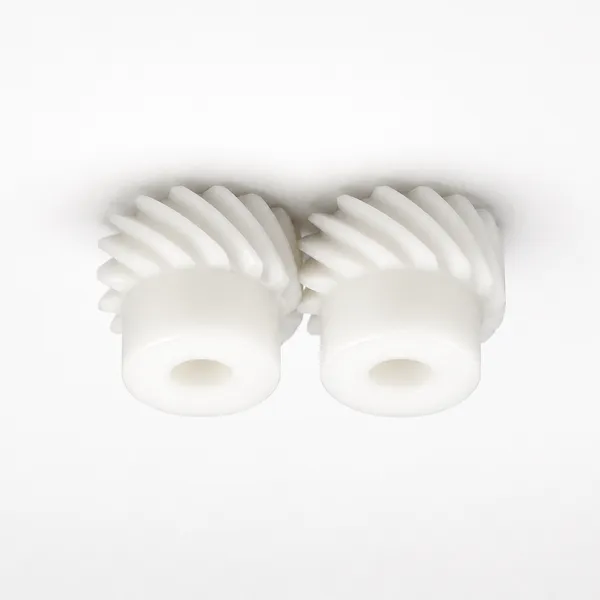
Korea Ever-Power plastic helical gears are precision-cut or moulded in POM (polyacetal) and Nylon, with custom configurations in other engineering polymers. Teeth cut at a helix angle produce gradual, progressive tooth engagement — smoother and quieter than spur gears of equivalent size. Module M0.1 to M2.0, outer diameter Ø10–Ø50 mm, bore from Ø1.40 mm. Applications include laser printers, cameras, scanners, medical equipment, vending machines, household appliances, and any compact mechanism requiring lightweight, corrosion-resistant, self-lubricating gear transmission. OEM and ODM service. Custom moulds available.
Product Overview
Plastic helical gears have their teeth cut at an angle to the gear axis, producing gradual progressive tooth engagement as the gear rotates. When two teeth in the gear system engage, contact begins at one end of the tooth and spreads gradually across the face width with gear rotation, until both teeth are fully engaged. This progressive engagement is what makes helical gears smoother and quieter than spur gears of equivalent size — an advantage that plastic helical gears carry into compact consumer and industrial product applications.
Korea Ever-Power produces plastic helical gears in POM (polyacetal/Delrin) and Nylon as standard materials, with custom configurations in other engineering polymers to customer specification. The standard range covers module M0.1 to M2.0 and outer diameters from Ø10.0 mm to Ø50.0 mm — the size range that corresponds to the widest application base in consumer electronics, office automation, medical devices, and household appliances. Custom mould tooling is available for OEM programmes requiring non-standard tooth geometries or proprietary gear profiles.
Korea Ever-Power provides handmade and machined custom plastic gears, allowing gear testing and evaluation before mould tooling is committed. This means an OEM customer can confirm the tooth geometry, mesh quality, and dimensional consistency on a prototype set before placing production tooling — eliminating the risk of discovering a geometry mismatch only after the mould is cut.
Technical Specifications
Specifications from the standard production range. Custom configurations — module, bore, outer diameter, face width, material, and profile — are available to customer drawing or sample.
| Plastic Helical Gear — General Specifications | |
|---|---|
| Taper | Engrenage hélicoïdal |
| Module | M0.1 – M2.0 (standard); other modules per customer drawing |
| Matériel | Polyacetal (POM / Delrin), Nylon (PA6, PA66); other engineering polymers per application |
| Bore Diameter | Ø1.40 / Ø1.90 / Ø2.05 / Ø2.40 / Ø2.55 / Ø2.90 / Ø3.05 mm (standard series); flexible per drawing |
| Outer Diameter | Ø10.0 mm – Ø50.0 mm (standard); flexible per drawing |
| Face Width (L) | 2.0 mm – 10.0 mm (standard); flexible per drawing |
| OEM / ODM | Full service; custom mould tooling available; prototype before mould commitment |
Example Configuration 1 — D-Hole Plastic Helical Gear (POM)
| Parameter | Value | Parameter | Value |
|---|---|---|---|
| Item | D-Hole Helical Gear | Matériel | POM (Polyacetal) |
| Module | M0.6 | No. of Teeth | 16T |
| Weight | 0.95 g / pcs | Application | Any product with transmission design |
Example Configuration 2 — OEM/ODM Custom Plastic Helical Gear
| Parameter | Value | Parameter | Value |
|---|---|---|---|
| Item | Custom OEM Gear | Matériel | ODM (customer-specified polymer) |
| Module | ODM | No. of Teeth | ODM |
| Weight | ODM | Application | IP camera, monitor, and similar devices |
Advantages of Plastic Helical Gears
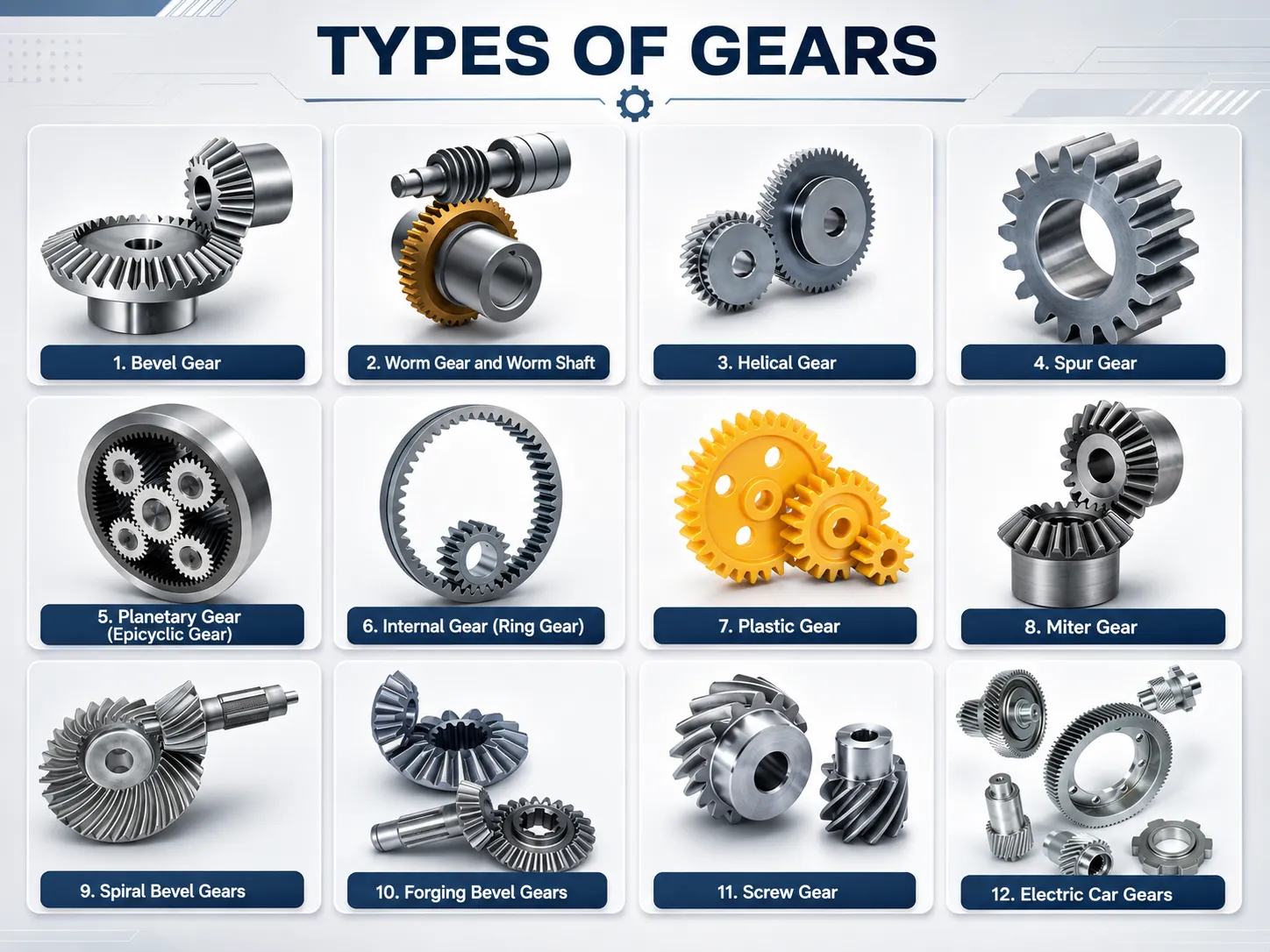
A gear is a toothed wheel designed to transmit force to another component. The teeth of a gear can be shaped to minimise wear, vibration, and noise and maximise power transmission efficiency. Gears of differing sizes are often used in pairs for a mechanical advantage, producing different torque and speed ratios at the output. Plastic helical gears offer a specific set of advantages over metal gears that make them the preferred choice in a wide range of compact, lightweight, or cost-sensitive applications.
- Easily moulded into various shapes — plastic gears can be formed by injection moulding into complex geometries — integrated hubs, flanges, through-holes, D-profile bores, and gear-shaft combinations — in a single moulding operation. Metal gears require multiple machining setups to achieve equivalent geometry. This gives plastic helical gears a wider range of possible configurations for a given tooling cost.
- Less expensive and lighter in weight — the per-unit cost of injection-moulded plastic gears is dramatically lower than machined metal gears at the same tooth geometry. The density of POM is approximately 1.41 g/cm³ versus 7.8 g/cm³ for steel — a weight reduction of over 80% for the same gear volume. In portable devices, consumer electronics, and medical instruments where product mass is critical, this matters.
- Chemical and corrosion resistant — POM and Nylon are resistant to the majority of industrial chemicals, oils, greases, and cleaning agents that would corrode or attack steel gears. In food processing, laboratory, pharmaceutical, and marine environments where metal corrosion is a concern, plastic helical gears in POM or Nylon are the practical alternative without the cost premium of stainless steel.
- Quieter and smoother operation — the inherent vibration damping of engineering polymers absorbs some of the tooth mesh energy that would otherwise be transmitted as structure-borne noise in a metal gear. The combination of the helical tooth form (progressive engagement) and the polymer material (damped contact) makes plastic helical gears among the quietest gear types available for low-to-medium load drives.
- Inherent self-lubrication — POM and Nylon have a low coefficient of friction against metal and against themselves. At light loads and moderate speeds, they run without external lubrication — the polymer surface itself provides the lubricating film at the tooth contact. This is particularly valuable in sealed consumer products where a lubrication port is impractical and where grease migration would contaminate adjacent components.
While plastic helical gears offer these advantages over metal gears, their practical use requires proper design and engineering to account for possible dimensional and property variations over the expected range of operating conditions — particularly temperature, which affects the modulus of elasticity and the dimensions of thermoplastic gears more significantly than metal gears. Korea Ever-Power's engineering team provides design review for new plastic gear applications on request.
POM vs Nylon — Selecting the Right Plastic Gear Material
POM (Polyacetal / Delrin)
POM is the first-choice material for plastic helical gears where dimensional stability, surface hardness, and wear resistance are the primary requirements. Its crystalline structure gives it a very low coefficient of friction and excellent resistance to abrasive wear at the tooth contact surface. POM is stiffer than Nylon under load, which means lower tooth deflection for a given torque — important in applications where tooth-to-tooth spacing accuracy must be maintained under operating loads.
POM is the standard material for the D-hole and standard-bore plastic helical gears in the Korea Ever-Power range. It is suitable for continuous duty in dry-running and lightly lubricated drives in office automation, consumer electronics, and precision instrument applications where the operating temperature stays below approximately 90°C.
Nylon (PA6 / PA66)
Nylon is tougher and more impact-resistant than POM — it absorbs shock and impact loads without the brittle fracture that POM can exhibit under sudden overload. Nylon also has better resistance to dilute acids and some solvents that POM cannot withstand. For applications with intermittent overload or shock events, Nylon is the more robust choice.
The tradeoff is that Nylon absorbs moisture from the environment, which changes its dimensions and stiffness over time. A Nylon gear in a high-humidity environment will swell by 1–3% in dimensions as it equilibrates to the ambient humidity. In dry environments or when moisture absorption is controlled (enclosed lubricated drives), Nylon is an excellent gear material. Nylon is the preferred choice for gears in power hand tools, garden equipment, and applications where impact resistance is the primary mechanical requirement.
Applications
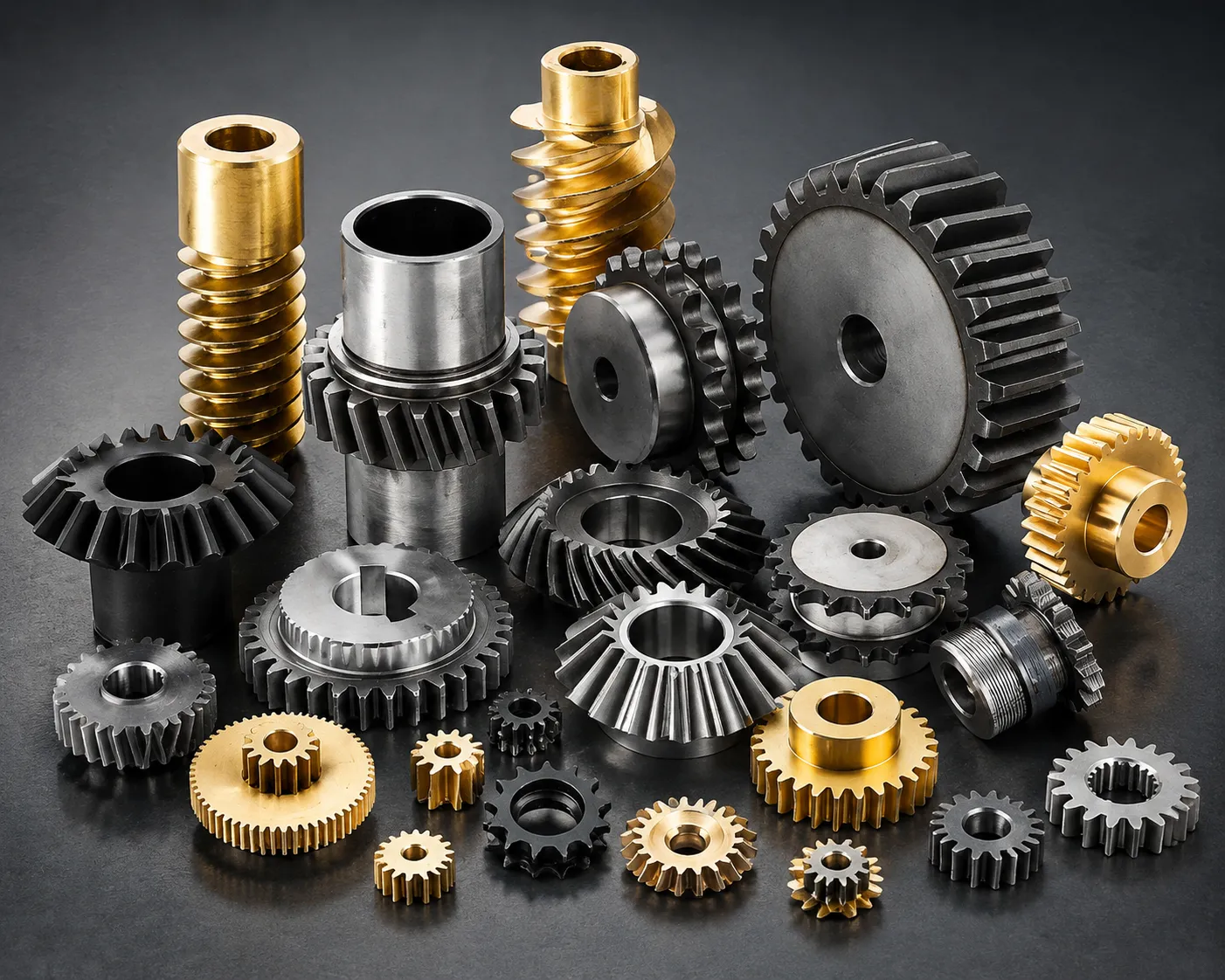
Korea Ever-Power plastic helical gears meet the transmission requirements of a wide range of compact consumer and industrial products where lightweight, corrosion resistance, low noise, and self-lubrication are valued over maximum load capacity.
Office Automation & Electronics
Laser printers, digital cameras, scanners, CD-ROMs, fax machines, and photocopiers. The combination of quiet operation, self-lubrication, and lightweight construction is ideal for the paper and optical path drives in office automation equipment.
Medical Equipment
Infusion pumps, imaging device drives, and diagnostic instrument actuators. POM's chemical resistance, biocompatibility potential, and self-lubricating properties make it a frequent choice in medical device gear trains where external lubrication is not possible.
Household Appliances
Washing machines, kitchen appliances, vacuum cleaners, and electric fans. Plastic helical gears provide the noise reduction that is expected in domestic products, the corrosion resistance needed in wet environments, and the low cost required for consumer goods at scale.
Vending Machines
Product dispensing mechanisms and coin handling drives in vending machines. Self-lubrication and quiet operation suit the sealed dispensing drives; corrosion resistance is important in the coin path where moisture and contaminants are present.
Stepping Motors & Automation
Low-to-medium power drives for stepping motors in automated handling systems, conveyor positioning, and packaging machinery. The combination of plastic helical gears and stepping motors offers a cost-effective, low-noise, and maintenance-free motion system for light industrial automation.
IP Cameras & Surveillance
Pan-tilt mechanism drives in IP cameras, PTZ monitors, and security cameras. The extremely quiet operation of plastic helical gears avoids acoustic interference in sound-sensitive surveillance environments; self-lubrication eliminates the maintenance requirement in sealed camera heads.
Gear Pumps
Chemical dosing pumps and fluid transfer gear pumps where POM's chemical resistance and low friction are the correct material properties. Plastic gear pumps are used in applications where metal contamination of the pumped fluid must be avoided.
Toys & Specialised Products
High-volume toy and consumer product gear trains, watches, and specialised mechanical products where plastic gear moulding provides the cost level and production volume required. Custom configurations with integrated hubs and shaft profiles are feasible through OEM mould tooling.
Frequently Asked Questions
Can a gear test be done before mould tooling is committed?
Yes — this is a specific capability that Korea Ever-Power provides for plastic gear OEM programmes. We produce handmade or machined prototype plastic gears to the customer's drawing before any mould tooling is cut. The prototype gears can be used to verify the tooth geometry, mesh quality, dimensional accuracy, and performance in the customer's product. Only after the customer confirms that the prototype gear meets requirements does tooling proceed. This eliminates the risk of discovering a geometry or fit problem only after production tooling has been committed.
How does operating temperature affect plastic helical gears?
Operating temperature is the most critical design parameter for plastic helical gears. The elastic modulus and yield strength of POM and Nylon both decrease with increasing temperature — a POM gear at 80°C carries approximately 50% of the torque it can carry at 20°C for the same tooth stress. Continuous operating temperature should be confirmed against the material data sheet for the specific grade; for POM, the practical continuous service limit is approximately 90–100°C; for Nylon, approximately 100–110°C depending on the grade. In applications near or above these limits, the gear design must account for the reduced material properties, or a metal gear should be used instead.
What is the MOQ and lead time for plastic helical gears?
For standard configurations, the MOQ depends on the specific product; please send us the drawing for a confirmed minimum quantity. Samples are available with prototype machining before mould commitment; sample cost ranges from $2 to $100 depending on configuration, and sample express freight is paid by the customer. Production lead time is 20 business days for samples and 25 business days for bulk orders after drawing confirmation and tooling approval.
Which plastic is better for gears — POM or Nylon?
For most gear applications — office equipment, medical devices, consumer electronics, and precision instruments — POM is the first choice. It has better dimensional stability (especially in humid environments), a harder and more wear-resistant tooth surface, and lower friction under sliding contact. Nylon is preferred when impact resistance or shock absorption is the primary requirement, or when the application involves exposure to dilute acids or solvents that POM cannot withstand. If in doubt, specify POM — it will outperform Nylon in the majority of gear applications. Contact our engineering team with your duty cycle and environment and we will confirm the appropriate material.
Can plastic helical gears be produced with a D-shaped bore or custom hub profile?
Yes. D-hole, hexagonal bore, keyed bore, and custom hub profiles are all achievable through mould design or secondary machining. For OEM programmes using injection moulding, the bore profile and hub geometry are integrated into the mould design — no secondary machining is required in production. For prototype quantities before tooling is committed, the bore profile can be machined into the handmade or cut prototype gear. Provide the full bore specification — bore diameter, D-flat dimension if applicable, keyway size — with your drawing. Contact our team with your drawing or sample to begin the quotation process.
Customer Reviews
"We develop compact infusion pumps for clinical use. The POM plastic helical gears from Korea Ever-Power run dry in the sealed pump mechanism — no lubricant contamination risk near the drug path. After 3,000 hours of accelerated life testing, tooth wear is below our measurement threshold. The OEM programme included prototype gears before tooling, which allowed us to confirm gear geometry in the pump before committing to the mould."
Lee Su-yeon | Product Engineer, Incheon Medical Devices · Q2 2026
"We replaced the spur gears in our laser printer paper feed drive with M0.6 POM plastic helical gears from Ever-Power. The gear noise at paper feed speed dropped by over 4 dB — audible to our acoustic test team in the first evaluation unit. Dimensional batch-to-batch consistency has been excellent across six production batches over 18 months."
Park Ji-won | Mechanism Engineer, Seoul Office Automation Co. · Q4 2025
"We supply PTZ drive mechanisms for IP surveillance cameras. The M0.5 POM helical gears from Korea Ever-Power are essentially silent during pan-and-tilt operation — a requirement for audio-capture cameras where motor noise interferes with the microphone. The D-hole bore profile was integrated into the mould and requires no secondary machining at our assembly stage."
Kim Dong-il | Mechatronics Engineer, Gyeonggi Surveillance Systems · Q1 2026
"We manufacture stepping motor gear trains for automated dispensing equipment and switched from machined metal to moulded POM plastic helical gears from Ever-Power. Unit cost reduced by 62% at our annual volume. The machined prototype gears let us confirm all gear geometry and mesh quality in prototype dispensers before the production mould was cut. Zero tooling corrections required."
Choi Hyun-ah | Product Development Manager, Busan Automation Equipment · Q3 2025
"We produce chemical dosing gear pumps in POM for pharmaceutical process lines. Ever-Power supplies M1.0 POM helical gears that run in direct contact with pharmaceutical-grade process fluids. The material certificate confirms POM grade and no plasticisers — required for our regulatory submission. Three years of supply, no quality issues."
Shin Bo-kyung | Process Equipment Engineer, Daejeon Pharma Machinery · Q2 2025
Related Products
Request a Quotation for Plastic Helical Gears
Send us your module, tooth count, bore diameter, face width, material (POM or Nylon), and annual production volume. Prototype machined gears available for evaluation before mould tooling commitment. Sample lead time 20 business days; production lead time 25 business days.
Informations complémentaires
| Editor |
|---|
Produits similaires
-
Industrial Double Helical Gears – Alloy Steel, OD to 1370mm
-
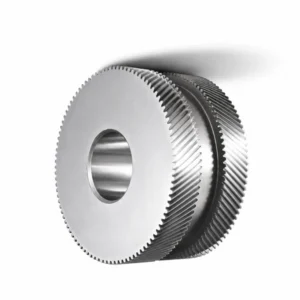
Engrenage à double hélice en acier au carbone – 45#, diamètre extérieur et module personnalisés
-
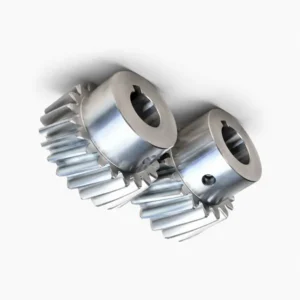
Parallel Axis Helical Gears – Steel, Custom Module & Ratio
-
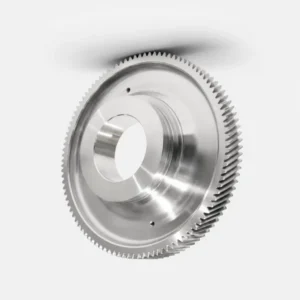
High Speed Train Hard Tooth Flank Helical Gear – 56-62 HRC
-
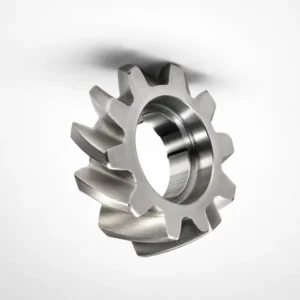
Engrenage hélicoïdal pour machines d'emballage de boissons – Acier inoxydable de qualité alimentaire
-
Engrenage hélicoïdal croisé (engrenage à vis) – Angle droit, OEM sur mesure
-
Metallurgy Machinery Soft Tooth Flank Helical Gear – ≤350HB
-
Engrenages hélicoïdaux rectifiés – DIN 4-6, M0,5-M10, rectifiés avec précision
 French
  English
  Italian
  Korean
  Japanese