
헤링본 기어
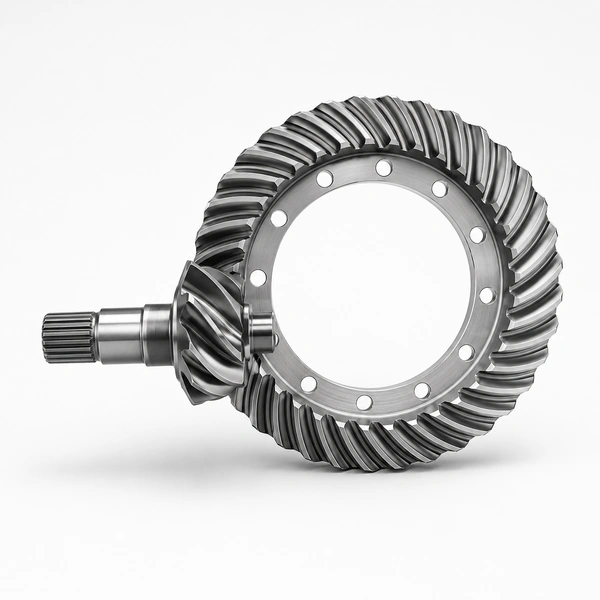
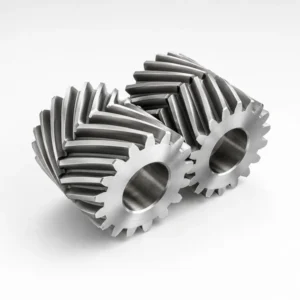
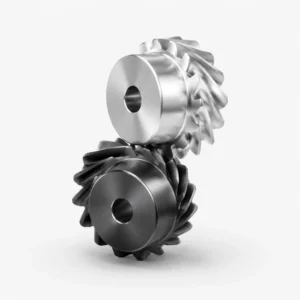
A herringbone gear is a combination of double helical gears with two helices arranged on opposite sides of the hand. The teeth of the herringbone gears are arranged at an angle called the helix angle, with no gaps between the left and right helixes, appearing in the shape of the letter V. These letters together form a pattern that resembles a fishbone structure. Since this structure has more than two teeth meshing with each other at the same time, the advantage is that the power transmission is smooth. Korea Ever-Power custom herringbone gears: hobbing up to M40, milling up to M50, precision 0.05 mm. Materials: 20CrMnTi, 20CrMnMo, 40Cr, 42CrMo, 40CrNiMo, HT250, QT400.
Product Overview
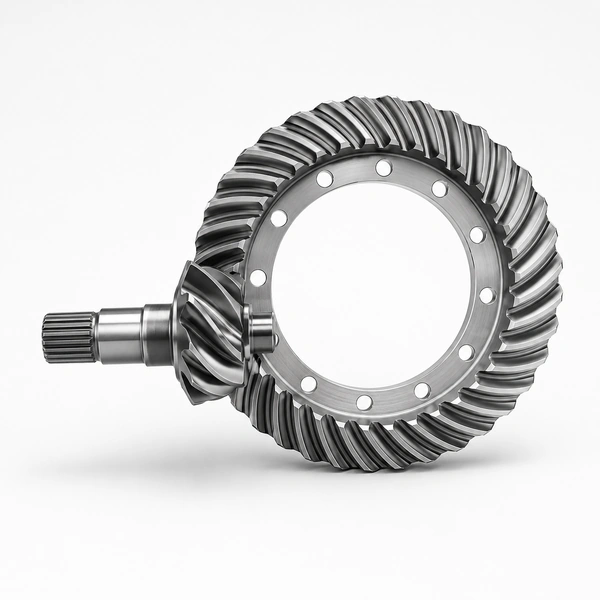
A herringbone gear is a specific type of double helical gear — a side-to-side (not face-to-face) combination of two helical gears of opposite hands on a single gear body. Viewed from the top, the helical grooves form the shape of the letter V — the left-hand helix and right-hand helix meet at the gear face centre with no gap between them. This V-pattern, repeated across all teeth, forms the characteristic fishbone (herringbone) pattern that gives the gear type its name. Korea Ever-Power custom herringbone gears are available in both large modules (hobbing up to M40, gear milling up to M50) and large diameters, with precision up to 0.05 mm, in carburising steel, alloy steel, medium carbon steel, and cast iron.
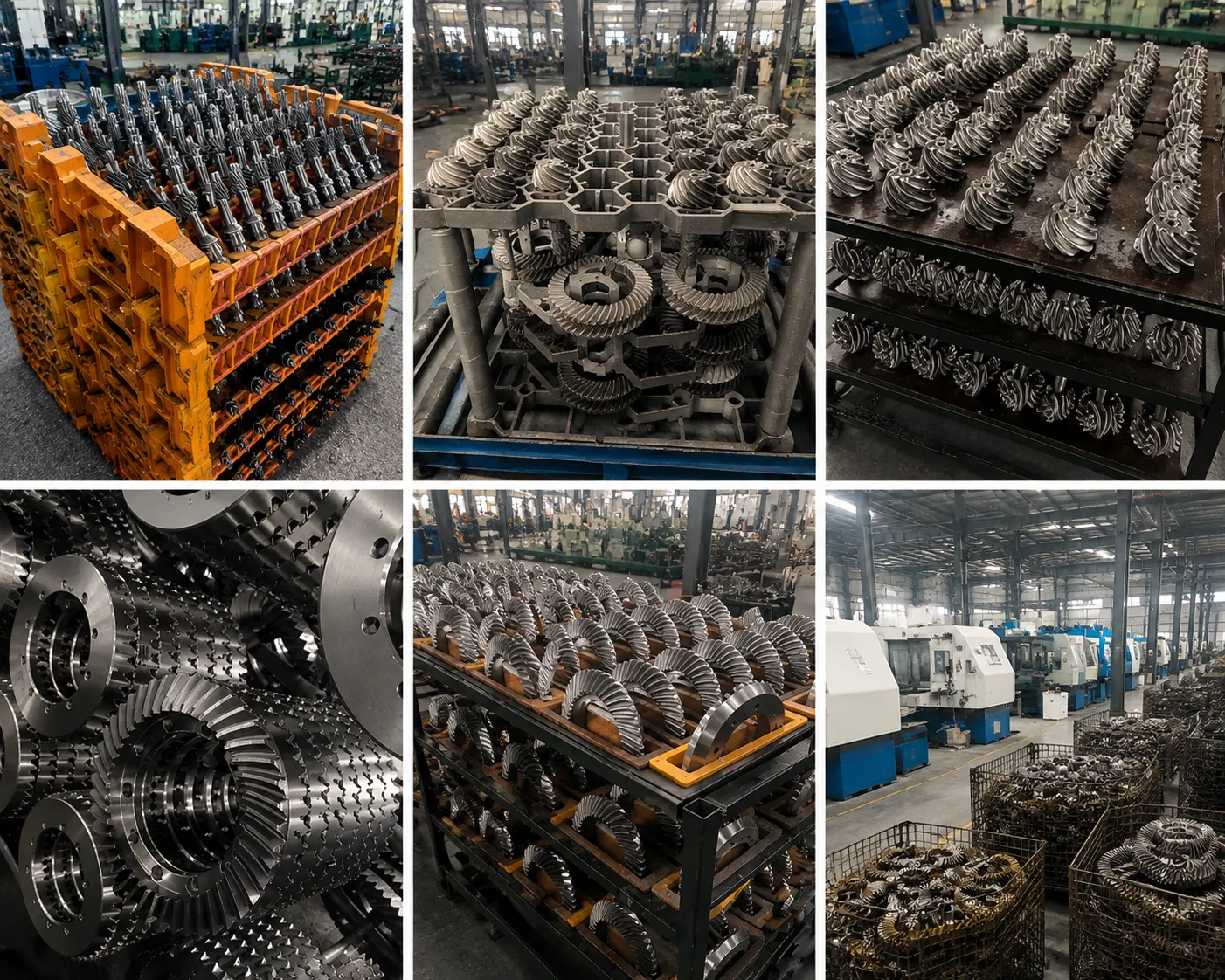
Korea Ever-Power's herringbone gears offer: large module and large diameter capability; high precision to 0.05 mm; quality control from ingot smelting through forging, heat treatment, machining, and final inspection; and competitive pricing with reliable delivery. Widely used in all kinds of transmission, speed changing, rotation, and other civilian or military equipment.
Unlike standard helical gears, which produce an axial thrust force from the helix angle that must be reacted by the shaft bearings, herringbone gears cancel the axial thrust internally: the left-hand helix produces an axial force in one direction; the right-hand helix produces an equal force in the opposite direction. These two forces cancel each other within the gear body, leaving zero net axial force on the shaft — eliminating the need for thrust bearings that would otherwise be required to react the helical gear axial load.
Technical Specifications
| Parameter | 사양 |
|---|---|
| Product Type | Herringbone gear (double helical, V-tooth, no gap between halves) |
| Module Range | Hobbing up to M40; gear milling up to M50 |
| Precision | Up to 0.05 mm; standard DIN, GB, ISO, JIS, BS, ANSI |
| Gear Classification | Spur gear, helical gear, herringbone gear, spiral bevel gear, bevel gear |
| Material — Medium Carbon Steel | 35#, 45# — general duty herringbone gears |
| Material — Carburising Steel | 20CrMnTi, 20CrMnMo — high-duty carburised herringbone gears |
| Material — Alloy Steel | 40Cr, 35CrMo, 42CrMo, 40CrNiMo — Q&T and induction hardened |
| Material — Cast Iron | HT250 (grey iron), QT400 (ductile iron) — large low-speed herringbone gears |
| Heat Treatment | Hardening & tempering; surface quenching; integral quenching; carburising quenching; tempering; normalising; nitriding |
| Helix Angle | Typically 15°–45°; 45° provides maximum axial cancellation and smoothest operation; custom per drawing |
| QC Process | Ingot smelting → forging → heat treatment → machining → final inspection before delivery |
Herringbone Gear Principles — Why the V-Tooth Matters
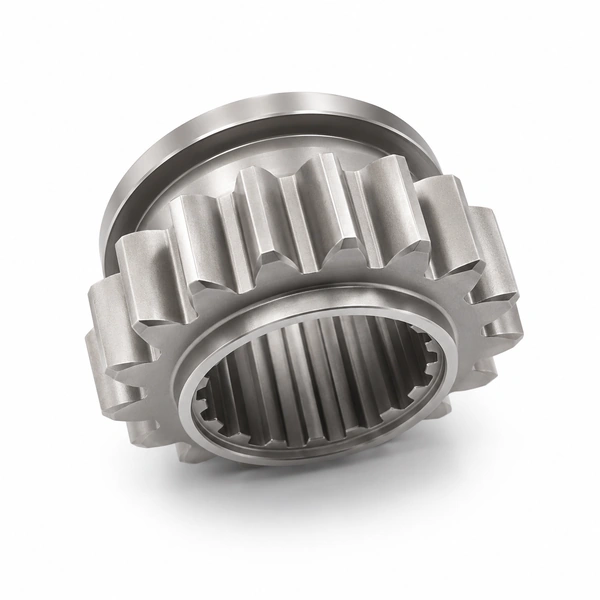
The herringbone gear's V-tooth geometry gives it a unique combination of properties that neither spur nor single-helix helical gears can achieve simultaneously. To understand why, it helps to trace the evolution from spur to helical to herringbone:
Spur Gear Baseline
Spur gear teeth are parallel to the gear axis. Each tooth engages the mating tooth all at once — the full tooth width enters contact simultaneously, creating an abrupt load application. This produces a characteristic gear mesh noise at the tooth engagement frequency and limits the gear to moderate speeds before noise becomes unacceptable. No axial force generated. Simple to manufacture — the reference point for gear cost comparison.
Single Helical Gear: Quieter but Thrust
Helical gear teeth are angled to the gear axis at the helix angle λ. Each tooth engages progressively along its length as the gear rotates — the contact line sweeps across the tooth face rather than engaging all at once. This gradual contact produces smoother, quieter transmission, higher contact ratio, and higher load capacity than spur gears at the same module. The penalty: an axial thrust force Fa = Ft × tan(λ) acts along the gear shaft, requiring thrust bearings. At large helix angles for maximum smoothness, this axial force becomes very large.
Herringbone: Smooth + Zero Thrust
The herringbone gear keeps all the smoothness advantages of the helical gear (gradual contact engagement, high contact ratio, low noise) while eliminating the axial thrust entirely. By combining equal-width left-hand and right-hand helical sections on the same gear body with no gap between them, the axial forces from the two halves are equal and opposite — they cancel internally. The net axial force on the shaft and bearings is zero, even at the large helix angles (30°–45°) that produce the smoothest operation. This is the defining advantage of herringbone gearing.
Self-Centering Capability
Because the herringbone gear produces no net axial force on the shaft, the gear pair's internal axial force balance acts as a self-centering mechanism: any slight misalignment in the axial direction is corrected by the equal and opposite axial forces from the two helical halves, which act to restore the mesh to the geometrically correct position. This self-centering property allows herringbone gears to be mounted with slightly more bearing clearance than helical gears without increasing vibration — simplifying bearing specification in large industrial gear units.
Contact Ratio and Load Capacity
The herringbone gear's total contact ratio is the sum of the transverse contact ratio (same as the equivalent spur gear) and the overlap ratio (from the helix angle). At 45° helix angle, the overlap ratio can exceed 1.0 — meaning more than one full tooth is always in engagement across the face. This continuous multi-tooth engagement distributes the tooth force over a larger area simultaneously, producing the highest load capacity of any parallel-shaft gear type at the same module and pitch diameter, while maintaining the smoothest, quietest operation.
Manufacturing Difficulty — Higher Cost
The herringbone gear's V-tooth geometry without a centre groove is the most difficult gear form to machine. The cutting tool must reach the centreline from both sides and reverse without a gap — requiring either specialised hobbing with a split hob, or milling from both sides with careful registration. This manufacturing complexity makes herringbone gears significantly more expensive than helical gears at the same module — the premium is justified where zero axial thrust and maximum smoothness are both required simultaneously, particularly in large, high-power industrial drives.
Five Advantages of Herringbone Gears
① Reduced Axial Force
The two opposite-hand helical halves produce equal and opposite axial forces that cancel internally — zero net axial load on shaft and bearings. Eliminates the thrust bearing requirement and the associated bearing losses that single-helix helical gears impose. In large industrial gear units where bearing losses from heavy axial loads can be significant, the herringbone gear's zero axial thrust reduces gearbox power losses and bearing maintenance requirements.
② Smoother Transmission and Engagement
The high overlap contact ratio (from large helix angles) combined with the continuous multi-tooth engagement of the herringbone tooth form produces the smoothest torque transmission of any parallel-shaft gear type. The torque ripple — the cyclic fluctuation in transmitted torque as teeth engage and disengage — is minimised to near-zero, making herringbone gears ideal for vibration-sensitive applications including turbine reduction gears, compressor drives, and precision machine tool spindle drives.
③ Reduced Noise
Herringbone gears produce the lowest noise level of parallel-shaft gear types at high speeds. The large helix angle (30°–45°) produces high overlap ratio — the number of tooth pairs simultaneously in contact — which reduces the tooth mesh frequency noise amplitude that dominates single-tooth or low-contact-ratio gears. Noise reductions of 5–15 dB(A) compared with equivalent spur gears are typical in high-speed industrial herringbone gear drives.
④ Self-Centering Capability
The internal axial force balance acts as a self-centering restoring force for axial misalignment — any axial displacement from the nominal mesh position is resisted by the differential axial force from the misbalanced helix forces. This gives herringbone gears a degree of tolerance for thermal expansion and housing deflection without degrading the contact pattern, which is valuable in the large, high-temperature industrial gear units where herringbone gears are typically applied.
⑤ High Load Capacity
The herringbone gear's effective face width is the full double-helical width — effectively twice the face width of a single-helix helical gear at the same module. The high contact ratio further distributes the tooth load across more tooth pairs simultaneously. The result is the highest power density (power per unit gear volume) of any parallel-shaft gear type — making herringbone gears the standard for the largest industrial power transmission applications including marine reduction gears, rolling mill drives, and power generation turbine gearboxes.
응용 프로그램
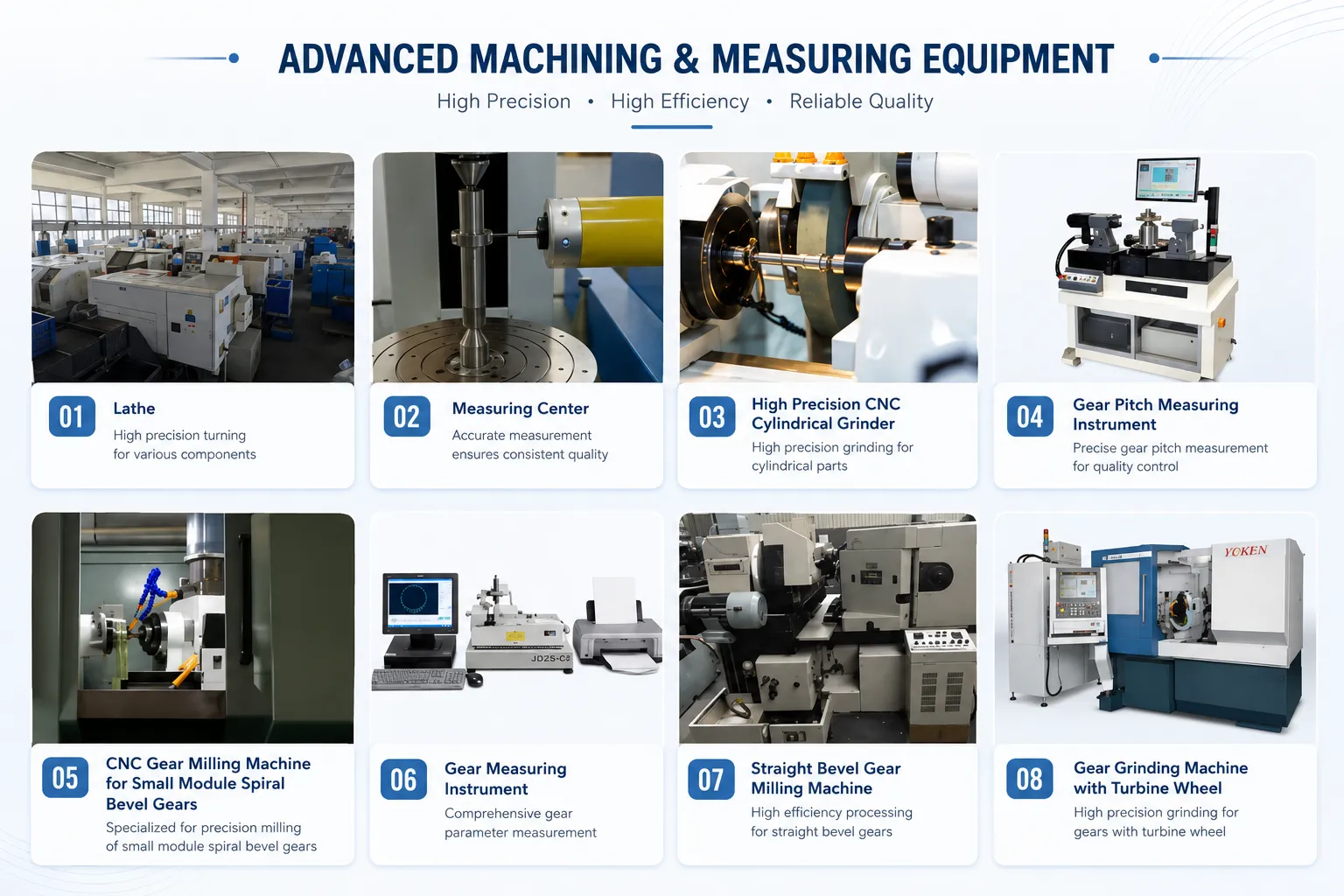
Marine Reduction Gears
Large herringbone gear sets in marine main engine reduction gearboxes for ships and offshore vessels. Marine reduction gears transmit 1,000–20,000+ kW from diesel or gas turbine prime movers to propeller shafts at very low propeller speeds (80–200 RPM). The herringbone gear's zero axial thrust, high load capacity, and low noise make it the standard for naval and commercial ship reduction gearboxes where bearing life, noise signature (naval vessels), and transmission efficiency are all critical.
Rolling Mill Drives
Herringbone gears in steel mill pinion stand drives and rolling mill main drives. Rolling mill herringbone gears are among the largest produced — modules up to M50, face widths exceeding 1,000 mm, transmitted powers in the MW range. The large module (hobbing up to M40, milling to M50) and precision capability of Korea Ever-Power's herringbone gear programme is designed specifically to address these large industrial gear applications.
Power Generation and Turbines
Herringbone gear step-up gearboxes in gas turbine and steam turbine power plants — increasing the turbine's high-speed output to the generator's synchronous speed (50 or 60 Hz). The self-centering property of herringbone gears is especially valuable in these applications, where thermal growth of the rotor and casing at operating temperature makes precise initial alignment difficult and axial freedom essential for correct tooth contact throughout the temperature range.
Heavy Industrial Transmission
Herringbone gears in mining hoist drives, cement mill drives, sugar mill drives, and other large continuous-duty industrial applications where high power, low noise, long service life, and minimum maintenance are required simultaneously. The full production process control — ingot smelting through final inspection — that Korea Ever-Power provides for herringbone gears is the quality foundation these critical industrial applications demand.
Military Equipment
Herringbone gears in naval vessel propulsion reduction gearboxes, military vehicle final drive systems, and military aircraft accessory drives. Military herringbone gears require the highest material quality (40CrNiMo, full heat treatment certification, destructive testing of representative samples), tightest precision (DIN 4–5), and lowest noise signature — all supported by Korea Ever-Power's full-chain quality control process.
Frequently Asked Questions
What is the difference between a herringbone gear and a double helical gear?
The terms are often used interchangeably, but there is a precise technical distinction. A "double helical gear" has two helical sections of opposite hand with a groove or space between them at the centre — this groove allows the cutting tool to exit between the two halves. A "herringbone gear" is a double helical gear with no gap between the two helical sections — the V-form teeth meet at the centre. The herringbone (no-gap) form is mechanically superior (no stress concentration at the groove) but more difficult to manufacture. Korea Ever-Power's herringbone gears are the true no-gap form.
Why are herringbone gears more expensive than helical gears?
Herringbone gears are more expensive because they are significantly more difficult to manufacture than single-helix helical gears. The V-tooth form without a centre groove requires specialised tooling (split hob or two-sided milling approach), careful registration of the two halves, and more machining time. The arrangement of the teeth in the V-form increases manufacturing cost at all module sizes. The cost premium is justified where the combination of zero axial thrust and maximum load capacity/smoothness is required — which is the case in all the major herringbone gear applications (marine, power generation, rolling mills).
What is the maximum module and diameter Korea Ever-Power can manufacture for herringbone gears?
Korea Ever-Power produces herringbone gears up to M40 by hobbing and up to M50 by gear milling. Both large modules and large diameters are available — for large industrial applications such as rolling mill drives and marine gearboxes where the gear dimensions exceed the capability of standard gear machine tools. Precision up to 0.05 mm is maintained across these large sizes. Contact Korea Ever-Power with the required module, diameter, and face width to confirm capability and obtain a quotation.
Customer Reviews
"We build marine reduction gearboxes and source large herringbone gears M16, 40CrNiMo, from Korea Ever-Power. Axial force measured at our gearbox test bench: zero net axial displacement of the gear shaft under full load — confirming the herringbone force cancellation is functioning correctly. Precision measured at 0.04 mm — within Korea Ever-Power's 0.05 mm guarantee. Production quality control documentation (material cert, heat treatment report, dimensional inspection) complete and accepted by our classification society surveyor."
Kim Byeong-ho | Marine Gearbox Design Engineer, Incheon Marine Drive Systems Co. · Q1 2026
"We design rolling mill pinion stand drives and specified herringbone gears M24, 42CrMo, from Korea Ever-Power for our 600 mm wide-strip mill. Noise measurement at 1 metre from gearbox at 500 RPM pinion: 72 dB(A) — 8 dB(A) lower than the spur gear set we replaced. No axial bearing failures in 26 months of continuous operation — compared with the thrust bearing replacements every 8–10 months with the previous helical gear set."
Lee Jong-hyun | Rolling Mill Drive Engineer, Gyeonggi Steel Mill Equipment Co. · Q4 2025
Related Products
Request a Quotation for Custom Herringbone Gears
Hobbing up to M40, milling up to M50. Precision 0.05 mm. 20CrMnTi, 42CrMo, 40CrNiMo, cast iron. Full process QC from ingot to delivery. DIN/GB/ISO/JIS/ANSI standard. Large diameter available.
추가 정보
| Editor |
|---|
 Korean
  English
  Italian
  French
  Japanese