
Miter Gears – 1:1 Straight & Spiral, Right-Angle Drive
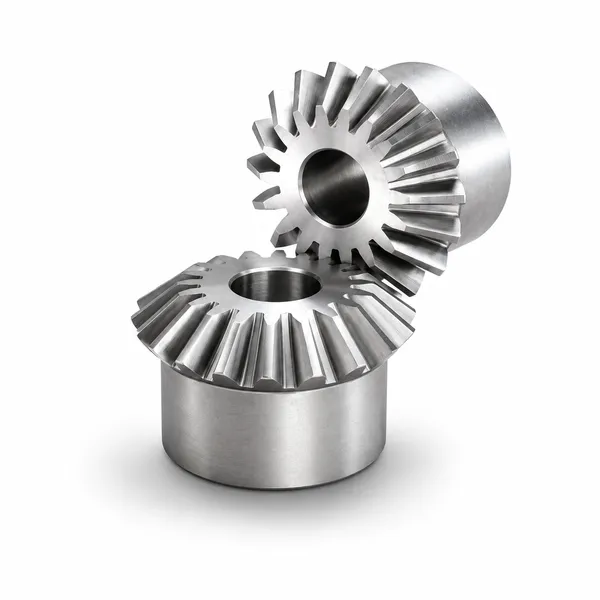
Korea Ever-Power miter gears are a specialised subset of bevel gears with identical tooth count and dimensions on both members, delivering a fixed 1:1 speed ratio while changing the drive direction — most commonly through 90°. Available in straight-cut and spiral configurations from module 0.5 upward, in steel, stainless steel, and engineering plastics. Both gears in a set are supplied as matched pairs with dimensional and hardness documentation.
Product Overview
Miter gears are a specialised form of bevel gear defined by one fixed property: both members of the pair are identical in tooth count, module, and pitch cone angle. This means the gear ratio is always 1:1 — the output shaft turns at exactly the same speed as the input shaft, in a direction changed by the cone geometry. In the most common configuration the two shafts are at 90° to each other, and both pitch cone angles are 45°. Non-90° miter arrangements are possible where the shaft intersection angle differs from a right angle, but both gears still carry the same tooth count and the speed ratio remains 1:1.
The defining application for miter gears is any drive where the designer needs to redirect power through a corner without changing speed. Unlike a general bevel gear set — where one gear is smaller than the other and the ratio is determined by the tooth count difference — a miter pair contributes no speed reduction or increase. This makes miter gears the natural choice in hand-tool angle drives, door opener mechanisms, right-angle transmission extensions, and instrumentation where the output must mirror the input speed precisely.
Korea Ever-Power produces miter gears in both straight-cut and spiral configurations from module 0.5 upward. Straight miter gears cover small sizes and low-speed applications where cost and simplicity matter more than noise. Spiral miter gears are better suited to high-speed applications — power tool heads, machine drive extensions, lawn trimmer angle drives — where the gradual tooth engagement reduces clashing noise and allows higher continuous torque. Both types are supplied as matched pairs. The close dimensional relationship between both gears means that replacing only one member produces a mismatched contact pattern that accelerates wear on the new part; when one gear shows significant wear or damage, the pair should be replaced together.
Straight vs. Spiral Miter Gears
(1) Straight Miter Gears
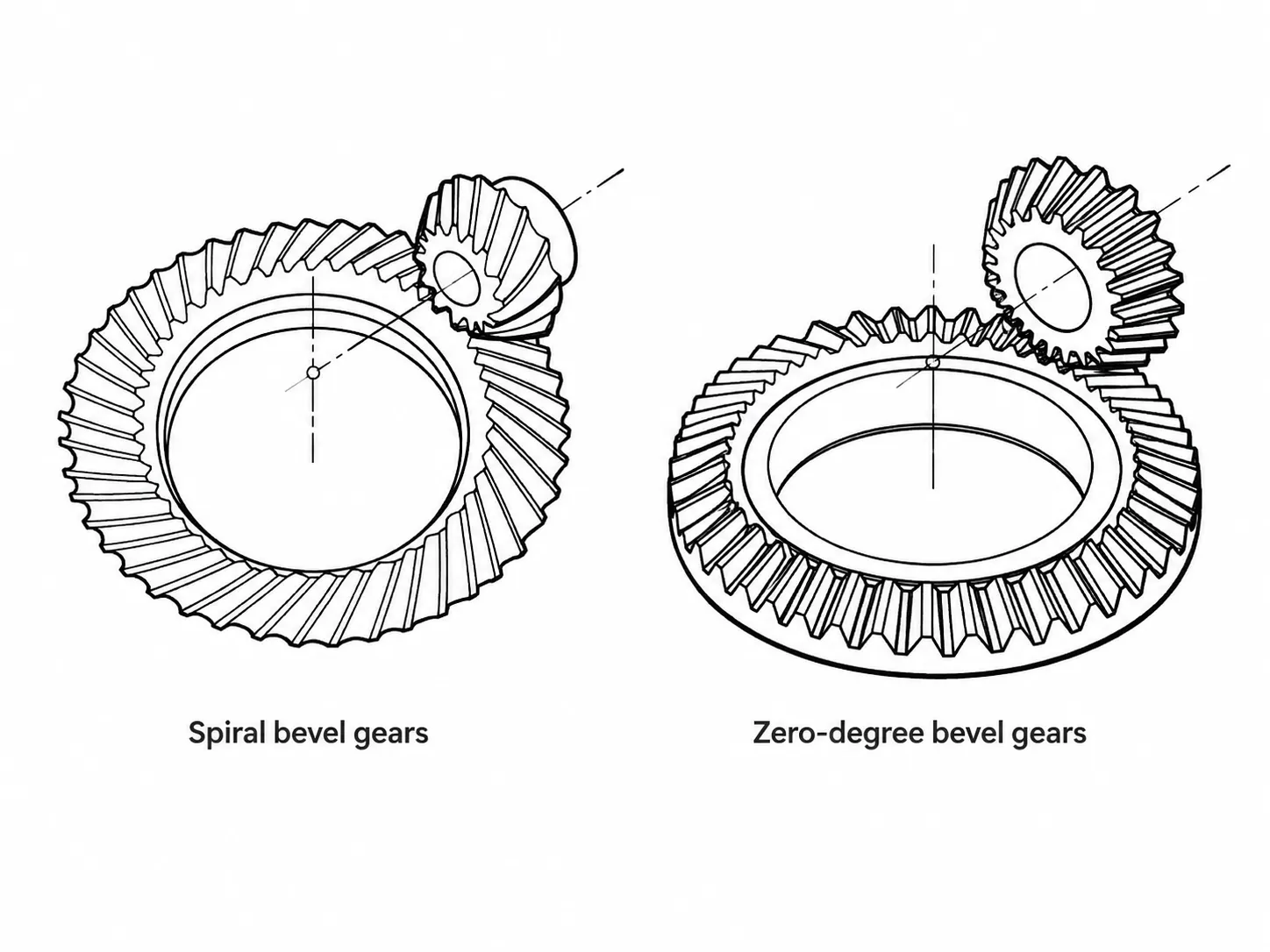
In straight miter gears the teeth run parallel to the generators of the pitch cone — that is, they point directly from the small end to the large end of the tooth face with no curvature or twist. Contact begins simultaneously along the full tooth length at each mesh cycle, which produces an abrupt load application. At low speeds this is entirely manageable, and straight miter gears are both simpler to manufacture and achievable in smaller modules than spiral miter gears. Korea Ever-Power standardises straight miter gears from module 0.5, covering miniature instrument drives, hand tools, and slow-speed indexing mechanisms where the snap engagement of straight teeth is not a performance limitation.
(2) Spiral Miter Gears
Spiral miter gears have teeth formed along curved spiral lines across the cone face, analogous to the helical teeth on a cylindrical gear but applied to the conical surface. The curvature allows each tooth to enter mesh gradually at one end and exit at the other, so the load transition between successive teeth is smooth rather than abrupt. This is the property that gives spiral miter gears their advantage over straight-cut versions at higher speeds: less clashing noise, lower vibration, higher achievable torque within the same outer diameter, and better fatigue life at the tooth root. The trade-off is that spiral miter gears generate an axial thrust load that straight-cut miter gears do not. Bearings and housings must be sized and arranged to carry this thrust — particularly on the shaft whose rotation direction pushes the pinion away from the bearing rather than into it.
| Criterion | Straight Miter Gear | Spiral Miter Gear |
|---|---|---|
| Tooth engagement | Full line, instantaneous | Progressive, gradual entry and exit |
| Noise & vibration | Higher at elevated speed | Significantly lower |
| Torque capacity | Moderate | Higher for same outer diameter |
| Axial thrust | None | Present — bearing design must account for it |
| Minimum module available | From module 0.5 | Confirm with enquiry |
| Typical speed range | Low to moderate | Moderate to high |
| Typical applications | Hand tools, door openers, instruments, slow indexing | Power tool heads, machine drives, lawn trimmers |
| Replacement rule | Replace as a pair | Must replace as a matched lapped pair |
Technical Specifications
The parameters below describe Korea Ever-Power's general production capability for miter gears. All specific dimensions — module, tooth count, bore, face width, and heat treatment — are confirmed against your drawing or sample at the quotation stage.
| Parameter | Typical Range / Options |
|---|---|
| Gear Type | Miter gear — straight cut or spiral; always supplied as matched pairs |
| Gear Ratio | Fixed 1:1 (equal tooth count and dimensions on both members) |
| Shaft Intersection Angle | 90° standard (pitch cone angle 45° each); other angles per drawing |
| Module | From module 0.5 (straight); confirm minimum for spiral with enquiry |
| Pressure Angle | 20° standard; other angles per customer drawing |
| Number of Teeth | Equal on both gears; per drawing or standard series |
| Material — Steel | 45# carbon steel, 40Cr, 20CrMnTi, 42CrMo (per load requirement) |
| Material — Stainless | 304, 316 stainless steel (food, marine, corrosive environments) |
| Material — Non-Metallic | Nylon (PA66), acetal (POM), engineering resins (light load, low noise) |
| Heat Treatment | Carburising & quenching, through-hardening, normalising, or as-machined |
| Tooth Finishing | As-cut; lapped pairs for smoother contact; ground for high-accuracy grades |
| Machining Standard | AGMA, DIN, JIS, GB; customer drawings accepted |
| Surface Treatment | Phosphating, black oxide, zinc plating, as-machined |
| 인증 | ISO 9001:2015; material cert and hardness report with each order |
Miter Gear vs. Standard Bevel Gear — What Makes Them Different
A miter gear is technically a bevel gear, but with one constraint that changes how it is selected and applied: the 1:1 ratio. In a general bevel gear set, the designer chooses two different tooth counts to achieve the required speed reduction or increase. In a miter set, both gears must have the same tooth count — any deviation from this breaks the 1:1 ratio and turns the pair into a standard bevel set.
This constraint has several practical consequences worth understanding before specifying miter gears:
Identical outer dimensions
Because both gears share the same module and tooth count, they also share the same pitch diameter, outer diameter, and back-cone geometry. This means both gears are interchangeable physically — you can mount either member on either shaft. This symmetry simplifies assembly and reduces spare-parts inventory compared with a bevel set where pinion and ring gear must be tracked separately.
45° pitch cone angle (at 90° intersection)
For a 90° shaft intersection angle, the pitch cone angle of each gear in a miter set is exactly 45°. This is a consequence of the 1:1 ratio combined with the 90° angle — the two pitch cones share the intersection point equally. In a non-90° miter set (say, 60° intersection angle), both pitch cone angles are still equal to each other but each equals 30° instead of 45°. The equal-angle property is what defines a miter gear regardless of the shaft intersection angle.
No speed change — only direction change
The miter gear contributes no mechanical advantage and no speed reduction. The output shaft turns at the same rpm as the input shaft. If the application requires both a direction change and a speed ratio, the miter pair is not the answer — a standard bevel set with unequal tooth counts, or a multi-stage arrangement combining a miter set with a separate reduction stage, is the correct solution.
Applications
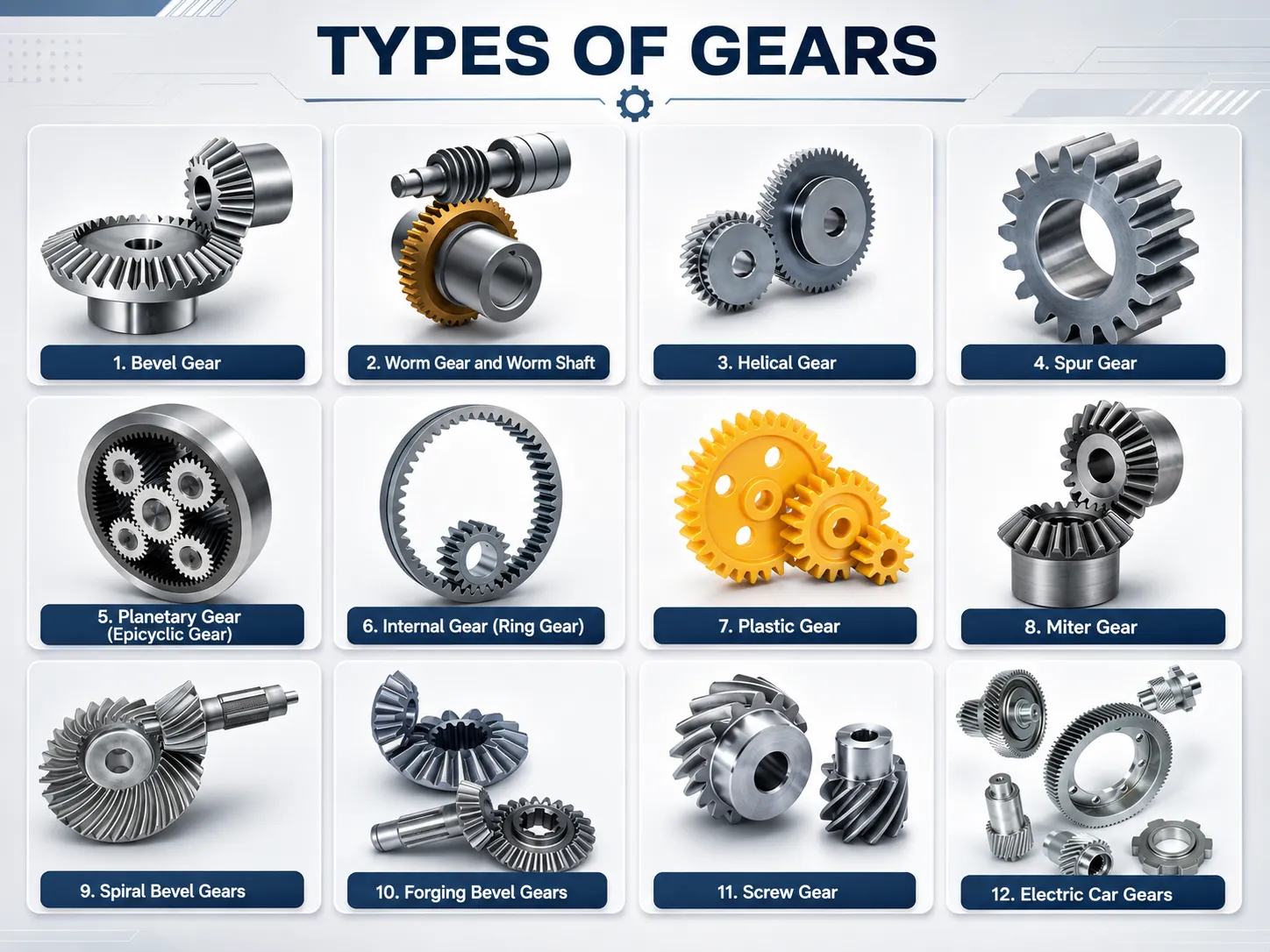
Because miter gears change direction without altering speed, they are used in a specific and well-defined set of applications. The common thread across all of them is the need to route a shaft around a corner while keeping the driven mechanism running at exactly the same speed as the power source.
Power Tools & Angle Drives
Angle grinders, drill angle adaptors, and lawn trimmer heads all require a compact 90° direction change between the motor shaft and the working tool. Spiral miter gears handle the high continuous speeds of these applications without generating the noise or vibration that would be unacceptable in a hand-held tool. The compact, equal-dimension geometry of a miter pair also minimises the size of the gearhead casing.
Door Openers & Gate Mechanisms
Automated door and gate drives use straight miter gears to translate a motor's rotation into the lateral movement needed to push or pull the door panel. The 1:1 speed ratio means the drive mechanism runs at motor speed, with reduction achieved elsewhere in the drive train. Low-speed operation makes straight miter gears practical here, and the lower manufacturing cost of straight teeth is an advantage in cost-sensitive consumer products.
Instrumentation & Measurement
Precision instruments, rotary encoders, and measurement systems sometimes require a shaft direction change without any change in angular velocity — any ratio error would introduce a measurement error. Small-module straight miter gears from module 0.5 fill this role, often produced in brass or stainless steel to avoid corrosion in laboratory and calibration environments.
Machine Tool Auxiliaries
Right-angle drive extensions on machine tools, milling heads, and multi-axis fixture drives use miter gear pairs to route the spindle drive around obstructions. The 1:1 ratio preserves the spindle speed that the machine control system expects; any ratio change would require recalibration of feeds and speeds throughout the control programme. Spiral miter gears are standard in production environments where the drive runs continuously.
Building Services Equipment
HVAC damper actuators, ventilation fan angle drives, and roof exhauster drives use miter gears to change the direction of a motor shaft when ceiling geometry or duct routing prevents a direct co-axial arrangement. Miter gears in these applications typically run continuously at low speed, making straight-cut versions in normalised carbon steel the economical choice.
Agricultural Hand Tools
Manual seed drills, garden cultivators, and hand-operated field tools often use small straight miter gears to redirect the operator's cranking motion through 90° to the working element. Nylon or acetal versions are suitable for these lightly loaded, intermittent-duty applications and provide quiet operation without lubrication when the design does not accommodate an oil sump.
Material Selection for Miter Gears
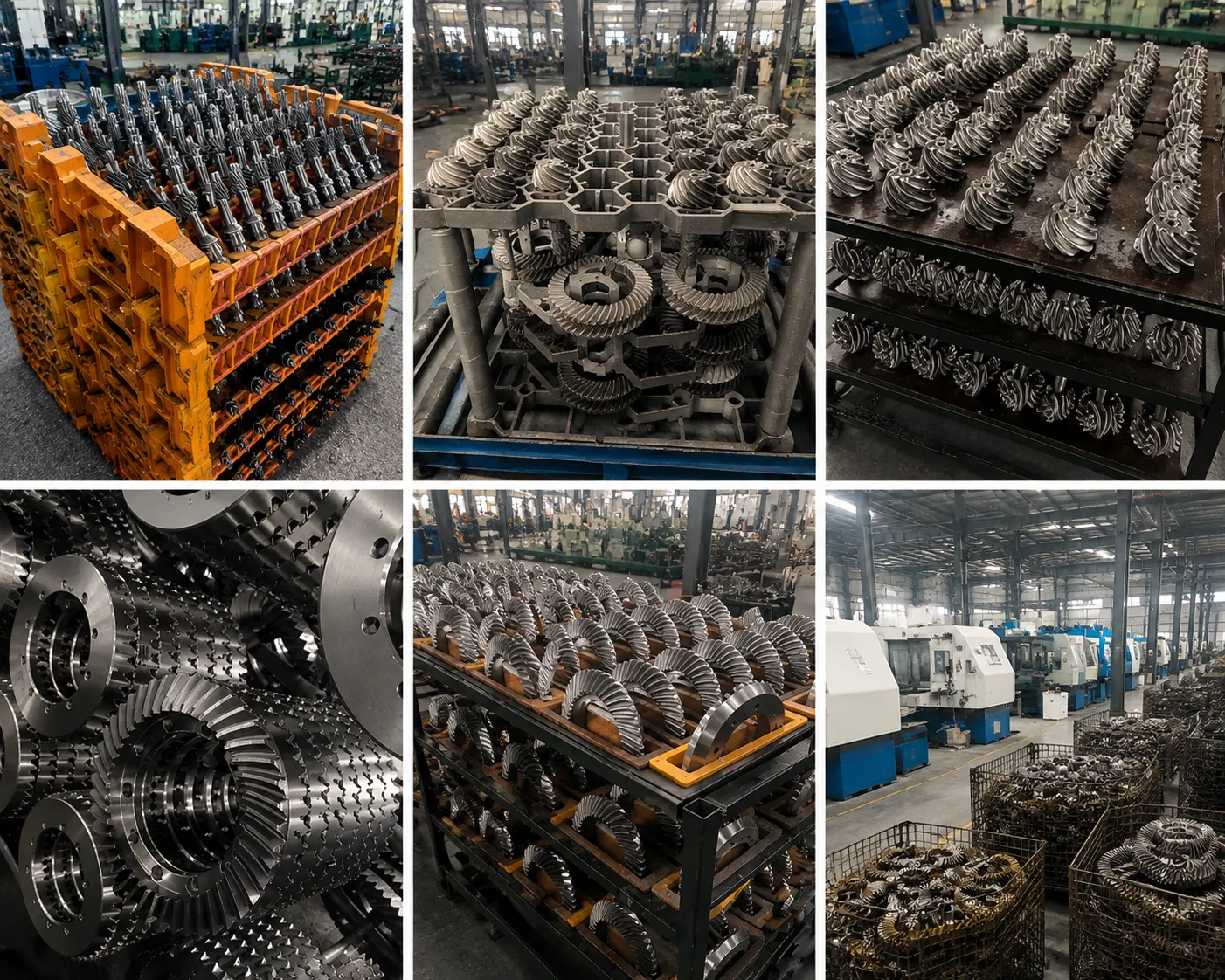
Miter gear material selection is driven by four variables: load level, speed, operating environment, and whether lubrication is available. The following covers the main material categories in use:
High-carbon and alloy steels
The standard choice for high-load and high-speed applications. Case-hardening alloy steels such as 20CrMnTi deliver a hard tooth flank over a tough core, combining contact fatigue resistance with the ability to absorb impact loads. Through-hardened grades such as 42CrMo suit applications where the entire cross-section should be at uniform hardness — typical in heavy-duty machine tool angle heads and power transmission drives that see shock loading. High-carbon steel is the appropriate material for miter gears working at the highest load and speed levels.
Stainless steels
For food processing equipment, medical devices, and marine environments where corrosion resistance is required alongside reasonable load capacity. 316 stainless adds molybdenum for chloride resistance useful in wash-down environments. At equivalent tooth module, stainless steel miter gears carry a lower load rating than alloy steel — specifying a larger module or face width compensates for this where load is a constraint.
Engineering plastics (Nylon, Acetal / POM)
Used in low-torque, intermittent-duty applications where weight, quiet operation, and the ability to run without oil lubrication are priorities. Nylon (PA66) has good impact resistance and self-lubricating properties; acetal (POM) offers better dimensional stability and lower moisture absorption. Both are injection-moulded rather than cut from blanks, which limits tooth accuracy class but reduces cost dramatically for large quantities of small gears. A common pairing is a steel driving gear meshing with a plastic driven gear — the plastic gear absorbs wear preferentially, protecting the steel member and providing a visual indication that the set is approaching replacement.
Installation and Axial Thrust Considerations
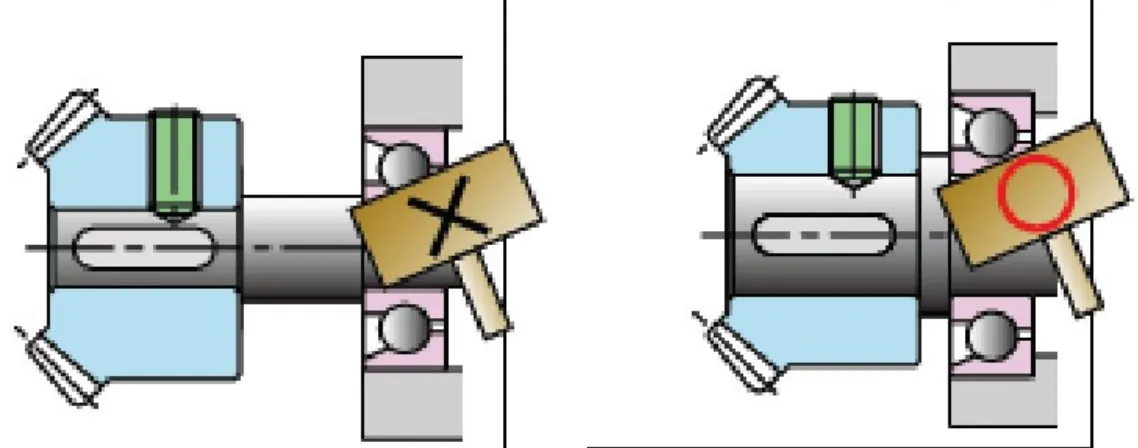
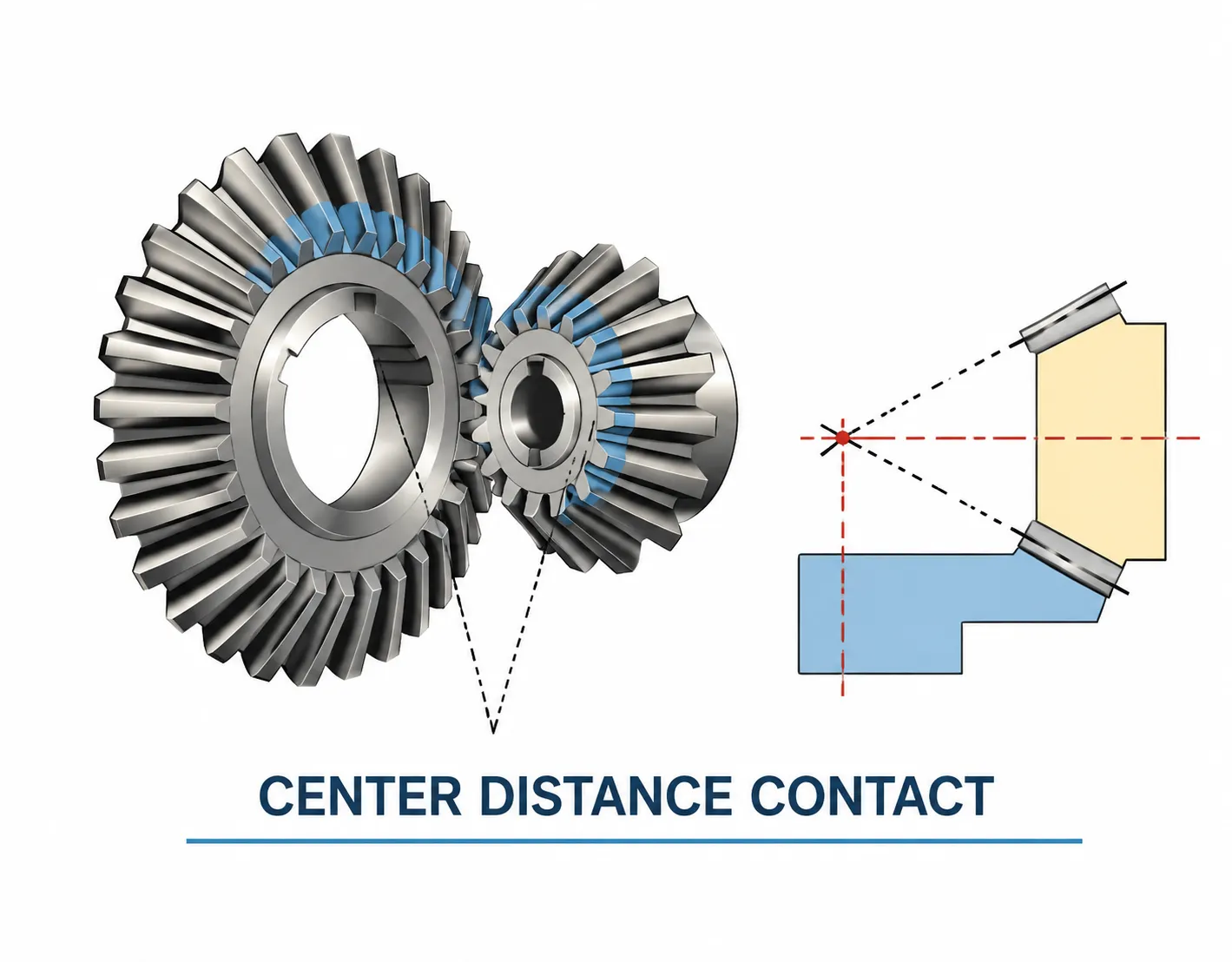
Miter gear installation follows the same mounting distance principles as any bevel gear pair. The mounting distance — the dimension from the gear's back-cone face to the pitch cone apex — must be set correctly on both shafts. Because both gears in a miter set are identical, the mounting distance is the same on both shafts for a 90° set, which simplifies the housing design compared with a general bevel set where the two gears have different back-cone distances.
Straight miter gear — no axial thrust
Straight miter gears produce no axial thrust component. The only bearing loads from the gear mesh are the transmitted tangential force, the separating force (which pushes the gears apart along the pitch cone axis), and radial loads from the shaft weight. Standard deep-groove ball bearings handle these loads in most low-speed straight miter applications. The lack of axial thrust is one of the reasons straight miter gears remain preferred in cost-sensitive, slow-speed designs despite their noise disadvantage at speed.
Spiral miter gear — axial thrust requires planning
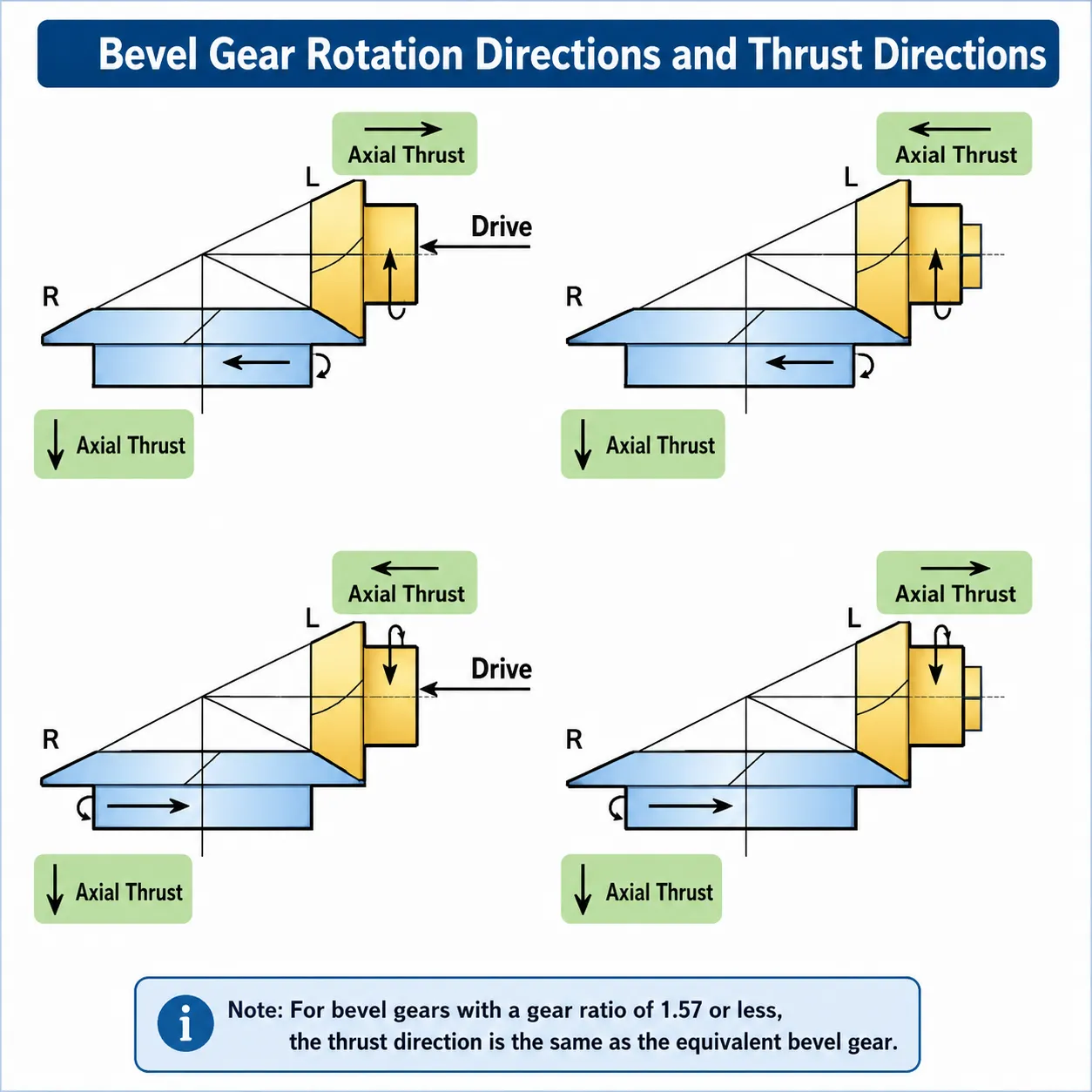
Spiral miter gears generate an axial thrust whose direction depends on the hand of spiral and the direction of rotation. For a right-hand spiral gear rotating clockwise when viewed from the large end, the axial thrust pushes toward the large end. If the rotation reverses, the thrust reverses. In drives that run in both directions — reversing power tools, bidirectional actuators — the bearing must carry axial thrust in both directions, which typically means using angular contact bearings in a back-to-back arrangement or taper roller bearings with pre-load shimming. Confirm the thrust direction with your Korea Ever-Power engineer at the design stage.
Frequently Asked Questions
What is the difference between a miter gear and a bevel gear?
A miter gear is a bevel gear, but with the specific constraint that both members of the pair have the same tooth count, the same module, and — at 90° shaft intersection — the same 45° pitch cone angle. This makes the gear ratio exactly 1:1. A standard bevel gear set has two members with different tooth counts, giving a ratio other than 1:1 and different pitch cone angles for the two gears. Use a miter pair when you need direction change with no speed change. Use a standard bevel pair when you need direction change combined with a speed ratio.
Can miter gears be used at shaft intersection angles other than 90°?
Yes. The 1:1 ratio and equal tooth count are maintained, but the pitch cone angle on each gear changes from 45° to half the shaft intersection angle. For a 60° intersection, each pitch cone angle is 30°. For a 120° intersection, each is 60°. Non-90° miter pairs must be specified with the shaft intersection angle clearly stated on the drawing, because the gear body geometry changes accordingly. Our engineering team calculates the correct blank geometry and confirms it with the customer before production.
Do I need to replace both miter gears even if only one is visibly worn?
For spiral miter gears, yes — the contact pattern is optimised by lapping the pair together during manufacture, so replacing one half produces a mismatch that accelerates wear on the new part and may reintroduce noise. For straight miter gears running at low speed, individual replacement is more forgivable because the contact geometry relies more on mounting distance accuracy than on the lapping result. In practice, the cost of replacing both gears is usually small relative to the labour cost of a reassembly, and the peace of mind from a fully matched pair is worth the investment. If you are in doubt, replace the pair.
Are plastic miter gears suitable for continuous-duty drives?
Plastic miter gears in nylon or acetal are suited to light-load, intermittent-duty, or low-continuous-power applications — typically below 100 W at moderate speed in a cooled environment. At higher power or continuous duty, the tooth temperature rises due to friction and the material's low thermal conductivity; once the gear body temperature approaches 80–100°C, nylon loses a significant proportion of its strength and dimensional stability. For continuous duty above light load, a steel or stainless steel miter pair is the correct choice, and a small enclosed oil sump ensures adequate lubrication without operator attention.
What is the smallest module miter gear Korea Ever-Power can produce?
For straight miter gears, our standard production covers from module 0.5 in steel, stainless steel, and engineering plastics. This covers instrument drives, miniature power tools, and small actuator heads where the overall gear diameter is only a few millimetres. For spiral miter gears, the minimum achievable module depends on the specific tooth count and the available cutting tooling; contact our engineering team with your outer diameter constraint and tooth count requirement to confirm feasibility for very small spiral miter gears.
What information should I include in a miter gear enquiry?
The minimum information needed for a quotation is: tooth count (which is the same for both gears), module, shaft intersection angle (90° if standard), bore diameter and keyway or spline details, face width, material, heat treatment, and required surface finish. If you have an existing gear that needs replicating, a sketch or photograph with the outer diameter, hub diameter, hub length, face width, tooth count, and bore diameter gives us enough to identify the module and prepare a quotation. For spiral miter gears, also specify the hand of spiral (left-hand or right-hand) and the rotation direction of the driving shaft.
Can miter gears drive multiple output shafts from one input?
A single miter gear on the input shaft can mesh simultaneously with two or more miter gears whose shafts are arranged around it — this configuration is sometimes called a miter gear box or right-angle power splitter. Each output gear runs at the same speed as the input. The only limitation is that the torque load on the input gear is the sum of all output loads, so the input gear must be sized for the total transmitted torque. This arrangement is used in multi-head tools, parallel conveyor drives, and multi-channel instrumentation where several mechanisms must be synchronised to a single drive source. Contact our team with your multi-output requirement and we will advise on the configuration and gear sizing.
Customer Reviews
"We manufacture angle-head attachments for CNC milling machines and use spiral miter gear pairs throughout. Speed accuracy at the output is critical — any ratio error shows up directly in the cut. Ever-Power's miter gear pairs have held the 1:1 ratio within our measurement tolerance across every batch. Contact pattern photographs confirm consistent lapping between deliveries."
Kim Sung-jin | Engineering Director, Daegu Precision Tooling Co. · Q1 2026
"We source straight miter gears in module 0.5 stainless steel for a laboratory measurement instrument. The outer diameter of the gear is under 8 mm. Ever-Power produced to our drawing at this size with the bore and keyway we needed. Dimensional report confirmed every critical dimension within tolerance. Running in the instrument for six months with no measurable wear."
Park Seon-hee | Instrument Designer, Seoul Scientific Instruments · Q3 2025
"We needed acetal miter gears for a consumer garden product — low load, intermittent duty, no oil lubrication. Ever-Power supplied injection-moulded acetal pairs at a cost that worked for our retail price point. Noise in the assembled product is well below the target, and the self-lubricating properties have held up through two seasons of field testing."
Choi Jae-won | Product Development Engineer, Gyeonggi Garden Equipment · Q2 2025
"We replaced a worn spiral miter pair in a lawn trimmer angle drive. Sourcing the correct module and hand of spiral from the original equipment was the tricky part. Ever-Power's team identified both from the measurements I sent on a photograph and confirmed before ordering. The replacement pair fitted without any housing modification and the trimmer runs as quietly as when new."
Lee Hyeon-jun | Service Manager, Busan Power Tool Repairs · Q4 2025
"We use a three-output miter gear box arrangement to drive three parallel conveyor lanes from a single motor. Ever-Power sized the input gear for the combined output torque and confirmed the housing arrangement with us before production. All three output speeds match within 0.1% across the production run. The arrangement has been in operation for over a year with no maintenance issues."
Yoon Jae-beom | Automation Engineer, Incheon Logistics Machinery · Q1 2026
Request a Quotation for Miter Gears
Send us your drawing, sample gear, or key dimensions — tooth count, module, bore, shaft intersection angle, and material. Our engineering team returns a price and lead time within two working days. Straight and spiral types, steel to plastic, miniature to industrial sizes.
추가 정보
| Editor |
|---|
연관 상품
-
Medical Bevel Gear – M0.15 to M2.2, ISO 6 / AGMA 13
-
Bevel Gears European Standard – DIN Type A & B, 1:1 to 1:4
-
Sintered Metal Bevel Gears – Self-Lubricating, DIN 6–9
-
Precision Bevel Gear – M0.15 to M2.2, AGMA 13, 5 HT Routes
-
Forging Bevel Gears – Hot & Cold Forged, Custom OEM Supply
-
Differential Gears – Open, LSD, Torque Vectoring, Forged PM
-
Spiral Bevel Gears – Helical Bevel Gear, Custom OEM Supply
-
Helical Bevel Gear – Tangential Tooth, Low Noise Bevel Drive
 Korean
  English
  Italian
  French
  Japanese