
Plastic Spur Gears
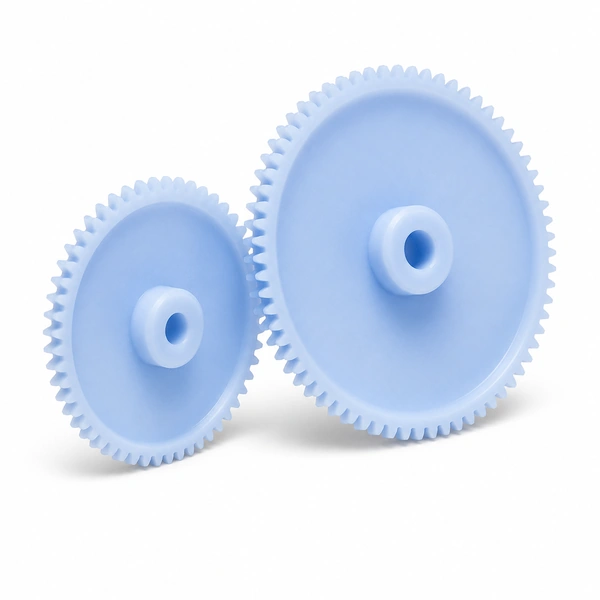
Custom Plastic Spur Gears from Korea Ever-Power — Hangzhou plastic gear manufacturer. POM, MC Nylon, PA66, PEEK, UHMWPE. ISO9001, SGS, FDA, RoHS certified. Custom size, colour, material. 24hr quote.
Product Overview
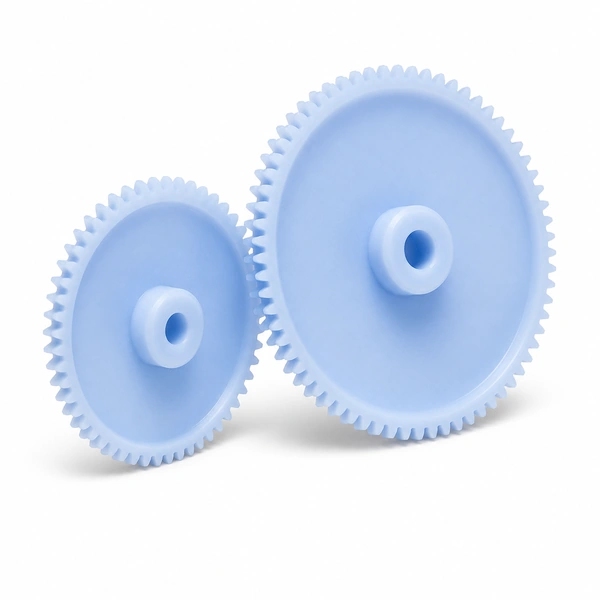
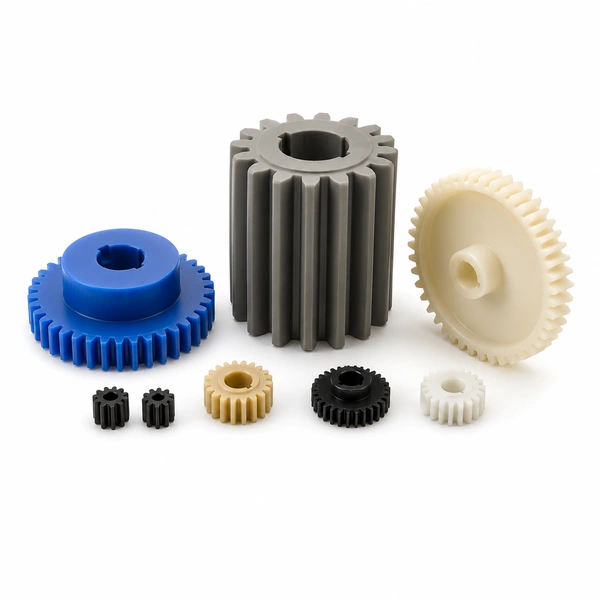
Plastic spur gears are straight-toothed gears with teeth cut radially — parallel to the gear axis — used to transmit power and motion between parallel shafts. They are the most widely used plastic gear type across office automation, consumer electronics, medical equipment, toys, and instrumentation. Korea Ever-Power's plastic spur gears are available in POM (Polyacetal / Delrin 500P) and Nylon, module M0.1 to M2.0, outer diameter Ø2.0 mm to Ø100.0 mm, bore Ø1.40 mm to Ø3.05 mm (flexible), face width 2.0 mm to 10.0 mm. Custom configurations per customer drawing or sample. Handmade / machined prototypes available for testing before mould making.
Korea Ever-Power's plastic spur gears are widely used for speed increase or reduction, high torque transmission, and resolution for positioning systems — at lower tooling cost than other gear types. Applications include laser printers, digital cameras, scanners, CD-ROMs, stepping motor drives, medical equipment, vending machines, gear pumps, household appliances, fax machines, watches, and toys. Korea Ever-Power meets all kinds of needs across these applications from its extensive mould inventory and precision CNC gear hobbing capability.
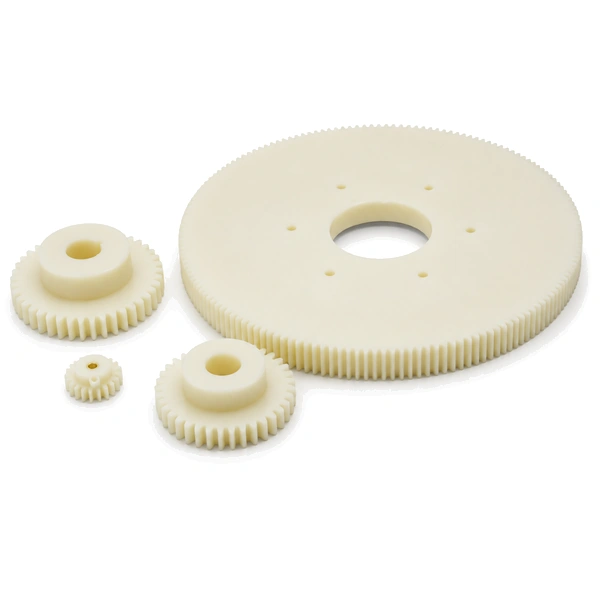
MC Nylon Spur
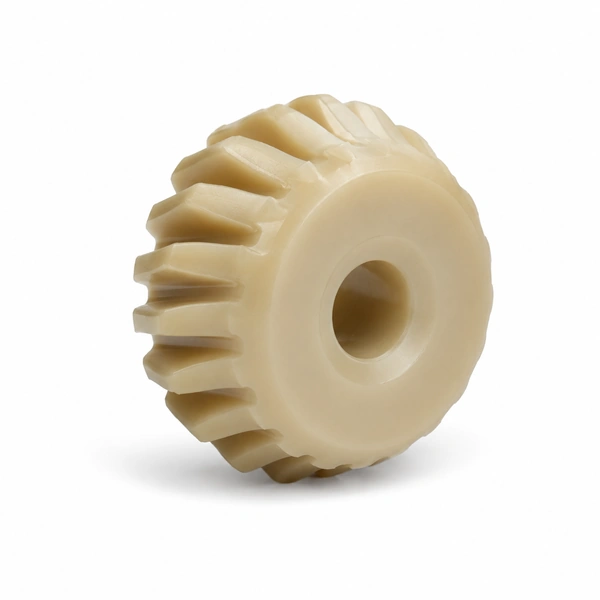
Wear Resistant
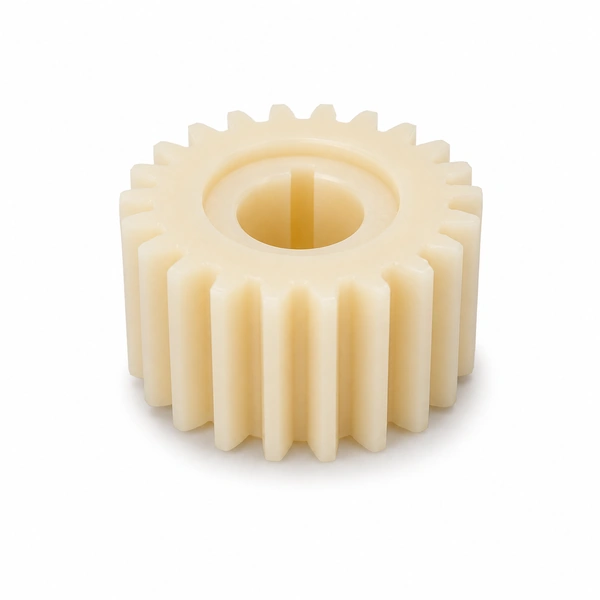
Nylon Spur
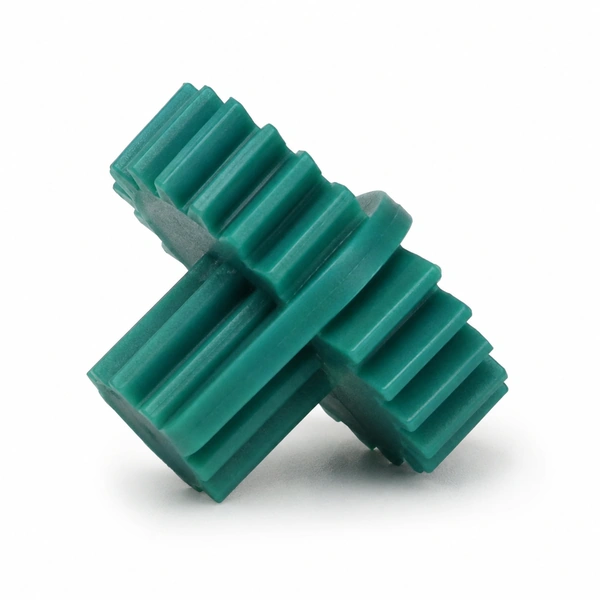
Double Spur
Technical Specifications
Standard Specification Range
| Parameter | Range |
|---|---|
| Type | Plastic Spur Gear |
| Module | M0.1 – M2.0 |
| Material | POM (Polyacetal / Delrin) / Nylon |
| Bore | Ø1.40 / 1.90 / 2.05 / 2.40 / 2.55 / 2.90 / 3.05 mm (flexible) |
| Outer Diameter | Ø2.0 mm – Ø100.0 mm (flexible) |
| Face Width (L) | 2.0 mm – 10.0 mm (flexible) |
| Pressure Angle | 20° standard |
| Customisation | Per drawing or sample; all parameters flexible |
Example Product — Printer Drive Gear
| Item | Detail |
|---|---|
| Product | M0.7 Double Spur Gear (LH + RH) |
| Material | Delrin 500P (POM copolymer) |
| Module | M0.7 |
| Teeth | 24T (LH) + 52T (RH) |
| Weight | 6.47 g / pc |
| Application | Printer, multifunction printer, copier |
Spur Gear Operating Principles
Spur gears are the simplest and most efficient gear type for transmitting power and motion between parallel shafts. Their straight-tooth design and radial tooth profile make them the foundation of gear theory and the most common gear type in mechanical engineering. Understanding how spur gears work clarifies their advantages in plastic gear applications:
Parallel Shaft Transmission
Spur gears transmit power between two parallel shafts. The two gear axes are perfectly parallel — the gears rotate in the same plane, with external spur gears rotating in opposite directions and internal spur gears (planet gears inside a ring gear) rotating in the same direction. This parallel-shaft geometry is the most common shaft arrangement in mechanical systems — making spur gears the most frequently encountered gear type in all applications from wristwatches to industrial machinery.
Tooth Contact — Abrupt Full-Width Engagement
Spur gear teeth are parallel to the gear axis — the full tooth face width engages simultaneously as the gear rotates. This abrupt full-width contact is the key difference between spur and helical gears: spur gears engage all at once (producing a slight load impulse at each tooth engagement), while helical gears engage gradually along the tooth face. For plastic gears, the lower elastic modulus of POM and Nylon significantly reduces the load impulse magnitude — making plastic spur gears quieter than equivalent steel spur gears despite the abrupt contact start.
No Axial Force — Simple Bearings
Because spur gear teeth are parallel to the shaft axis, there is no component of the tooth force in the axial direction — only radial and tangential forces exist. This means the shaft bearings need only support radial loads, with no thrust (axial) load — allowing simple, inexpensive radial bearings (ball bearings or plain plastic bushings) without the thrust bearings that helical or bevel gears require. For small plastic gear assemblies, this often means the gear can be supported on a simple plastic boss without any bearing at all.
Speed and Torque — The Gear Ratio
The gear ratio i = Z₂ / Z₁ (driven teeth / driving teeth) determines the speed reduction and torque multiplication. A 24T driving gear meshing with a 52T driven gear produces a ratio of 52/24 = 2.167:1 — the output shaft rotates 2.167× slower but produces 2.167× the torque (minus friction losses of ~2–4% for a plastic mesh pair). Spur gears are widely used for positioning systems because the exact, constant ratio of a spur gear train gives precise angular positioning — each revolution of the input shaft produces an exact, repeatable angular displacement of the output shaft.
Contact Ratio — Number of Teeth in Mesh
The contact ratio ε is the average number of tooth pairs simultaneously in contact — for standard 20° pressure angle spur gears, ε ≈ 1.5–1.7 for typical tooth counts. A contact ratio above 1.0 means there is always at least one tooth pair in contact, and for most of the rotation cycle, two pairs are in simultaneous contact — distributing the load over two teeth and reducing the peak tooth force. At very low tooth counts (< 12 teeth), the contact ratio can approach 1.0, meaning load is sometimes transmitted by only one tooth pair, increasing the peak stress.
Lower Tooling Cost than Helical
Spur gear tooling cost is lower than helical gears of the same module and diameter — the straight-tooth injection mould requires no helix angle compensation in the tool geometry, and the ejection of the moulded gear from the die can be done axially without unscrewing (which helical gear moulds require). This lower tooling cost is a significant reason spur gears are preferred over helical gears for high-volume plastic gear applications where mould tooling cost must be minimised.
POM vs Nylon for Plastic Spur Gears
The two dominant materials for plastic spur gears are POM and Nylon. Choosing correctly requires understanding their key differences in the context of spur gear applications:
| Consideration | POM (Delrin/Acetal) | MC Nylon / PA6 |
|---|---|---|
| Tooth surface friction | Lower (μ ≈ 0.10–0.15) ✓ | Moderate (μ ≈ 0.20–0.30) |
| Dimensional stability (wet) | Excellent — absorbs only 0.2% water ✓ | Moderate — swells 2–3% with moisture absorption |
| Tooth bending strength | ~90 MPa | ~110 MPa — 1.2× stronger ✓ |
| Production method | Injection moulding — fastest for small sizes ✓ | Cast block + CNC hobbing — best for large/small lot |
| Best gear size range | OD 2–100 mm (injection moulded) | OD 50–2,000 mm (CNC cut from cast) ✓ for large |
| Chemical resistance | Excellent — not attacked by most solvents ✓ | Good but absorbed acids hydrolyse nylon over time |
| Noise level | Lower (higher stiffness → less deformation noise) ✓ | Good — slightly more flexible absorbs shock better |
| Choose when | Precision, humid environment, high-volume small gears | High load, large diameter, heavy-duty industrial drive |
Applications
Laser Printers and Copiers
POM spur gear trains in paper feed mechanisms, image transfer units, and fuser drive systems. The double spur gear (24T+52T M0.7 Delrin 500P, 6.47 g) is a standard Korea Ever-Power product for this application — the two-stage speed reduction in one compact double gear saves housing space and simplifies the gear train. Over millions of print cycles, POM's low friction coefficient keeps tooth wear minimal.
Stepping Motor Drives
POM spur gear reduction stages between stepping motors and the mechanism they position. The exact, constant ratio of spur gears converts each step angle of the motor into a precise, repeatable angular or linear displacement of the output — essential for positioning in printers (paper feed distance per step), cameras (focus and zoom position), and laboratory automation equipment (pipette positioning). Plastic's low inertia also reduces the step-settling time compared with metal gears.
Medical Devices
POM spur gears in infusion pump drive mechanisms, blood analyser sample carousels, and diagnostic equipment positioning drives. Medical spur gears require biocompatible material (POM is FDA-listed for food contact and medical device use), freedom from lubrication (contamination risk), consistent batch-to-batch quality (patient safety), and dimensionally stable performance over the expected product lifetime of 5–10 years.
Vending Machines and Dispensers
Nylon and POM spur gears in vending machine product selection and dispensing mechanisms. These gears operate in cycles of high loads (product-dispensing stroke) followed by long idle periods — a duty cycle that suits the fatigue characteristics of Nylon (which recovers well between load cycles). The self-lubricating property is essential in vending machines where maintenance access for re-greasing is impractical in remote locations.
Household Appliances
POM and Nylon spur gears in electric toothbrush drives, kitchen mixer speed selectors, window blind drive mechanisms, and robot vacuum cleaners. Household appliance gears operate in consumer-use environments requiring low noise, high reliability over 5–10 years of light daily use, and safety under abnormal conditions (jam, overload) — the lower strength of plastic gears compared with metal acts as a controlled failure point that protects the motor and housing from damage in jam conditions.
Industrial Gear Pumps
POM spur gear pairs in chemical-resistant gear pumps for metering and transfer of corrosive fluids. The gear pump operates by carrying fluid in the tooth spaces from inlet to outlet — the gear precision directly determines the pump's volumetric efficiency and pressure capability. POM's chemical resistance suits pump applications with acid, alkali, and solvent fluids; its low friction reduces motor power consumption in continuous-running pump applications.
Frequently Asked Questions
What is the difference between spur gears and helical gears?
Spur gears have teeth parallel to the gear axis; helical gears have teeth at an angle (helix angle) to the axis. Spur gears engage abruptly across the full face width — producing a slight mesh impulse noise. Helical gears engage gradually along the tooth length — producing lower noise and higher contact ratio. Spur gears produce no axial force; helical gears produce an axial thrust force requiring thrust bearings. Spur gear moulds are simpler and cheaper (straight-pull ejection); helical gear moulds require rotating ejection (unscrewing mechanism). For most plastic gear applications where noise and load are moderate, spur gears are the preferred choice for simplicity and lower tooling cost.
What is the smallest spur gear Korea Ever-Power can produce in plastic?
Korea Ever-Power's plastic spur gear range starts at M0.1 — the smallest practical injection-moulded module for POM. At M0.1, the tooth height is only 0.225 mm and the pitch diameter of a 10-tooth gear is only 1.0 mm — a truly micro gear requiring extreme mould precision and material purity. These ultra-fine-pitch plastic gears are used in miniature instrument mechanisms, wristwatch components, and micro-motor reduction stages in consumer electronics where the space envelope is measured in millimetres.
Can plastic spur gears mesh with metal gears?
Yes — plastic spur gears can mesh with metal spur gears of the same module and pressure angle, and this is a common arrangement in precision plastic gear drive systems. A POM pinion driving a steel ring gear is used in many printer and camera mechanisms — the POM pinion wears as the sacrificial component (easily and cheaply replaced), protecting the more expensive steel gear. The mixed-material mesh is typically quieter than metal-on-metal but louder than plastic-on-plastic, sitting between the two extremes. Contact Korea Ever-Power for specific mixed-material mesh design advice.
Customer Reviews
"We build precision label printers and source POM double spur gears (M0.7, 24T+52T, Delrin 500P) from Korea Ever-Power. Tooth thickness tolerance measured: ±0.007 mm across 100 consecutive pieces. Paper feed accuracy per step: 0.07 mm ± 0.003 mm over 5,000 cycles — within our ±0.005 mm application spec. Noise in quiet office environment: 32 dB(A). Zero returns under our 2-year warranty."
Kim Sang-hyun | Printer Mechanism Engineer, Incheon Document Systems Co. · Q1 2026
"We manufacture food dispensers for hospital catering and specified MC Nylon spur gears (M2, 30T) from Korea Ever-Power for the dispensing drive. Passed our food-contact material test (no migration of harmful substances). Gear surface after 100,000 dispense cycles: no visible wear. Oil-free operation confirmed — no lubricant contamination of food contact surfaces. Korea Ever-Power confirmed the MC Nylon grade as food-contact safe and provided material data sheet."
Lee Yun-ho | Food Equipment Design Engineer, Gyeonggi Catering Systems Co. · Q4 2025
Related Products
Request a Quotation for Plastic Spur Gears
POM (Delrin 500P) and MC Nylon. M0.1–M2.0. Ø2–100 mm OD. Double spur gears, D-hole, through-bore. Prototype before mould — test before tooling. Custom per drawing or sample. Printers, cameras, medical, toys, instruments.
Additional information
| Editor |
|---|
Related products
-
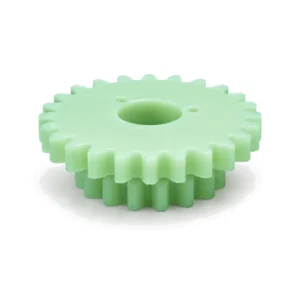
Customized High Precision Hobbing Nylon Gear Plastic Gears
-
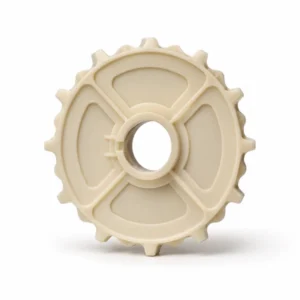
White CNC Machining Delrin Star Wheel Pom Big Star Wheel Plastic Gear
-
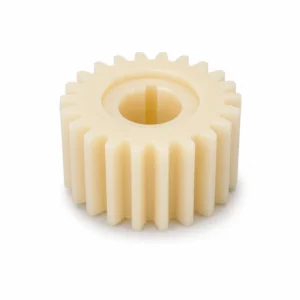
Nylon Spur Gears
-
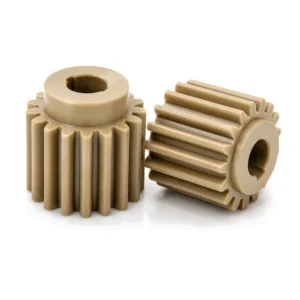
Manufacturer’s Customization Plastic Gears
-
Gear Manufacturers Custom Nylon Gear Helical Gear
-
Manufacturer Direct Wear-resistant Self-lubricating Natural Green Oil-containing Nylon Gear
-

Low Noise Oil Casting Mc Nylon Star Wheel CNC
-
Wear Resistance Plastic Drive Uhmw-pe Chain Sprocket Wheel Plastic Gear
 English
  Italian
  Korean
  French
  Japanese