
Precision Bevel Gear – M0.15 to M2.2, AGMA 13, 5 HT Routes
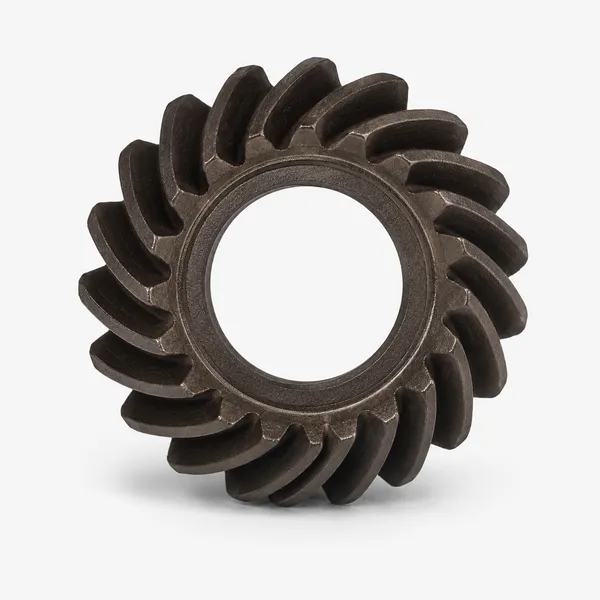
Korea Ever-Power precision bevel gears achieve the highest measurable tooth accuracy — AGMA 13, JGMA 1, DIN 5, ISO 6 — across module M0.15 through M2.2 in any of eleven metallic and non-metallic materials. Five heat treatment routes — carburising and quenching, high-frequency quenching, nitriding, hardening and tempering, and material-specific selection — are available and specified by the engineering team to match the application’s required surface hardness, core toughness, and dimensional stability after heat treatment. Outer diameter Φ3 mm to Φ120 mm. ODM and OEM service. ISO 9001 and TS16949 certified. Samples in 3–5 days from stock.
Product Overview
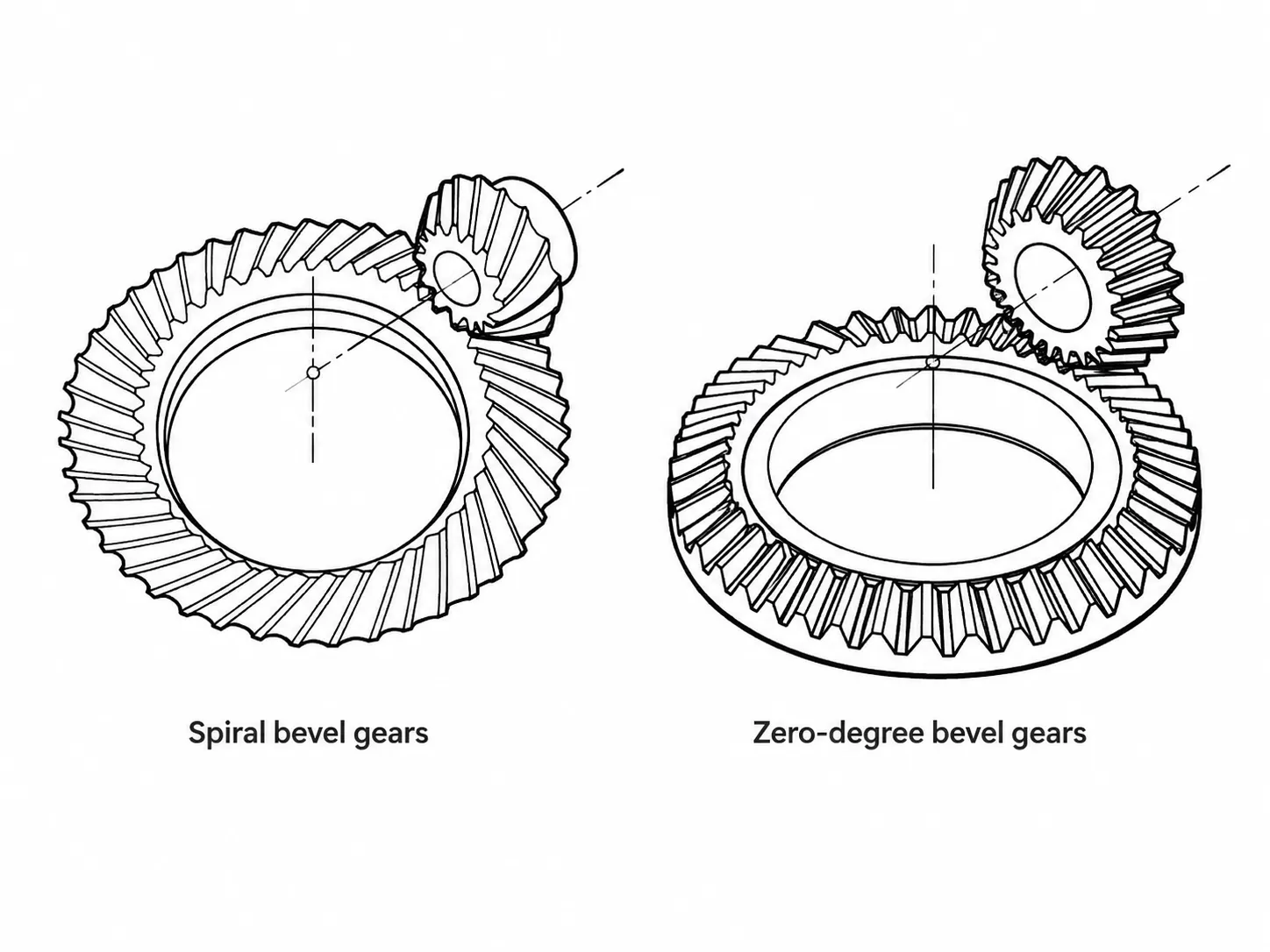
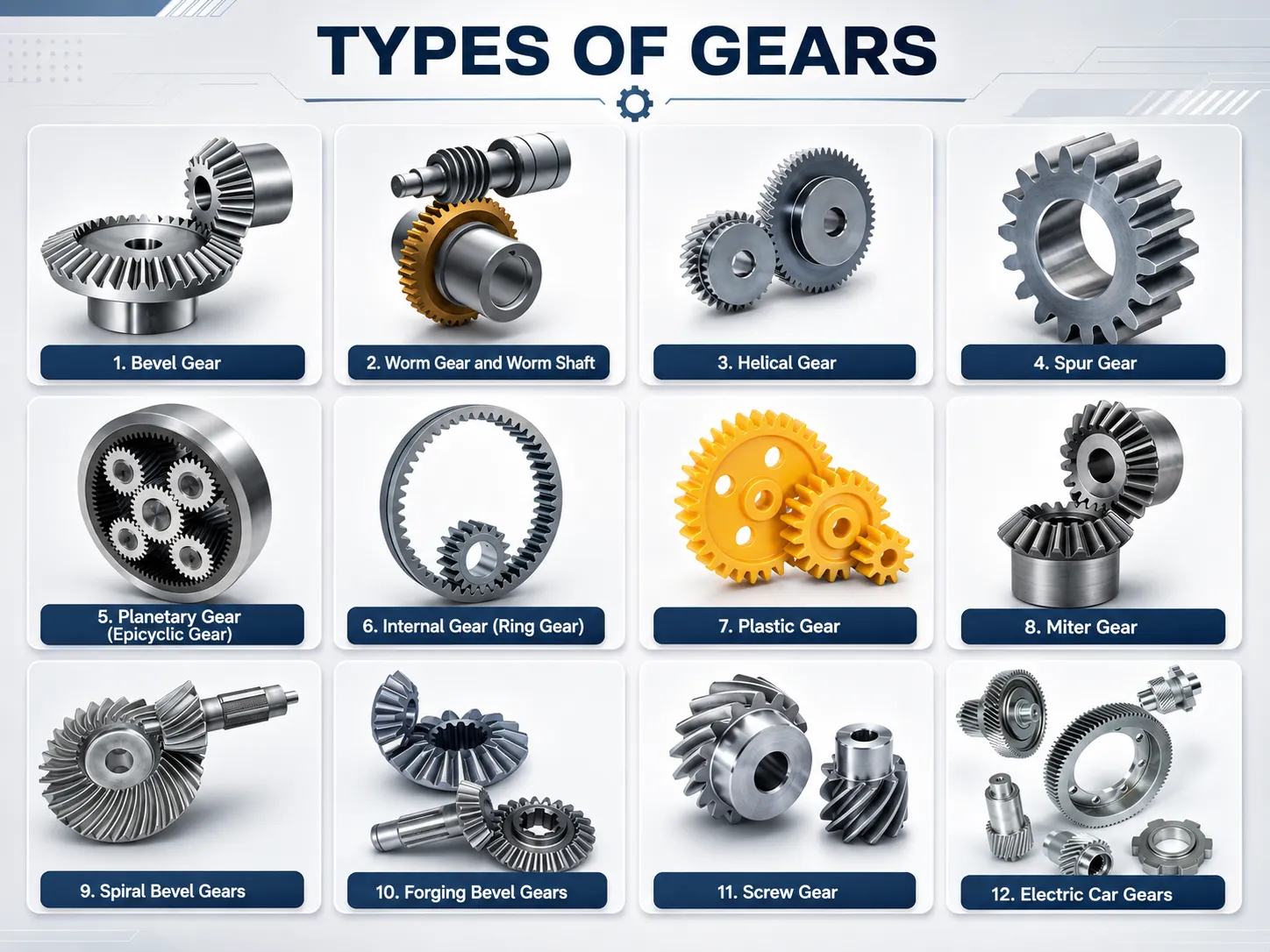
The label precision bevel gear is used broadly in the industry, but Korea Ever-Power applies it in a specific engineering sense: a bevel gear produced to one of the top accuracy grades — AGMA 13, JGMA 1, DIN 5, or ISO 6 — with tooth spacing error, profile form deviation, and runout held to single-digit micrometre tolerances. Achieving and reliably verifying these tolerances requires the full combination of CNC bevel gear cutting, post-hardening tooth grinding, temperature-controlled metrology, and a documented measurement system capable of resolving the relevant errors. Korea Ever-Power provides this complete precision production chain for bevel gears from module M0.15 through M2.2.
What separates a precision bevel gear from a standard-accuracy gear in practice is not simply the tolerance on tooth spacing — it is the combination of lower transmission error, lower noise at operating speed, and more predictable backlash behaviour over the gear set's service life. All three of these characteristics matter in servo-driven positioning drives, precision instrument gearheads, and motion control systems where the angular position accuracy of the output shaft must be maintained within a tight bound regardless of load, temperature, or operating history.
A unique feature of this product series is the explicit specification of five heat treatment routes, each matched to a different combination of material, application load type, and post-hardening dimensional stability requirement. Selecting the correct heat treatment is as important as selecting the correct accuracy grade: a gear ground to AGMA 13 before heat treatment and then distorted by an incorrect quenching cycle will not meet AGMA 13 in the delivered condition. Korea Ever-Power's engineering team specifies and documents the heat treatment route for each precision bevel gear order as part of the production engineering package. Samples from stock are available in three to five working days for standard configurations.
Five Heat Treatment Routes — Matching Process to Application
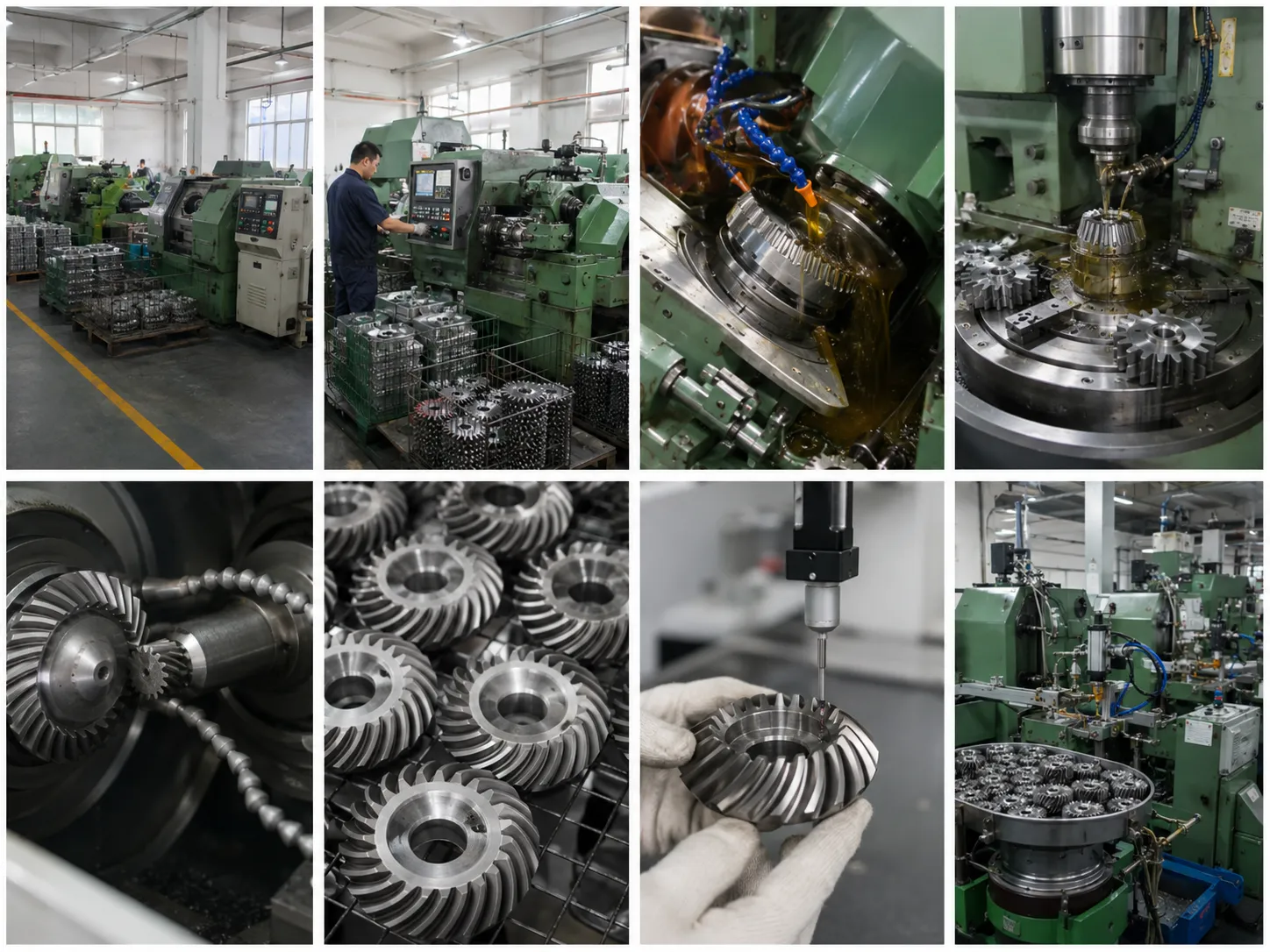
The precision bevel gear series is distinguished from lower-accuracy production by the explicit definition of five heat treatment routes. The route is selected by the engineering team based on the material, the required surface hardness, the acceptable post-hardening distortion, and whether post-hardening grinding (to correct distortion and achieve the final accuracy grade) is part of the production sequence.
Applied to low-carbon alloy steels (20CrMnTi, 20CrNiMo, 9310). Carbon enrichment of the tooth surface to 0.8–1.0% followed by quenching produces 58–62 HRC case over a tough low-carbon core. Post-quench distortion is corrected by tooth grinding (mandatory for AGMA 13 / JGMA 1). The combination of hard case, tough core, and ground tooth flanks is the highest-performance route for precision bevel gears in load-bearing applications.
Best for: automotive differentials, military drives, servo gearheads requiring maximum load and top accuracy
High-frequency induction heating hardens the tooth surface rapidly without prolonged furnace cycles. Applicable to through-hardening steels (40Cr, 42CrMo). The hardened zone is shallower and more localised than a carburised case, and the process introduces compressive residual stresses at the tooth surface that improve fatigue life. Dimensional distortion is lower than carburising because only the surface is heated. For large gears where furnace capacity is a constraint, or for gears requiring selective surface hardening of the tooth only, induction is the practical route.
Best for: medium-load drives, selective surface hardening, gears too large for carburising furnace
Nitrogen diffusion at 500–580°C — below the transformation temperature — produces a very hard, thin surface layer (0.2–0.5 mm) without the dimensional distortion of quenching. For precision bevel gears that must achieve AGMA 12 or 13 without post-hardening grinding, nitriding is the preferred route: finish-machine the tooth to final accuracy, nitride, and the gear leaves the furnace dimensionally within the target tolerance. The surface hardness after nitriding (700–1000 HV / approximately 60–68 HRC equivalent) is very high. Applied to nitriding steels (31CrMoV9, 34CrAlMo5) or stainless steel grades.
Best for: AGMA 12–13 without post-nitriding grinding; large gears; corrosion-sensitive environments
Through-hardening of medium-carbon alloy steels (42CrMo, 40Cr) followed by tempering produces uniform hardness from surface to core — typically 280–340 HB. No case-core differentiation; the entire tooth cross-section is at equal hardness. This provides good impact resistance (the core does not fail in a brittle mode under shock) and allows field repair by re-machining the tooth profile after wear, since the hardness is consistent through the section. The accuracy achievable after through-hardening plus tooth grinding is fully compatible with AGMA 13.
Best for: shock-loaded drives, agricultural and construction equipment, gears requiring field re-machinability
For non-standard materials — 17-4PH stainless (age hardening H900), 440C stainless (oil quench hardening), titanium alloys (stress relieving), or special alloys per customer specification — the heat treatment route is engineered to that material's specific phase transformation or precipitation hardening mechanism. Korea Ever-Power's engineering team selects and documents the heat treatment cycle for each material variant, with the time-temperature curve retained per batch as part of the precision bevel gear's production record.
Best for: 17-4PH, 440C, titanium alloys, and other materials with non-standard heat treatment requirements
Technical Specifications
| Parameter | Specification |
|---|---|
| Gear Type | Precision bevel gear — straight or spiral; conically shaped tooth-bearing faces |
| Module Range | M0.15 – M2.2; per customer drawing |
| Outer Diameter | Φ3 mm – Φ120 mm; confirmed per drawing |
| Meshing Accuracy Grade | ISO 6, JGMA 1, JIS 6, AGMA 13, DIN 6, DIN 5, AGMA 12 |
| Heat Treatment | Carburising & quenching; high-frequency (induction) quenching; nitriding; hardening & tempering; material-specific route |
| Shaft Intersection | 90° standard; other angles per customer drawing |
| Material Options | Metal, Bronze, Steel, Alloy, POM, Zinc, Aluminium, Iron, Stainless, Brass, Copper |
| Application Sectors | Automotive, Military, Aircraft, Mechanical, Industrial, Medical |
| OEM / ODM | Full service; drawings in PDF, DXF, DWG, STEP accepted |
| Sample Lead Time | 3–5 working days from stock (standard configurations); new configurations per engineering review |
| Packing | Vacuum-packed with plastic tray |
| Delivery | DHL, UPS express |
| Certificazione | ISO 9001:2008; TS16949 |
Accuracy Grades in Practice — From DIN 6 to AGMA 13
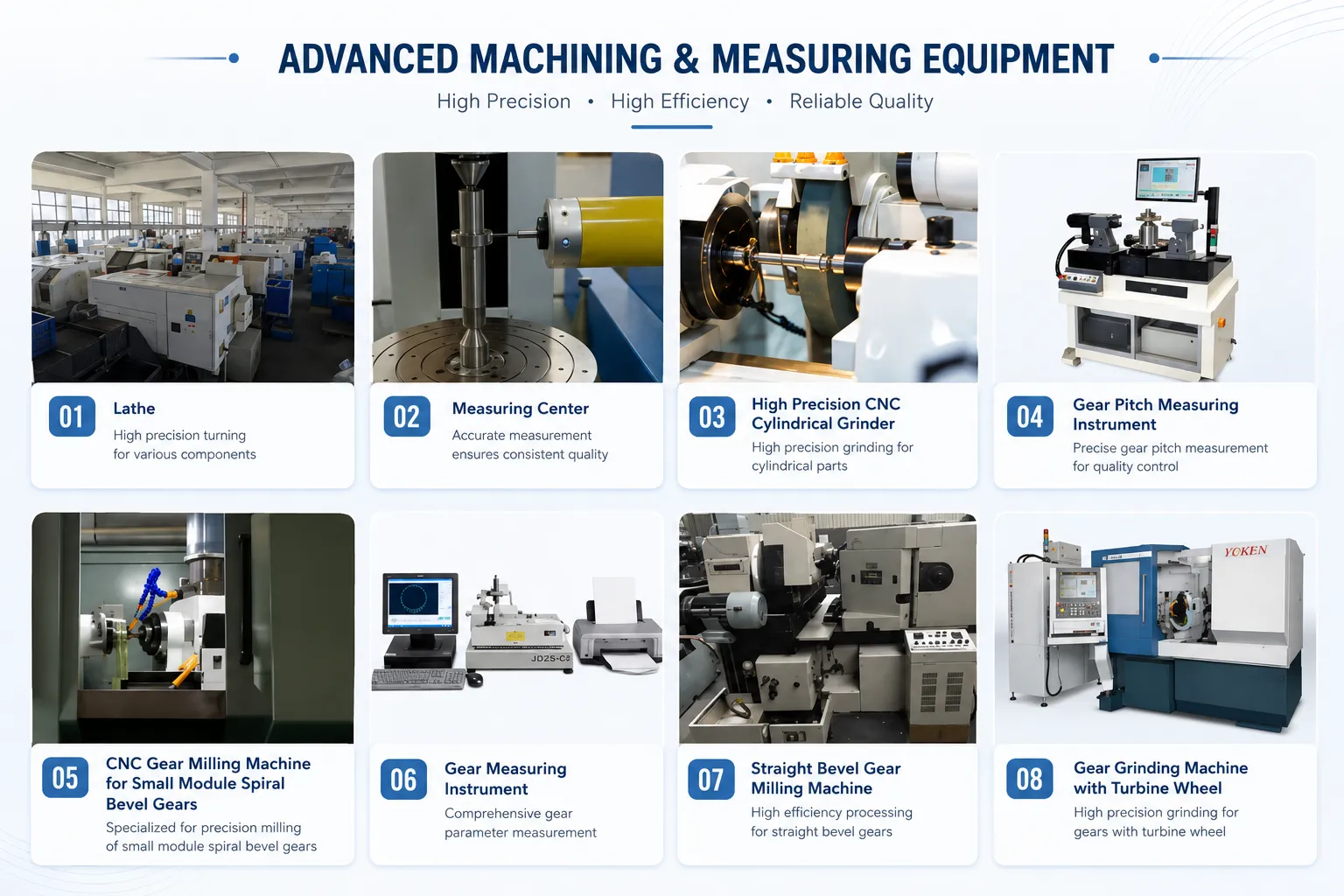
Gear accuracy grades define the permissible errors in four parameters: single pitch deviation, total cumulative pitch deviation, total profile deviation, and total helix deviation (for spiral gears). Each grade specifies a maximum value for each parameter as a function of module and gear diameter. The practical effect of accuracy grade on the application is as follows:
AGMA 13 / DIN 5 / JGMA 1 / ISO 6
Single pitch deviation below 2–4 μm depending on module. Transmission error is at its minimum — the periodic variation in angular position of the output shaft relative to the ideal is imperceptible in most servo systems. Applied in flight instrument drives, surgical robot wrists, precision pointing mechanisms, and high-speed printing press cross-drives where any periodic error at tooth mesh frequency produces a measurable output effect.
AGMA 12 / DIN 6 / JIS 6
Single pitch deviation 4–8 μm. The practical precision grade for the majority of automotive OEM and precision industrial applications. Transmission error is low enough for smooth quiet operation at vehicle speeds and industrial machine operating speeds. Achievable by tooth grinding after carburising and quenching; no temperature-controlled metrology is required for inspection, though it is recommended for gears at the tight end of this grade.
DIN 7–8 / AGMA 10–11
The standard industrial grades for general-purpose drives where noise at moderate speed is acceptable and positional accuracy is not a primary specification. Achievable by high-quality milling and hardening without mandatory post-hardening grinding. Sufficient for agricultural drives, construction equipment, and general-purpose industrial gearboxes. Not covered by this precision bevel gear series — see the industrial bevel gear product range for these grades.
Applications of Precision Bevel Gears
📈 Servo Drives & Motion Control
Precision bevel gear stages in servo-driven angular positioning systems must have low and consistent backlash, low transmission error, and dimensional stability over temperature and load cycles. Any periodic angular error at the gear mesh frequency appears as a position ripple in the servo loop, potentially destabilising the control. AGMA 13 gears with carburised and ground tooth flanks are the specification for high-performance servo angle drives.
📷 High-Speed Printing Presses
Cross-drives in offset printing presses synchronise multiple print cylinder shafts. Transmission error in the bevel gear stage appears as a repeating register error in the printed image — misalignment of colour separations or pattern repeat errors visible to the naked eye. AGMA 13 precision bevel gears with nitrided or ground flanks are the standard specification for high-speed commercial printing drives.
⚙ CNC Machine Tools
Angle head attachments, dividing head bevel drives, and rotary axis bevel stages in CNC machine tools. The angular position accuracy of the tool at the workpiece depends on the transmission error of every gear stage in the drive chain. AGMA 12–13 precision bevel gears in the machine tool's bevel stage are a prerequisite for achieving the angular positioning accuracy published in the machine's specification sheet.
🔯 Military Targeting & Optics
Weapon elevation and azimuth drives, targeting pod gimbals, and optical instrument angle drives in military equipment require the lowest achievable transmission error to maintain pointing accuracy under load, vibration, and shock. JGMA 1 / AGMA 13 in nitrided stainless or carburised alloy steel with full material traceability and non-magnetic material requirements for optical instrument applications.
🔩 Semi-Conductor & Electronics
Wafer handling robot angle drives and precision stage positioning systems in semi-conductor fabrication require bevel gears with low particle generation, cleanroom-compatible materials, and stable backlash over millions of operating cycles. Aluminium or stainless gears at AGMA 12–13 with hard anodising or passivation are standard for these applications.
🚗 Automotive OEM
Precision differential ring-and-pinion sets, electric power steering bevel stages, and automatic transmission auxiliary drives where the combination of AGMA 12 accuracy, TS16949 quality system, and PPAP documentation defines the supplier qualification requirements. Carburised 20CrMnTi or 20CrNiMo with ground flanks is the standard specification.
Frequently Asked Questions
What is the business scope and main export products of Korea Ever-Power?
Korea Ever-Power is a manufacturer specialising in CNC machining, custom gear production, and independent development of multi-category transmission products. Main export products include bevel gears (the full range covered by this website), gear racks, spur gears, helical gears, couplings, universal joints, gearboxes, and related power transmission components. The precision bevel gear series represents the highest-accuracy subset of the bevel gear range, targeting applications where DIN 5 through ISO 6 accuracy is a design requirement rather than an optional upgrade.
How do you select the heat treatment route for a precision bevel gear?
The selection involves three criteria evaluated together. First, the material: low-carbon alloy steels require carburising; medium-carbon steels can be through-hardened or induction-hardened; nitriding steels are designed for the nitriding route; special alloys follow their specific phase transformation or precipitation hardening schedule. Second, the required surface hardness: carburising achieves 58–62 HRC; nitriding achieves 60–68 HRC equivalent at the surface but in a thinner layer; through-hardening achieves 28–36 HRC uniformly. Third, post-hardening dimensional distortion tolerance: if the gear must achieve AGMA 13 and tooth grinding after hardening is acceptable (and often necessary), carburising is the typical route; if the gear must achieve AGMA 12 without post-hardening grinding, nitriding is often preferred because the lower process temperature minimises distortion. Our engineering team documents the route selected for each order in the production engineering package.
How quickly can a precision bevel gear sample be obtained?
For standard configurations held in stock — common module and ratio combinations in frequently ordered materials — samples are available in three to five working days. For configurations produced to order, the sample lead time follows the production sequence and is typically two to four weeks. Submit the drawing or sample part with the enquiry and we will confirm whether the configuration is in stock or requires production, and give the lead time accordingly. For urgent sample requirements, contact our team directly and we will confirm the fastest available path.
Can you provide a product catalogue in PDF format?
Yes. Our product documentation includes PDF datasheets for the precision bevel gear series covering the available module range, accuracy grades, material options, and standard heat treatment routes. For specific configurations, our technical department produces and issues a dimensioned drawing showing the proposed geometry for customer review before production. Request the relevant documentation through our contact page and our team will send it within one working day.
Can the gear be designed to work at shaft intersection angles other than 90°?
Yes. Bevel gears are not restricted to 90° shaft intersection — the pitch cone angle of each gear is determined by the ratio and the shaft intersection angle together, and any angle between approximately 45° and 135° is achievable within the bevel gear geometry. For angles other than 90°, the pitch cone geometry changes on both gears and the blank dimensions differ from the 90° standard. Provide the shaft intersection angle in your drawing or specify it clearly in the enquiry; our engineering team calculates the correct cone geometry and confirms it in the production drawing before cutting begins. Contact us with your intersection angle and ratio and we will confirm feasibility.
Customer Reviews
"We manufacture servo-driven angular positioning stages for semiconductor equipment. The M1.0 AGMA 13 precision bevel gears from Ever-Power eliminated the position ripple we were seeing with our previous AGMA 10 supplier. The CMM report they supply with each batch documents the tooth spacing error on every gear — we use these reports directly in our process validation records."
Kim Tae-jun | Motion Control Engineer, Suwon Precision Systems · Q2 2025
"We specified M0.8 nitrided 31CrMoV9 precision bevel gears for a printing press cross-drive — nitriding to avoid post-hardening grinding while maintaining AGMA 12 accuracy. Ever-Power's engineering team confirmed the nitriding route was correct for this material and specified the case depth. Register accuracy in the press improved measurably after fitting the new gear set."
Oh Hyun-jae | Press Drive Engineer, Gyeonggi Commercial Printing · Q4 2025
"We needed M1.5 alloy steel precision bevel gears with carburising and quenching for a CNC angle head. Sample arrived in four days from stock — faster than we expected at this accuracy grade. The heat treatment curve and dimensional report were both included. First batch in production for six months, positioning accuracy unchanged from commissioning."
Jeon Sang-won | Machine Tool Design Engineer, Daegu Precision Tooling · Q1 2026
"We source AGMA 12 precision bevel gears in 42CrMo through-hardened for an electric vehicle auxiliary drive. The through-hardening route allows our service engineers to assess tooth wear by hardness measurement in the field — not possible with a case-hardened gear. Ever-Power correctly identified this as the reason for our material choice without us having to explain it."
Lim Jae-hwan | Powertrain Component Engineer, Incheon EV Systems · Q3 2025
"We design precision gimbal drives for military thermal imaging pods. The bevel gear pairs are M0.5 17-4PH stainless at JGMA 1, age-hardened H900. The material-specific heat treatment route — age hardening rather than standard quenching — was correctly specified by Ever-Power's team before production. Four completed programmes, each passing our acceptance test for transmission error on first submission."
Cha Byeong-woo | Optical Systems Engineer, Busan Defence Optics · Q2 2026
Request a Quotation for Precision Bevel Gears
Send us your drawing or application data — module, accuracy grade, material, heat treatment requirement, and shaft intersection angle. Samples in 3–5 days from stock for standard configurations. Heat treatment route selected and documented by our engineering team at no additional charge.
Informazioni aggiuntive
| Editor |
|---|
Prodotti correlati
-
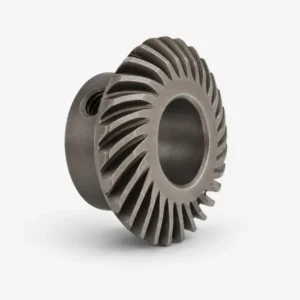
Metal Bevel Gear – M0.15 to M2.0, 11 Alloys, AGMA 13
-
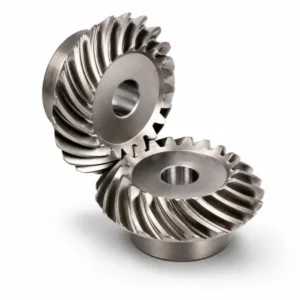
Spiral Bevel Gear – Localized Contact, Min 5 Teeth, M3-M12
-
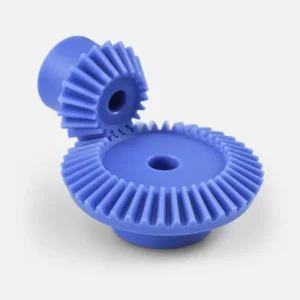
Plastic Bevel Gears – POM PA PEEK, -40°C to 80°C, 1:1–5:1
-
Sintered Metal Bevel Gears – Self-Lubricating, DIN 6–9
-
Helical Bevel Gear – Tangential Tooth, Low Noise Bevel Drive
-
Spiral Miter Gears – 35° Spiral Angle, 1:1 High-Speed Drive
-
Spiral Bevel Gears – Helical Bevel Gear, Custom OEM Supply
-
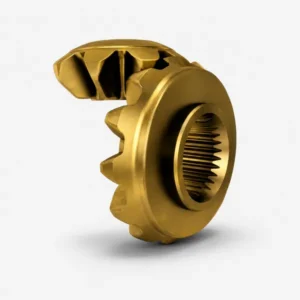
Differential Gears – Open, LSD, Torque Vectoring, Forged PM
 Italian
  English
  Korean
  French
  Japanese