
Helical Angle 7° Internal Helical Ring Gear, DIN 4-8
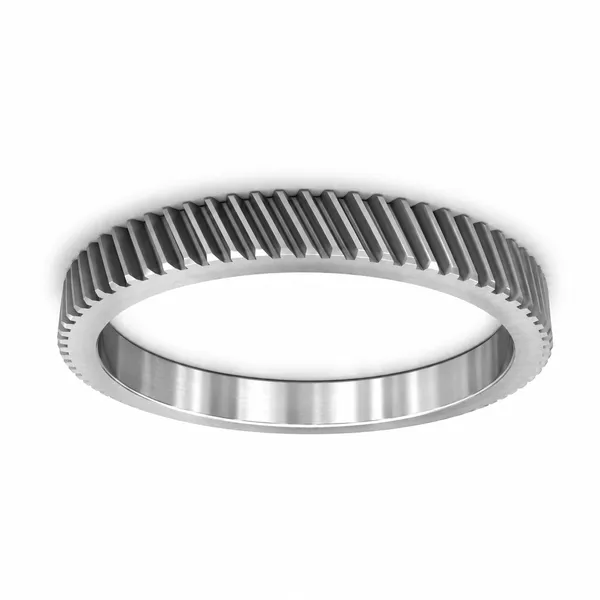
Korea Ever-Power helical angle 7° internal helical ring gears are precision-manufactured internal ring gears with a 7° helix angle — a specific geometry used in planetary epicyclic gearboxes, differential mechanisms, and compact multi-stage reduction units where the internal helical form delivers the high contact ratio and smooth torque transmission of a helical gear in a ring (annular) configuration. Internal gears: max OD 2,500 mm, min ID from 50 mm (shaping) / 100 mm (grinding), max face width 500 mm, max module 45 mm (grinding), DIN Class 4–8. External gears: max OD 2,500 mm, max face width 1,480 mm (grinding), max module 45 mm, DIN Class 4–8. Tooth surface finish Ra 0.6 (grinding). Full custom to drawing.
Product Overview
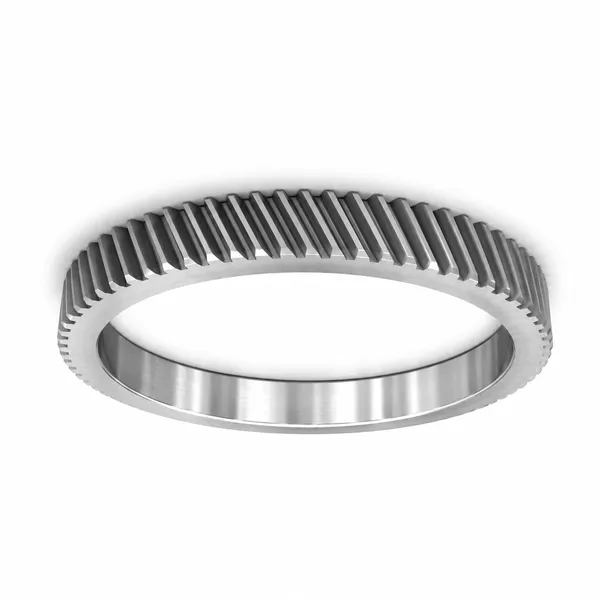
An internal helical ring gear with 7° helix angle is the annular (ring) gear form of a helical gear — teeth are cut on the inside face of a ring blank at a helix angle of 7°. Where an external helical gear has teeth on its outer cylindrical surface, an internal helical ring gear has teeth on its inner bore, and a mating external pinion or planet gear of the same helix angle and opposite hand meshes inside the ring. This configuration is fundamental to planetary epicyclic gearboxes: the sun gear meshes with the planet gears, and the planet gears in turn mesh with the internal ring gear (annulus), achieving high reduction ratios in a compact coaxial arrangement.
The 7° helix angle is a specific design choice for internal helical ring gears used in precision epicyclic drives: it is shallow enough to allow gear shaping (the standard manufacturing method for internal helical gears) without the extreme tool approach angle constraints that higher helix angles impose on the shaping process, while providing the contact ratio improvement of a helical gear over a spur internal gear — smoother load transfer, lower noise, and higher effective contact ratio than a spur ring gear of identical module and tooth count.
Korea Ever-Power produces internal helical ring gears and the complementary external helical gear and spline range across the full production capability shown in the specification tables below. The capability covers OD from 50 mm (internal, shaped) through 2,500 mm (internal, milled or ground) and face widths up to 1,480 mm for external ground configurations — a complete gear and spline production service for designers of complex multi-stage reduction drives, differential mechanisms, and epicyclic power split systems.
Gear / Spline Production Capabilities
The capability tables below define the full production range for internal and external helical gears and splines. The 7° helix angle internal ring gear sits within these bounds in any module and tooth count combination required by the customer's design.
Internal Gears and Internal Splines
| Teeth Milling | Teeth Shaping | Teeth Grinding | |
|---|---|---|---|
| Maximum O.D. | 2,500 mm | 2,500 mm | 2,500 mm |
| Minimum I.D. | 650 mm | 50 mm | 100 mm |
| Maximum Face Width | 500 mm | 500 mm | 500 mm |
| Maximum Diametral Pitch | DP 1 | DP 1 | DP 0.5 |
| Maximum Module | 26 mm | 26 mm | 45 mm |
| AGMA / DIN Grade | DIN Class 8 | DIN Class 8 | DIN Class 4 |
| Tooth Surface Finish | Ra 3.2 | Ra 3.2 | Ra 0.6 |
| Maximum Helix Angle | ±22.5° | ±22.5° | ±45° |
External Gears and External Splines
| Hobbing | Milling | Teeth Grinding | |
|---|---|---|---|
| Maximum O.D. | 1,250 mm | 2,500 mm | 2,500 mm |
| Minimum O.D. | 20 mm | 200 mm | 20 mm |
| Maximum Face Width | 500 mm | 500 mm | 1,480 mm |
| Maximum Diametral Pitch | DP 1 | DP 1 | DP 0.5 |
| Maximum Module | 26 mm | 26 mm | 45 mm |
| AGMA / DIN Grade | DIN Class 8 | DIN Class 8 | DIN Class 4 |
| Tooth Surface Finish | Ra 3.2 | Ra 3.2 | Ra 0.6 |
| Maximum Helix Angle | ±45° | ±45° | ±45° |
Why 7° Helix Angle for Internal Helical Ring Gears
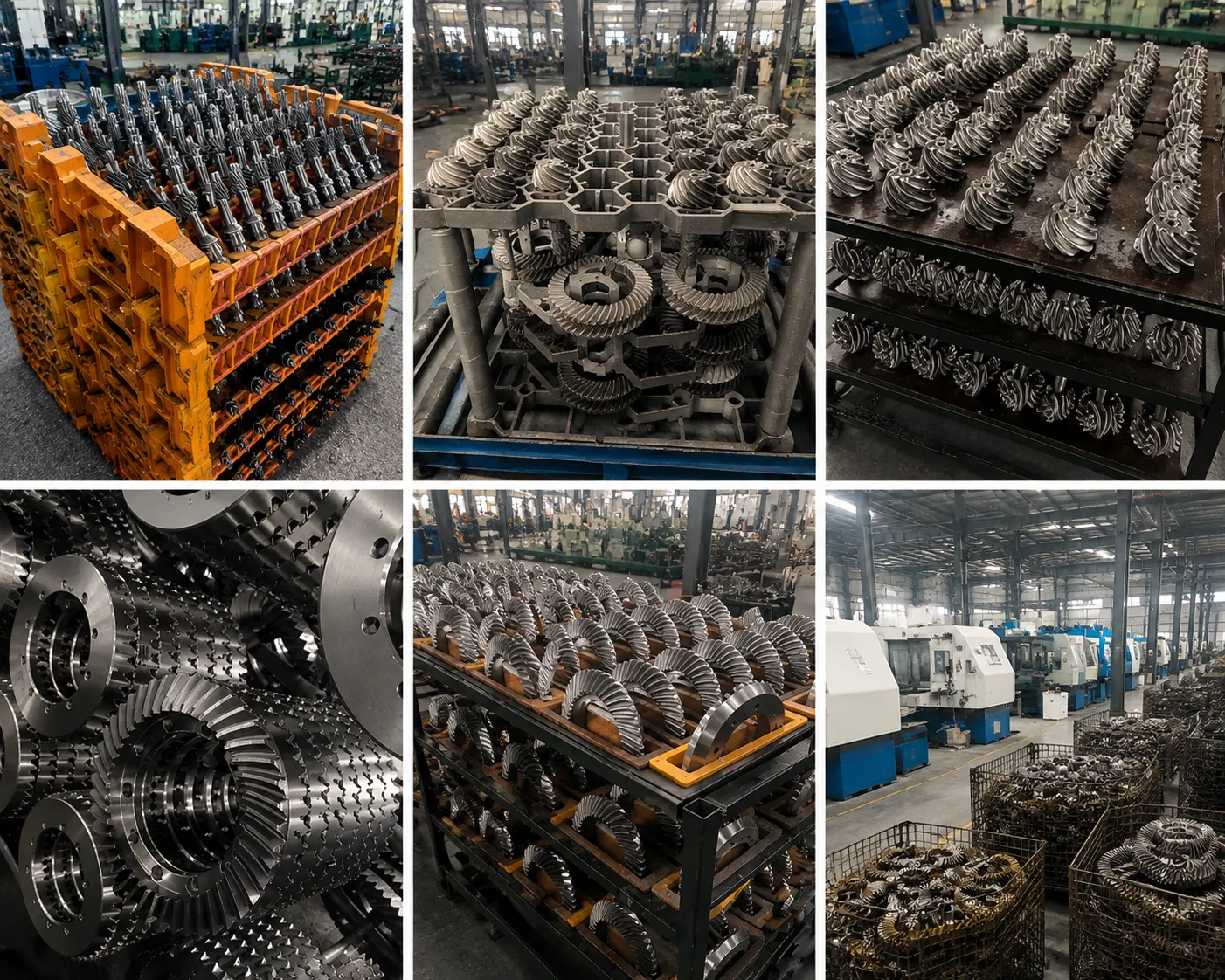
The 7° helix angle for internal helical ring gears is not an arbitrary choice — it represents a specific engineering balance between the performance advantages of helical tooth engagement and the manufacturing constraints of producing helical teeth on the inside face of a ring blank.
Manufacturing Constraint: Gear Shaping for Internal Helical Gears
Internal helical gears cannot be hobbed — hobbing requires the cutter to approach the gear from outside, which is impossible for an internal (ring) gear. The standard manufacturing method for internal helical gears is gear shaping with a helical shaping cutter. Shaping of internal helical gears at the helix angle of the ring gear and the matching planet pinions. As the helix angle increases, the shaping process becomes progressively more difficult due to tool interference and cutter approach constraints. At 7°, the shaping operation is practical with standard helical shaping cutters on conventional gear shaping machines. Helix angles above approximately 20–25° for internal gears require special tooling or grinding after shaping.
Performance Advantage: Higher Contact Ratio Than Spur Internal Gear
Even at 7°, the helical tooth form provides a measurable increase in overlap contact ratio compared with a spur internal ring gear of identical module and tooth count. The transverse contact ratio of the helical internal gear is the same as the equivalent spur gear; the overlap contact ratio of approximately 0.15–0.25 (at 7° helix angle for typical face widths) is added on top, giving a total contact ratio approximately 10–20% higher than the spur equivalent. This improvement reduces the gear-generated noise at the tooth mesh frequency and distributes the transmitted load more evenly across the face width.
Axial Thrust Management in Epicyclic Stages
An internal helical ring gear generates an axial thrust force on the planet carrier bearing arrangement when the helix angle is non-zero. At 7°, this axial thrust is small relative to the tangential force — the planet carrier thrust bearing requirement is modest and does not significantly increase the epicyclic stage's axial envelope. For comparison, a 25° helix angle internal ring gear would generate a tangent(25°) = 0.47× the tangential force as axial thrust — a significant bearing design constraint. The 7° angle is a deliberate choice to achieve helical performance advantages without creating a thrust management problem in the epicyclic carrier design.
Internal Helical Ring Gear in Epicyclic and Planetary Drives
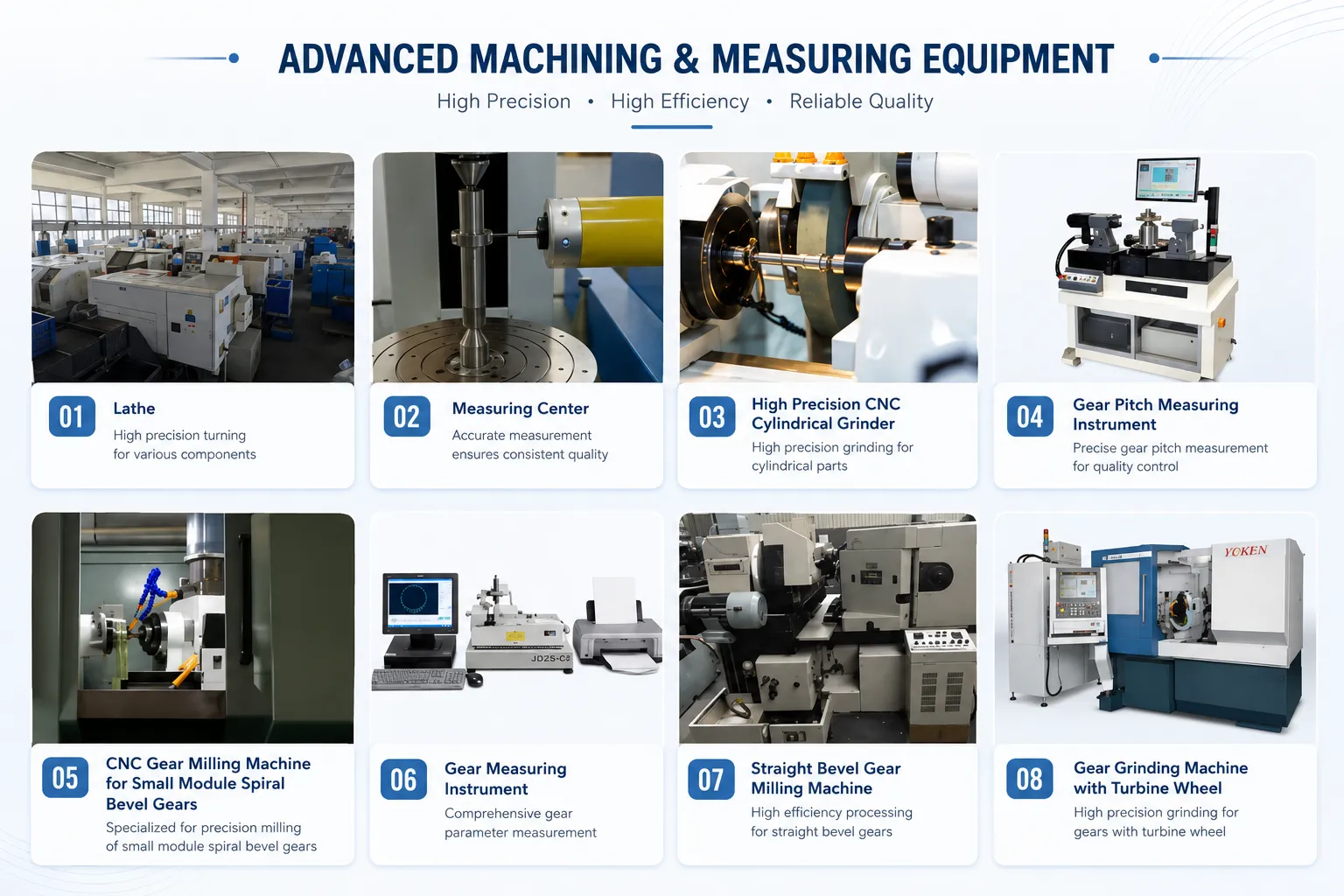
The internal helical ring gear is the annulus — one of the three fundamental members of a planetary epicyclic gear stage (sun gear, planet gears, and ring gear / annulus). The function of the internal ring gear in each standard epicyclic configuration determines its specification requirements:
Fixed Ring Gear (Sun Input, Carrier Output)
The most common planetary arrangement — the ring gear is fixed to the housing, the sun gear is the input, and the planet carrier is the output. The ring gear carries the full reaction torque from the stage. At 7° helix angle, the ring gear tooth load is distributed across a higher contact ratio than a spur ring gear, reducing the tooth bending and contact stress at the ring gear teeth — which carry the highest absolute force in the stage.
Rotating Ring Gear (Differential / Power-Split)
In power-split and differential epicyclic stages, the ring gear rotates rather than being fixed. The 7° helical ring gear in a rotating configuration generates an axial force on the ring gear's bearing — at 7° helix angle this is small enough to be absorbed by modest thrust bearings or by the helical gear pair's own axial preload without additional hardware.
Multi-Stage Epicyclic Systems
In multi-stage planetary gearboxes for industrial robots, wind turbines, and large servo drives, the 7° helical internal ring gear is specified consistently across all stages to maintain a common helix angle between the sun, planet, and ring gears of each stage — simplifying the gear cutting tooling requirement and allowing the same shaping tools to produce all helical gears in the gearbox.
Compact Coaxial Reduction
Epicyclic stages with a 7° helical ring gear achieve higher reduction ratios per unit of axial length than spur epicyclic stages of equivalent contact ratio — because the helical form's additional overlap contact ratio allows a slightly narrower face width for the same transmitted load, reducing the stage's axial dimension in space-constrained gearbox designs.
Applications
Planetary Gearboxes
Industrial planetary reduction units for conveyors, hoists, extruders, and mixers. The 7° helical ring gear reduces the gear-generated noise and vibration of the epicyclic stage compared with spur planetary gearboxes of equivalent ratio.
Industrial Robot Joints
Multi-stage planetary gearboxes for articulated robot joint drives. The 7° helical ring gear reduces transmission error in the epicyclic stage — directly improving the robot's positional accuracy at the end effector. Compact coaxial design suits the constrained envelope of robot joint mechanisms.
Wind Turbine Main Gearboxes
Multi-stage planetary-helical hybrid gearboxes in wind turbines. The first stage is typically a planetary stage with a helical ring gear; subsequent stages are parallel-shaft helical stages. The 7° helical ring gear in the planetary stage reduces acoustic emission from the gearbox — an increasingly important specification for wind turbines in noise-sensitive locations.
Automotive Automatic Transmissions
Planetary stages in automatic transmission gearsets where the helical ring gear provides quieter operation than spur epicyclic gears. The 7° helix angle is a frequently specified angle in automotive planetary transmission ring gears where moderate helix angle provides noise improvement without excessive axial force on the transmission case.
Servo Planetary Gearheads
Precision servo gearheads for CNC machine tool drives, packaging machinery, and semiconductor handling equipment. The 7° helical ring gear reduces the transmission error at the tooth mesh frequency — the dominant source of positioning noise in servo epicyclic drives — improving closed-loop servo performance.
Electric Vehicle Differentials
Epicyclic differential and power-split mechanisms in electric vehicle transmissions. The helical ring gear's lower noise is directly perceptible to vehicle occupants in the near-silent EV drivetrain; the 7° helix angle provides the noise advantage without the axial force management complexity of higher helix angle ring gears.
Frequently Asked Questions
Why can't internal helical ring gears be produced by hobbing like external helical gears?
Gear hobbing is a continuous generation process where a rotating hob cutter meshes with the gear blank. For external gears, the hob approaches from outside the blank — there is unlimited space for the hob body, its mounting arbor, and its swarf clearance. For an internal ring gear, the hob would need to operate inside the bore of the ring — the hob body, arbor, and motor are physically too large to fit inside any practical internal gear bore. Gear shaping with a reciprocating shaping cutter is the correct process: the shaping cutter fits inside the bore and cuts by reciprocating in the axial direction while rotating in mesh with the ring gear blank. For internal helical gears, helical guide gears on the shaping machine impose the helix angle on the shaping motion.
Can the helix angle of an internal ring gear be other than 7°?
Yes — the capability table shows a maximum helix angle of ±22.5° for internal helical gears produced by shaping, and ±45° for internal helical gears produced by grinding. The 7° helix angle is the specific design choice for this product page's application range — it is within the shaping capability and well within the grinding capability. Other helix angles are possible within these bounds. Provide the required helix angle on the drawing and Korea Ever-Power will confirm the feasibility and select the appropriate manufacturing process.
What is the minimum bore diameter (I.D.) achievable for a 7° helical internal ring gear?
The minimum I.D. depends on the manufacturing process. For gear shaping: minimum I.D. 50 mm — the smallest shaping cutter that can fit inside the bore and generate the tooth profile. For gear grinding of the internal tooth: minimum I.D. 100 mm — the grinding wheel must fit inside the bore with adequate clearance for the wheel body and arbor. For gear milling of the internal tooth: minimum I.D. 650 mm — milling of internal teeth requires a large diameter tool that cannot enter small bores. For planetary epicyclic ring gears in the 50–100 mm I.D. range, gear shaping is the only feasible production method.
What accuracy grade is achievable for a 7° helical internal ring gear?
DIN Class 8 is achievable by gear shaping or milling. DIN Class 4 is achievable by tooth grinding after shaping — the shaping produces the tooth profile to approximately DIN 7–8, and the post-shaping grinding corrects the profile to DIN 4. For servo planetary gearheads and industrial robot joint drives where low transmission error is critical, DIN 4 by tooth grinding is the standard specification for the 7° helical internal ring gear.
Can Korea Ever-Power supply the complete epicyclic gear set — sun, planets, and ring gear?
Yes — Korea Ever-Power's external gear capability (hobbing, milling, and grinding for external helical gears) directly complements the internal ring gear production capability. For a complete planetary epicyclic gear set, provide drawings for all three members — the sun pinion, the planet pinions, and the internal ring gear — and Korea Ever-Power will produce and verify all three to the specified helix angle and accuracy grade. Producing the set from a single supplier ensures the helix angles and tooth profiles are consistent across all mating surfaces, which is the critical quality factor in helical epicyclic gear set performance. Contact our team with your complete epicyclic gear set drawing package.
Customer Reviews
"We manufacture industrial servo planetary gearheads and specified 7° helical ring gears at DIN 4 from Korea Ever-Power. Transmission error measured on our test rig at the tooth mesh frequency was 35% lower than the equivalent spur ring gear configuration. Korea Ever-Power supplied the full set — sun, planets, and ring gear — from a single order. Helix angle consistency across all three members was confirmed by gear measurement machine report."
Kim Jae-young | Gearhead Design Engineer, Incheon Servo Drive Systems · Q1 2026
"We supply wind turbine planetary stage housings and ring gears. Korea Ever-Power produced our 7° helical internal ring gears at DIN 8 by gear shaping — minimum I.D. 120 mm at our required module. Dimensional inspection report confirmed all parameters within specification. Ring gear noise at rated speed was below our acoustic target on the first turbine installation."
Lee Min-jun | Drivetrain Component Engineer, Daejeon Wind Turbine Systems · Q4 2025
"We design robot joint gearboxes for collaborative robots and require 7° helical ring gears at DIN 4 to achieve our target transmission error specification. Korea Ever-Power ground the internal tooth after shaping and provided the profile inspection chart showing DIN 4 accuracy. The ring gear transmission error contribution in our assembled gearbox test is within our 3 arc-second budget."
Park Soo-in | Precision Gearbox Design Lead, Seoul Collaborative Robotics · Q2 2026
"We supply electric vehicle differential gear sets and needed 7° helical internal ring gears for our planetary differential stage. Korea Ever-Power produced all three epicyclic members from our drawing set — sun, planets, and ring — with helix angles confirmed on all parts. The EV drivetrain acoustics team confirmed the helical epicyclic configuration meets our NVH specification without the acoustic treatment needed for spur planetary alternatives."
Choi Dong-min | EV Transmission Engineer, Gyeonggi Electric Vehicle Drivetrain Co. · Q3 2025
"We manufacture automatic transmission components and source 7° helical internal ring gears from Korea Ever-Power. The DIN 8 accuracy by shaping meets our transmission specification without the cost of grinding; the capability table confirmed the 7° helix angle is well within the ±22.5° shaped gear limit. Consistent delivery lead time across five production batches over 20 months."
Yoon Ji-hoon | Transmission Component Procurement, Busan Automotive Drivetrain Co. · Q1 2025
Related Products
Request a Quotation for Internal Helical Ring Gears
Send drawing with helix angle, module, tooth count, I.D., O.D., face width, material, and accuracy grade. Complete epicyclic gear sets (sun + planets + ring) produced from a single order. Internal gear shaping: min I.D. 50 mm. Tooth grinding to DIN 4: min I.D. 100 mm.
Additional information
| Editor |
|---|
Related products
-
Rolling Mill Double Helical Gear – 42CrMo, 50-55 HRC, OEM
-
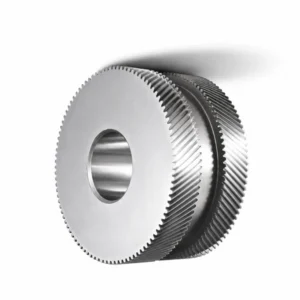
Carbon Steel Double Helical Gear – 45#, Custom OD & Module
-
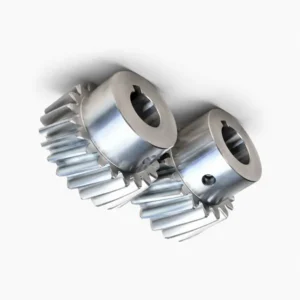
Parallel Axis Helical Gears – Steel, Custom Module & Ratio
-
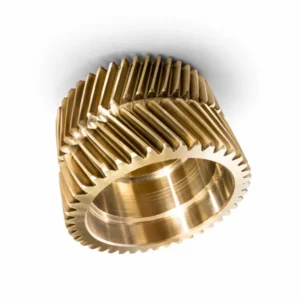
Industrial Alloy Steel Double Helical Gears – Custom OEM
-
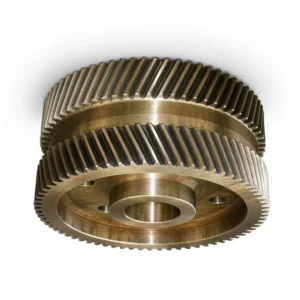
Heavy Machinery Double Helical Gear – 42CrMo, 50-55 HRC
-
Customized Double Helical Gear – OD 100-5000mm, OEM Design
-
Beverage Packing Machinery Helical Gear – SS, Food Grade
-
Mining Machinery Carburized Helical Gear – 58-62 HRC, 20CrMnTi
 English
  Italian
  Korean
  French
  Japanese