
Screw Gears (Crossed Helical Gears)
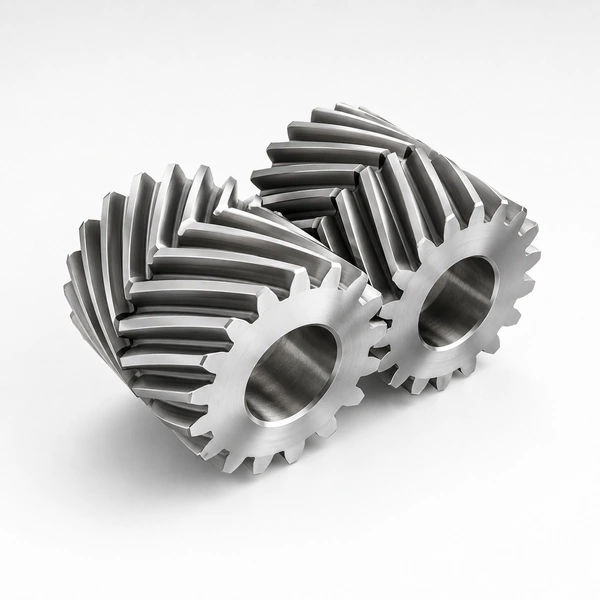
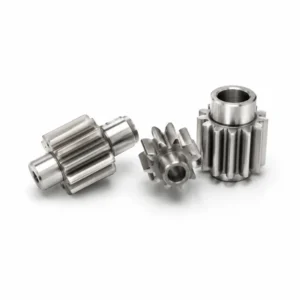
Screw gears, also sometimes called crossed helical gears, are helical gears used in motion transmission between non-intersecting shafts. Screw gears can be used to transmit power between non-parallel shafts. This is because the helical teeth allow the gears to mesh even when the shafts are not aligned. Screw gears are also able to transmit high torques, which makes them ideal for applications such as hoists and winches. Screw gears can be made from a variety of materials, including steel, stainless steel, and plastic. The material used will depend on the application and the loads that the gear will be subjected to.
Product Overview
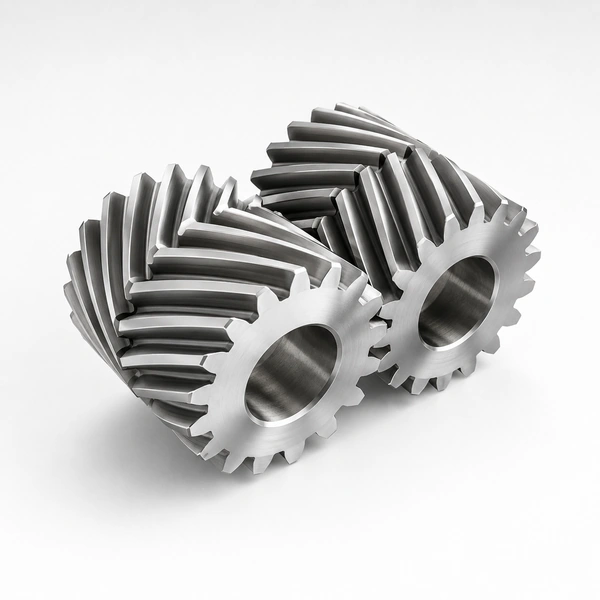
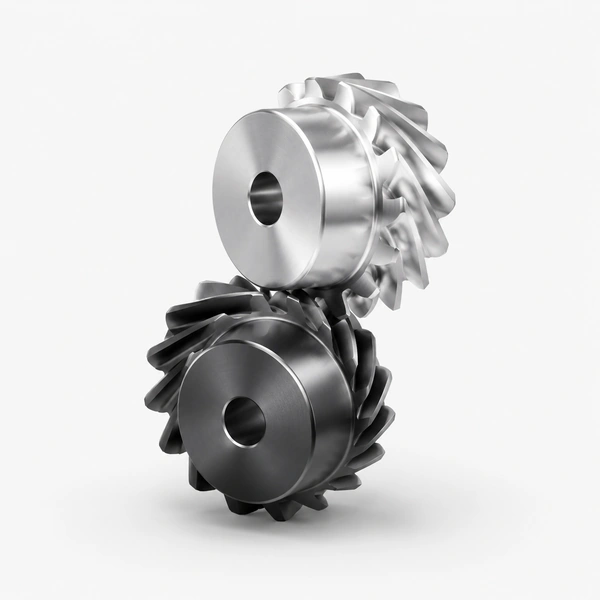
Screw gears — also called crossed helical gears — are helical gears used to transmit motion between shafts that are neither parallel nor intersecting: the shafts cross each other at an angle (most commonly 90°) in different planes. This makes screw gears one of the only gear types capable of transmitting power between completely skew (non-parallel, non-intersecting) shafts without bevel gears or worm gears. Screw gears can be right-handed or left-handed, single-stage or multi-stage, and are available in steel, stainless steel, aluminium-bronze, and plastic. Korea Ever-Power manufactures the industry's broadest inventory of screw gears — from steel and stainless steel for industrial applications, through aluminium-bronze for corrosion-resistant drives, to plastic for lightweight consumer applications.
Korea Ever-Power's screw gears are characterised by smooth operation, high efficiency (up to 98% at low helix angles), the ability to transmit high torque, and greater flexibility for shaft misalignment than other gear types. Available in single-stage and multi-stage configurations. Custom per drawing or sample.
The key geometric distinction between a screw gear (crossed helical gear) and a standard helical gear is the direction of the shaft axes they connect: a standard helical gear pair connects parallel shafts (the helix angles are equal and opposite); a screw gear pair connects skew shafts (the helix angles add up to the shaft crossing angle — typically 90° for the most common arrangement where both gears have a 45° helix angle). When two screw gears mesh, the teeth make point contact — not the line contact of a true worm gear — which limits the load capacity but enables the shaft crossing geometry and the smooth, gradually meshing tooth engagement that gives screw gears their characteristically quiet operation.
Technical Specifications
Screw Gear Specification
| Parameter | Options |
|---|---|
| Gear Type | Screw gear / crossed helical gear |
| Shaft Angle | 90° standard; any angle (helix angles sum to crossing angle) |
| Configuration | Single-stage or multi-stage |
| Hand | Right-hand (RH) or left-hand (LH) |
| Efficiency | Up to 98% (low helix angle, light load) |
| Contact Type | Point contact (limits load capacity vs worm gear) |
Material Types Available
| Matériel | Best For |
|---|---|
| Steel | General industrial — strong and durable |
| Stainless Steel | Corrosive environments — food, marine, chemical |
| Aluminium-Bronze | Anti-friction pairing with steel worm, corrosion resistant |
| Plastic (POM/PA) | Light duty, low cost, self-lubricating |
How Screw Gears (Crossed Helical Gears) Work
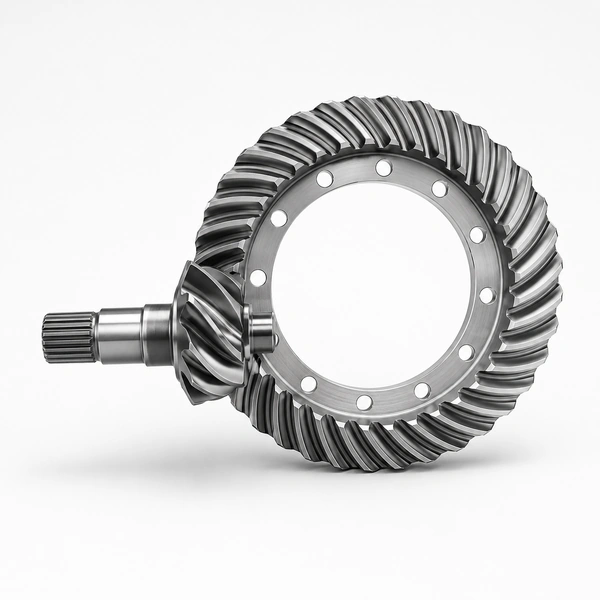
Understanding the geometry of screw gears clarifies both their capabilities and their limitations:
The Crossing Angle and Helix Angles
For two screw gears meshing at a shaft crossing angle Σ, the helix angles of the two gears must satisfy: ψ₁ + ψ₂ = Σ (for same-hand gears) or ψ₁ − ψ₂ = Σ (for opposite-hand gears). For the most common 90° shaft crossing with equal-size gears: both gears have 45° helix angles of the same hand. This helix angle relationship is what determines the motion transmission between skew shafts — by making the helix angles add up to the crossing angle, the tooth flanks can engage smoothly despite the shaft directions being neither parallel nor intersecting.
Point Contact — Smooth but Load-Limited
Unlike all other gear pairs (spur, helical, bevel, worm) which transmit force through line or area contact, crossed helical gears transmit force through a single point contact. This point contact means the Hertzian contact stress at the mesh is very high relative to the transmitted force — limiting the practical torque capacity of screw gears to light and moderate loads. The benefit of point contact is the absence of sliding in the tooth width direction (only a small sliding component in the tooth profile direction), producing the smooth, quiet operation and low wear that characterises screw gears in their appropriate load range.
Right-Hand vs Left-Hand
A right-hand screw gear has teeth that spiral clockwise when viewed from the end; left-hand gears spiral counter-clockwise. For crossed helical gears at 90°, both gears of the same hand are used (both RH or both LH). The hand combination determines the output rotation direction: same-hand gears at 90° produce rotation in the same sense as the crossed helix geometry dictates. Korea Ever-Power supplies both RH and LH screw gears, and advises on the correct hand combination for the required output direction in each application.
Single-Stage vs Multi-Stage
Single-stage screw gears transmit power directly from the input shaft to the output shaft in a single mesh — the simplest and most compact arrangement. Multi-stage configurations use two or more screw gear meshes in series: each stage provides a speed reduction ratio equal to the gear teeth ratio, and the total ratio is the product of individual stage ratios. Multi-stage screw gear trains are used in applications requiring high torque or very low output speed — such as clock and instrument drives where the overall ratio of 1,000:1 to 1,000,000:1 is achieved through many successive small screw gear stages.
Features of Screw Gears
Low Noise Operation
The helical teeth of screw gears mesh smoothly and gradually — one contact point sweeps across the tooth face rather than engaging all at once. This gradual tooth engagement eliminates the impulse loading that produces gear noise at the tooth mesh frequency in spur gears, making screw gears ideal for machine tools, medical equipment, and instruments where noise is a primary concern.
High Efficiency
Screw gears can achieve efficiency up to 98% at low helix angles and light loads. The point contact between crossing helical teeth produces lower friction losses than the line sliding contact of worm gears — making screw gears significantly more efficient than worm gears at similar light-duty applications. This efficiency advantage means less heat generation, smaller motors, and longer gear life in continuous-duty applications.
Wide Speed Range
Screw gears can transmit a wide range of speeds — from slow instrument clock drives (fractions of an RPM) to moderate speed industrial drives. The absence of the resonance and impact loading that limits spur and helical gears at high speeds means screw gears operate smoothly across a broad speed range, making them suitable for variable-speed drives where the operating speed changes over a wide range during normal operation.
Greater Shaft Misalignment Tolerance
Screw gears can accommodate a wider range of shaft misalignments than other gear types. Because the point contact between the teeth allows slight positional variations between the mating gears without dramatic changes in the contact stress pattern, crossed helical gears are more tolerant of assembly inaccuracy and operational deflections than spur, helical, or bevel gears — reducing the precision required in housing and bearing design.
Long Life and Self-Lubrication
Screw gears are durable and long-lasting under normal operating conditions. The helical tooth form is self-lubricating at the point contact — the sliding motion at the contact point draws oil or grease into the mesh, maintaining a lubrication film even without forced lubrication. This makes screw gears suitable for sealed-for-life applications in instruments, clocks, and consumer devices where external lubrication access is not practical.
Screw Gear vs Worm Gear — Key Differences
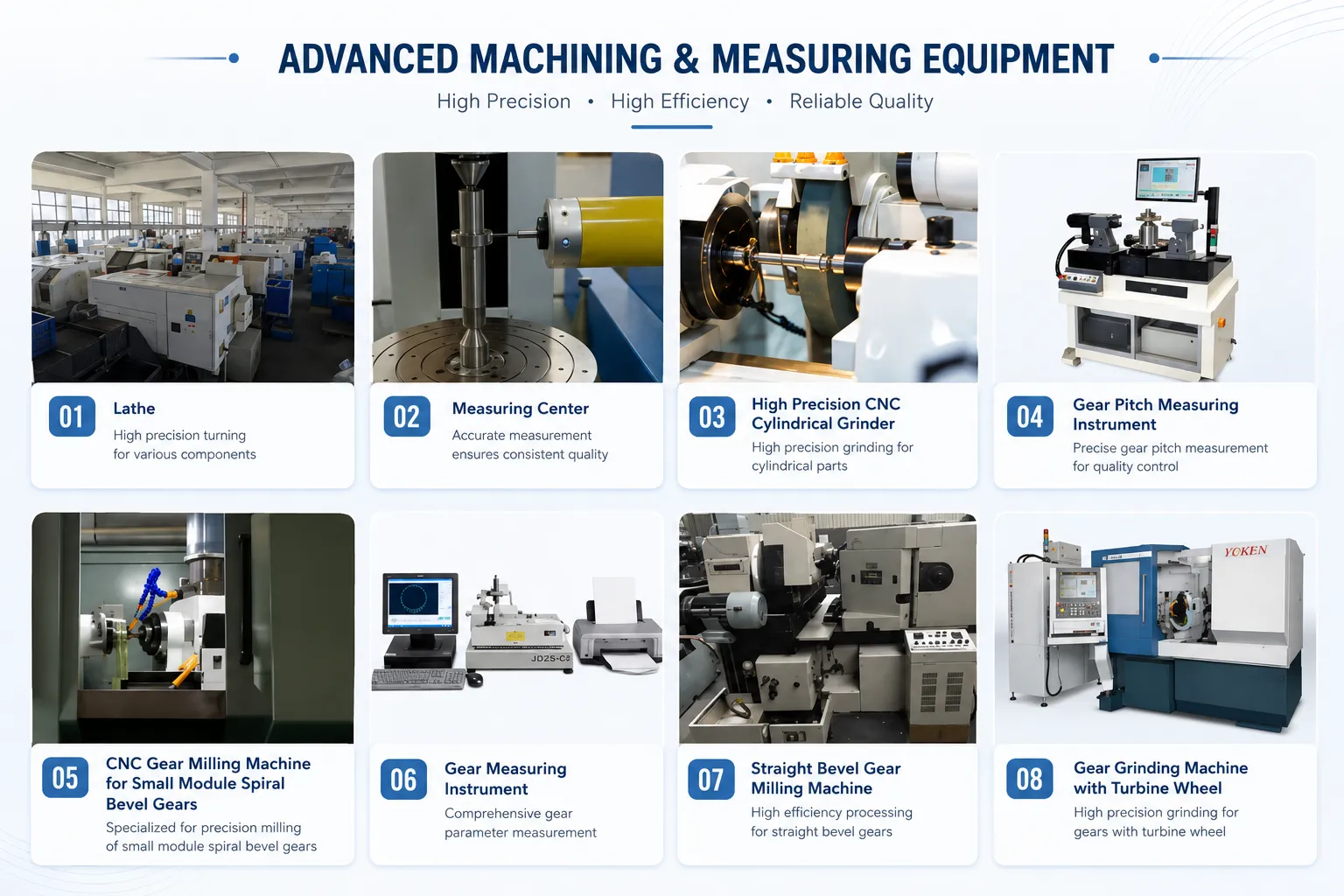
Screw gears and worm gears look superficially similar — both have helical teeth and transmit power between non-parallel shafts at 90°. The critical differences determine which is correct for a given application:
| Feature | Screw Gear | Engrenage à vis sans fin |
|---|---|---|
| Shape | A helical gear with teeth | A shaft with spiral thread (worm) + enveloping wheel |
| Mates with | Another screw gear (crossed) | A worm wheel (dedicated) |
| Contact Type | Point contact | Line contact (higher load capacity) |
| Efficiency | Higher (up to 98%) ✓ | Lower (40–90%) |
| Torque Capacity | Low (light duty) | High (heavy duty) ✓ |
| Speed Reduction | Low per stage | High (20:1–300:1) ✓ |
| Self-Locking | No | Yes (low lead angle) ✓ |
| Best Applications | Clocks, instruments, light mechanisms, steering | Hoists, winches, conveyors, lifts |
Applications of Screw Gears
Steering Systems
Screw gear drives in rack-and-pinion and recirculating ball steering systems where the worm gear (a crossed-helical variant) converts the driver's steering wheel rotation into the transverse linear motion of the steering rack. The steering column shaft (input) and rack shaft (output) are at 90° — exactly the arrangement where screw gears excel, providing smooth steering feel with no self-locking (steering can be returned to centre) and adequate efficiency for the light steering forces involved.
Machine Tools
Screw gear drives in lathes, mills, and grinders — transmitting power from the motor to the cutting tool and providing precise positioning. Machine tools require low noise (screw gears excel), precise positioning (point contact limits backlash accumulation), and smooth motion at low speeds without stick-slip. Stainless steel screw gears are specified for precision machine tools where coolant contamination requires corrosion resistance.
Robotics
Screw gear drives in robotic arm joint drives, grippers, and end-effector positioning mechanisms. The compact crossed-axis output configuration enables perpendicular shaft arrangements in robot joints that would be impossible with parallel-shaft gear trains, while the high efficiency and low noise of screw gears suit the precision motion control requirements of robotics applications.
Conveyors
Screw gear drives in light-duty conveyor systems for food, small product, and instrument conveyor applications. The controlled speed output from a multi-stage screw gear train maintains the correct conveyor belt speed with minimal speed variation, while the low-noise operation suits food processing and clean-room conveyor environments.
Lifts and Elevators
Light-duty screw gear drives in goods lifts, dumbwaiters, and small elevator mechanisms where the load is light enough for the point-contact torque capacity of crossed helical gears. For heavy-duty lifting where the screw gear's torque capacity is insufficient, worm gears (with their line contact and higher torque capacity) or planetary gears are specified instead.
Clocks, Instruments, and Precision Drives
Multi-stage screw gear trains in mechanical clocks, precision timing instruments, and scientific instrument drives. Multi-stage crossed helical gear trains achieve astronomical overall ratios (1,000:1 to 10,000,000:1) by stacking multiple small-ratio stages, each providing the ratio of its tooth count — enabling the derivation of extremely slow rotation rates from motor speeds in a compact, self-contained gear train that runs silently and with minimal friction losses.
Frequently Asked Questions
What is the difference between a screw gear and a worm gear?
A screw gear (crossed helical gear) has conventional helical gear teeth and makes point contact with its mating screw gear — the mating gear is also a helical gear, just on a crossed (skew) axis. A worm gear has a spiral thread (the worm) that engages a specially enveloping worm wheel, making line contact. The line contact of the worm gear gives it much higher torque capacity but lower efficiency. Screw gears are more efficient but limited to light loads; worm gears are less efficient but can handle heavy loads. Choose screw gears for light duty, high efficiency, and quiet operation; choose worm gears for heavy loads, high speed reduction, and self-locking.
Can screw gears transmit power at any shaft crossing angle?
Yes — screw gears can transmit power between shafts at any crossing angle from 0° (parallel shafts — reduces to standard helical gear) to 180°. The helix angles of the two gears must sum to (or differ by) the crossing angle. The most common crossing angle is 90° (both gears at 45° helix angle), but 45°, 60°, and other angles are possible with appropriate helix angle combinations. Korea Ever-Power can manufacture screw gear pairs for any required crossing angle.
What materials are available for screw gears from Korea Ever-Power?
Steel (standard industrial applications — strong and durable), stainless steel (corrosive environments including food, marine, and chemical processing), aluminium-bronze (anti-friction pairing with steel, good corrosion resistance, suited for moderately loaded drive applications), and plastic POM/PA (light duty, self-lubricating, low cost for consumer and instrument applications). Korea Ever-Power carries the industry's largest inventory of screw gears across these materials. Contact Korea Ever-Power with your specifications.
Customer Reviews
"We build precision lab instruments and use stainless steel screw gears from Korea Ever-Power in our sample positioning drives. Efficiency measured on our test rig: 94% at operating speed — allowing us to use a smaller, quieter motor. Noise at 1 metre: 38 dB(A). 20 months continuous operation without lubrication — confirming the self-lubricating characteristic. Korea Ever-Power's broadest inventory meant we selected from stock items rather than waiting for custom production."
Kim Jae-ho | Precision Instrument Design Engineer, Incheon Scientific Instruments Co. · Q1 2026
"We design robotic arm wrist joints and use aluminium-bronze screw gears from Korea Ever-Power for the crossed-axis output stage. The 90° crossed-axis configuration fits within our wrist housing better than any alternative gear type. Point contact limits backlash accumulation across multiple joints — our 6-axis arm maintains ±0.05 mm TCP (tool centre point) accuracy over 5,000 hours of operation. Custom shaft crossing angle 75° produced to our drawing in 14 days."
Lee Chang-min | Robotic Arm Drive Engineer, Gyeonggi Industrial Robotics Co. · Q4 2025
Related Products
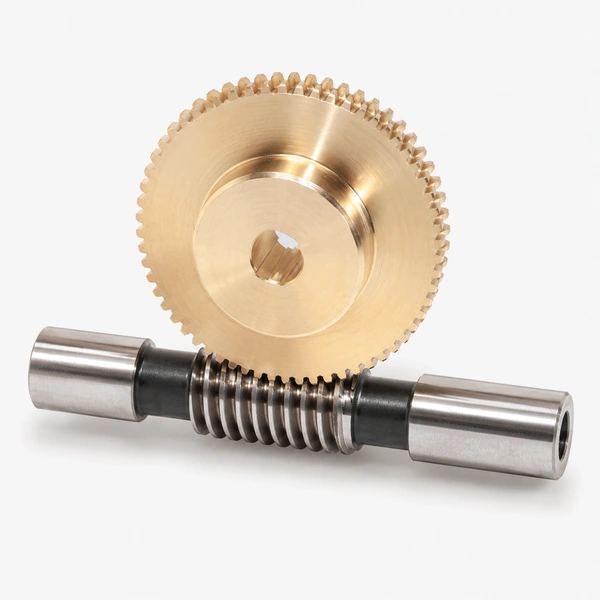
Request a Quotation for Screw Gears (Crossed Helical Gears)
Steel, stainless steel, aluminium-bronze, plastic. RH and LH. 90° and custom crossing angles. Single and multi-stage. Industry's largest screw gear inventory. Custom per drawing.
Informations complémentaires
| Editor |
|---|
Produits similaires
-
Engrenages à chevrons
-
Pièces mécaniques personnalisées OEM Engrenages de tracteur
-
Engrenage hypoïde
-
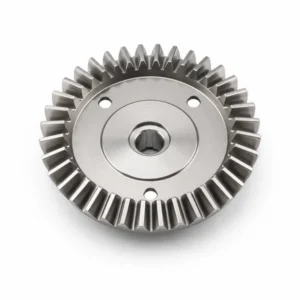
Couronnes dentées pour trains sur voies en montée, montagnes russes et volants de voiture
-
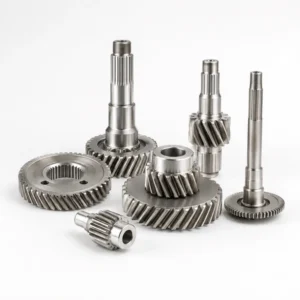
Engrenages de chariot élévateur
-
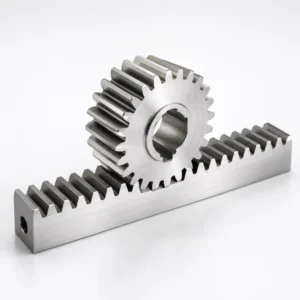
Roue dentée et crémaillère
-
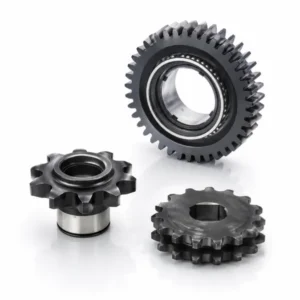
Boîte de vitesses automatique
-
Engrenages pour pompes à huile
 French
  English
  Italian
  Korean
  Japanese