
Spur Gears for Printing Machines:
Register Accuracy, Speed Synchronisation and Ink Transfer Drives
Printing machine spur gears must maintain perfect rotational synchronisation between impression cylinders, plate cylinders, and blanket cylinders across the full press speed range — any transmission error in the gear train produces a periodic image registration defect that renders the printed output unusable. This guide covers spur gear specification for sheet-fed offset presses, web offset presses, flexographic printing machines, and gravure presses — including quality class selection, ghost-free tooth geometry, and the ink transfer cylinder drive requirements that make printing machine gears one of the most demanding precision spur gear applications.
TE <3 μrad · M2–M8 · PLV 3–15 m/s
Sheet-Fed · Web Offset · Flexo · Gravure
Spur Gears in Printing Machine Drive Systems
The printing machine cylinder gear train is one of the most precision-demanding spur gear applications in manufacturing. Every impression cylinder, plate cylinder, blanket cylinder, and transfer cylinder in a multi-colour offset press must rotate in perfect angular synchronisation — any deviation from the ideal synchronised rotation, at the pitch line velocity of the cylinder gears, produces a periodic velocity variation that translates directly into a registration error between colour separations on the printed sheet. At commercial printing quality (register tolerance ±0.05 mm on a 500 mm format sheet), the allowed angular registration error at the cylinder is approximately 0.1 mrad — placing the cylinder gear transmission error requirement in the range of DIN 4–5, significantly tighter than the DIN 7–8 quality class used for most industrial gear applications.
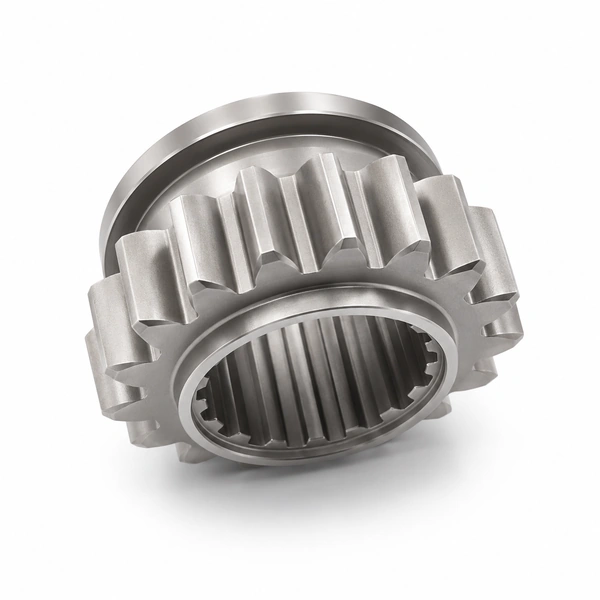
Korea Ever-Power’s spur gears for printing machines are manufactured in 20CrMnTi case carburized (standard for cylinder and main drive gears), nodular cast iron GGG60 (traditional for large-diameter printing press body gears where cast iron’s self-damping reduces noise and vibration), and Cronidur 30 stainless bearing steel (for waterless offset and UV printing machine applications where corrosion resistance is required). All printing press cylinder gears are ground to DIN 4–5 quality class with tip relief applied to reduce dynamic mesh force and eliminate the “tooth entry impact” that is the primary source of printing machine ghost images.
The phenomenon of “gear ghosting” in offset printing — a periodic density variation in solid ink areas corresponding to the gear mesh frequency — is entirely caused by tooth-to-tooth transmission error in the cylinder gear drive. When the impression cylinder and plate cylinder are driven by spur gears with DIN 7 quality, the tooth spacing error produces a periodic speed variation at the mesh frequency, which modulates the ink transfer rate at each revolution of the cylinder. The result is a faint but visible horizontal band pattern in solid printed areas. Replacing the cylinder gears with DIN 5 quality ground gears reduces tooth spacing error by approximately 50%, reducing the ghost pattern amplitude below the threshold of visibility for commercial print quality.
Ghost-Free Tooth Geometry
Anti-ghosting spur gear design for printing presses uses three geometric measures beyond standard DIN quality class compliance: (1) Profile tip relief — 5–12 μm tip relief on both driver and driven gear tooth tips reduces the tooth entry impact load spike that is the primary TE harmonic visible as ghosting. (2) Tooth crowning — 5–10 μm lead crowning prevents load concentration at the gear tooth ends from press body deflection under cylinder contact pressure. (3) Matched pairs — cylinder gear pairs are matched on a rolling test rig to confirm the combined transmission error of the assembled pair is below the specified TE limit, not just that each individual gear meets the DIN tolerance. Korea Ever-Power supplies all printing press cylinder spur gears as matched pairs with measured TE certificate.
Cast Iron vs Steel Cylinder Gears
Nodular cast iron GGG60 (also called ductile iron) has been the traditional material for large printing press body gears and main drive bull gears because: (1) Its internal graphite microstructure provides acoustic damping that reduces gear noise by 3–5 dB(A) vs steel gears at equivalent quality class — important in commercial print shops where press operators work in proximity to the press. (2) Large-diameter cast iron gears can be cast near-net-shape, reducing machining cost vs forged steel for gears above 400 mm OD. (3) Cast iron gears are more tolerant of contamination (ink mist, paper dust) in the oil than steel gears. The limitation of cast iron: it cannot be carburized or induction hardened to the hardness level of steel — maximum HB 300 vs HRC 58–62 for carburized steel. Korea Ever-Power supplies both GGG60 and 20CrMnTi cylinder gear options depending on the press size and load rating.
Ink Contamination and Lubrication
Printing press spur gears operate in an environment where ink mist and solvent vapour contaminate the gear oil continuously. Sheet-fed offset press cylinder gears typically run in an enclosed gear oil bath (ISO VG 100–150), with the oil changed at 1,000–2,000 hour intervals depending on ink solvent content. UV-cured ink printing machines require particular attention — UV inks contain acrylate monomers that polymerise on contact with UV radiation, and if UV-cured ink enters the gear housing it can progressively increase the oil viscosity and restrict gear lubrication. Korea Ever-Power recommends specifying UV-resistant shaft seals and quarterly oil viscosity checks for printing machine spur gear housings in UV ink printing lines. Waterless offset (toray process) presses require Cronidur 30 stainless cylinder gears and stainless housings due to the silicone plate cleaning chemistry.
Printing Machine Type Applications
Frequently Asked Questions
Explore Korea Ever-Power Gear Categories
Seven precision gear product lines for printing, packaging, industrial and specialist applications worldwide.
편집자: Cxm
 Korean
  English
  Italian
  French
  Japanese