Spur Gears for Mining Equipment: Crusher Drives, Conveyor Systems and Underground Machinery
Mining equipment spur gears operate under conditions that would destroy components designed to industrial standards — cyclic shock loads from crusher jaw and cone impacts, continuous heavy-duty torque on conveyor belt drives running 20 hours per day, corrosive atmospheres from sulphide ores and mine water, and service intervals measured in years rather than months. From open-pit coal mine feeder conveyor drives to underground hard-rock development drill auxiliary gears, spur gears in mining equipment must combine maximum bending fatigue resistance, shock tolerance, and contamination immunity in a package that is economical enough to replace when worn without shutting down the mine. This guide covers spur gear specification for the principal mining equipment applications.
34CrNiMo6 · 18CrNiMo7-6 · 42CrMo4 · M8–M30 SF 1.8–3.0 · DIN 6–8 · 24h Duty · 10,000 h Life Crusher · Conveyor · Dragline · Drill Rig
MODULE RANGE
M8 – M30
Mining equipment spur gear module range. Belt conveyor head pulley drive: M8–M16. Jaw crusher pitman drive: M12–M20. Cone crusher eccentric drive: M16–M24. Large dragline bucket drive: M20–M30
SERVICE FACTOR
1.8 – 3.0
Mining equipment spur gear service factors per ISO 6336/AGMA 2001. Conveyor drive (smooth): SF 1.8. Cone crusher (moderate impact): SF 2.2. Jaw crusher (high impact): SF 2.5–3.0. Dragline machinery (extreme shock): SF 3.0+
DESIGN LIFE
10,000 h
Minimum B10 life target for primary mining drive spur gears at rated load and service factor. Belt conveyor drives running 20 h/day at 95% availability: 10,000 h = approx. 1.5 years continuous operation between planned gear replacements
MATERIAL
34CrNiMo6
Through-hardened 34CrNiMo6 (HB 300–360) is the primary material for large mining spur gears where case carburizing is impractical due to size. Case carburized 18CrNiMo7-6 (HRC 58–62) for smaller mining auxiliary gears where the higher surface hardness justifies the carburizing process
Spur Gears in Mining Equipment — Design Challenges and Material Demands
Mining is the most demanding service environment for spur gears in any industrial sector — a characterisation that is not hyperbole but a direct consequence of the physical realities of rock extraction and material handling at industrial scale. The three primary challenges that differentiate mining spur gears from standard industrial spur gears are severity and unpredictability of shock loading, the scale of the equipment (which pushes gear dimensions beyond what carburizing heat treatment can reliably cover), and the unforgiving consequences of unexpected gear failure (a failed crusher drive or conveyor gear can halt production at a cost of hundreds of thousands of dollars per hour at a large mine).
Korea Ever-Power’s spur gears for mining equipment are manufactured in three material tiers matched to the gear size and application shock level: 18CrNiMo7-6 case carburized (HRC 58–62, for mining auxiliary gears up to approximately 400 mm OD where case carburizing can achieve the required uniform case depth), 34CrNiMo6 through-hardened (HB 310–360, for large gear bodies above 400 mm OD in crusher and dragline applications where uniform through-hardening is more consistent than case carburizing at large section thickness), and 42CrMo4 QT (HB 260–310, for budget-conscious conveyor and screen drive gear replacements where the application duty is within the reduced contact fatigue resistance of this material). All large mining spur gears are manufactured from forged blanks — forging breaks the as-cast dendritic grain structure of the steel ingot, producing a refined grain that improves fatigue strength by 20–35% vs equivalent cast steel at the same hardness level.
The service factor is the most important single parameter in mining spur gear specification, and the parameter most frequently underestimated in budget-driven replacement gear orders. A belt conveyor drive at rated capacity running uniformly on a flat gradient uses SF 1.8 — but the same conveyor starting under full load on a 15° upgrade, or experiencing a belt jam that causes the drive motor to stall against the locked conveyor, generates instantaneous torque spikes that are 3–5× the rated torque. If the spur gear was sized to SF 1.8 and the actual peak torque is 4× rated, the gear is in catastrophic overload — tooth fracture is instantaneous. Korea Ever-Power specifies mining conveyor spur gears to a minimum of SF 2.0 for flat conveyor drives with soft-start control, SF 2.5 for inclined conveyor drives, and SF 3.0 for all crusher applications where the jaw or cone contact with an uncrushable tramp metal object is a credible event.
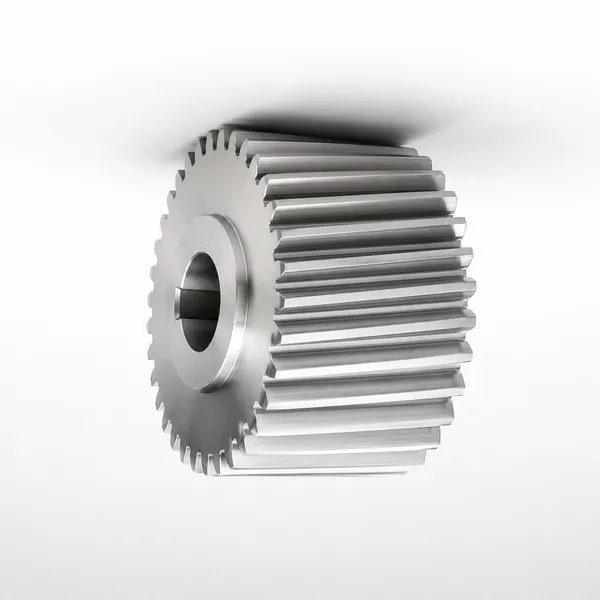
Korea Ever-Power forged 34CrNiMo6 through-hardened spur gear for mining conveyor head pulley drive — M14, 72 teeth, OD 1,036 mm, bore 180 mm, HB 330–360 through section. Forged blank grain flow confirmed parallel to tooth profile by macro-etch test cross-section. Hobbed to DIN 7 quality class; induction hardened tooth surface HRC 52–56 for improved contact fatigue resistance while retaining the tough through-hardened core for shock resistance. Service factor 2.2 applied in ISO 6336 bending strength calculation for the specified overland conveyor drive application at rated belt load. Individual forging certificate, heat treatment record, and dimensional inspection report supplied. Replacement supply for major mining OEM conveyor drive gearboxes including Rexnord, Dodge (ABB), David Brown (Timken Drives), and Elecon mining conveyor series.
Mining Equipment Application Drive Specifications
APP 01
JAW CRUSHER
FLYWHEEL DRIVE
Spur gear specification: M16–M24, 34CrNiMo6 through-hardened HB 300–350, DIN 7, SF 2.5–3.0, wide face width b/m ≥ 8 for high bending fatigue safety factor, forged blank mandatory. The jaw crusher uses a large flywheel driven by a V-belt or directly by the motor pinion gear, which in turn drives the eccentric shaft through a spur gear pair. The crushing action is discontinuous — each jaw closure event crushes rock and releases a large fraction of the flywheel’s stored kinetic energy, then the flywheel must re-accelerate between jaw strokes. This creates severe cyclic torque variation in the spur gear drive at the jaw stroke frequency (typically 1.5–4 Hz), with peak torques during stall (when an uncrushable object enters the jaw) reaching 5–6× rated torque. The spur gear must withstand these stall events without tooth fracture — hence SF 3.0 and the choice of 34CrNiMo6 with its exceptional core toughness (impact energy ≥ 60 J at -20°C) to resist brittle fracture in cold-climate open-pit operations. Korea Ever-Power jaw crusher spur gears are available as matched drive-and-driven pairs to maintain the designed backlash and contact ratio, supplied with ISO 6336 bending and contact fatigue calculation confirming the SF at the specified peak stall torque.
APP 02
BELT CONVEYOR
HEAD DRIVE
Spur gear specification: M8–M16, 42CrMo4 QT HB 260–310 or 34CrNiMo6 QT HB 300–360 (for conveyor power above 1,000 kW per drive), DIN 7–8, SF 2.0–2.5, continuous 24 h/day duty, sealed gearbox ISO VG 220 or 320. Mining belt conveyor drives — including overland conveyors moving ore from pit to processing plant (which can be 5–15 km long with multiple drive stations), underground coal conveyors, and stacker-reclaimer conveyors at stockyards — are the highest-volume single application for large spur gears in mining. The drive gearbox typically contains two or three spur gear or helical gear stages plus a final spur gear stage that meshes with the head pulley shaft gear. Spur gears are preferred in the final stage because they can be inspected in-place without gearbox disassembly by removing the inspection cover. At continuous 24 h/day operation, the 10,000-hour life target corresponds to approximately 17 months of service — most mines schedule conveyor gear inspections and replacement in coordination with planned maintenance shutdowns every 12–18 months. Korea Ever-Power maintains production schedules for the most common mining conveyor spur gear sizes used in South Africa, Australia, Chile, and Indonesia coal and iron ore operations.
APP 03
CONE CRUSHER
ECCENTRIC DRIVE
Spur gear specification: M16–M24, 34CrNiMo6 through-hardened HB 310–360, DIN 6–7, SF 2.2–2.5, ground tooth surface Ra ≤ 0.8 μm for smooth torque transmission, bevel-cut tooth root for improved stress distribution at root fillet. The cone crusher drive uses a bevel gear set to change shaft direction from the horizontal motor to the vertical eccentric shaft, but the primary power distribution spur gear — which divides the motor torque between the main shaft and the eccentric — is often the most heavily loaded gear in the crusher. Cone crushers run at 200–400 RPM, transmitting 100–750 kW per crusher, and the spur gear must maintain tight pitch accuracy (DIN 6–7) to ensure smooth torque sharing between the main and eccentric shafts. Mismatched spur gears in a cone crusher (from using different-quality replacement gears on the two drive positions) cause cyclic torque imbalance that is transmitted to the mainframe as vibration, accelerating mainframe fatigue cracking — a failure mode significantly more expensive to repair than the gear replacement cost. Korea Ever-Power supplies cone crusher spur gear replacements as matched sets with verified pitch accuracy to prevent this outcome.
APP 04
UNDERGROUND DRILL
AUXILIARY DRIVES
Spur gear specification: M4–M10, 18CrNiMo7-6 carburized HRC 58–62 or 20CrMnTi, DIN 6–7, compact design for underground equipment space constraints, IP67 sealed housing, service factor 1.5–2.0. Underground development drills (jumbos), longhole drills, and production drills use spur gears in their auxiliary drives — the drill carousel feed drive, rock drill positioning arm drive, and drill string rotation auxiliary drive. These are smaller power levels (2–15 kW per axis) but must operate in the extremely abrasive underground environment where fine rock dust from drilling operations penetrates any imperfect seal. Underground drill spur gears are also subject to vibration from the pneumatic or hydraulic rock drill mounted on the same boom — this vibration causes fretting corrosion at any loose interference fit and can work-harden bearing surfaces to the point of brittle fracture. Korea Ever-Power underground drill spur gears are specified with interference fit bores (H6/p6 press-fit to shaft) rather than keyed connections for the vibration environment, with phosphate surface treatment on all non-hardened surfaces to resist fretting corrosion.
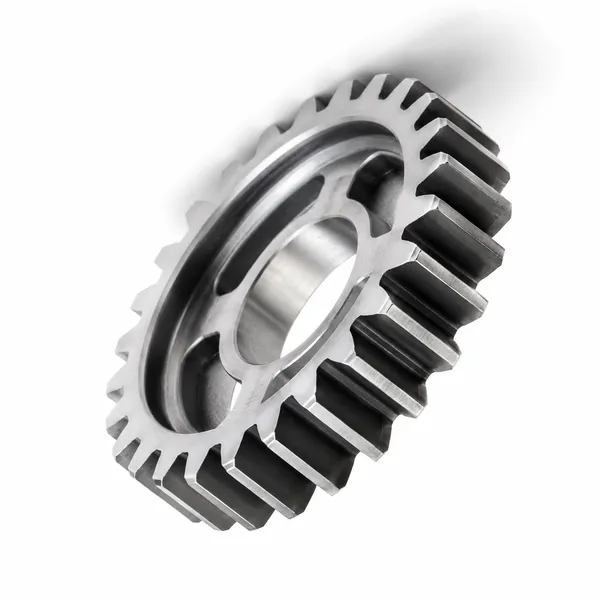
Korea Ever-Power 18CrNiMo7-6 case carburized gear for mining machinery auxiliary drive — the carburizing process at 920°C for 24–36 hours produces an effective case depth of 1.2–1.8 mm at M10–M14 module gears, with core tensile strength 900–1,100 MPa. This combination of hard case (HRC 58–62) and tough core provides the mining gear’s defining resistance to both contact fatigue pitting and catastrophic core fracture from shock overload. Shot peening of the carburized tooth root is mandatory for all mining application gears — the compressive residual stress layer induced by shot peening increases the tooth root bending fatigue limit by 25–30%, providing the additional margin needed against the unpredictable peak torques of crusher and underground drill service.
Contamination Control and Lubrication for Mining Spur Gear Drives
Mining gear oil contamination is the primary life-limiting factor for spur gears in belt conveyor drives and crusher auxiliary gearboxes — responsible for the majority of premature gear failures that occur before the calculated fatigue life is reached. The mine environment provides a relentless supply of abrasive contaminants: silica dust from blasting and crushing operations (Mohs hardness 7 — harder than any gear tooth surface), iron oxide and sulphide minerals from the ore itself, water from mine dewatering sprays and natural ground water ingress, and diesel combustion products from underground LHD vehicles and trucks. Any one of these contaminants entering the gear oil at concentrations above their threshold level causes three-body abrasive wear on the gear tooth flank surface, progressively increasing the surface roughness and reducing the EHL film parameter Λ below 1.0 — triggering micro-pitting and ultimately macro-pitting failure at a fraction of the calculated fatigue life.
Oil Viscosity Selection for Mining Drives
Mining conveyor and crusher gearbox gear oil viscosity must be selected to balance two competing requirements: adequate EHL film thickness at the operating temperature (which requires higher viscosity) and adequate churning loss at cold start (which requires lower viscosity). The standard for most mining gear drives is ISO VG 220 at ambient above 10°C, ISO VG 150 at cold climate operations below 0°C, and ISO VG 320 for large crusher gearboxes where the oil sump temperature at full load exceeds 75°C. Synthetic PAO gear oil (equivalent viscosity to mineral ISO VG 220 but with significantly better viscosity-temperature characteristics) is increasingly specified for mining applications — the synthetic base oil maintains adequate viscosity at both cold start (-25°C) and high operating temperature (+95°C), eliminating the seasonal oil change between summer mineral VG 220 and winter mineral VG 150 that is common at open-pit mines in continental climates.
Mine ambient 10–40°C: ISO VG 220 mineral or VG 150 PAO synthetic
Sealed Gearbox Design for Mining
Mining gearbox sealing for spur gear drives must address three ingress paths simultaneously: (1) Shaft seal entries — the most common ingress point. Mining conveyor gearboxes use triple-lip shaft seals (two oil-retention lips + one exclusion lip facing the mine environment) on the high-speed input shaft and a single or double-lip seal with water and dust excluder on the low-speed output shaft. (2) Housing joint faces — the bolted split of a conveyor gearbox housing must be sealed with a cured silicone RTV compound applied to the joint face, not just metal-to-metal contact, to prevent fine silica dust ingress through micro-gaps at the joint. (3) Breather valves — gearboxes must breathe to accommodate thermal expansion and contraction of the oil; the breather must include a filter element rated for the mine atmosphere dust concentration (typically 5 mg/m³ or higher in open-pit blast areas). Korea Ever-Power recommends desiccant breathers with 3-micron filtration for all mining conveyor gearboxes — these breathers both filter the incoming air and capture water vapour from the incoming air column.
Triple lip seal + desiccant breather = mine-proven sealing system
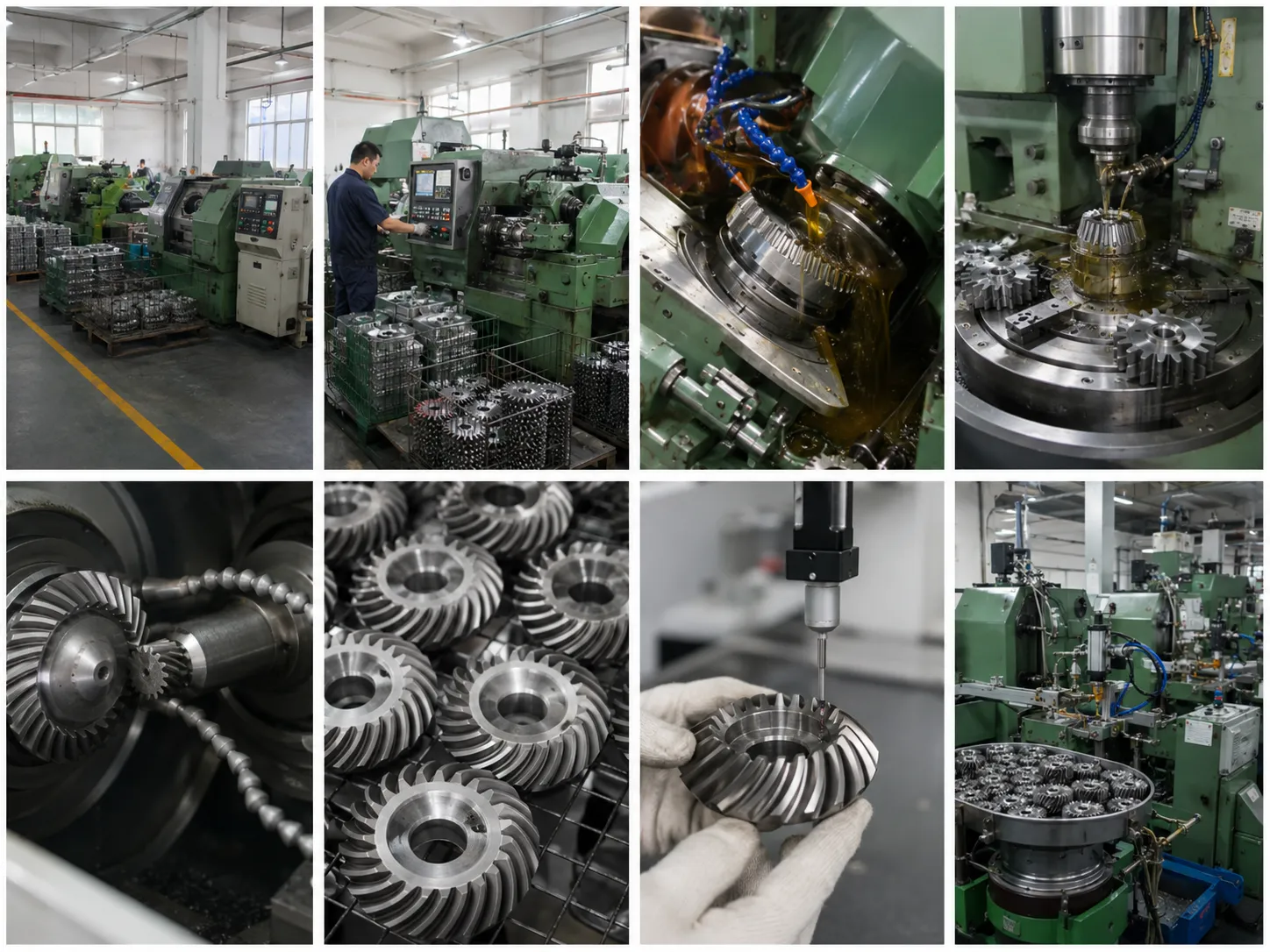
Korea Ever-Power precision gear manufacturing facility — large-module mining spur gear production on CNC hobbing machines in the M8–M30 range. Large mining spur gears are manufactured from individually forged blanks (not machined from bar stock) to ensure the required grain flow orientation and ultrasonic-tested to confirm the forging is free of internal flaws before machining begins. Post-machining non-destructive examination (magnetic particle inspection of all tooth surfaces and roots after hobbing and heat treatment) is standard for mining crusher and dragline spur gears. Korea Ever-Power maintains multi-week production capacity in large mining gear sizes to supply coordinated replacement programmes for mines operating fleet maintenance schedules across multiple conveyor and crusher systems.
Our jaw crusher spur gear is failing by tooth root fracture every 6–9 months, well short of the 18-month replacement cycle we need. What causes this and what specification changes would extend the life?
Repeated tooth root fracture in a jaw crusher spur gear at 6–9 months indicates the gear is experiencing peak torques significantly above its design rating — the tooth root fatigue is being exhausted faster than the calculated life because the actual peak stress exceeds the designed peak stress. Before specifying a replacement, determine the root cause: (1) Tramp metal incidents: has the crusher processed uncrushable material (steel tools, wear plate fragments, blasting caps) that stalled the crusher jaw against full hydraulic or mechanical stop? Each tramp metal event that arrests the jaw mid-stroke generates a torque spike of 5–8× rated torque — even one or two events per year can exhaust the remaining fatigue life of a gear already carrying 80% of its fatigue limit at rated load. Install a tramp metal protection system (magnetic separator on the feed conveyor, or a shear bolt on the drive coupling) to limit the peak torque delivered to the crusher gear. (2) Inadequate service factor in the gear specification: if the gear was sized to SF 2.0 and the actual peak torque including tramp metal events is 5× rated, the effective SF at the peak torque is 0.4 — tooth fracture is inevitable. Specify the replacement to SF 3.0 with 34CrNiMo6 QT at HB 320–360 to increase the bending fatigue limit. (3) Incorrect material — wrong heat treatment: if the failed gear shows brittle crystalline fracture surfaces (no ductile deformation before fracture), the through-hardened material may be too hard for the impact toughness requirement — specify HB 300–320 rather than HB 350–380 if cold ambient temperature is a factor. Korea Ever-Power provides failure analysis consultation for mining gear premature failure — send photographs of the fracture surfaces and the application data (crusher model, rated motor power, feed material type, and tramp metal history) for a root cause assessment.
Q 02
What is the procurement lead time for large mining spur gears (M16–M24) and how should we plan for planned maintenance shutdowns?
Large mining spur gear procurement planning must account for three lead time components: (1) Forging procurement: 34CrNiMo6 forged blanks in large sizes (OD 800–1,500 mm, weight 500–3,000 kg) are not catalogue items — they are ordered from a steel forging mill against a specific purchase order. Lead time for the forging alone is 4–8 weeks depending on the steel mill’s production schedule and ingot size availability. (2) Machining and heat treatment: rough machining, heat treatment (through-hardening at 850°C, tempering at 580–620°C), finish machining (gear hobbing, bore grinding, keyway cutting), and optional tooth surface induction hardening add 4–6 weeks. (3) Inspection and documentation: ultrasonic testing of the forging, magnetic particle inspection of tooth surfaces, dimensional CMM inspection, and documentation preparation add 1 week. Total lead time from order placement to shipment: 10–16 weeks for first-time orders of large mining spur gears. For mines operating planned shutdown schedules, Korea Ever-Power recommends: (a) order the next planned maintenance gear set immediately after installing the current replacement set, (b) keep one set of critical crusher gears as on-site emergency stock rather than relying on just-in-time supply, (c) establish a standing order schedule with Korea Ever-Power for regular replacement sets at the planned interval, which allows production scheduling that can shorten lead time to 8–10 weeks for repeat orders. Contact Korea Ever-Power’s mining supply team to establish a standing order programme — mines running multiple crushers of the same model can consolidate orders to reduce per-set lead time and cost.
Q 03
Should I specify 34CrNiMo6 through-hardened or 18CrNiMo7-6 case carburized for a belt conveyor head drive spur gear at M16, 900 kW, 24 h/day coal mine service?
For M16, 900 kW, 24 h/day coal mine conveyor service, the recommendation depends on the gear OD: (a) If OD is below 600 mm: 18CrNiMo7-6 case carburized is preferred. At OD below 600 mm, case carburizing can achieve a uniform effective case depth of 1.5–2.0 mm across the full tooth height with manageable distortion (correctable by post-carburizing grinding). The surface hardness HRC 58–62 provides a contact fatigue limit approximately 40% higher than 34CrNiMo6 through-hardened at HB 340, allowing either a smaller gear (M14 instead of M16) to achieve the same fatigue life, or the same gear size with extended life to 15,000+ hours instead of 10,000. (b) If OD is above 600 mm: 34CrNiMo6 through-hardened QT at HB 320–350 is more practical. At this size, the carburizing furnace loading and the case depth consistency across a large cross-section become problematic — carburizing distortion at OD 600+ mm requires grinding allowances so large that the gear must be hobbed significantly oversize, complicating tool selection and increasing machining time and cost. 34CrNiMo6 through-hardening is a more consistent process at large section sizes, and with tooth surface induction hardening applied after through-hardening (achieving HRC 52–56 on the tooth surface while retaining the tough HB 300–340 core), the fatigue performance approaches that of carburized steel for belt conveyor service. Korea Ever-Power can calculate the ISO 6336 bending fatigue life for both material options at the specified power, speed, and service factor to provide a quantitative comparison — contact with the full application data including gear ratio and motor soft-start characteristics for the calculation.
Explore Korea Ever-Power Gear Categories
Seven precision gear product lines for mining, heavy industry, construction and specialist applications worldwide.
Korea Ever-Power manufactures 34CrNiMo6, 18CrNiMo7-6, and 42CrMo4 spur gears for all mining equipment applications — jaw crushers (SF 3.0), cone crushers, belt conveyor head drives (SF 2.0–2.5), and underground drill auxiliary drives. Module M8–M30, forged blanks, DIN 6–8. Full material, forging, heat treatment, NDE, and dimensional documentation. Supply to Australian, South African, Chilean, and Indonesian mining operations. ISO 9001:2015 certified.

 Korean
  English
  Italian
  French
  Japanese