
Bevel Gears for Robotics and Automation:
Wrist Drives, Angular Joints and Collaborative Robot Direction Change
Bevel gears in robotics and automation fill a design role that no other gear type can replace — they redirect shaft rotation through a defined angle (most commonly 90°) in a compact package that integrates directly into the robot joint or gripper actuator mechanism, enabling the perpendicular wrist roll and tool-change axes that give multi-axis robots their spatial dexterity. Unlike the spur and helical gears that handle the high-ratio reduction in robot joint drives, the bevel gear in a robot application is typically used at a ratio of 1:1 to 3:1, making it a direction-change element rather than a speed-reduction element. This guide covers bevel gear application in 6-axis robot wrist drives, linear motion robot end effectors, parallel kinematic robot (delta robot) arm angle joints, and precision CNC machine tool automatic tool changer (ATC) mechanisms that share the same precision requirements as robotic systems.
Ratio 1:1–3:1 · Backlash ≤ 2 arc-min · 100M cycles
Wrist · Delta · SCARA · ATC · Cobot
Bevel Gear Engineering for Robotic Applications — Precision Direction Change
The role of bevel gears in robotic and automation systems is fundamentally different from their role in industrial machinery. In a standard industrial application (a conveyor right-angle drive, an agricultural implement drive), the bevel gear pair is a direction-change element between two shafts that are fixed in space — the alignment between the bevel gear pair is set once at installation and does not change during operation. In a robotic application, the bevel gear pair in a wrist joint is part of a kinematic chain where every upstream joint rotation changes the spatial orientation of the bevel gear pair — the J4 wrist bevel gear pair, for example, rotates its own axis with every J1, J2, and J3 movement, carrying dynamic loads from acceleration and deceleration that are not present in a fixed-installation bevel drive. This kinematic coupling of the bevel gear load with the robot’s full motion profile makes the dynamic load analysis of robotic bevel gears significantly more complex than standard industrial bevel gear design.
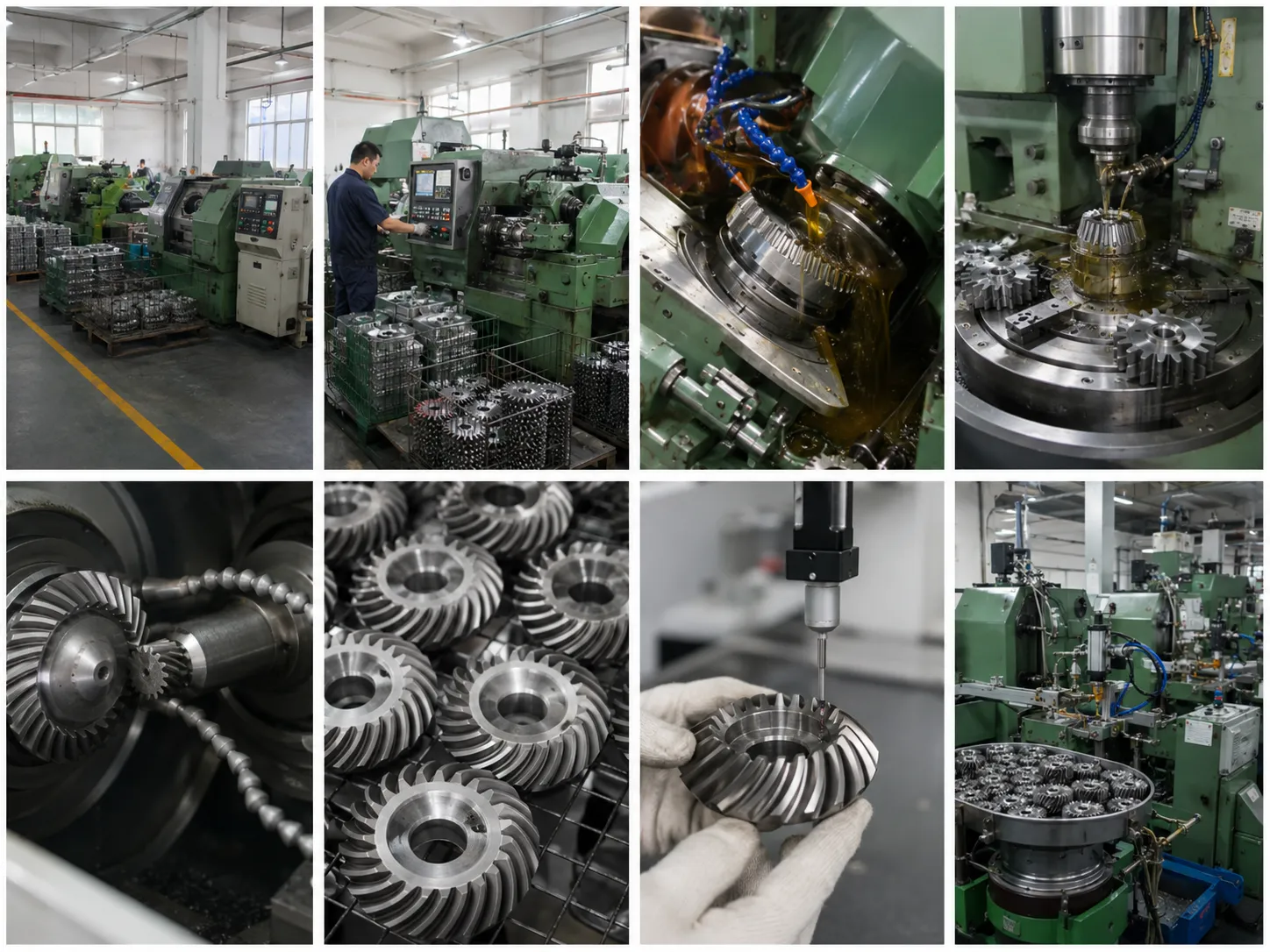
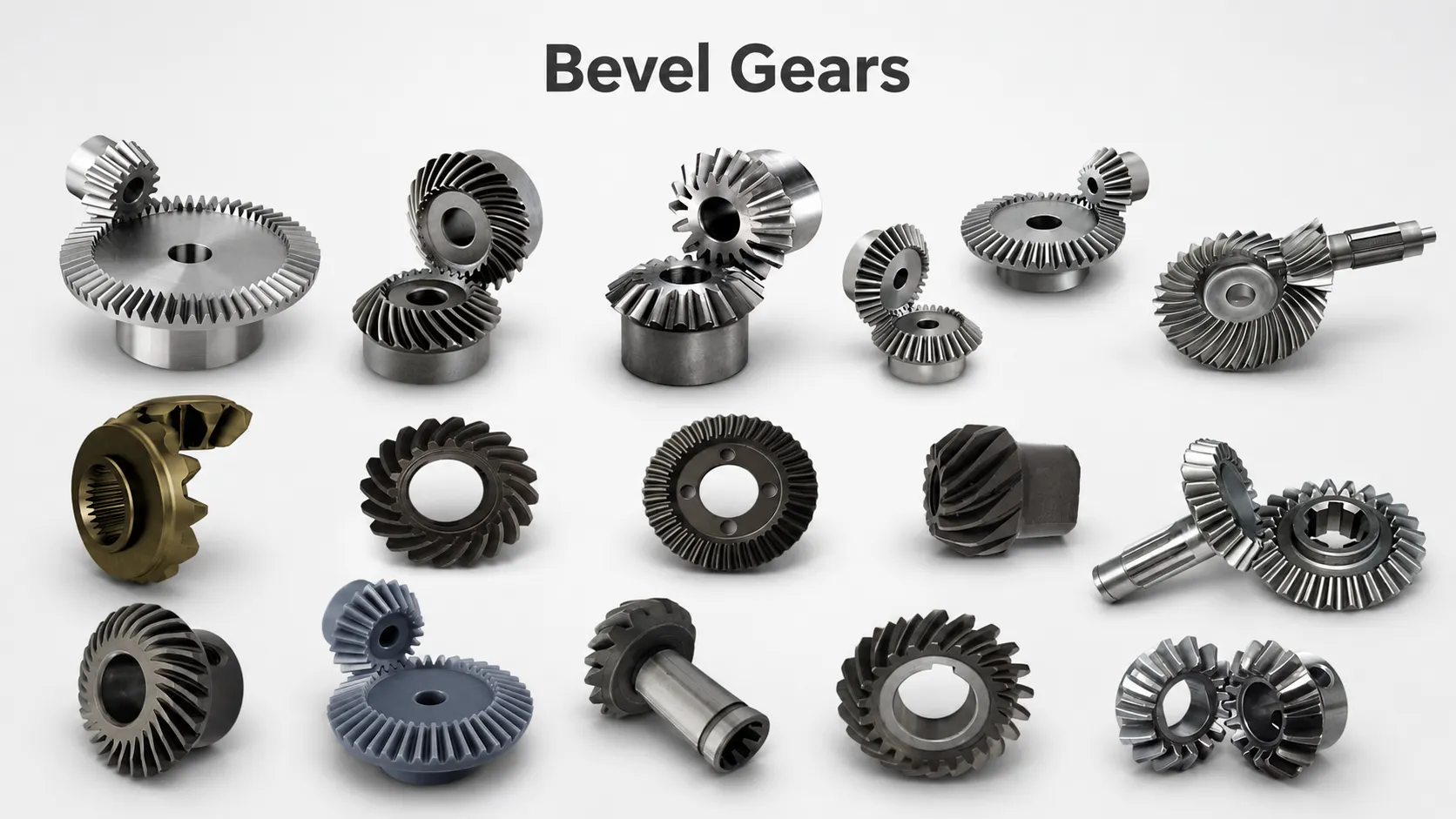
Korea Ever-Power’s bevel gears for robotics and automation are manufactured in 20CrMnTi case carburized for the standard industrial and collaborative robot joint market, and in 17-4 PH stainless (H900, HRC 38–43) for all food, pharmaceutical, cleanroom, and medical robotic applications. The spiral bevel tooth form is standard for all robotic bevel gears at M1.5 and above — the overlapping tooth contact of the spiral form provides 30–40% higher load capacity at the same pitch diameter and smoother torque transmission with lower dynamic mesh force than straight bevel. For the very smallest robotic bevel gears at M1 module (used in surgical robot end-effectors and micro-gripper actuators), straight bevel is used because the spiral bevel geometry at M1 is too fine for reliable manufacturing by the Gleason face-milling process — Korea Ever-Power uses the Klingelnberg cyclo-palloid spiral bevel process for M1–M1.5, which is capable of generating accurate spiral bevel geometry at smaller modules than the standard Gleason process.
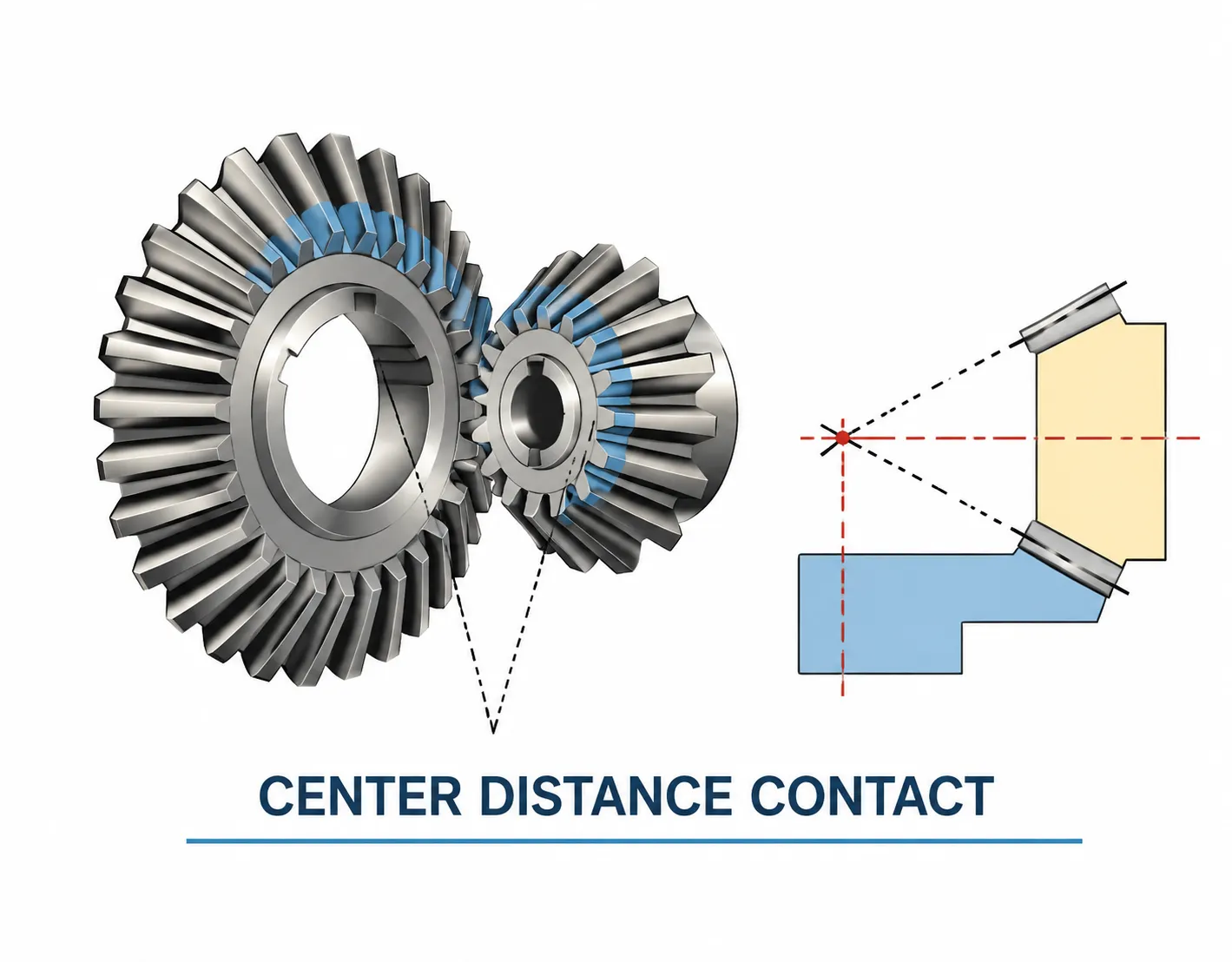
The backlash control of robotic bevel gears is achieved through the combination of tight manufacturing tolerances on the tooth thickness and the adjustable mounting distance (V-distance) of the bevel gear pair — the same principle as for standard miter gears, but applied with much tighter tolerances. The V-distance adjustment in a robot wrist bevel gear pair is typically accomplished by shimming the inner bearing of each shaft — a stack of thin shims between the bearing outer race and the housing bore that controls the axial position of each gear to within ±0.01 mm. Korea Ever-Power supplies robotic spiral bevel gear pairs with the measured tooth thickness of each gear (to ±0.002 mm, measured by an over-pin method with a calibrated micrometer), the tooth contact pattern photographs at 25%, 50%, and 75% of rated torque, and the calculated V-distance adjustment required to achieve the target backlash. This documentation package allows the robot builder to achieve the target backlash at first assembly without iterative trial-and-error shimming — a significant time saving in high-volume robot production.
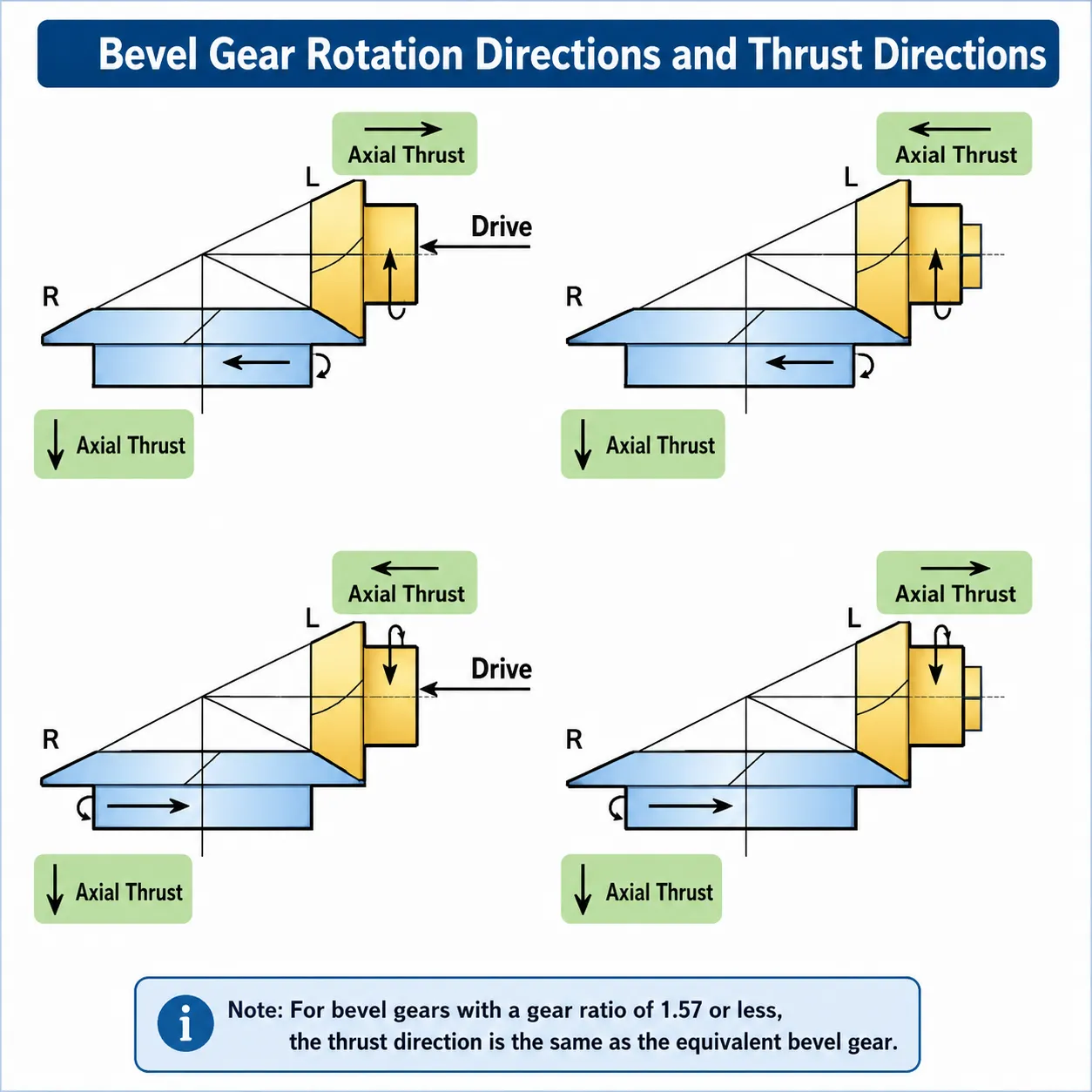
Robot Application Bevel Gear Specifications
6-Axis Robot Wrist (J4–J6)
M1.5–M2.5 spiral bevel, 20CrMnTi carburized, DIN 5–6 ground, individually matched pair from same production run. The J4, J5, and J6 wrist joints of a 6-axis industrial robot are the axes most commonly incorporating bevel gears — they enable the compact, spherical wrist configuration that allows the robot tool to reach any orientation. J6 (tool rotation) is typically a spur gear driven wrist, but J4 and J5 often use bevel pairs for the space-efficient 90° direction change within the wrist housing. The bevel gear in a robot wrist runs at the highest speed of any joint (J6 can reach 500–900 RPM output), placing the pitch line velocity of M2 bevel gears at 1.5–3 m/s — requiring spiral bevel for smooth, low-noise operation. Temperature limit for the wrist joint: 60–80°C continuous, 100°C peak — standard greases remain within specification at these temperatures, but Korea Ever-Power provides high-temperature-rated gear greases for robot manufacturers whose wrist joints exceed 80°C in automotive welding or plasma-cutting environments.
M1.5–M2.5 · spiral · DIN 5–6 · 20CrMnTi
Delta Robot Arm Joint
M2–M4 spiral or straight bevel, 20CrMnTi or C45 induction hardened, DIN 6–7, 1:1 ratio (miter configuration common), high fatigue cycle life mandatory (>500 million). Delta robots (parallel kinematic architecture, used in food packing, pharmaceutical sorting, and electronics assembly for high-speed pick-and-place) use bevel gears in the forearm link angle joints that transmit the end-effector rotation (J4 rotation) down through the parallel arms to the tool. These bevel gears operate at the high cycle rates characteristic of delta robot pick-and-place operation — 120–200 cycles per minute in food packing applications, accumulating 500+ million cycles per year. The load on delta robot arm bevel gears is primarily from the end-effector inertia during rapid acceleration and deceleration at cycle reversal — the dynamic load at the bevel gear tooth can be 3–5× the static load at the rated end-effector mass. Korea Ever-Power delta robot bevel gears are designed with a dynamic load factor K_v = 1.5 to account for these impulse loads at reversal, in addition to the fatigue life calculation for the mean load.
M2–M4 · spiral · DIN 6–7 · high cycle fatigue
CNC ATC Mechanism
M2–M4 spiral bevel, C45 induction hardened or 20CrMnTi carburized, DIN 6–7, toolchanger-speed rated (up to 3 m/s PLV for fast ATC designs), compact housing integration. CNC machining centre automatic tool changers (ATCs) use bevel gears in the tool pot carousel drive, the arm swing mechanism, and the tool clamp/release actuator angle joints — all of which require compact right-angle drives that fit within the tight spatial envelope of the tool changer magazine and arm. The ATC bevel gear operates at lower precision requirement than a robot joint (the tool position is ultimately determined by the spindle taper, not the ATC gear position), but at high cycle rates — a machining cell running 500 tool changes per shift accumulates 1 million tool change cycles per year. Korea Ever-Power ATC bevel gears for Fanuc, Mazak, Yamazaki, and DMG Mori machining centres are supplied in M2–M4 with DIN 6–7 quality and C45 or 20CrMnTi material matching the original ATC mechanism specification.
M2–M4 · ATC magazine · DIN 6–7 · compact
Frequently Asked Questions — Bevel Gears for Robotics and Automation
Explore Korea Ever-Power Gear Categories
Seven precision gear product lines for robotics, automation, CNC machining and precision industrial applications worldwide.
편집자: Cxm
 Korean
  English
  Italian
  French
  Japanese