
Automotive Bevel Gear – M0.15 to M2.2, AGMA 13 / DIN 5
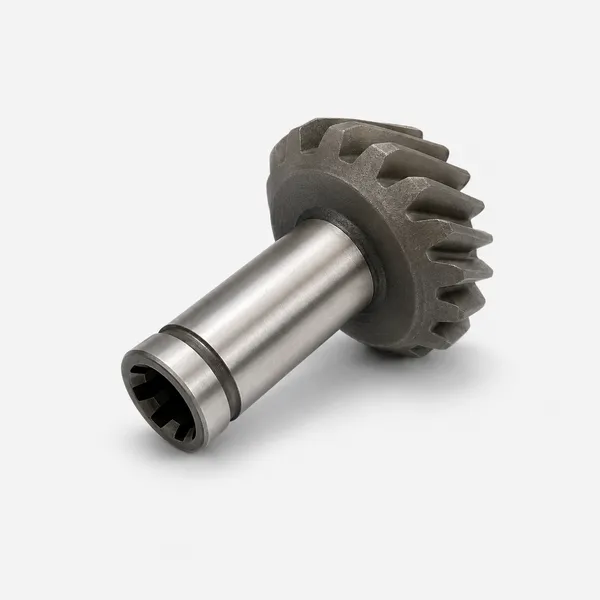
Korea Ever-Power automotive bevel gears cover module M0.15 through M2.2 and outer diameters from 3 mm to 120 mm. Meshing accuracy grades reach JGMA 1, AGMA 13, and DIN 5 — the highest precision tiers used in automotive drivetrains, military instruments, aircraft subsystems, and precision medical devices. Twelve material options from steel and alloy to POM, zinc, brass, and copper. TS16949 and ISO 9001:2008 certified. ODM and OEM service. Vacuum-packed with plastic tray; DHL and UPS available.
Product Overview
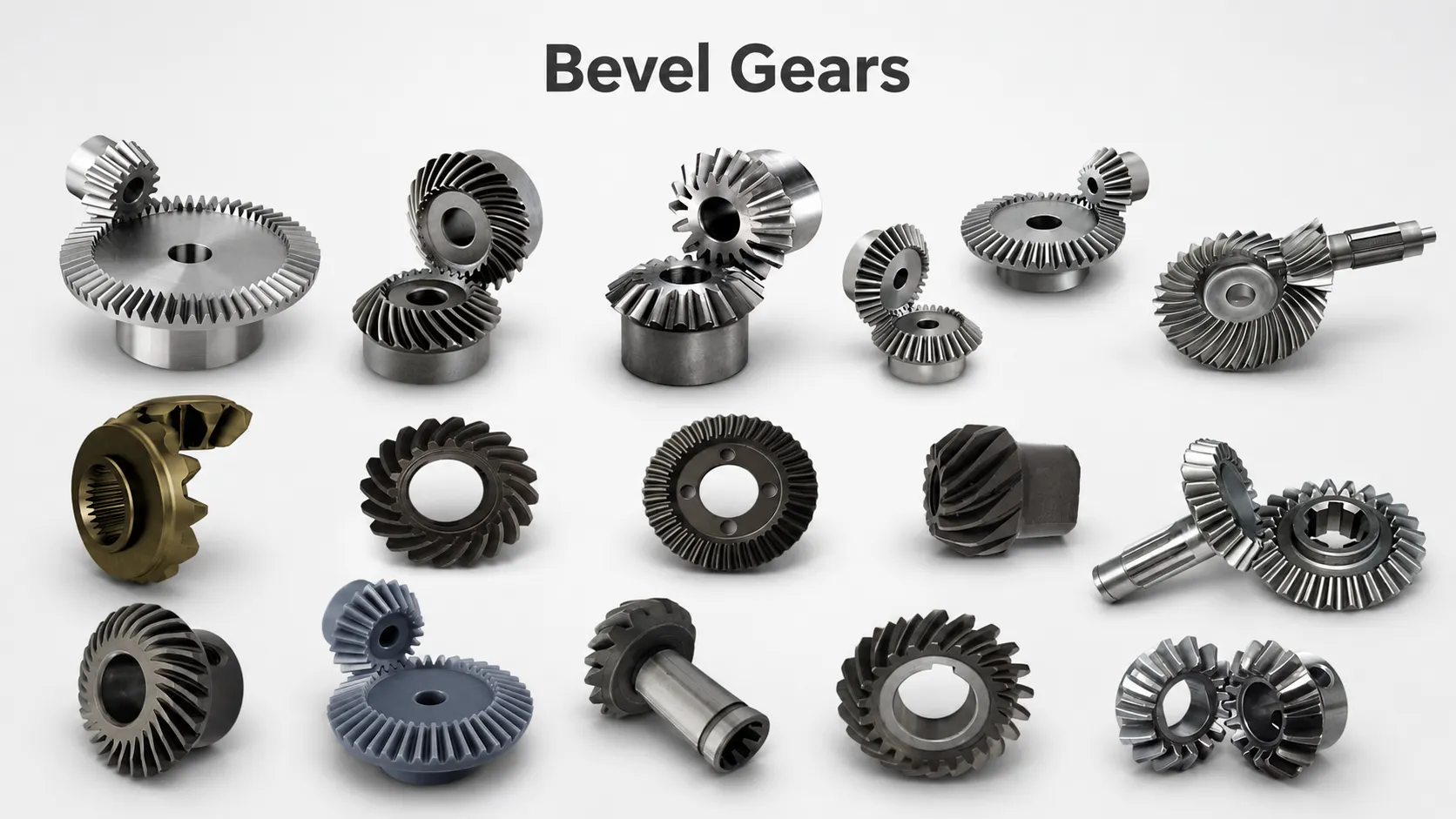
Korea Ever-Power automotive bevel gears occupy the precision end of the bevel gear range — small modules from M0.15 to M2.2, outer diameters from 3 mm to 120 mm, and meshing accuracy grades reaching JGMA 1, AGMA 13, and DIN 5. These are the tightest tolerance tiers specified anywhere in mechanical transmission — used in automotive electric power steering units, vehicle instrument clusters, military targeting and sighting systems, aircraft flight instrument drives, and precision medical diagnostic equipment. At these accuracy grades, tooth spacing error, profile form deviation, and runout are measured in single-digit micrometres.
The Gleason manufacturing method is applied throughout Korea Ever-Power's automotive bevel gear production. Gleason geometry defines the tooth form, contact pattern, and generating method used for the great majority of precision automotive and aerospace bevel gears worldwide. It is distinct from the Klingelnberg method in tooth form and contact geometry; when a customer drawing specifies Gleason geometry — as most automotive OEM drawings do — it is not interchangeable with Klingelnberg-produced gears even at the same module and tooth count. Korea Ever-Power produces to Gleason geometry as standard; the customer's drawing standard governs the specification.
Certification to TS16949 and ISO 9001:2008 covers the quality management system applied to automotive bevel gear production. TS16949 (now IATF 16949) is the automotive sector's specific quality system standard, adding production-part approval process (PPAP), failure mode and effects analysis (FMEA), and statistical process control (SPC) requirements on top of the base ISO 9001 framework. Customers in automotive supply chains, military procurement, and aerospace sub-tiers who require PPAP documentation or SPC data as part of their supplier qualification can request these at the quotation stage. All automotive bevel gears are vacuum-packed with a plastic tray for protection during transit, and DHL and UPS express delivery are available for urgent requirements.
Precision Grades — What AGMA 13, DIN 5, and JGMA 1 Mean
Gear accuracy grades in the AGMA, DIN, and JGMA systems define the permissible errors in tooth spacing, tooth profile form, pitch variation, and total runout. Higher AGMA numbers mean tighter tolerances; lower DIN and JGMA numbers mean tighter tolerances. The grades available for automotive bevel gears from Korea Ever-Power span the range from AGMA 12 / DIN 6 (precision industrial) up to AGMA 13 / DIN 5 / JGMA 1 (the highest practical production grade).
AGMA 13 / DIN 5 / JGMA 1 — Highest Precision
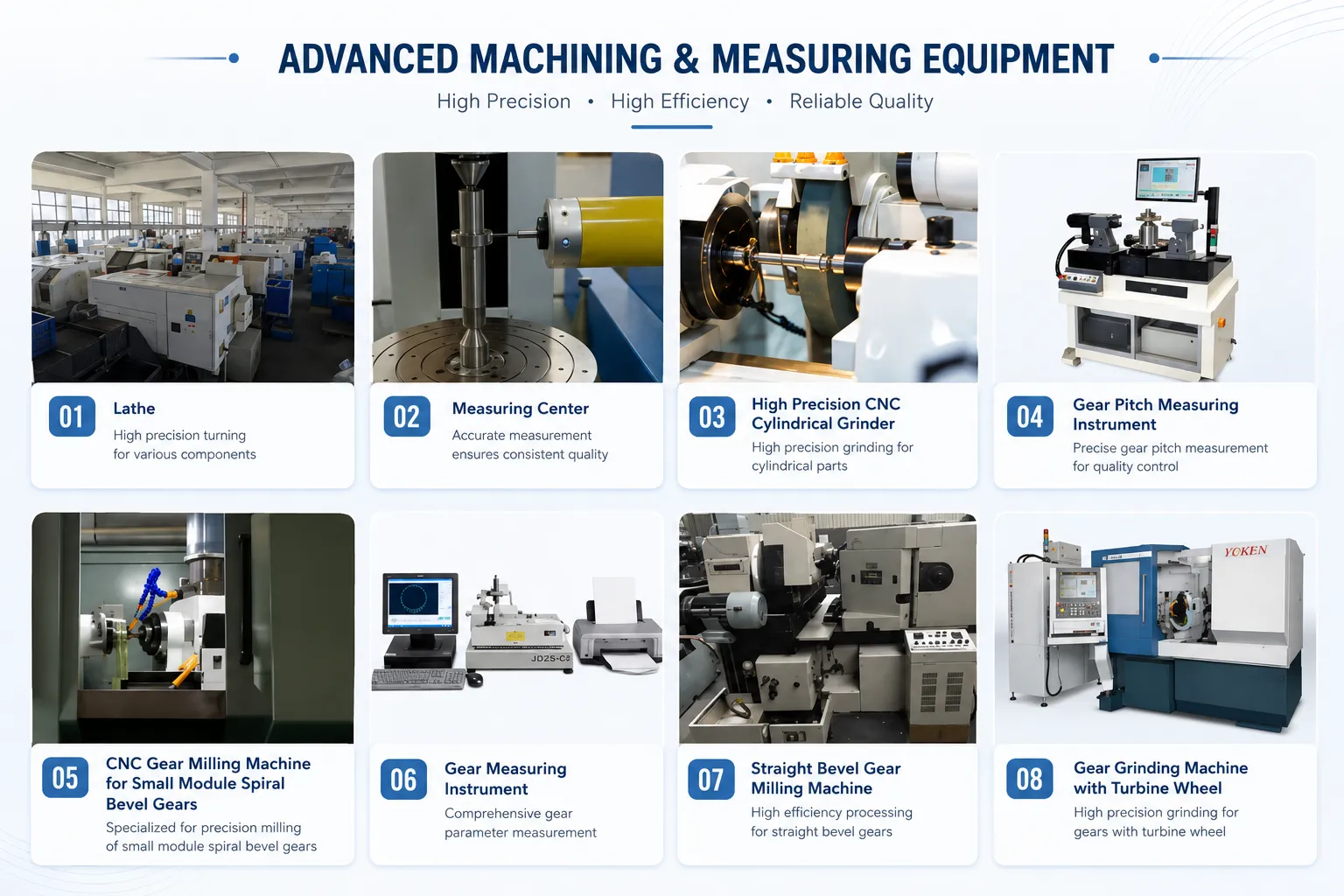
Tooth spacing error, profile form deviation, and pitch variation are each controlled to single-digit micrometre tolerances. Achieved only through post-hardening gear grinding with CMM verification of every critical parameter. Applied in precision aircraft instruments, military sighting drives, medical device rotary actuators, and automotive electric power steering gear trains where transmission error must be minimised to below a threshold detectable by the vehicle's torque sensor. Production at this grade requires temperature-controlled metrology and measurement traceability to national standards.
AGMA 12 / DIN 6 / JIS 6 — High Precision
One step below the top tier — still produced by gear grinding with full CMM verification, but with slightly relaxed tolerances that allow higher production throughput. Applied in automotive differential ring-and-pinion sets for passenger cars, precision servo drives, and military vehicle subsystem drives. The tolerance field is tight enough for most automotive and defence applications where the top-tier grade is not explicitly required by the drawing.
JIS 6 / AGMA 11 — Standard Automotive
The baseline precision grade for general automotive applications. Produced by high-quality milling followed by hardening and optional lapping. Applied in passenger car accessory drives, motorcycle bevel drives, light commercial vehicle differentials, and general-purpose precision instrument gearheads where the tolerance requirements are defined by the application's noise and backlash specification rather than by a specific AGMA grade requirement.
Technical Specifications
All specific values are confirmed against the customer's drawing or sample at the quotation stage. For automotive OEM programmes, a PPAP submission plan and first-article inspection report format can be agreed before production commences.
| Parameter | Specification |
|---|---|
| Gear Type | Automotive bevel gear — straight, spiral, or zero-degree spiral; Gleason method standard |
| Module Range | M0.15 – M2.2; confirmed per customer drawing |
| Outer Diameter Range | Φ3 mm – Φ120 mm |
| Meshing Accuracy Grade | JGMA 1, JIS 6, AGMA 13, DIN 6, DIN 5, AGMA 12 |
| Manufacturing Method | Gleason method (standard); customer drawing method governs |
| Material Options | Metal, Bronze, Steel, Alloy, POM, Zinc, Aluminium, Iron, Stainless steel, Brass, Copper — 12 options |
| Application Sectors | Automotive, Military, Aircraft, Mechanical, Industrial, Medical |
| OEM / ODM Service | Full ODM and OEM capability; customer drawings, samples, or specifications accepted |
| Certification | ISO 9001:2008; TS16949 (IATF 16949 automotive quality system) |
| Packing | Vacuum-packed with plastic tray (precision protection during transit) |
| Delivery | DHL, UPS express; sea freight for larger volumes |
| Samples | Samples available prior to production batch approval |
Material Guide — 12 Options for Every Operating Environment
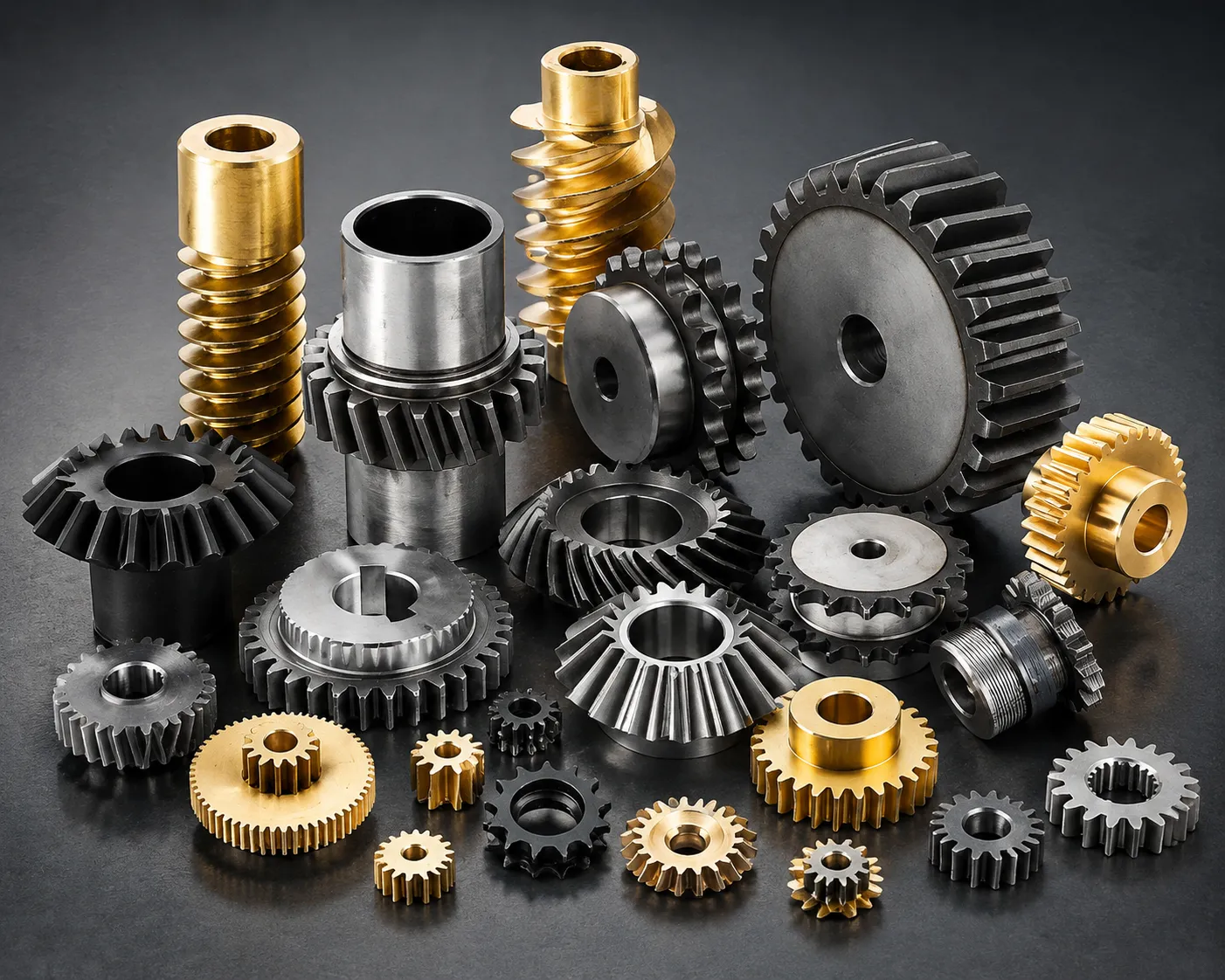
The breadth of material options available for automotive bevel gears reflects the diversity of applications they serve — from heavily loaded steel differential gears to lightly loaded plastic instrument gears running without lubrication. The guide below matches each material family to its primary application context.
Case-hardening alloy steels (20CrMnTi, 20CrNiMo) for maximum load capacity in automotive differentials, transfer cases, and power take-off drives. Through-hardening grades (42CrMo, 40Cr) for moderate-load applications where dimensional stability after heat treatment is important. Alloy steel at small module produces tooth profiles with adequate strength even at Φ5–10 mm outer diameter.
Automotive differentials, transfer cases, military vehicle drives, heavy motorcycle final drives
For automotive and medical applications in corrosive or wash-down environments. Surgical robotic wrist drives, medical imaging gantry bevel stages, and food-service vehicle gearheads where corrosion resistance takes precedence over maximum load capacity. Passivation after machining maximises the passive oxide layer and is certifiable for medical device supplier audits.
Medical devices, food vehicles, marine auxiliary, surgical robotics
Brass automotive bevel gears machine to very tight tolerances and run quietly against a steel driver gear, making them standard in precision automotive instrument clusters and dashboard mechanism drives where low noise and no lubrication are both required. Bronze provides higher load capacity than brass and better corrosion resistance, used in marine automotive and specialised instrument applications.
Instrument clusters, dashboard drives, automotive clocks, precision gauges
Pure copper automotive bevel gears are specified in electrical grounding mechanisms and specialised EMI-sensitive automotive control systems where the material's conductivity is exploited. Also used in non-sparking applications in potentially explosive vehicle environments. Load capacity is low; use only where the electrical or non-sparking property is the primary specification driver.
Electrical grounding, non-sparking drives, EMI-sensitive controls
Anodised aluminium automotive bevel gears offer minimum weight combined with good machinability and corrosion resistance. Used in weight-sensitive automotive drivetrain subassemblies, motorsport angle drives where rotating mass is minimised, and drone/UAV angle drives where both weight and corrosion resistance matter. Anodising adds measurable hardness to the tooth flank surface and can be dyed for visual identification of different gear ratios.
Motorsport, UAV, lightweight automotive subsystems, EV drive subassemblies
POM automotive bevel gears are self-lubricating, quiet, and chemically resistant to automotive fluids including fuel, brake fluid, and coolant. Used in window regulator mechanisms, seat position adjusters, HVAC damper drives, and instrument panel actuators where the drive runs intermittently, loads are light, and no maintenance access is possible after assembly. At small module, POM gears can be injection-moulded to tight dimensional tolerances at high volume.
Window regulators, seat actuators, HVAC drives, instrument panel mechanisms
Zinc die-cast automotive bevel gears are economical for high-volume low-load applications such as door handle mechanisms, trunk lid actuators, and interior trim adjustment drives. Die-casting produces near-net-shape parts with minimal post-machining, reducing per-unit cost at volumes above tens of thousands of pieces. Dimensional accuracy is lower than machined gears; application must tolerate the die-cast tolerance range.
Door mechanisms, interior trim drives, trunk actuators, high-volume light-load applications
Grey cast iron provides good vibration damping and wear resistance at low cost for slow-speed automotive and commercial vehicle auxiliary drives — water pump angle drives, oil pump bevel stages, and PTO drives on trucks where the pitch-line speed is below 3 m/s and noise damping is valued. Ductile iron adds impact resistance while retaining the machinability and cost advantage of the cast iron family.
Truck PTO, water pump drives, oil pump bevel stages, slow auxiliary drives
Gleason Method — The Automotive Industry Standard
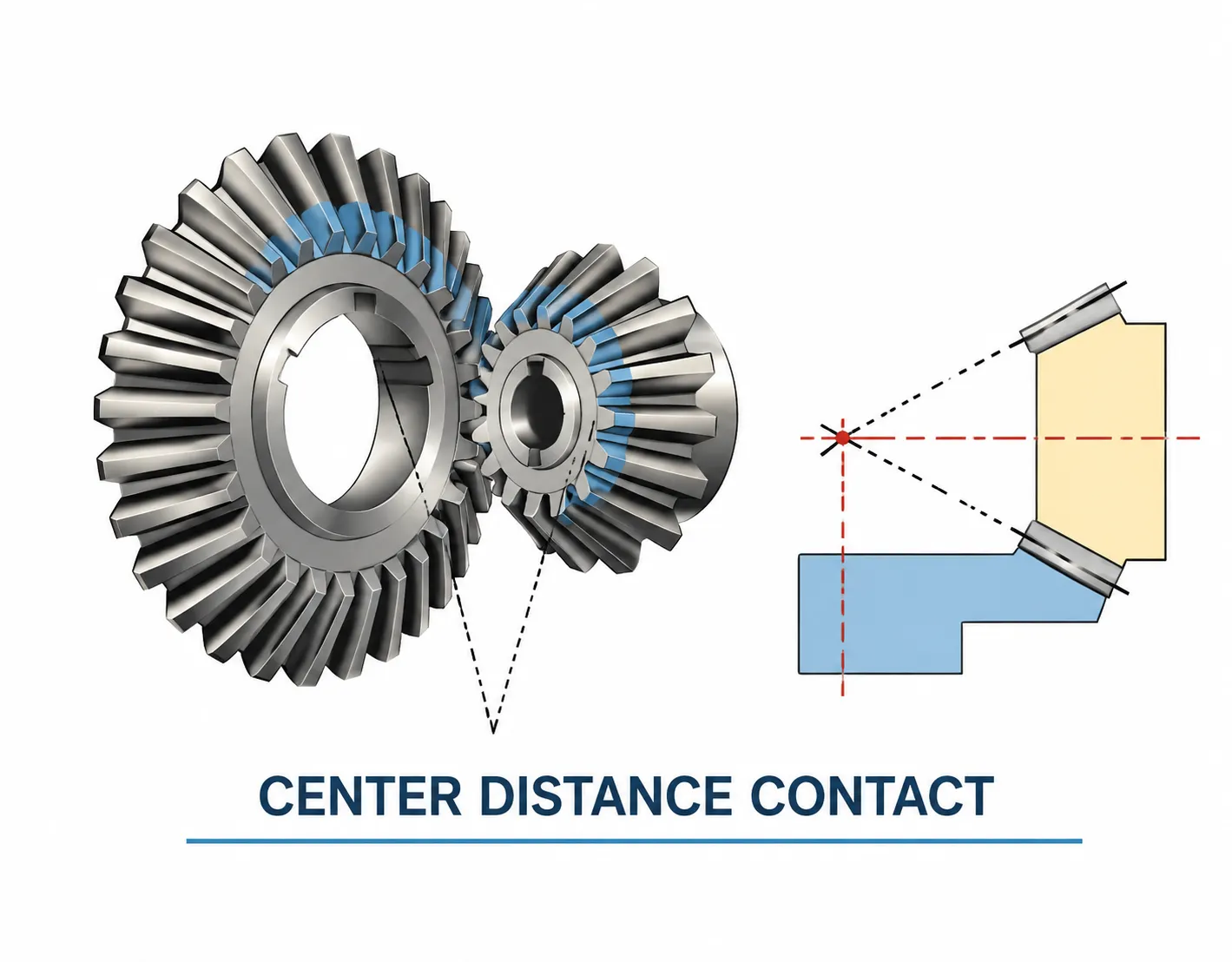
Automotive bevel gears can be manufactured by two principal methods — Gleason and Klingelnberg — which produce different tooth forms and contact geometries. The majority of automotive OEM designs, and all gears produced by Korea Ever-Power for automotive applications, use the Gleason method. Understanding the difference matters when sourcing replacement or interchangeable gears.
Gleason method — tapering slot width
The Gleason system uses a single-indexing face-milling process that produces tapered tooth slot widths — the slot is wider at the heel and narrows toward the toe. Tooth depth is also tapered from heel to toe. The resulting tooth contact geometry is designed for a localised contact zone that is positioned and shaped by adjusting the cutter radius, cradle angle, and roll ratio during setup. Gleason gears from different manufacturers are interchangeable if they share the same module, tooth count, and Gleason dimension sheet parameters.
Klingelnberg method — uniform slot width
The Klingelnberg system uses continuous face-hobbing that produces uniform depth teeth — the tooth depth is constant from heel to toe, while the slot width tapers. Contact geometry differs from Gleason, and Klingelnberg gears are not interchangeable with Gleason gears even at the same module and tooth count. European industrial and commercial vehicle manufacturers have historically used both methods; confirm which method your application drawing specifies before ordering.
Practical implication for replacement orders
If you are ordering a replacement automotive bevel gear, the method used by the original gear manufacturer must be matched. A Gleason replacement for a Klingelnberg original, or vice versa, will produce different tooth contact and may not fit the original housing contact verification requirements, even if the external envelope dimensions are identical. Korea Ever-Power produces Gleason-method gears as standard; if your application uses Klingelnberg geometry, please specify this explicitly at the enquiry stage.
TS16949 Quality System — What It Means for Automotive Buyers
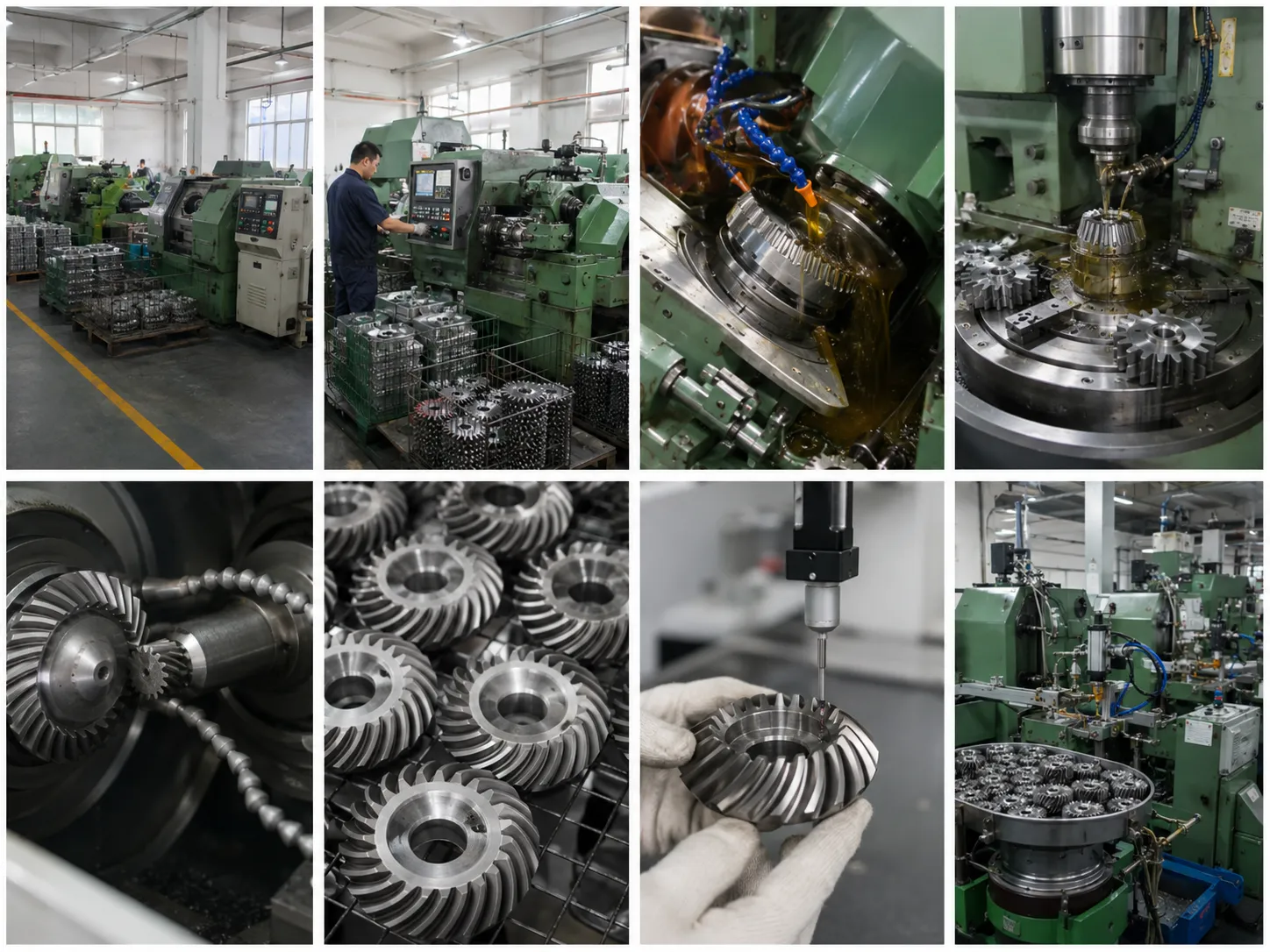
TS16949 (now formally IATF 16949) is the quality management standard required of Tier 1 and Tier 2 suppliers in the global automotive supply chain. It adds specific automotive requirements on top of the ISO 9001 base framework, covering the following elements that are relevant to automotive bevel gear customers:
- PPAP (Production Part Approval Process) — for new programmes, Korea Ever-Power can submit a PPAP package at the level specified by the customer (Level 1 through Level 5). A Level 3 PPAP includes the full design record, process flow, PFMEA, control plan, dimensional study, material performance results, initial process study, and sample parts.
- FMEA (Failure Mode and Effects Analysis) — Process FMEA for automotive bevel gear production identifies potential process failure modes, their effects, and the controls in place to prevent or detect them. Available for customer review as part of the PPAP package.
- SPC (Statistical Process Control) — Key characteristics on automotive bevel gear dimensions — typically tooth spacing error and bore diameter — are monitored using statistical process control with Cp and Cpk values reported against the customer's capability index requirement.
- Control plan — A documented control plan defines the inspection frequency, measurement equipment, and acceptance criteria for each critical characteristic through the production process, from incoming material through final shipment.
- Traceability — Each production batch is traceable to raw material heat, processing dates, equipment used, and operator records. In the event of a field quality event, Korea Ever-Power can provide a complete production history for the affected parts within one working day of the request.
Applications
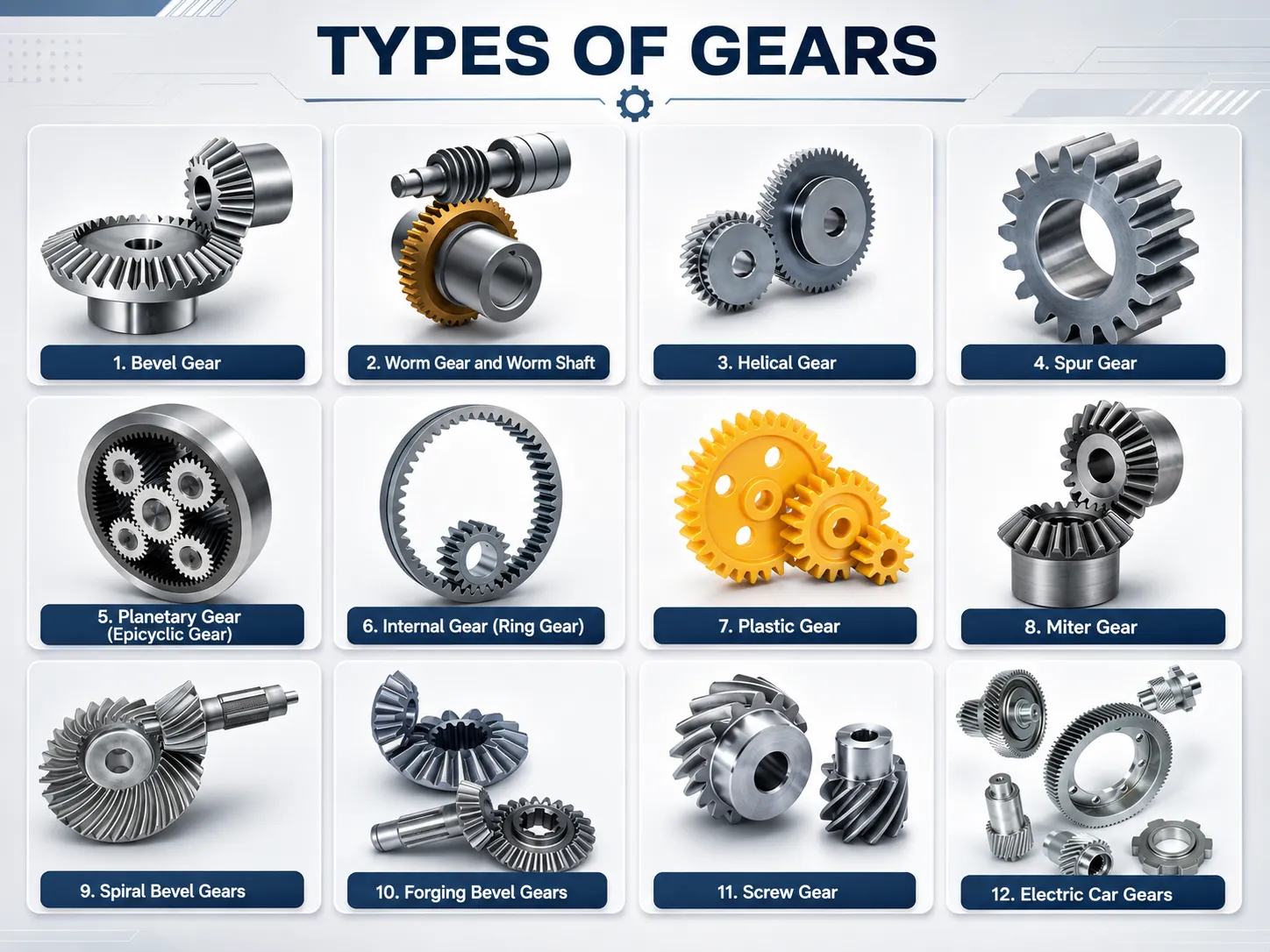
Korea Ever-Power automotive bevel gears are deployed across six application sectors, each with distinct requirements for accuracy grade, material, and documentation. The small module range M0.15–M2.2 covers the most demanding precision applications in all six sectors.
Automotive
Differential ring-and-pinion sets, electric power steering bevel stages, HVAC damper drives, window regulator drives, and transmission auxiliary drives. The widest material range applies here — from carburised alloy steel in the differential to POM in the window regulator — reflecting the diversity within a single vehicle's drivetrain.
Military
Targeting and sighting drive systems, gun elevation and traverse drives, vehicle turret rotation drives, and field instrument angle transmissions. Military applications frequently require AGMA 13 / JGMA 1 accuracy for low transmission error, non-magnetic stainless or brass materials in proximity to magnetically sensitive equipment, and full material traceability documentation per defence procurement standards.
Aircraft
Flight instrument bevel drives, avionics cooling fan drives, actuator feedback gear trains, and helicopter cockpit instrument gearheads. Aviation applications at module M0.15–M2.2 are among the most demanding in the range — AGMA 13 accuracy, temperature-resistant materials, and full material traceability to AS9100 requirements. Korea Ever-Power can provide AS9100-compatible documentation on request.
Mechanical & Industrial
Precision instrumentation gearheads, servo drive angle stages, encoder coupling drives, and laboratory test equipment. These applications typically require the accuracy of an automotive grade but operate at much lower loads than an automotive differential — the accuracy grade is driven by low transmission error and backlash requirements rather than by load capacity considerations.
Medical
Surgical robotic wrist joints, MRI gantry drives, infusion pump angle stages, and diagnostic imaging rotary axes. Medical applications combine the highest accuracy requirements with the strictest material and cleanliness standards — stainless or anodised aluminium materials, passivation certification, and validated cleanliness per ISO 15223. Korea Ever-Power's automotive-grade quality system covers the process control requirements for medical device supplier qualification.
Semi-Conductor Equipment
Wafer-handling robot wrist bevel drives and stage positioning angle drives in semi-conductor fabrication use automotive-grade precision bevel gears at very small module. Cleanroom compatibility requires low particle generation — anodised aluminium or passivated stainless gears with degreased and vacuum-packed delivery are the standard specification for cleanroom-destined bevel gear sets.
Frequently Asked Questions
What is the minimum module automotive bevel gear you can produce?
Korea Ever-Power's automotive bevel gear production covers module M0.15 at the lower end of the range. At module M0.15, the gear outer diameter for a typical 12-tooth gear is approximately 3–4 mm — a miniature gear suitable for instrument cluster drives, MEMS-adjacent mechanical systems, and ultra-compact medical device actuators. Producing at this scale requires specialised tooling and measurement equipment that operates in temperature-controlled metrology rooms; tooth spacing errors at M0.15 are measured in sub-micrometre increments. Please submit your drawing with the exact module and tooth count for a feasibility confirmation before ordering at the smallest module sizes.
My application requires a unique material not listed — can you produce to a special specification?
Yes. Korea Ever-Power's R&D team reviews custom material requests against the machinability, heat treatment response, and tooth strength requirements of the specific gear geometry. Provide the material specification (grade standard, chemistry limits, mechanical property requirements) and the application data (torque, speed, temperature range, and any regulatory constraints such as RoHS, REACH, or biocompatibility). The R&D team confirms feasibility and estimated cost impact within five working days. Non-standard materials that require sourcing outside our regular stock will affect lead time; this is communicated at the feasibility stage before you commit to an order.
What is the difference between AGMA 13, DIN 5, and JGMA 1 in practice?
These three designations are the highest precision grades in their respective national standards — AGMA (American), DIN (German/European), and JGMA (Japanese). They are broadly equivalent in the tolerance levels they specify, though not numerically identical because the standards were developed independently and use different reference formulas. A gear produced to AGMA 13 will generally meet DIN 5 requirements and vice versa at the same module, though strict compliance must be verified against the specific tolerance tables in each standard. When a customer's drawing references one standard, Korea Ever-Power produces to that standard and verifies against its specific tolerance tables. If a customer needs compliance to two standards simultaneously, state this at the enquiry stage and we will confirm whether the tolerance intersection is achievable for the specific module and tooth count.
Can you supply automotive bevel gears with a PPAP package for a new production programme?
Yes. Korea Ever-Power's TS16949 quality system supports PPAP submission at Levels 1 through 5 for automotive bevel gear programmes. A Level 3 PPAP — the most commonly requested — includes the design record, process flow diagram, PFMEA, control plan, measurement system analysis (MSA), dimensional results, material and performance test results, initial process capability study, qualified laboratory documentation, and sample parts. PPAP lead time is typically four to six weeks after first-article sample production, depending on the scope of the submission. Please include the required PPAP level in your programme request so we can schedule the documentation activity alongside the tooling and production planning.
Are samples available before committing to a production order?
Yes. Samples are available prior to production batch approval. For automotive bevel gears the standard approach is to produce a first-article sample batch — typically 3 to 10 pieces — accompanied by a dimensional inspection report, material certificate, and (where specified) a PPAP Level 1 design record confirmation. The customer inspects and approves the samples before the production order is released. Sample freight is by DHL or UPS express, and the customer is responsible for express freight costs unless otherwise agreed in the purchase terms.
Can I visit the Korea Ever-Power factory before placing a production order?
Factory visits are welcome and encouraged for new automotive programme customers who need to qualify the supplier facility before approving production. Please let us know your planned visit dates at least two weeks in advance so we can arrange the factory tour, QA team briefing, and metrology room demonstration. For customers based in Korea, we can also arrange reference contacts at existing Korean automotive tier-1 suppliers currently active in our customer base, subject to their consent. Contact our team to begin the qualification discussion.
Customer Reviews
"We qualified Ever-Power as a Tier 2 supplier for our electric power steering bevel gear programme. The PPAP Level 3 package was complete and submitted within the agreed timeline — no requests for supplemental data from our customer quality team. SPC data in the first six production months shows Cpk above 1.67 on the critical characteristics. The programme has been running for 14 months without a single quality escape."
Song Ji-young | Supplier Quality Engineer, Seoul Automotive Steering Systems · Q2 2025
"We source M0.5 brass automotive bevel gears for a precision instrument cluster drive in commercial vehicles. The AGMA 12 accuracy requirement and the brass material combination are unusual — most suppliers quote steel only. Ever-Power produced to the drawing with a complete dimensional report. The gear set runs quietly with no lubrication, which was the key requirement in the sealed instrument housing."
Yoo Chang-min | Design Engineer, Incheon Vehicle Instrument Systems · Q4 2025
"We manufacture UAV propulsion angle drives and needed M1.0 aluminium anodised bevel gears at AGMA 12 accuracy. Weight was the primary constraint — every gram matters at the wing root. Ever-Power produced at the specified module and accuracy grade with anodising, and the weight per gear matched our material calculation. The drive has now completed over 200 flight hours in test without gear failure."
Kim Do-hyun | Mechanical Design Engineer, Daejeon Unmanned Systems · Q1 2026
"We source M0.3 stainless bevel gears with passivation certification for a surgical robotic wrist. The passivation cert is required by our medical device QMS and the dimensional tolerances must be held to the drawing for the autoclave sterilisation cycle to maintain dimensional stability. Ever-Power's automotive-grade process control extended naturally to our medical application — the SPC data they provided showed all critical dimensions well within our tolerance limits."
Choi Eun-mi | Quality Manager, Seoul Surgical Robotics · Q3 2025
"Our military targeting drive uses M0.8 alloy steel bevel gears at JGMA 1 accuracy in a non-magnetic housing — material and accuracy both specified by the defence procurement standard. Three other suppliers declined due to the JGMA 1 requirement. Ever-Power confirmed feasibility within three days and delivered to the accuracy grade with full traceability documentation. The qualification inspection passed on first submission."
Park Jun-seok | Procurement Engineer, Busan Defence Equipment Co. · Q2 2026
Request a Quotation for Automotive Bevel Gears
Send us your drawing with module, tooth count, accuracy grade, and material. For automotive OEM programmes, include the required PPAP level. For military and aerospace applications, include the documentation standard. Samples available before production approval. Our engineering team returns a feasibility confirmation and price within two working days.
Additional information
| Editor |
|---|
Related products
-
Aircraft Bevel Gear – M0.15 to M2.2, AGMA 13, AS9100
-
Straight Bevel Gear – M3 to M12, DIN6-9, Multi-Material
-
Metal Bevel Gear – M0.15 to M2.0, 11 Alloys, AGMA 13
-
Zero-Degree Spiral Bevel Gear – Zerol, No Axial Thrust
-
Forging Bevel Gears – Hot & Cold Forged, Custom OEM Supply
-
Differential Gears – Open, LSD, Torque Vectoring, Forged PM
-
Plastic Bevel Gears – POM PA PEEK, -40°C to 80°C, 1:1–5:1
-
Spiral Miter Gears – 35° Spiral Angle, 1:1 High-Speed Drive
 English
  Italian
  Korean
  French
  Japanese