
Forging Bevel Gears – Hot & Cold Forged, Custom OEM Supply
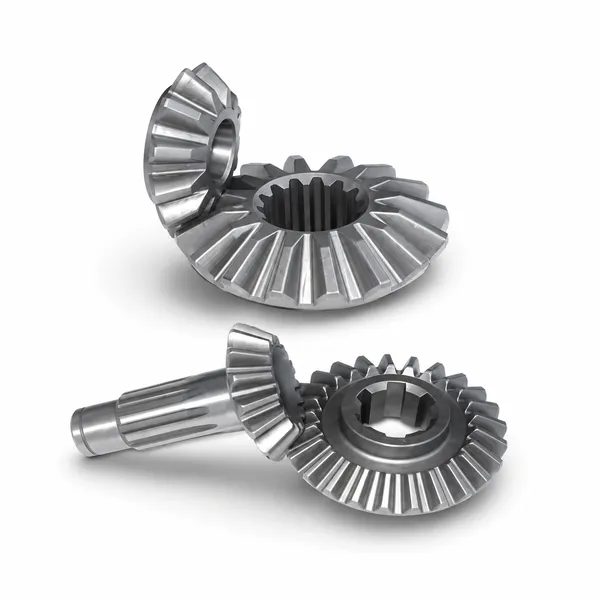
Korea Ever-Power forging bevel gears cover straight and spiral profiles produced by hot forging, cold forging, and compound forming. Alloy steel blanks, full heat treatment, and ISO 9001 quality control make these gears a direct-fit choice for automotive differentials, agricultural drivetrains, wind turbines, and industrial gearboxes. Standard and non-standard dimensions available; OEM enquiries welcome.
Product Overview
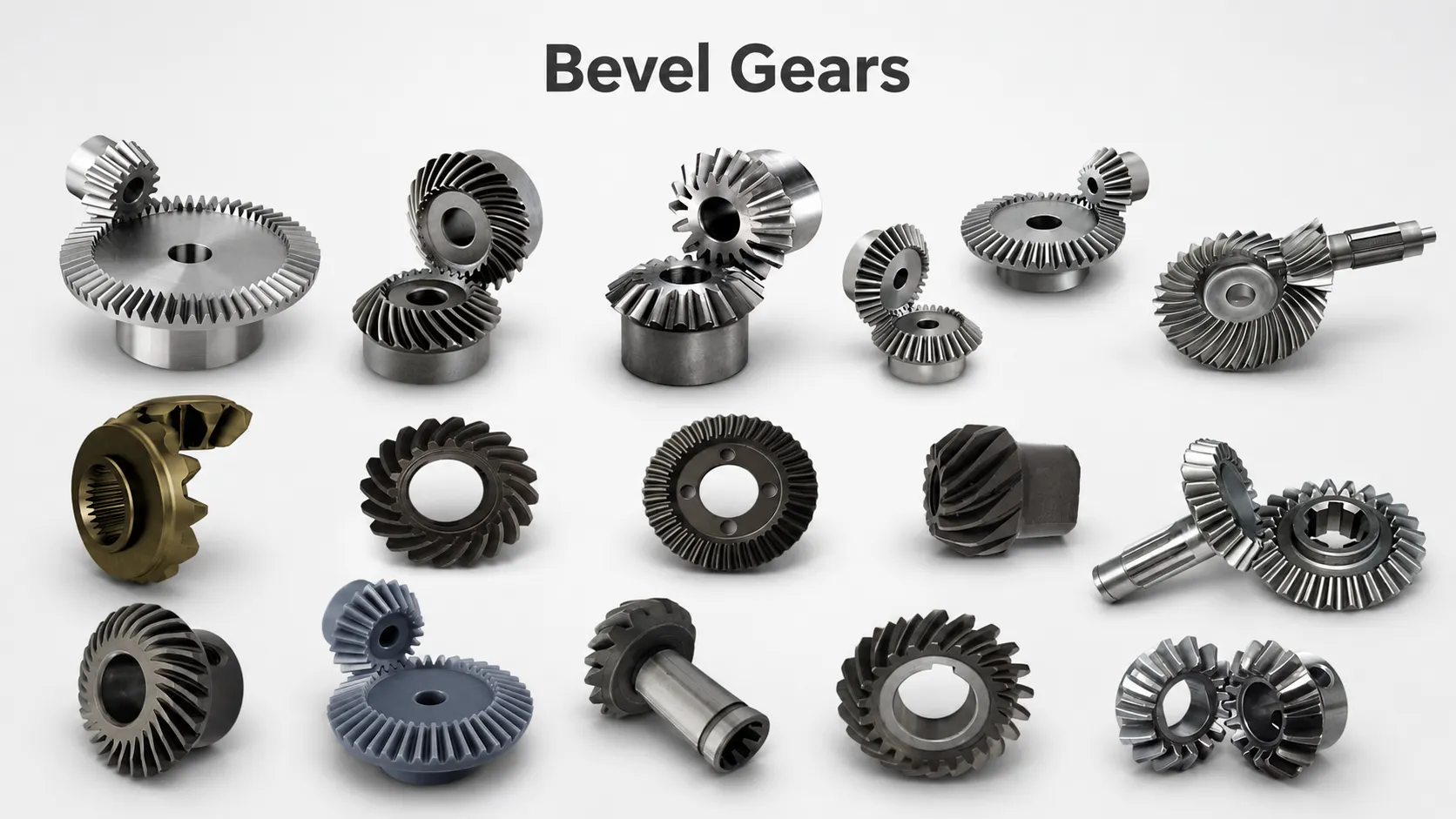
Korea Ever-Power forging bevel gears are produced through hot forging, cold forging, and compound forming processes applied to alloy steel and carbon steel blanks. The forging route delivers a continuous grain structure across the tooth profile — something machined-from-bar stock simply cannot replicate — which is why forged bevel gears carry higher load ratings at the same tooth module as cast or cut alternatives. Both forging straight bevel gears and forging spiral bevel gears are available from our production line, covering shaft intersection angles from 45° to 135° and gear ratios from 1:1 miter configurations up to 5:1 for reduction applications.
From the gear geometry standpoint, a bevel gear transmits rotation between two shafts whose axes meet at a point rather than running parallel. The pitch surfaces are conical — they form the shape of truncated cones — and the working flanks lie on those cones. This geometry is what makes bevel gears the standard solution wherever a right-angle or angular drive is needed without resorting to a worm stage. Compared with worm gears in the same power class, bevel gears maintain mechanical efficiency in the 97 to 99 percent range under full load, while worm stages rarely exceed 90 percent at high reduction ratios. Compared with crossed-axis helical gears, bevel gears carry significantly higher contact loads because the tooth engagement is along a full line rather than a theoretical point.
Korea Ever-Power supplies forged bevel gears to OEM buyers across the automotive, agricultural machinery, construction equipment, renewable energy, and marine sectors. Standard production covers a wide module range in carbon steel and alloy steel grades. Heat treatment — carburising, induction hardening, or through-hardening — is applied to suit the application's surface hardness and core toughness requirements. Non-standard tooth geometries and bore configurations are fully supported, with engineering review available from our Korean technical team throughout the quotation stage.
Technical Specifications
The parameters below reflect the general production capability for Korea Ever-Power forging bevel gears. Specific values for your application — including exact module, tooth count, bore, and heat treatment — are confirmed at the quotation stage based on your drawing or sample. All custom specifications are reviewed by our engineering department before order confirmation.
| Parameter | Typical Range / Options |
|---|---|
| Gear Type | Straight bevel gear, spiral bevel gear (both forged) |
| Module | As per customer drawing or standard series; confirm with enquiry |
| Pressure Angle | 20° most common; 14.5° and other angles per drawing |
| Shaft Intersection Angle | 90° standard; other angles per customer specification |
| Gear Ratio | 1:1 (miter) through high-reduction ratios; per drawing |
| Number of Teeth | Per customer drawing; standard and non-standard tooth counts |
| Outer Diameter | Small to large; confirmed against drawing at quotation |
| Face Width | Per AGMA / DIN / customer drawing |
| Material (Common) | 20CrMnTi, 20Cr, 45# steel, 40Cr, 42CrMo, 20CrNiMo |
| Material (Optional) | 304 / 316 stainless steel, brass, custom alloy per spec |
| Heat Treatment | Carburising & quenching, induction hardening, through-hardening, normalising, nitriding |
| Forging Process | Hot forging, cold forging, compound precision forging |
| Machining Standard | AGMA, DIN, JIS, GB; customer drawings accepted |
| Surface Treatment | Phosphating, black oxide, zinc plating, as-machined |
| Certification | ISO 9001:2015; material cert and hardness report with each order |
Straight vs. Spiral Forging Bevel Gears — Which to Choose
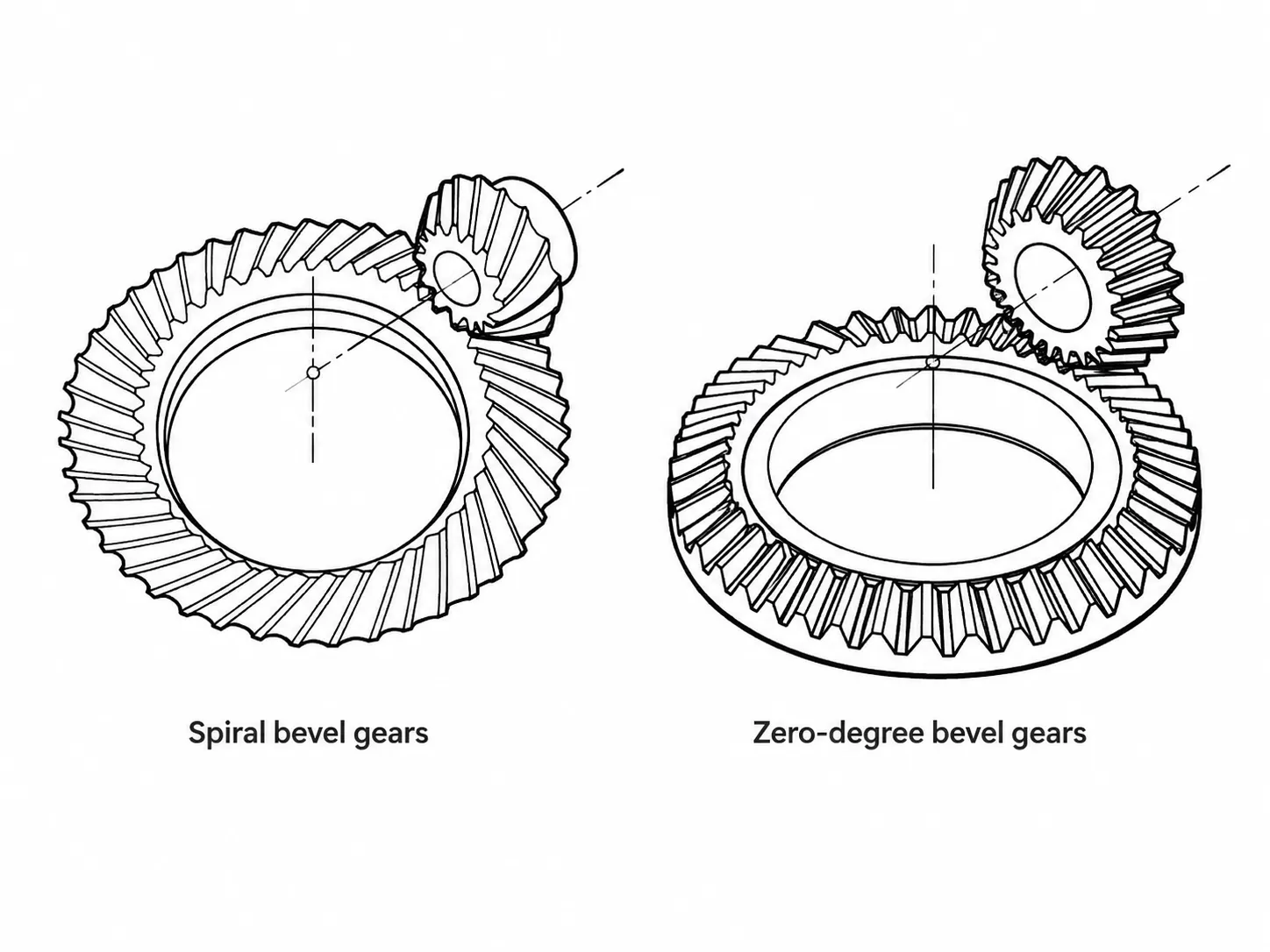
Both profiles are available in forged form. The selection depends on your speed range, noise budget, and torque class.
Straight bevel gears engage along the full tooth length simultaneously. Contact is instantaneous and generates an impact-type loading at each mesh cycle. This is manageable at low pitch-line speeds — typically below 5 m/s — but becomes a noise and fatigue concern above that. Straight teeth are also mechanically simpler, generate no axial thrust, and are less demanding on bearing selection. For low-speed drives, agricultural PTO attachments, and hand-tool gearheads, the straight profile is the practical default.
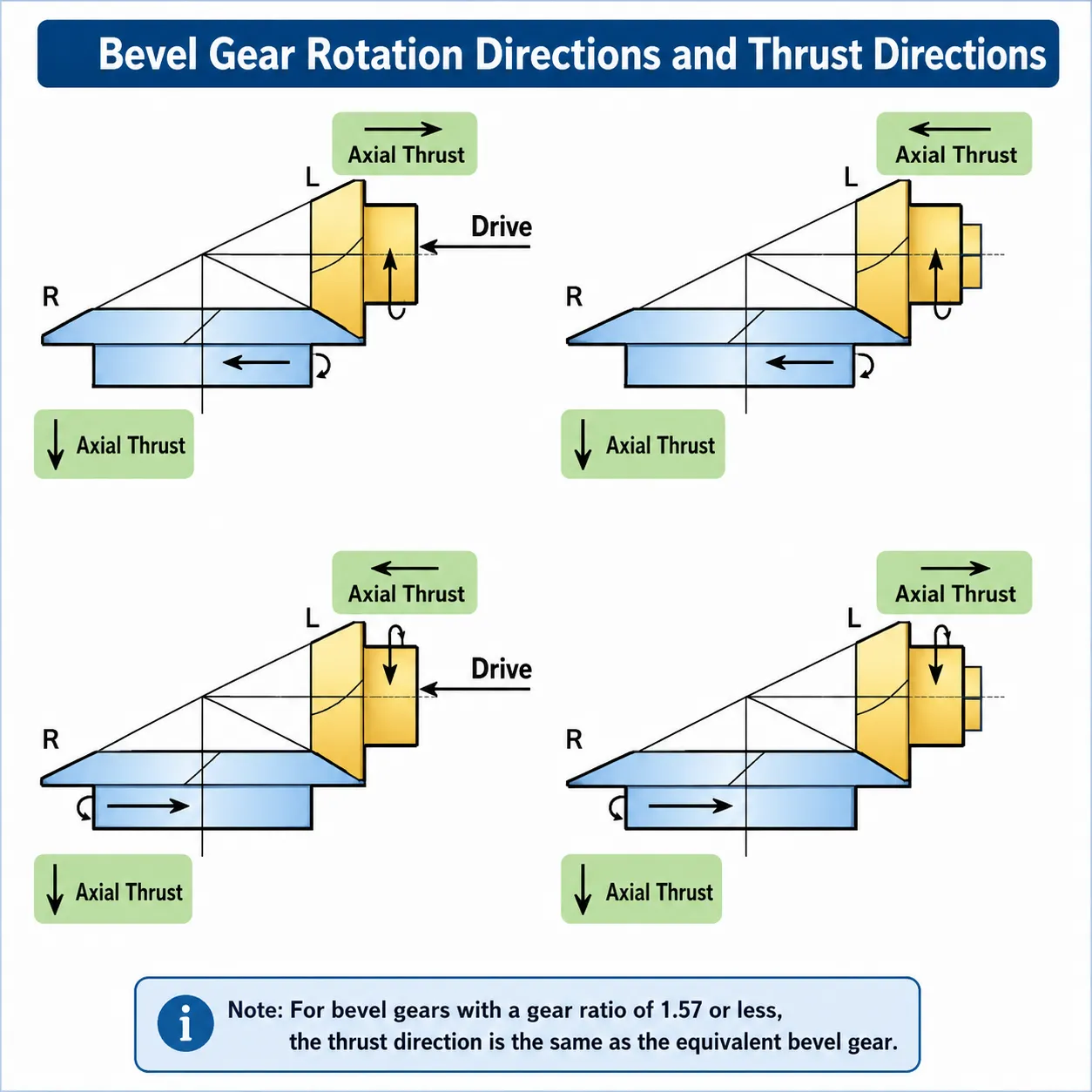
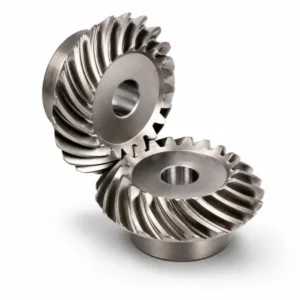
Spiral bevel gears have curved teeth set at a helix angle across the face. Because teeth enter and leave mesh progressively — rather than all at once — the load is shared across multiple teeth at any instant, reducing noise and allowing higher torque capacity within the same tooth module. The trade-off is that a spiral tooth generates an axial thrust component whose direction depends on the hand of spiral and the direction of rotation. Bearing and housing design must account for this. Above 5 m/s pitch-line speed, the spiral profile is almost always the correct choice, and it is the standard in automotive differentials, wind-turbine nacelle drives, and precision robotic joints for this reason.
| Criterion | Forging Straight Bevel Gear | Forging Spiral Bevel Gear |
|---|---|---|
| Tooth engagement | Full line, instantaneous | Progressive, multiple teeth in mesh |
| Noise level | Higher at elevated speed | Significantly quieter |
| Load capacity | Moderate | Higher — more teeth share load |
| Axial thrust | None | Present; bearing selection matters |
| Pitch-line speed | Up to ~5 m/s | 5 m/s and above |
| Tooling complexity | Simpler | More complex, higher accuracy achievable |
| Typical uses | Agricultural PTO, hand tools, low-speed drives | Automotive differentials, turbine gearboxes, robotics |
For the spiral type, the hand of spiral on the pinion determines thrust direction under load. A right-hand pinion rotating clockwise pushes axially toward its support bearing; reversing rotation pushes it away. This is a design parameter, not a deficiency — correct bearing pre-load and mounting distance compensate for it in any well-engineered installation. Thrust direction diagrams and bearing load estimates are provided as part of our standard application review.
Installation and Tooth Contact Confirmation
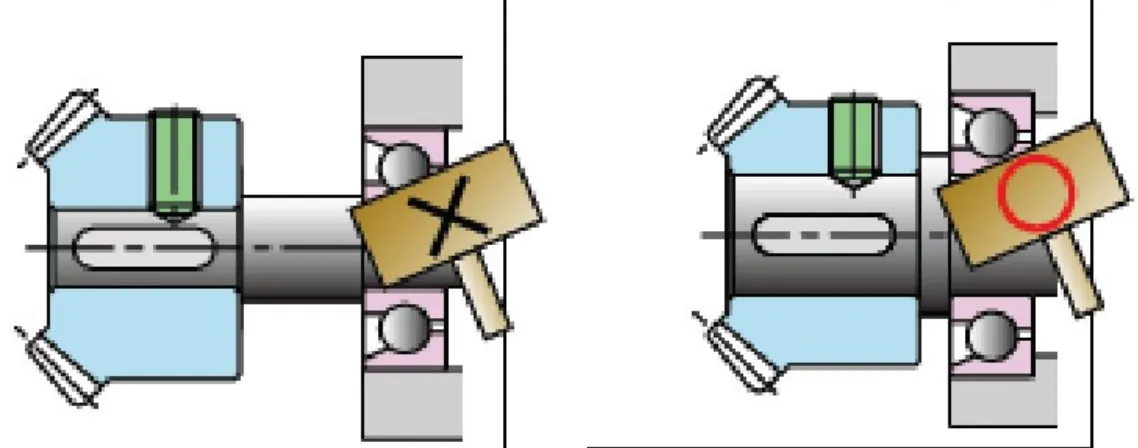
Bevel gear performance depends not only on the gear pair quality but on how precisely the pair is positioned during assembly. The mounting distance — the axial distance from each gear's pitch cone apex to its mounting face — must be held to the design value. Errors in mounting distance shift the tooth contact pattern toward either the toe (small end) or heel (large end) of the tooth, reducing effective face width and raising local stress.
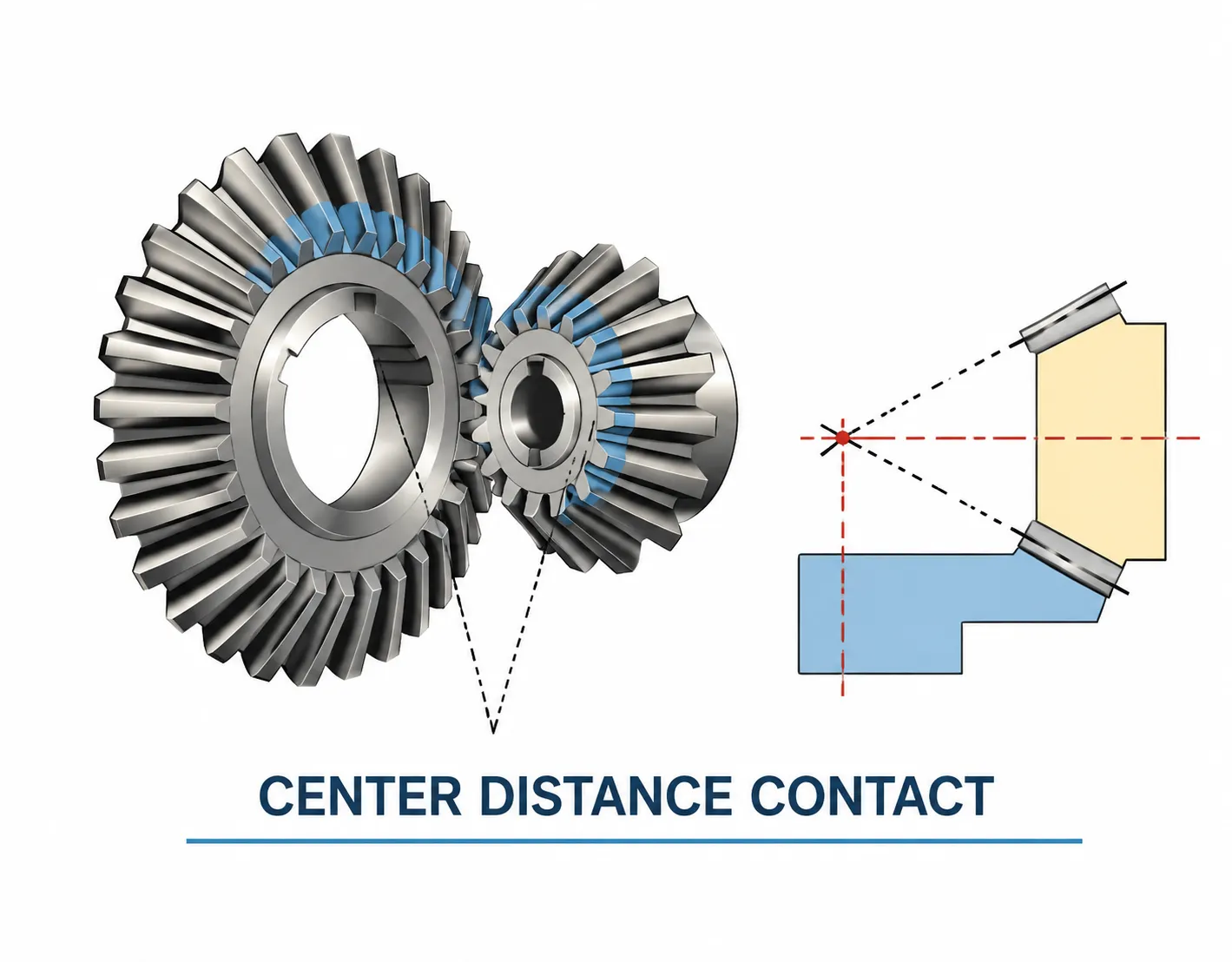
The standard confirmation method is to apply a thin coat of engineer's blue to several teeth on one gear, mesh the pair under light hand load, rotate by half a turn, and read the print. A correct no-load contact sits slightly toward the toe and at mid-height on the tooth face. Under full operating load, elastic deflections in the shaft and housing shift this pattern slightly toward the heel — the gear set is intentionally designed for this shift.
If the blue-print at no-load already sits at mid-face or toward the heel, the loaded contact will move beyond the heel, shortening service life. Shim corrections to mounting distance resolve this before first production use. Korea Ever-Power includes a reference contact pattern datasheet with every matched bevel gear set, showing the expected print under our standard test load so you have a direct comparison for your housing installation.
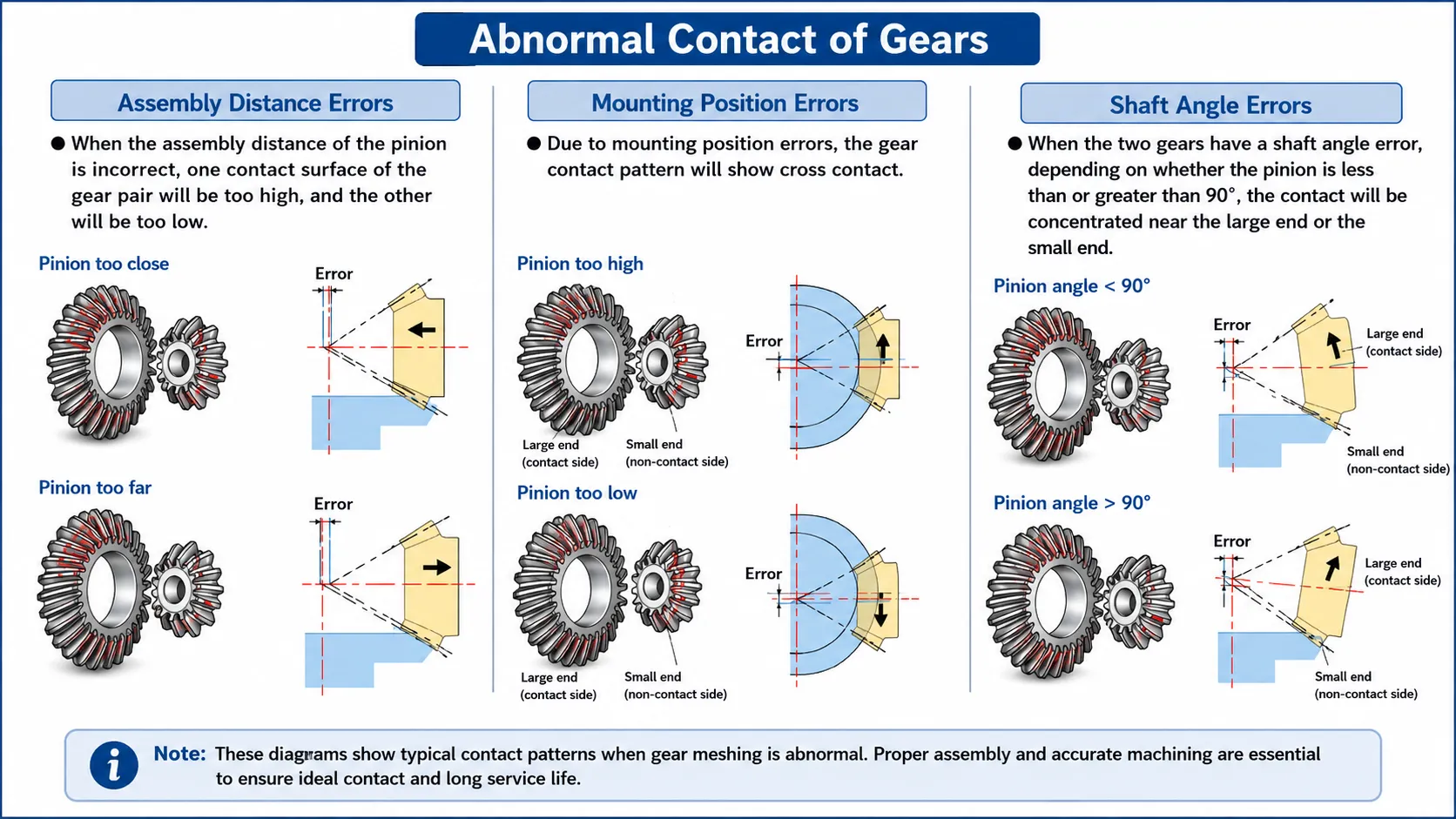
Abnormal contact conditions — face-edge contact, flank-edge contact, or root contact — indicate alignment problems rather than gear manufacturing defects. The pattern shown in the image above covers the four most common abnormal prints and the mounting distance adjustment that corrects each one. Our applications team is available to walk through contact pattern diagnosis for any installation that does not behave as expected — send a photograph of your blue-print and we can advise within one working day.
Applications of Forging Bevel Gears
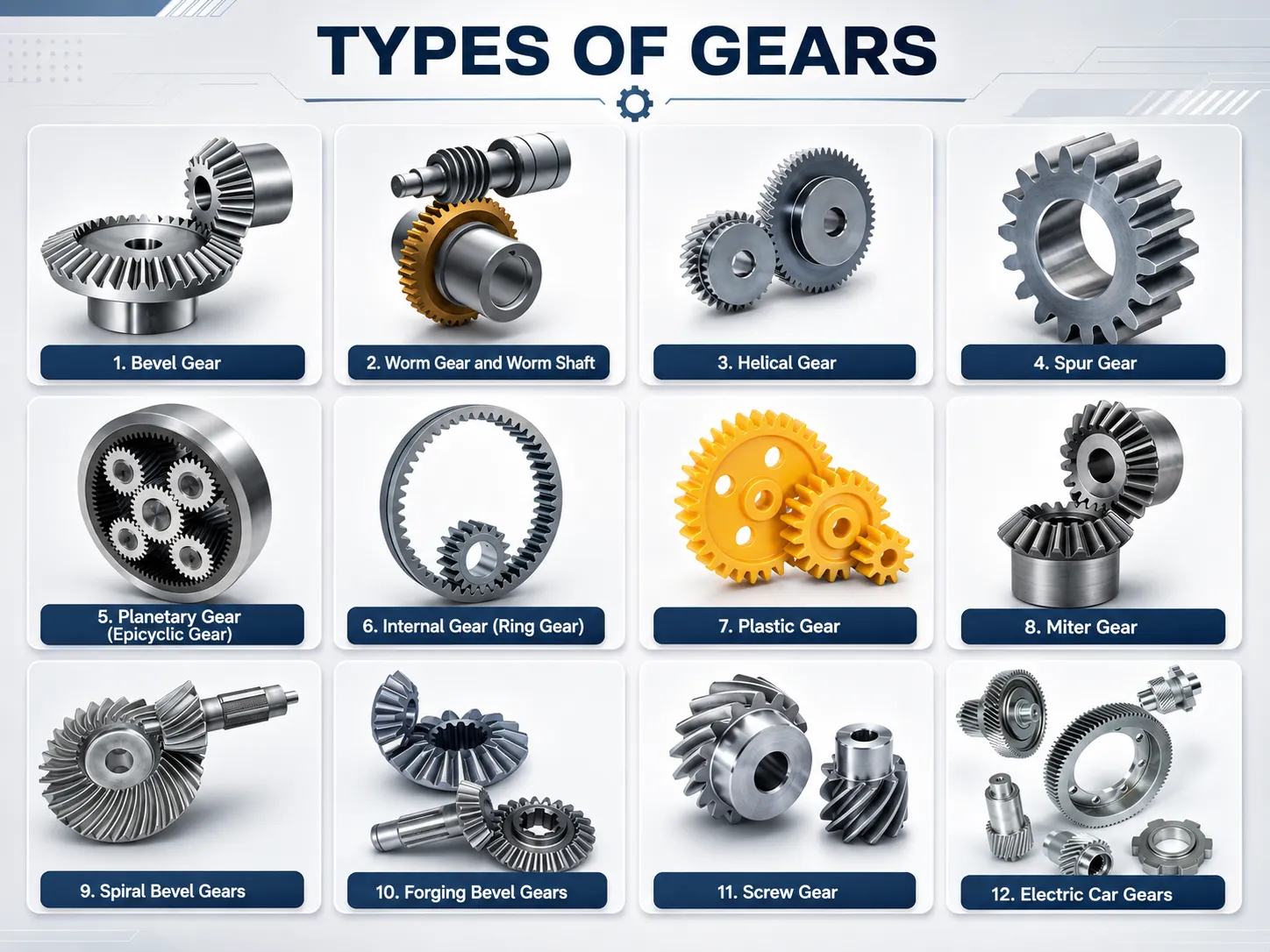
Korea Ever-Power forging bevel gears ship to customers in the following industries. Each sector places specific demands on tooth geometry, material grade, and heat treatment — our production covers all of them.
⚙ Automotive Differentials & Drivetrains
Passenger cars, SUVs, commercial trucks, and off-road vehicles use bevel gears in the final drive differential to allow the two wheels on the same axle to rotate at different speeds through corners. Forged blanks with carburised tooth flanks are the industry standard for this application, balancing fatigue life against the weight constraints of modern axle design.
🌾 Agricultural Machinery
Tractor PTO drives, harvester header gearboxes, irrigation pump drives, and rotary tiller angle drives all require compact right-angle power transmission at moderate to high torque. Forging bevel gears in alloy steel with normalised cores and hard tooth flanks are the preferred configuration in this environment.
🏭 Wind Turbine Nacelle Gearboxes
The yaw drive and blade pitch adjustment systems in multi-megawatt turbines use spiral bevel gears to transfer rotation between vertical and horizontal shafts. Long fatigue life under variable loads — the turbine sees a different load spectrum on every rotation — and corrosion-resistant surface treatments are both addressed in our wind-sector production variants.
⛏ Construction & Mining Equipment
Excavator final drives, drill-rig angle heads, and conveyor drive stations all rely on heavy-duty forging bevel gears that can absorb shock loads. Through-hardened alloy steel provides the combination of toughness and wear resistance these environments demand — surface hardness high enough to resist abrasive wear from contaminated lubricant, with a tough core to survive impact loading.
⚓ Marine Propulsion & Steering
Angle drive units in boat outdrives, yacht windlass systems, and ship auxiliary machinery transmit engine power at 90-degree bends where shaft routing demands it. Stainless steel and nickel-alloy variants resist the saltwater exposure inherent to marine installations while maintaining the structural integrity required by classification society rules.
🤖 Robotics & Industrial Automation
Articulated robot wrists, CNC rotary axes, and servo-driven material handling systems use compact, high-precision bevel gear sets. High accuracy grades with ground tooth flanks are available for applications where positional repeatability is a key requirement, and our CMM inspection records provide the traceability that robot integrators require.
Lubrication of Bevel Gears — Practical Guidelines
Lubrication is the single maintenance factor most directly linked to bevel gear service life. The goal is to maintain a continuous hydrodynamic film across the tooth flanks during mesh, supplemented by an extreme-pressure (EP) additive layer when pitch-line speed is too low for full film formation, or when shock loading is expected.
For splash-lubricated enclosed bevel gear drives, oil level should be set so that the large-end teeth of the lower gear dip into the sump by no more than twice the full tooth depth. Deeper immersion generates churning losses and foam; shallower immersion leaves flanks dry on entry. ISO VG 220 or VG 320 gear oil with an EP additive package covers most industrial enclosed drives at pitch-line speeds below 25 m/s. At higher speeds or elevated operating temperatures, synthetic PAO-based gear oil of equivalent viscosity grade maintains its film thickness more reliably than mineral grades across the operating temperature range.
For open bevel gear drives in agricultural and construction equipment, adhesive open-gear grease or bitumen-based lubricant applied at the mesh point keeps contamination from grinding into the tooth flanks. Oil change intervals for enclosed drives on standard mineral oil are typically 2,500 to 4,000 hours; initial fill oil should be drained at around 500 hours to remove running-in debris, particularly on new forging bevel gears where minor surface asperities are removed during the first operational period.
Why Forging — Advantages Over Machined and Cast Alternatives
Superior Grain Flow
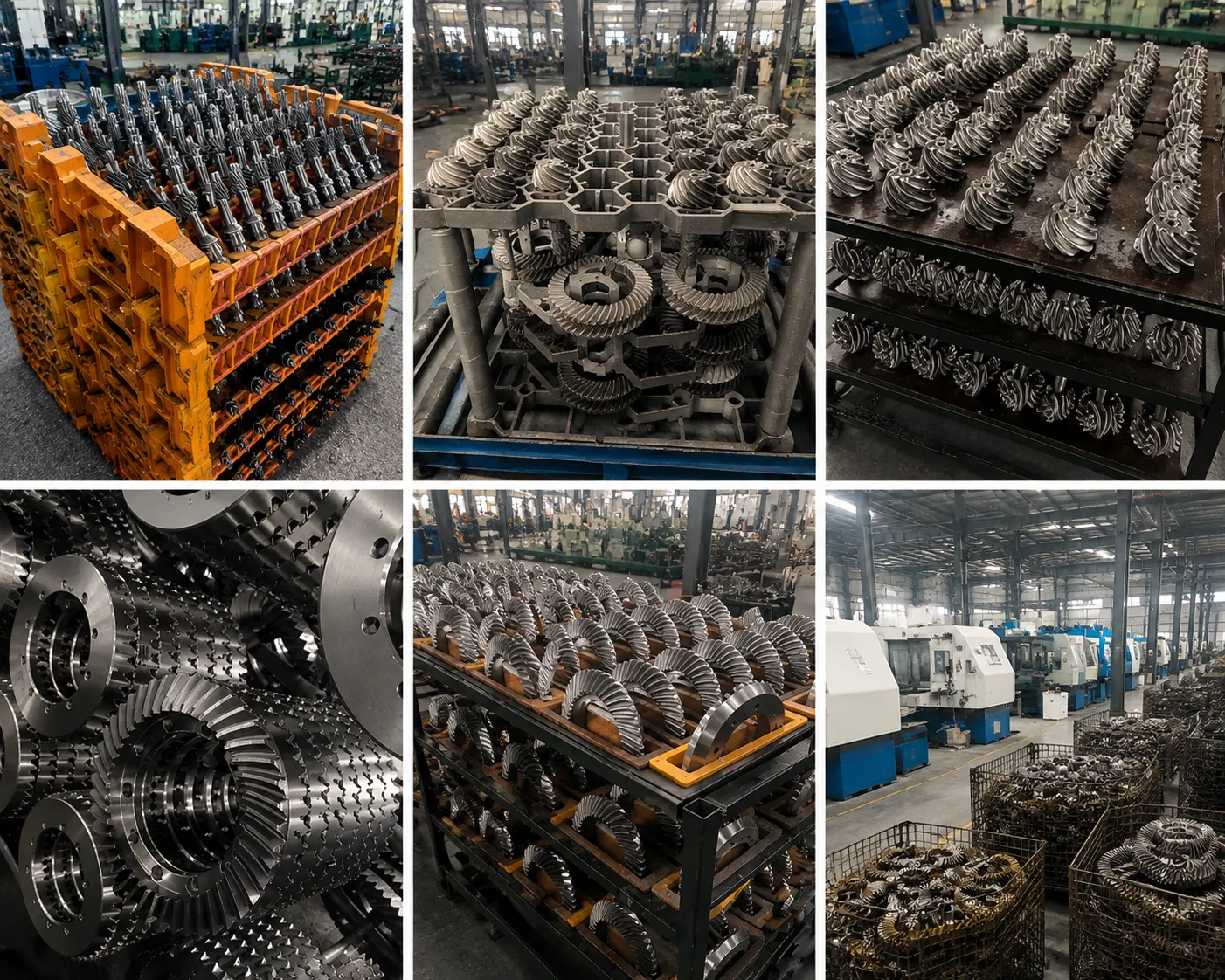
Forging aligns the metal grain structure with the tooth shape, producing continuous fibre flow from root to tip. A machined-from-bar gear cuts across grain lines at the tooth profile, creating potential fracture paths under bending fatigue. Forged teeth consistently outlast cut-from-bar versions in the same steel grade when tested to the same load spectrum.
Higher Strength-to-Weight
Closed-die forging produces a denser, more homogeneous microstructure than casting. This allows a smaller module or reduced face width for the same load rating, achieving weight savings compared with equivalent sand-cast bevel gears while meeting the same design torque. Where weight reduction matters — aerospace, automotive, agricultural equipment — forging is the established route.
Near-Net-Shape Blank
Precision forging produces a blank close to final tooth dimensions, reducing machining time and material scrap compared with starting from a rough bar. This is particularly significant for large-module gears in expensive alloy steels. Cold forging can bring tooth dimensions close enough to final size that only a light finishing pass is needed on the flanks.
Cost Efficiency at Volume
Once tooling is amortised over production volume, the per-piece cost of a forged bevel gear drops well below the equivalent fully-machined part. OEM buyers in automotive and agricultural equipment routinely reduce piece cost by switching from full machining to precision forging with finish grinding on tooth flanks only — the structural benefit comes at a lower unit cost, not a higher one.
Consistent Surface Integrity
The dense surface layer produced by forging — plus optional nitriding or phosphating — gives forging bevel gears a wear-resistant surface that resists both abrasive and adhesive wear mechanisms. In field conditions with lubricant contamination or intermittent oil supply, a forged and heat-treated tooth surface outperforms a cast-then-machined equivalent in measured wear depth over the same operating period.
OEM Customisation
Korea Ever-Power accepts 3D models, 2D drawings, or sample parts as the basis for a forging bevel gear programme. Prototype tooling and sample submission are completed within a mutually agreed schedule confirmed at the quotation stage. All OEM orders carry material test certificates and hardness inspection reports as standard documentation.
Selecting the Right Forging Bevel Gear for Your Application
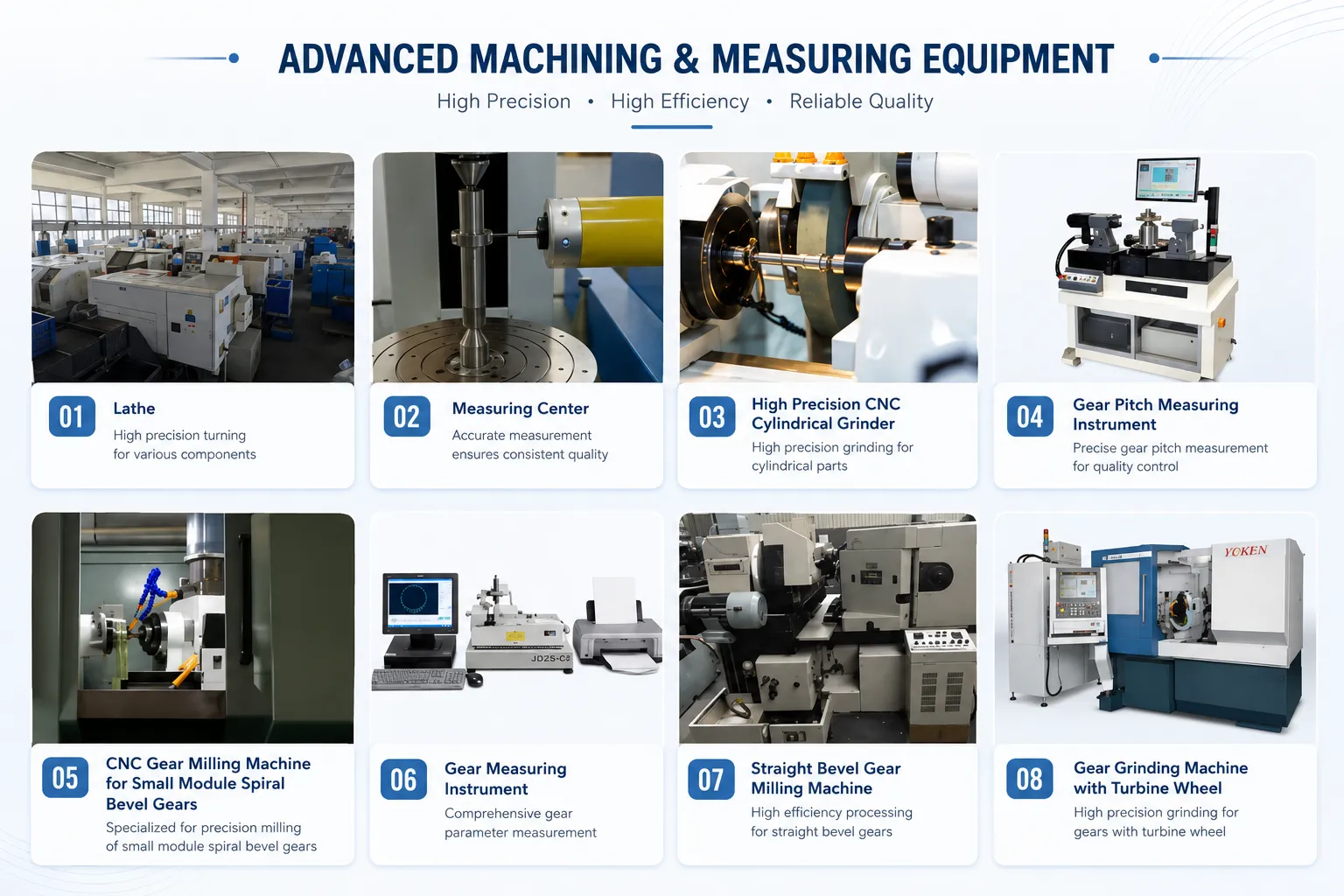
Sending us the right information at the enquiry stage avoids back-and-forth delays and ensures you receive a correctly-specified gear on the first order. The following are what our engineering team uses to prepare an accurate proposal:
- Power or torque at the bevel gear shaft, including peak shock load if applicable
- Input and output speed — both values confirm gear ratio and pitch-line velocity
- Shaft intersection angle — 90° is most common; angular configurations are possible
- Space envelope — maximum outer diameter and back-cone distance in the housing
- Required gear ratio — exact ratio or acceptable range
- Operating environment — temperature range, lubricant type, presence of contamination or moisture
- Service life requirement — hours of operation or load cycles under the stated torque
- Noise constraint — if a sound level limit applies, spiral bevel is usually the answer above 5 m/s
- Surface finish and bore details — fit tolerance class, keyway or spline configuration if applicable
If your application falls outside the standard right-angle 90° layout, or if you are working with an unusual resin or food-grade material, include those constraints with your initial enquiry. The full range of bevel gear types — spiral, straight, miter, zero-degree, and helical bevel — is available on the same platform so you can compare configurations before committing to an order.
Quality Assurance & Korea Ever-Power Manufacturing
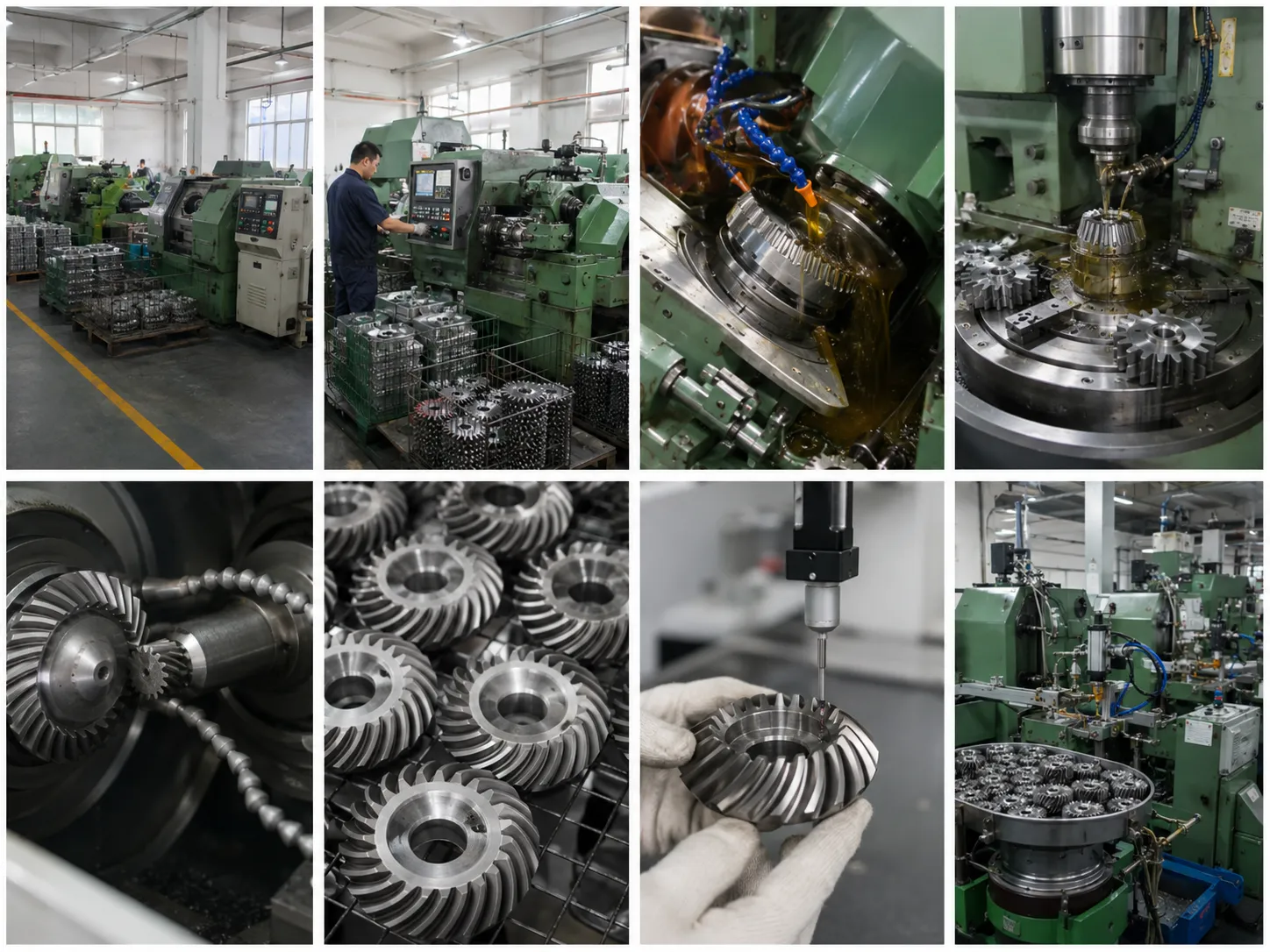
Korea Ever-Power operates an ISO 9001:2015 certified quality management system across forging, heat treatment, machining, and final inspection. Every batch of forging bevel gears is accompanied by a material certificate confirming steel grade and chemical composition, a heat treatment record, dimensional inspection data for critical parameters, and a hardness test report at tooth flank and root.
- Raw material incoming inspection — chemical composition and hardness verified before blanks enter the forging cell
- In-process forging inspection — die wear monitored at regular intervals to ensure blank dimensional consistency throughout the run
- Heat treatment records — time-temperature curves retained for each batch; case depth spot-checked by cross-section metallography on sample pieces
- CMM dimensional verification — pitch cone angle, tooth spacing error, runout, and bore dimensions checked against drawing for all precision-grade orders
- Gear rolling test — every matched bevel gear set is rolled under load on our test bench; the contact pattern is photographed and filed against the order number before shipment
- Export packaging — plywood crates with VCI anti-corrosion film and individual tooth protection for overseas freight; standard sea-freight transit from our facility to Busan port is 4 to 7 days
For applications requiring 100% magnetic particle or dye-penetrant inspection — common in aerospace and safety-critical structural drives — this can be specified at the quotation stage. Korea Ever-Power also produces gear racks, spur gears, helical gears, and worm gear assemblies; the full catalogue is available on our main site if you need to source multiple gear types in a single procurement.
Frequently Asked Questions
What is the difference between hot forging and cold forging for bevel gears?
Hot forging heats the steel billet to above its recrystallisation temperature before pressing into the die. This allows large deformations with lower press force, and the resulting grain refinement improves toughness. Cold forging is performed at room temperature, producing tighter dimensional tolerances and a better surface finish directly from the die, with work-hardening increasing surface layer strength. For most bevel gears, hot forging produces the blank and cold coining or cold sizing brings critical dimensions to tolerance. Korea Ever-Power applies both methods depending on the gear size and dimensional requirements of each order.
Can you produce forging bevel gears to AGMA or DIN standards from a customer drawing?
Yes. We accept customer drawings in DXF, DWG, STEP, or PDF format. Our engineering team converts these to production documentation and submits a first-article inspection report against the drawing dimensions before production parts ship. We routinely produce to AGMA 2003-B97, AGMA 2005-D03, and DIN 3971 / DIN 3975 standards. If your application references JIS B 1702, GOST, or another legacy standard, include the reference with your enquiry and we will confirm coverage.
What material should I specify for a bevel gear used in food processing?
For food-contact and wash-down environments, 304 or 316 stainless steel is the standard choice. 316 adds molybdenum for improved chloride resistance, which matters in facilities that use sodium hypochlorite cleaning agents. Where the required load rating cannot be met in standard stainless steel at the available tooth module, precipitation-hardened stainless grades such as 17-4PH offer higher hardness while retaining corrosion resistance. We supply all common food-grade variants in forged form.
How do I check whether tooth contact is correct after installing a bevel gear set?
Apply a thin, even coat of engineer's blue to four or five teeth on one gear. Mesh the pair by hand against light resistance through at least half a rotation, then read the wiped contact print. A correct no-load print sits between the centre and toe of the tooth at mid-height. It should not touch the toe edge, heel edge, top land, or root fillet. Heel contact means mounting distance is too small on the gear that shows the heel print; increase it by shimming that gear further into its bearing bore. Toe contact means the opposite. Korea Ever-Power includes a reference contact photograph for every matched set shipped.
What lubricant viscosity grade is correct for enclosed bevel gear drives?
For pitch-line speeds below 10 m/s in an enclosed splash-lubricated gearbox running at ambient temperatures between 10 and 40°C, ISO VG 220 gear oil with an EP additive is the general starting point. For pitch-line speeds above 10 m/s, a lighter viscosity reduces churning losses. In environments where operating oil temperature exceeds 80°C — common in summer field conditions on agricultural equipment — a synthetic PAO of equivalent viscosity grade maintains adequate film thickness at elevated temperature more reliably than mineral grades.
Are forging bevel gears more expensive than machined ones?
At low quantities, tooling cost amortisation makes forging more expensive than machining from stock. At higher production volumes, forging typically becomes more cost-effective because material removal time and scrap are both significantly lower. The structural advantages of forging — improved grain flow, higher fatigue resistance — remain regardless of quantity, so forging is worth considering even at moderate volumes if service life or weight is critical to the design.
What is bevel gear scoring resistance and why does it matter?
Scoring (also called scuffing or galling) occurs when the lubricant film breaks down under high sliding velocity and contact temperature at the tooth flanks, causing metal-to-metal contact and surface damage. It is a threshold failure mode rather than a fatigue mode — it can occur on the first few operating cycles under severe conditions. Spiral bevel gears have higher sliding velocities between flanks than equivalent straight bevel gears, making scoring resistance an important design check at high pitch-line speed and high torque. Surface hardness, EP additive selection, and surface finish all influence the scoring threshold. For heavily loaded spiral bevel applications, our engineering team provides a scoring resistance estimate as part of the pre-production application review.
Customer Reviews
"We source forging spiral bevel gears for the final drive of our commercial lawnmower product line. The previous supplier's machined gears were failing at the tooth root after around 1,800 hours of operation. Since switching to Ever-Power's forged version in 20CrMnTi with carburising, we have 14 units in the field past the 2,500-hour mark with no tooth failures. Contact pattern was correct on all units we checked — no shimming required."
Park Jae-hyun | Engineering Manager, Gyeonggi Outdoor Power Equipment Co. · Q1 2026
"We build custom gearboxes for irrigation pump stations and needed a 3:1 right-angle drive in 40Cr through-hardened to 280 HB. Ever-Power turned around a sample within the agreed schedule and the dimensional report was clean to our drawing. The production order came with the rolling test photograph as promised and delivery matched the committed date."
Kim Dong-won | Procurement Director, Chungnam Fluid Machinery · Q4 2025
"We evaluated three suppliers for forging straight bevel gears for a marine winch application. The main concerns were corrosion and load capacity. Ever-Power's proposal in 316L stainless was the only one to include an actual hardness test report with the sample. Tooth geometry was correct, surface finish was clean, and we have had no corrosion after 14 months in a saltwater deck environment."
Lee Sung-min | Technical Buyer, Busan Marine Equipment · Q2 2025
"We use forging bevel gears in a robotic pick-and-place wrist joint at a high accuracy grade. Ever-Power delivered to the specified grade on the first order and the CMM report was included with the packing documentation. Quiet operation and repeatable positioning have held up across 6 million cycles in our endurance testing."
Choi Yeon-ji | Mechanical Design Engineer, Seoul Automation Systems · Q3 2025
"Replacing a Japanese-sourced bevel gear set with the Ever-Power forging version gave us a meaningful piece-cost reduction at our production volume. We ran both sets side by side in identical tractor PTO test rigs for 500 hours. Wear measurements at tooth flank mid-height were comparable between the two sets. No functional difference, and the cost saving went straight to margin."
Jeong Ho-seok | Sourcing Manager, Incheon Agricultural Machinery Parts · Q1 2026
Request a Quotation for Forging Bevel Gears
Send us your drawing, tooth specification, or sample gear. Our engineering team returns a feasibility review and price within two working days.
Additional information
| Editor |
|---|
Related products
-
Plastic Bevel Gears – POM PA PEEK, -40°C to 80°C, 1:1–5:1
-
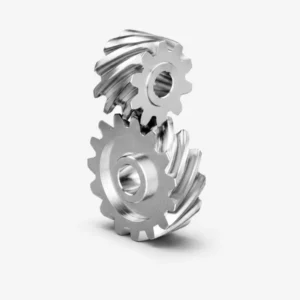
Helical Bevel Gear – Tangential Tooth, Low Noise Bevel Drive
-
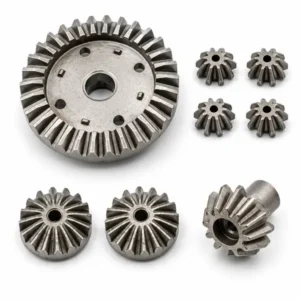
Sintered Metal Bevel Gears – Self-Lubricating, DIN 6–9
-
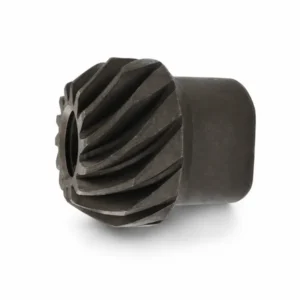
Aircraft Bevel Gear – M0.15 to M2.2, AGMA 13, AS9100
-
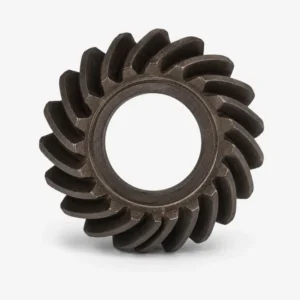
Precision Bevel Gear – M0.15 to M2.2, AGMA 13, 5 HT Routes
-
Spiral Bevel Gear – Localized Contact, Min 5 Teeth, M3-M12
-
Zero-Degree Spiral Bevel Gear – Zerol, No Axial Thrust
-
Automotive Bevel Gear – M0.15 to M2.2, AGMA 13 / DIN 5
 English
  Italian
  Korean
  French
  Japanese