
Differential Gears – Open, LSD, Torque Vectoring, Forged PM
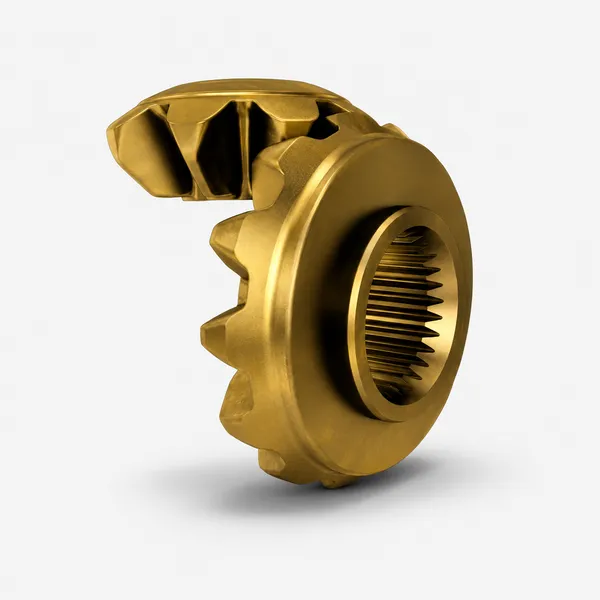
Korea Ever-Power differential gears are the four bevel gears at the heart of automotive differentials — two side gears connecting left and right axles, and two pinion gears transmitting torque between them. Available in three configurations: open differential, limited slip differential (LSD), and torque vectoring. Forged PM (powder metal) technology enables net-shape gear profiles, splines, and retaining grooves in a single operation, delivering higher strength-to-weight ratio and superior load-carrying capability over machined billet. Designed for eDrive gearboxes and eDrive AWD power transfer units.
Product Overview
At the heart of any differential is a set of four differential gears — bevel gears — that allow the left and right drive wheels to rotate at different speeds while continuing to receive torque from the powertrain. The set consists of two side gears, each splined or keyed to a left or right axle shaft, and two differential pinion gears that mesh simultaneously with both side gears, transmitting torque across the axis while permitting the speed difference that cornering requires. Korea Ever-Power produces differential gear sets for automotive, mobile equipment, and eDrive applications across all three differential architectures: open, limited slip, and torque vectoring.
The modern differential gear assembly in a rear-wheel drive or four-wheel drive vehicle is typically composed of a hypoid ring-and-pinion set (which provides the final drive ratio and 90° direction change from the propeller shaft), the differential case containing the four bevel gear differential set, and the axle shafts. The differential pinion gears provide the speed-splitting function; when one wheel spins faster than the other — as in a corner — the pinions rotate on their cross-shaft to allow the speed difference while maintaining torque transmission to both sides.
Korea Ever-Power applies Forged PM (powder metal) technology to differential gear production where the application calls for it. Forged PM enables net-shape production of the complete gear profile, spline, and retaining groove in a single forming operation, producing a gear with higher density, higher strength-to-weight ratio, and superior load-carrying capability compared with conventional machined-from-billet differential gears. This technology is particularly suited to eDrive gearboxes and AWD power transfer units in electric vehicles, where packaging density and mass reduction are primary design drivers.
Three Differential Configurations
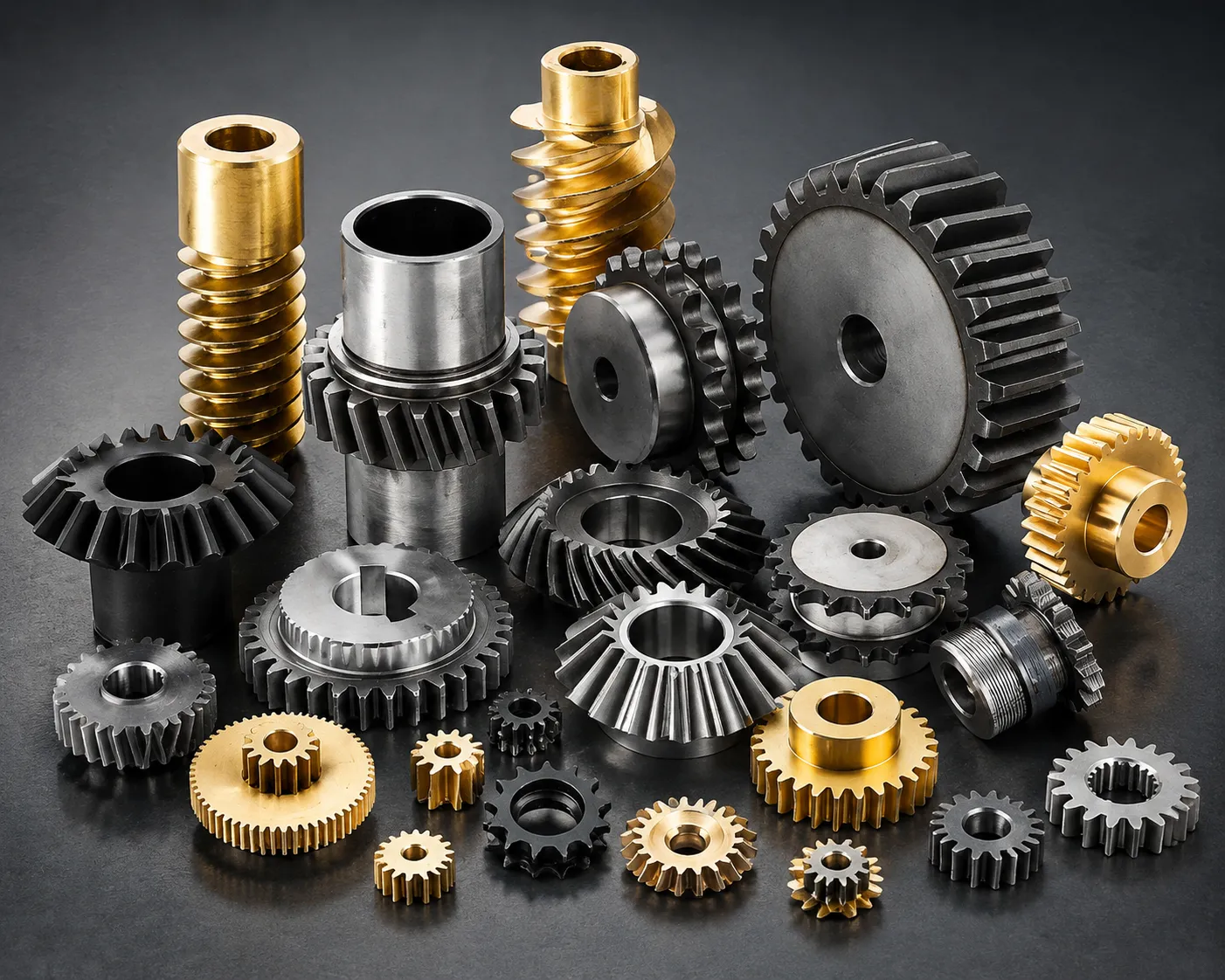
All three types of differential — open, limited slip, and torque vectoring — are built around the same four differential bevel gears at their core. The difference between them lies in the additional clutch, friction, or electronic control elements that modify how torque is distributed when traction conditions differ between the left and right wheels. Korea Ever-Power produces the differential gear set components for all three architectures.
Open Differential
The simplest and most common configuration. The four differential bevel gears allow free speed differentiation between left and right axles without any resistance to the speed difference. In normal driving — cornering on a road surface with equal traction on both sides — this is exactly what is needed: the outer wheel, which covers more distance in the corner, is free to rotate faster than the inner wheel.
The limitation appears when one wheel loses traction: the differential sends torque to the path of least resistance, which is the slipping wheel. The non-slipping wheel, which could provide traction, receives almost no torque. Open differentials are standard in passenger cars operated on normal road surfaces and in many light commercial vehicles where traction assist via ABS and traction control systems provides an adequate substitute for a mechanical limited-slip mechanism.
Limited Slip Differential (LSD)
A limited slip differential adds a clutch pack or friction element to the differential housing alongside the four bevel gears. When a speed difference develops between the left and right axles — signalling one wheel beginning to spin — the clutch engages progressively, applying a resistance torque that transfers drive to the higher-traction wheel. The four differential bevel gears continue to function as in an open differential; the LSD clutch modifies the torque split rather than replacing the bevel gear speed-splitting mechanism.
Used in performance vehicles, 4WD off-road vehicles, and commercial vehicles in traction-demanding applications. The clutch pack sees significant wear over the vehicle's life and is the primary service item; the differential bevel gears are designed to outlast multiple clutch pack replacements.
Torque Vectoring Differential
The newest differential architecture, featuring electronic controls and sensors that actively direct torque to the wheel or wheels with the most traction — and can intentionally send more torque to the outer wheel in a corner to improve the vehicle's yaw response and handling balance. Unlike an LSD which reacts passively to speed difference, a torque vectoring differential can proactively adjust the torque split on the basis of steering angle, lateral acceleration, yaw rate, and individual wheel speed signals from the vehicle's chassis control systems.
The bevel gear set in a torque vectoring differential must handle the full range of torque splits commanded by the control system, including asymmetric loading conditions that do not appear in open differential operation. Material and heat treatment specifications for differential gears in torque vectoring units are typically more demanding than in open differentials for this reason.
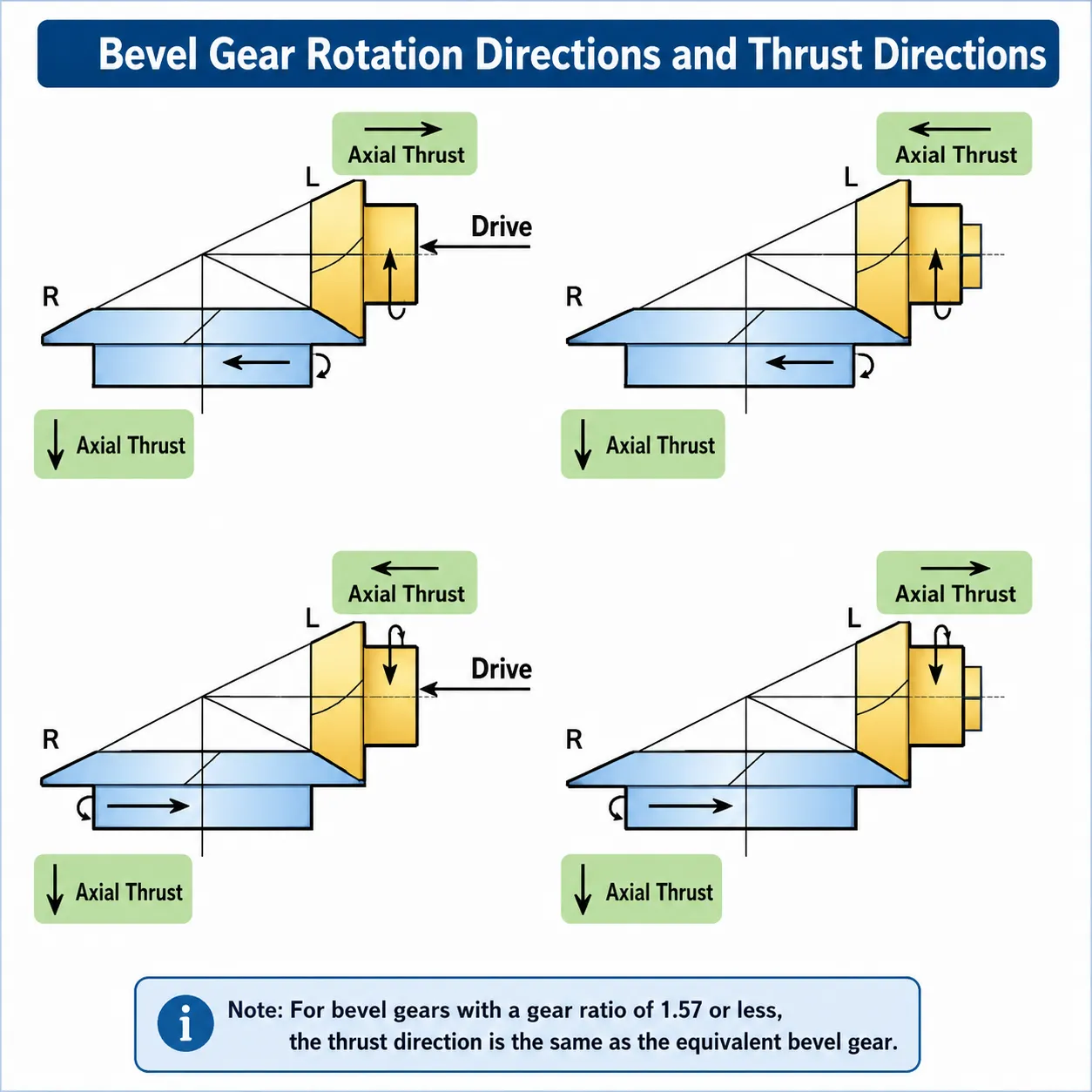
Forged PM Technology — Net-Shape Differential Gears for eDrive
Forged PM (powder metallurgy) technology produces differential gears by pressing pre-alloyed metal powder to near-full density in a precision die, then sintering and forge-densifying the compact to achieve final mechanical properties. This process is distinct from conventional casting (which leaves residual porosity) and from machining from solid billet (which wastes material and cannot form complex internal features in one operation).
The advantages of Forged PM for eDrive differential gears are substantial:
- Highest torque capacity — the forge-densification step eliminates residual porosity, achieving near-wrought material density and mechanical properties that exceed conventional PM and approach forged billet. The differential gear can carry higher torque at equivalent size.
- Higher strength-to-weight ratio — the near-net-shape process removes material only where the tooth form, spline, and retaining groove require it, leaving web and hub geometry optimised for load path rather than machinability. The resulting gear is lighter than an equivalent machined gear for the same load rating.
- Higher load-carrying capability — the combination of dense material and optimised geometry distributes the contact and bending stresses more uniformly than a machined gear produced from a simple blank, improving both pitting and bending fatigue life.
- Net-shape gear profile, spline, and retaining groove — the die forms all three features simultaneously in a single pressing and forging operation. No secondary machining of the tooth profile is required; spline and retaining groove are formed to final dimensions. This reduces processing steps, eliminates alignment errors between separately machined features, and lowers per-unit cost at volume.
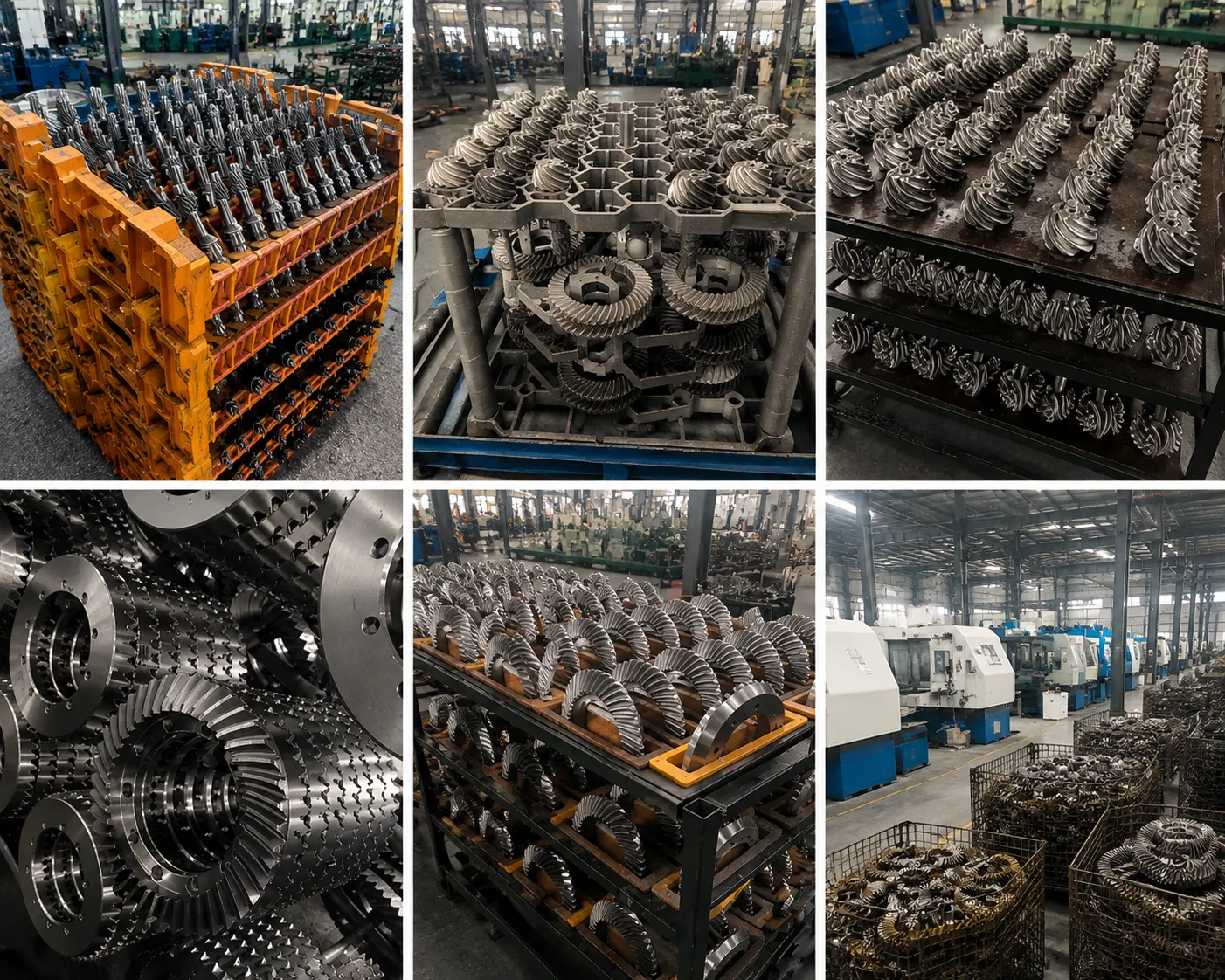
Forged PM differential gears are particularly suited to eDrive gearboxes and AWD power transfer units in electric vehicles, where the packaging constraints require smaller, lighter differential assemblies while EV torque delivery — instant and sustained at maximum motor output — places the differential gear set under higher sustained load than an equivalent ICE drivetrain. The Forged PM route enables the designer to meet both the packaging and the load requirements simultaneously.
Technical Specifications
| Parameter | Specification |
|---|---|
| Gear Function | Differential gear set — 2 side gears + 2 pinion gears; bevel gear tooth form |
| Differential Types | Open differential, limited slip differential (LSD), torque vectoring differential |
| Manufacturing Method | Forged PM (powder metal) for eDrive / AWD; CNC machined for standard automotive |
| Forged PM Features | Net-shape gear profile, spline, and retaining groove formed in single operation |
| Performance Advantage | Highest torque capacity; higher strength-to-weight ratio; higher load-carrying capability vs machined |
| Target Applications | eDrive gearboxes; eDrive AWD power transfer units; conventional automotive rear axles and transfer cases |
| Material | Pre-alloyed PM steel (Forged PM); alloy steel (machined); per customer specification |
| Heat Treatment | Carburising & quenching standard; per application specification |
| Customisation | ODM and OEM; customised to customer drawing or sample; all three differential types |
| QA Documentation | Material certificate, mechanical performance, heat treatment record, dimensional inspection |
How the Differential Gear Set Works
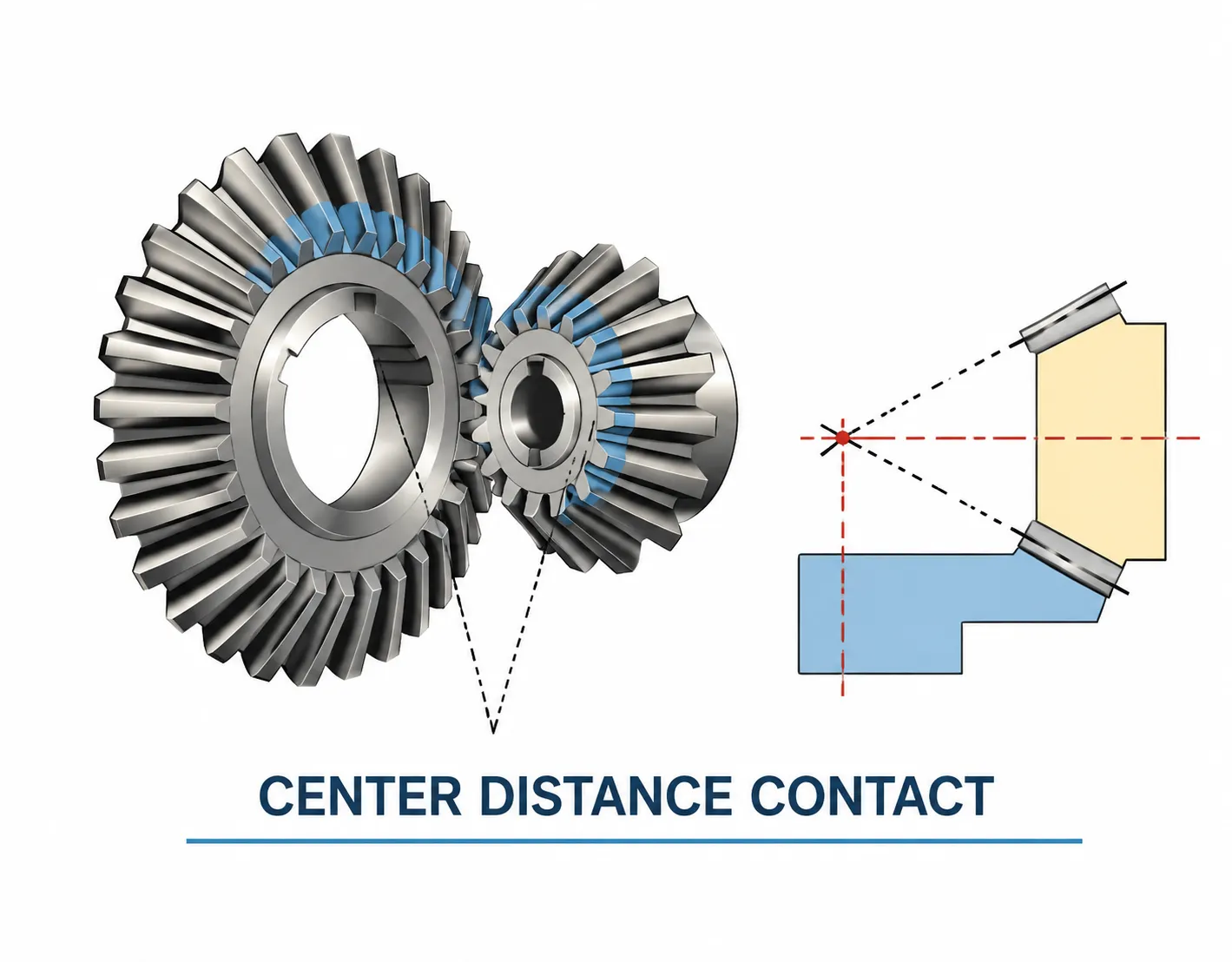
The four-gear differential bevel set operates as follows. The differential case — a housing that rotates with the ring gear — carries the two differential pinion gears on a cross-shaft. The two side gears are meshed with both pinions inside the rotating case.
Straight-line driving — pinions locked
When both driven wheels rotate at the same speed — as in straight-line driving on a traction-equal surface — the two side gears rotate at equal speed. The differential pinions do not rotate on their cross-shaft; they are effectively locked between the two equal-speed side gears and carry torque directly from the case to both side gears equally. The entire four-gear assembly rotates as a rigid unit within the case.
Cornering — pinions rotate on cross-shaft
In a corner, the outer wheel must cover more distance than the inner wheel in the same time. The outer side gear accelerates relative to the differential case; the inner side gear decelerates by an equal amount. The differential pinion gears rotate on the cross-shaft to accommodate this speed difference, maintaining torque transmission to both sides. The average speed of the two side gears equals the case speed — the pinions add the required differential to each side.
Wheel spin — torque goes to the spinning wheel
When one wheel loses traction and begins to spin, it becomes the low-resistance path. The open differential allows it to spin freely, and because torque always goes to the path of least resistance, the grounded wheel receives little torque. This is the fundamental limitation of an open differential — and the engineering reason why limited slip and torque vectoring configurations were developed. The differential pinion and side gears themselves are not the source of this limitation; it is an inherent property of the bevel gear differential's torque-splitting geometry.
Applications
eDrive Gearboxes (EV)
Electric vehicle single-speed eDrive units house the differential set directly downstream of the motor and reduction gear. EV motors deliver peak torque from zero RPM continuously, imposing sustained high load on the differential bevel gears that ICE powertrains only achieve in brief acceleration events. Forged PM differential gears are the preferred specification for eDrive units where packaging density and maximum load capacity are simultaneously required.
AWD Power Transfer Units
All-wheel drive eDrive systems use a dedicated rear power transfer unit containing a differential bevel gear set to split torque between the rear axle's left and right wheels. The Forged PM production route enables the rear power transfer unit to be significantly smaller and lighter than an equivalent machined-gear unit at the same load rating — critical in an AWD EV where the rear unit must fit within the rear suspension packaging envelope.
Passenger Car Rear Axles
Conventional ICE-powered passenger car rear axle differentials use machined alloy steel bevel gear sets in the open or limited slip configuration. These are the highest volume application for differential bevel gears globally. Korea Ever-Power produces replacement and OEM supply differential gear sets for passenger car rear axles in alloy steel with carburised and quenched tooth flanks, to the vehicle OEM drawing specification.
Commercial Vehicles & Trucks
Heavy truck rear axle differentials, bus final drives, and tandem axle through-drive differential sets use larger and more heavily loaded bevel gear sets than passenger car applications. 20CrNi2MoA with its nickel-enhanced core toughness is the preferred material for heavy truck differential pinions where shock loads from road surface irregularities and load reversals during braking must be absorbed without tooth root fracture.
Off-Road & Construction Equipment
Excavators, wheel loaders, agricultural tractors, and specialised off-road vehicles use limited slip or locking differentials to maintain traction in loose or uneven terrain. The differential bevel gear sets in these applications experience severe cyclic loading and shock events; the gear material specification must prioritise core toughness and impact resistance alongside tooth surface hardness.
Performance & Motorsport
Performance road cars and motorsport vehicles specify limited slip or torque vectoring differential gear sets to maximise traction on the exit of corners. The combination of high engine torque, high cornering forces, and frequent wheel spin events imposes demanding cyclic loading on the differential bevel gears. Torque vectoring differential gear sets for motorsport applications may specify AGMA 12 accuracy and Forged PM construction simultaneously to achieve the performance and durability targets.
Frequently Asked Questions
What is the difference between Forged PM differential gears and conventional machined differential gears?
Conventional machined differential gears are produced by cutting the tooth profile, spline, and retaining groove from a solid billet blank in multiple CNC operations. Material is removed to create each feature, and the alignment between separately machined features depends on the fixturing accuracy of each operation. Forged PM gears are produced by pressing pre-alloyed metal powder in a precision die that forms all three features — gear profile, spline, and retaining groove — simultaneously in a single forming sequence followed by forge densification. The resulting part has near-wrought material density, a grain structure that follows the part geometry (increasing fatigue resistance), and feature-to-feature alignment that is fixed by the die rather than by re-fixturing. At high production volumes, the Forged PM route is also more material-efficient than machining, since there is no swarf.
Why are eDrive differentials specified with Forged PM gears rather than conventional machined gears?
Electric drive motors deliver their peak torque from zero RPM and sustain it through a wide speed range, unlike ICE powertrains where maximum torque is available only in a narrow RPM band. This means the eDrive differential gear set experiences high sustained loading rather than brief torque peaks, demanding higher fatigue life from the gear material. Simultaneously, eDrive packaging requires smaller, lighter units to fit within the space available in an electric vehicle platform. Forged PM achieves both requirements: the forge-densified material has higher fatigue strength than conventional PM at equivalent size, and the net-shape forming allows the gear designer to optimise the hub and web geometry for minimum mass while maintaining the required tooth root and flank strength. Machined gears can match the strength but not the mass efficiency; conventional PM can match the mass but not the strength. Forged PM provides both.
Which differential type — open, LSD, or torque vectoring — is correct for my application?
The choice depends on the vehicle type, traction requirements, and the presence of electronic traction control systems. Open differentials are suitable for passenger cars operating on normal road surfaces where ABS and traction control electronics provide adequate traction management, and where simplicity and low cost are priorities. Limited slip differentials are specified where mechanical traction management is required independently of electronic systems — off-road vehicles, performance cars, and heavy commercial vehicles in traction-demanding environments. Torque vectoring is specified in performance vehicles and high-end EV platforms where active yaw control is a design objective in addition to traction management. If you are sourcing replacement differential gear sets, the type is determined by the existing differential housing design; replacing an open differential gear set with an LSD gear set requires additional clutch and housing components, not just different gears. Contact our team with the vehicle make, model, and differential housing type and we will confirm the correct gear set specification.
Can differential gear sets be supplied for replacement in existing vehicle axles?
Yes. Korea Ever-Power supplies replacement differential gear sets for existing vehicle axles, matching the original gear geometry from the vehicle OEM drawing or from a worn sample set. For a replacement order, provide the vehicle make, model, year, and differential housing type, or send us the worn gear set. Our engineering team identifies the tooth form, module, tooth count, and spline specification, produces the replacement to these dimensions, and ships with dimensional documentation. Material and heat treatment are matched to the original OEM specification where known, or to the applicable vehicle OEM standard where the original drawing is not available.
What documentation is provided with differential gear set orders?
Standard documentation includes material certificate confirming the alloy grade, mechanical performance test report, heat treatment record with time-temperature curves, and a dimensional inspection report covering tooth spacing, OD, bore diameter, and spline dimensions against drawing tolerances. For eDrive and AWD programme customers requiring automotive-grade quality documentation — PPAP, SPC data, FMEA — these can be arranged at the quotation stage. Contact our team with your vehicle platform, differential type, and documentation requirements to begin the qualification discussion.
Customer Reviews
"We develop eDrive units for a compact EV platform. The Forged PM differential gear sets from Ever-Power are 18% lighter than our previous machined-gear design at equal load rating, and they fit the tighter packaging envelope of the new platform. PPAP Level 3 package was submitted and approved within our programme timeline — no supplemental data requests."
Shin Dong-hyun | Drivetrain Systems Engineer, Seoul EV Powertrain · Q1 2026
"We supply AWD power transfer units to an EV OEM and specified Forged PM differential gears for the rear unit. The net-shape spline eliminated one machining operation from our assembly process. Fatigue test results from the validation programme exceeded the target life by a comfortable margin — the material density from forge densification makes a measurable difference."
Park Hyun-woo | Programme Manager, Gyeonggi AWD Systems · Q3 2025
"We source replacement differential gear sets for heavy truck rear axles. Ever-Power matched the geometry from our worn samples — tooth form, spline count, and retaining groove dimensions — and produced in 20CrNi2MoA per our material specification. Three delivery cycles completed; incoming dimensional inspection on every batch has confirmed consistency. No warranty claims on these parts in 18 months of fleet service."
Kim Jong-sik | Fleet Parts Manager, Busan Commercial Vehicle Services · Q4 2025
"We build limited slip differential kits for a track day and motorsport market. Ever-Power produces the bevel gear sets in 20CrMnTi carburised to our specification. The gears are sold with our LSD clutch packs and the combination passes our acceptance test on a differential test rig. Customer feedback on durability after a full racing season has been positive across all units deployed."
Lee Jun-young | Product Manager, Daegu Motorsport Components · Q2 2025
"We develop torque vectoring differential units for a high-performance road car programme. The bevel gear sets see asymmetric loading during torque vectoring events that conventional differential gear ratings do not fully account for. Ever-Power reviewed our load cycle data and confirmed the carburised 20CrNiMo specification was adequate for the torque vectoring duty cycle before production began. The gears passed our rig endurance test on first build."
Cho Sang-min | Chassis Systems Engineer, Seoul Performance Vehicles · Q1 2026
Request a Quotation for Differential Gears
Send us your vehicle platform, differential type (open / LSD / torque vectoring), drawing or worn sample, and documentation requirements. For eDrive and AWD programmes, specify whether Forged PM is required and the packaging envelope constraints. Our engineering team returns a feasibility confirmation and price within two working days.
Additional information
| Editor |
|---|
Related products
-
Spiral Miter Gears – 35° Spiral Angle, 1:1 High-Speed Drive
-
Straight Bevel Gear – M3 to M12, DIN6-9, Multi-Material
-
Sintered Metal Bevel Gears – Self-Lubricating, DIN 6–9
-
Forging Bevel Gears – Hot & Cold Forged, Custom OEM Supply
-
Automotive Bevel Gear – M0.15 to M2.2, AGMA 13 / DIN 5
-
Aircraft Bevel Gear – M0.15 to M2.2, AGMA 13, AS9100
-
90 Degree Bevel Gears – Right-Angle Drive, All Materials
-
Bevel Gears European Standard – DIN Type A & B, 1:1 to 1:4
 English
  Italian
  Korean
  French
  Japanese