
Steel Helical Gears for Conveyor Drives:
When to Choose Helical over Spur and How to Size Them
Helical gears are specified for conveyor drives when noise levels must be controlled, when pitch line velocity exceeds 5–6 m/s, or when maximum load capacity in a compact enclosed gearbox is the design priority. This guide covers the helical gear design advantages over spur gears for conveyor applications, helix angle selection, the axial thrust complication, material specification, and the conveyor drive configurations where helical gears outperform spur alternatives.
Helix 12°–25° · M4–M12 · DIN 5–8
Belt · Chain · Enclosed Gearbox · Noise Spec
When to Specify Helical Gears for a Conveyor Drive
The spur gear is the correct default choice for most industrial conveyor drives — lower cost, simpler housing design, no axial thrust bearing requirement, and equally high efficiency. Helical gear conveyor drives are the correct choice in four specific situations where spur gears cannot meet the design requirement: a documented noise specification, high pitch line velocity, a compact gearbox envelope requirement, or a smooth torque transmission requirement for precision conveyor positioning.
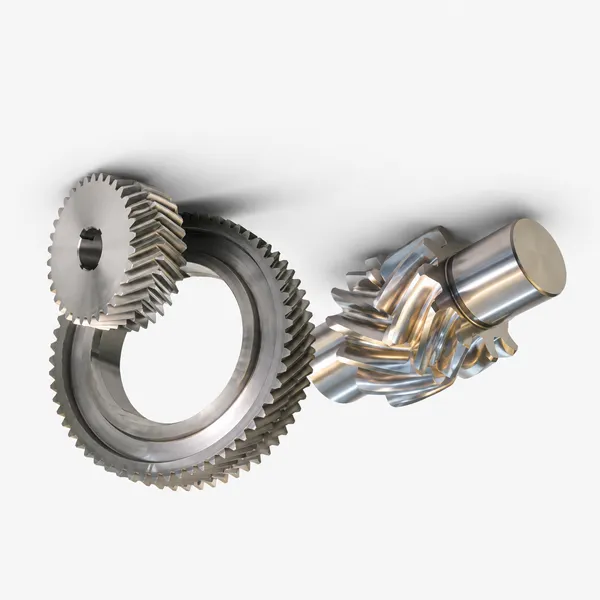
Korea Ever-Power’s helical gears for conveyor drives are manufactured in 20CrMnTi (standard heavy-duty), 42CrMo4 (through-hardened medium-duty), and 316L stainless (food and washdown conveyors) — covering single and multi-stage enclosed helical gearboxes for belt, chain, slat, and roller conveyor drives from 1.5 kW to over 500 kW. All enclosed conveyor drive helical gears are specified with the correct helix angle, thrust bearing arrangement, and module to match the conveyor’s duty cycle, speed, and noise environment.
Unlike the worm gear conveyor drive alternative, the helical gear drive achieves its noise reduction without any efficiency penalty — helical gear transmission efficiency is 98–99.5% per mesh, the same as spur gears and far better than worm reducers at equivalent ratio. This means a helical gear conveyor drive upgrade from a noisy spur gearbox reduces noise by 6–10 dB(A) without requiring a larger motor or increasing energy consumption — a combination that no other gear type delivers.
DECISION GUIDE: HELICAL vs SPUR FOR CONVEYOR DRIVES
Always Specify Helical
- ✓ Noise spec below 72 dB(A) at 1 m from gearbox
- ✓ PLV above 6 m/s at any gear stage
- ✓ Indoor logistics centre with operator noise regulations
- ✓ Food factory conveyor with staff noise exposure limit
- ✓ Hospital / pharmaceutical distribution conveyor
- ✓ Gearbox volume constraint requiring higher load density
Spur Gear Is Correct Choice
- ✓ Outdoor, mining, or aggregate conveyor (ambient >80 dB(A))
- ✓ PLV below 5 m/s throughout all stages
- ✓ Open-gear large-diameter conveyor head drive
- ✓ Budget-constrained replacement with no noise spec
- ✓ Existing spur gearbox housing (re-use housing)
- ✓ No axial thrust bearing capacity available in conveyor shaft
Additional Design Consideration
Helical gear conveyor drives require angular contact or tapered roller bearings on the conveyor head shaft to absorb the axial thrust generated by the helix angle. Before specifying helical gears for a conveyor that currently uses spur gears, confirm the conveyor head shaft bearings are rated for the combined radial and axial load. At helix angle 20°, axial thrust = tangential force × tan(20°) = 0.36 × Ft — significant on large high-load conveyors.
Conveyor Type Applications and Helical Gear Specifications
Frequently Asked Questions
Explore Korea Ever-Power Gear Categories
Seven precision gear product lines for conveyor, industrial, automotive and specialist applications worldwide.
Éditeur : Cxm
 French
  English
  Italian
  Korean
  Japanese