
GEAR APPLICATION GUIDE · PLANETARY GEAR · P01
Planetary Gears for Servo Motor Drives:
Backlash, Stiffness and Accuracy
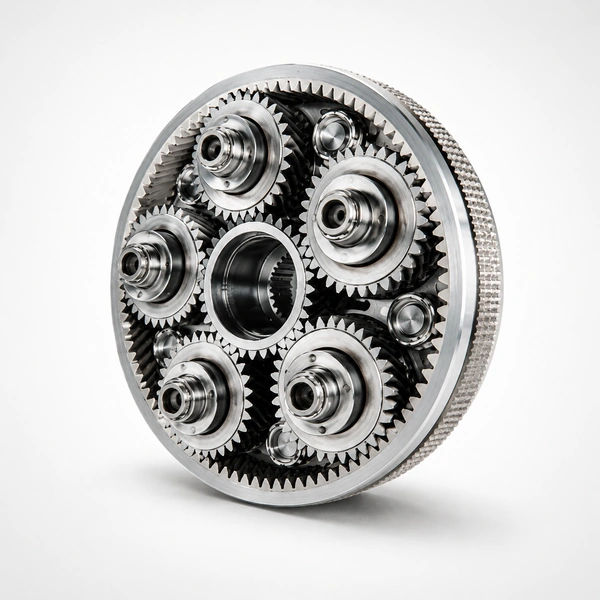
Servo motor planetary gearboxes are the standard output stage for CNC machine tool axes, industrial robots, semiconductor handling systems, and precision positioning equipment. Unlike industrial planetary gearboxes where load capacity is the primary driver, servo planetary design is dominated by backlash, torsional stiffness, inertia matching, and transmission error — the parameters that determine positioning accuracy and dynamic response of the servo axis.
Backlash <3 arcmin · Ratio 3:1–100:1
CNC · Robot · Semiconductor · AGV
Why Servo Motor Axes Use Planetary Gearboxes
The servo motor and planetary gearbox are engineering partners: the servo motor delivers high torque at high speed with precise angular position feedback, and the planetary gearbox multiplies that torque while reducing speed to match the driven axis — all within the tightest backlash and stiffness envelope of any gear type at equivalent ratio and output torque. No other gear type simultaneously achieves the combination of compact dimensions, coaxial (in-line) input/output shaft arrangement, high efficiency, and low backlash that servo planetary gearboxes provide.
Korea Ever-Power’s planetary gears for servo motor drives are manufactured in 20CrMnTi case carburized alloy steel for standard and precision servo gearboxes, and in 17-4 PH precipitation-hardened stainless steel for servo applications in corrosive or food-processing environments. All servo planetary gears are ground to DIN 4–6 quality class after case hardening, with tooth spacing error below 3–6 μm depending on accuracy class, to achieve the transmission error target that determines the positioning accuracy of the servo axis.
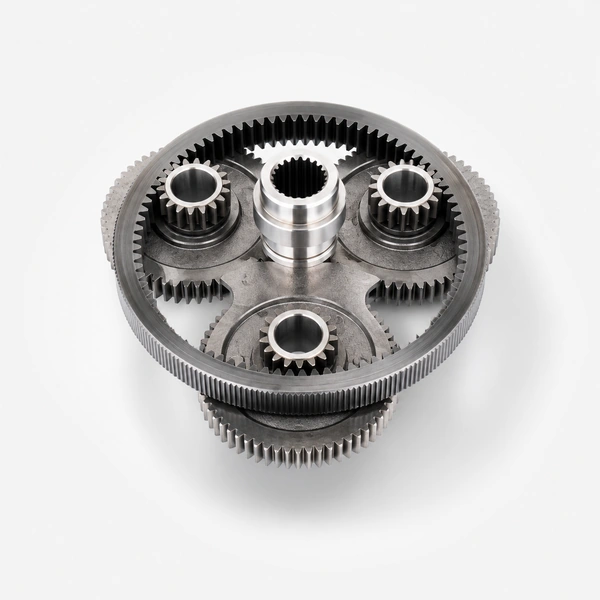
The reflected inertia reduction is the reason servo engineers specify planetary gearboxes even when the torque multiplication alone does not justify the cost: a planetary gearbox with ratio i reduces the load inertia seen at the motor shaft by a factor of i². An axis with a 10:1 planetary gearbox between the motor and a 100 kg·cm² load inertia presents only 100/10² = 1 kg·cm² reflected inertia to the motor — enabling a dramatically smaller servo motor with faster dynamic response. Without the gearbox, the same 100 kg·cm² load would require a much larger motor with correspondingly lower servo bandwidth. See also: planetary gearboxes selection guide for servo and robotics applications.
Backlash — the Positioning Limit
Backlash is the angular play at the output shaft when the motor reverses direction while the output shaft is held fixed — caused by the clearance between gear tooth flanks. In a servo axis, backlash is the dead band: the motor must rotate by the backlash angle before the output shaft begins to move after a direction reversal. For a 3 arcmin backlash gearbox on a servo axis with a 100 mm output moment arm: positional uncertainty at the tool point = 100 × tan(3/60 × π/180) = 0.087 mm — just under 0.1 mm. Standard servo gearboxes (<8 arcmin) are adequate for positioning above 0.2 mm; precision (<3 arcmin) for 0.05–0.2 mm; ultra-precision (<1 arcmin) for below 0.05 mm.
Torsional Stiffness — Dynamic Accuracy
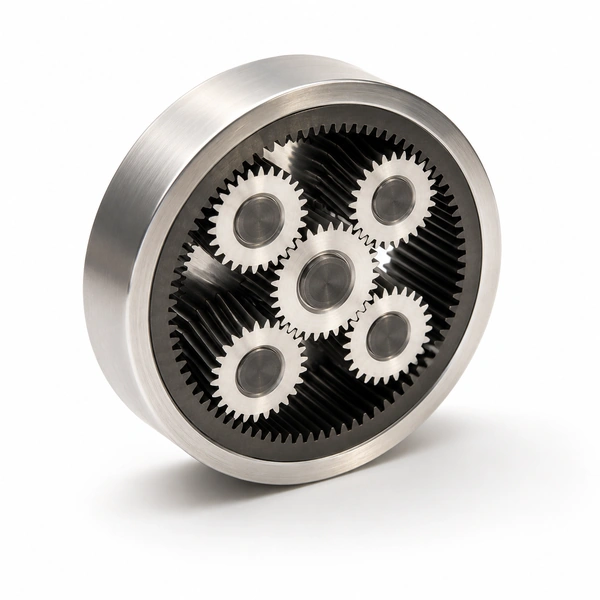
After the backlash dead band is taken up, the gearbox acts as a torsional spring between the motor and load. Low stiffness means the output shaft lags the motor angle under dynamic torque variation — the lag appears as contour error in CNC machining. Stiffness of a servo planetary gearbox is dominated by the tooth contact stiffness of the sun-planet-ring gear mesh — higher tooth accuracy, wider face width, and more planet gears all increase stiffness. Korea Ever-Power servo planetary gears are ground to DIN 4 with tight tooth profile tolerances to maximise the mesh stiffness contributing to gearbox torsional rigidity.
Inertia Matching — Motor Sizing
Reflected load inertia Jload,motor = Jload ÷ i². A 5:1 planetary gearbox reduces reflected load inertia by 25×; a 10:1 by 100×. The servo drive amplifier is most stable and achieves the highest servo bandwidth when the inertia ratio Jload,motor ÷ Jmotor is between 1:1 and 10:1. Without a gearbox, many CNC and robot axis applications have inertia ratios of 100:1 or greater — the servo system cannot be tuned for adequate bandwidth without oscillation. The planetary gearbox corrects this by compressing the reflected load inertia into the acceptable range.
Servo Planetary Accuracy Classes and Gear Specifications
INERTIA MATCHING WORKED EXAMPLE — CNC MACHINE TOOL LINEAR AXIS
Given
Ball screw J = 0.8 kg·cm²; table and workpiece Jlinear = (mass × lead²) ÷ (2π)² = (60 kg × (0.01 m)²) ÷ 39.5 = 0.152 kg·cm²; total load Jload = 0.95 kg·cm². Motor Jmotor = 0.40 kg·cm² (AC servo, 1 kW). Inertia ratio without gearbox = 0.95 ÷ 0.40 = 2.4:1.
With Direct Drive
Motor speed = 3,000 RPM; ball screw at 3,000 RPM, lead 10 mm: axis speed = 3,000 × 10/1,000 = 30 m/min — acceptable. Inertia ratio 2.4:1 is within the 1:1–10:1 servo recommendation. Direct drive acceptable IF the motor produces adequate torque at 3,000 RPM.
With Heavy Workpiece (300 kg)
Jload = (300 × 0.0001) ÷ 39.5 + 0.8 = 0.76 + 0.8 = 1.56 kg·cm². Ratio = 1.56 ÷ 0.40 = 3.9:1 — within limit but borderline. If workpiece grows to 600 kg: ratio = 7.4:1 — still within 10:1. At 1,200 kg workpiece: 14.8:1 — exceeds 10:1 recommendation. Solution: 2:1 planetary gearbox reduces reflected inertia by 4× → ratio = 14.8 ÷ 4 = 3.7:1 ✓
Servo Planetary Applications by Axis Type
Frequently Asked Questions
Explore Korea Ever-Power Gear Categories
Seven precision gear product lines for servo, CNC, robotics, industrial and automotive applications worldwide.
編集者: Cxm
 Japanese
  English
  Italian
  Korean
  French