
Ring Gears for Planetary Gearboxes:
Internal Gear Design and Load Distribution
The ring gear — internal gear — is the fixed outer element of a planetary gear set, defining the outer envelope of the gearbox and providing the reaction member that makes the high torque density of planetary gear drives possible. This guide covers ring gear tooth design, load distribution across planet gears, material selection, heat treatment, and quality requirements for servo, industrial, wind turbine and automotive planetary gearbox applications.
3–5 Planet Gears · ISO 6336 · DIN 3990
Servo · Wind · Automotive · Construction
Ring Gear Fundamentals in Planetary Gearboxes
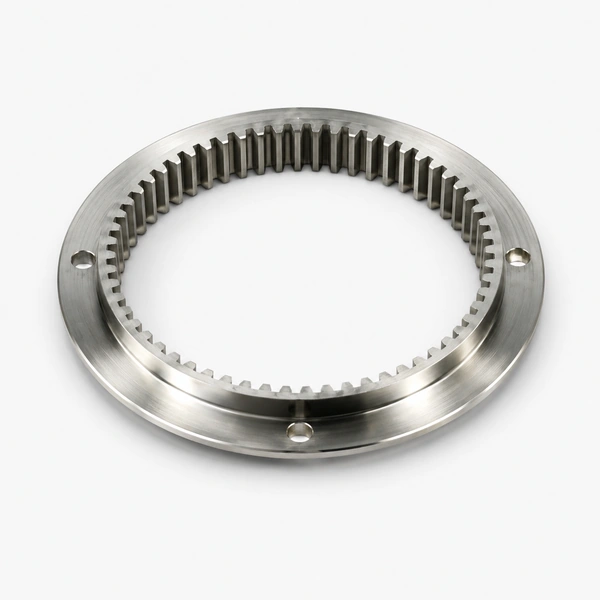
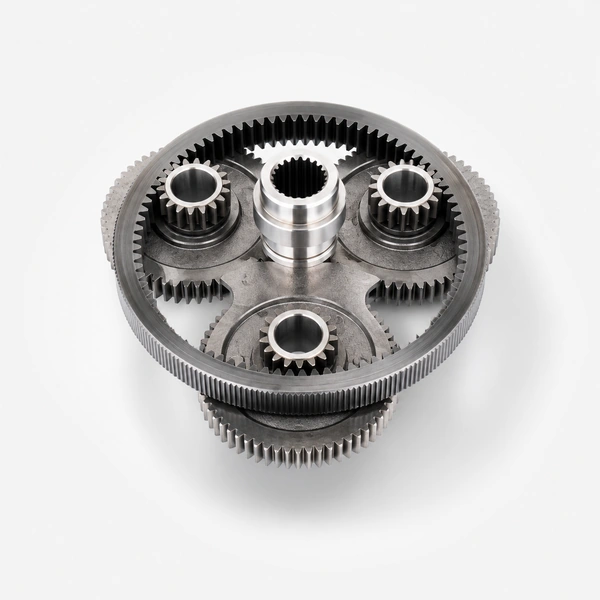
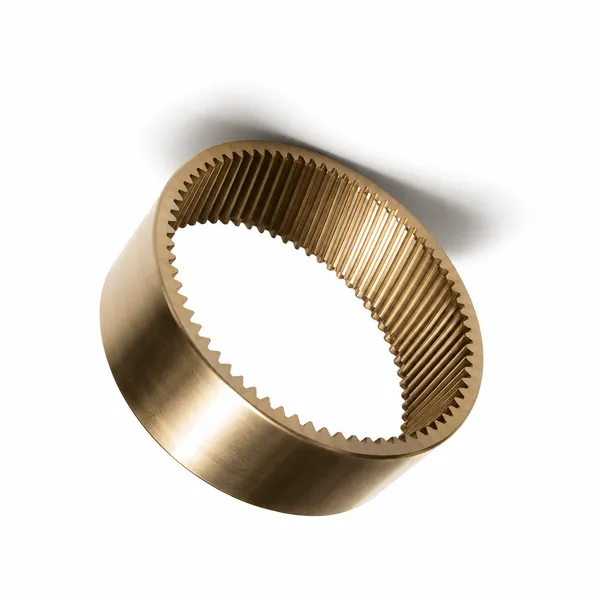
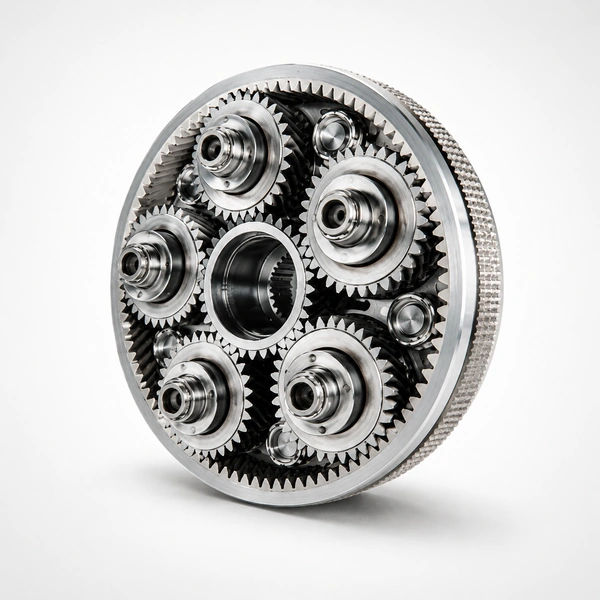
The ring gear (also called annulus gear or internal gear) is the outer fixed element in a standard planetary gear set. In the most common planetary configuration (fixed ring gear, sun gear input, planet carrier output), the ring gear provides the reaction torque that allows the planet carrier to rotate at reduced speed relative to the sun gear input. The ring gear teeth face inward — unlike all other gear types where teeth face outward — and mesh simultaneously with all planet gear teeth at N equally-spaced contact points, where N is the number of planet gears.
Korea Ever-Power’s ring gears for planetary gearboxes cover internal ring gears from module M1 (micro planetary gear for servo motor) to M16 (wind turbine planetary gearbox) in 20CrMnTi, 18CrNiMo7, 42CrMo4, and 316L stainless steel — for 3-planet to 5-planet configurations in servo drives, industrial planetary gearboxes, automotive automatic transmissions, wind turbine main gearboxes, and construction equipment final drives.
The multiple simultaneous contact points of the planetary ring gear with N planet gears provides the fundamental advantage of planetary gearboxes: load sharing. Where a single-mesh spur or helical gearbox transmits the full torque through one tooth contact, a 3-planet planetary gearbox theoretically divides the ring gear load among 3 simultaneous contacts — reducing the force per tooth contact to one-third, enabling a much smaller ring gear module and a much more compact gearbox for the same transmitted torque.
Internal Tooth Geometry Advantages
The internal ring gear tooth contact with an external planet gear tooth produces concave-convex (inside-outside) contact geometry rather than the convex-convex (outside-outside) contact of two external gears. Concave-convex contact has a significantly larger effective radius of curvature at the contact point, which reduces the Hertzian contact stress for the same normal force — allowing the ring gear and planet gear teeth to carry higher contact loads per unit face width than equivalent external gear pairs at the same module. This lower contact stress at the ring gear-planet interface contributes materially to the high power density of planetary gearboxes.
Load Sharing and Planet Equalisation
Theoretical equal load sharing among N planet gears requires perfectly uniform spacing and perfectly equal tooth geometry for all planet gears and the ring gear. In practice, manufacturing and assembly tolerances cause unequal load distribution — the most loaded planet can carry 25–40% more than the average load in a 3-planet system with standard tolerances. Planet equalisation mechanisms — floating sun gear, floating ring gear, or flexible planet pins — reduce load sharing inequality to below 15%, recovering nearly all the theoretical load sharing benefit. Korea Ever-Power supplies ring gears for planetary systems with or without equalisation, and recommends the appropriate mechanism for each application’s power and accuracy requirements.
Ring Gear Tooth Count and Ratio
Ring gear tooth count zR = zS + 2zP (where zS = sun teeth, zP = planet teeth) — this assembly condition ensures planet gears fit correctly between sun and ring. Gear ratio (fixed ring, sun input, carrier output): i = 1 + zR/zS. Example: zS = 20, zP = 30, zR = 80: i = 1 + 80/20 = 5:1. The ring gear tooth count determines both the ratio and the minimum planet count spacing condition: zR/N must be an integer for equally-spaced planet gears.
Material and Heat Treatment for Planetary Ring Gears
20CrMnTi — Industrial Planetary
Standard material for industrial planetary gearbox ring gears — conveyor drives, crane hoists, extruder gearboxes, and construction equipment planetary final drives. Case carburized to 0.8–1.2 mm depth, HRC 58–62 internal tooth surface. Internal ring gear teeth are hobbed on a vertical gear hobbing machine (external hobbing) or broached (small ring gears), then case-hardened and finish-ground on an internal gear grinding machine to DIN 5–7 quality class depending on the application speed and noise specification.
✓ Industrial, construction, conveyor planetary
18CrNiMo7 — Wind & High Power
Premium material for wind turbine planetary gearbox ring gears and large marine or steel mill planetary drives. IEC 61400-4 wind turbine gearbox standard specifies 18CrNiMo7-6 for planetary stage ring gears with design life 175,000 hours L10. Case depth 1.0–2.0 mm for M8–M16 ring gears. σF = 430–480 MPa, AKV > 80 J at −20°C for offshore and cold climate wind turbine applications. Ground to DIN 4–5 for the high pitch line velocity of the ring gear-planet interface at rated turbine speed.
✓ Wind turbine, marine, high-power planetary
42CrMo4 — Through-Hardened
Through-hardened to HB 280–340 for medium-duty planetary gearbox ring gears — agricultural planetary drives, light industrial planetary reducers, and mobility applications where the lower manufacturing cost of through-hardened vs case-carburized ring gear is commercially important. σF = 260–310 MPa. No post-hardening grinding required for ring gears at PLV below 5 m/s. The uniform hardness profile of through-hardened ring gears eliminates the internal gear case depth control challenges of carburizing.
✓ Agricultural, light-duty planetary gearbox
316L Stainless / Specialty
316L stainless internal ring gears for food processing planetary drives and pharmaceutical mixer drives subject to CIP washdown. Titanium or 17-4 PH stainless ring gears for aerospace and medical robotics planetary stages where non-magnetic, biocompatible, or lightweight ring gear material is required. Plastic ring gears (POM or MC Nylon) for low-load precision plastic planetary gear sets in office automation and instrument drives.
✓ Food, medical, aerospace, plastic planetary
Planetary Ring Gear Applications by Sector
Frequently Asked Questions
Explore Korea Ever-Power Gear Categories
Seven precision gear product lines for industrial, automotive, wind energy and specialist applications worldwide.
Editor: Cxm
 English
  Italian
  Korean
  French
  Japanese