
Planetary Gear Sets for Wind Turbines:
Low-Speed Stage Design, Materials and 20-Year Fatigue Life
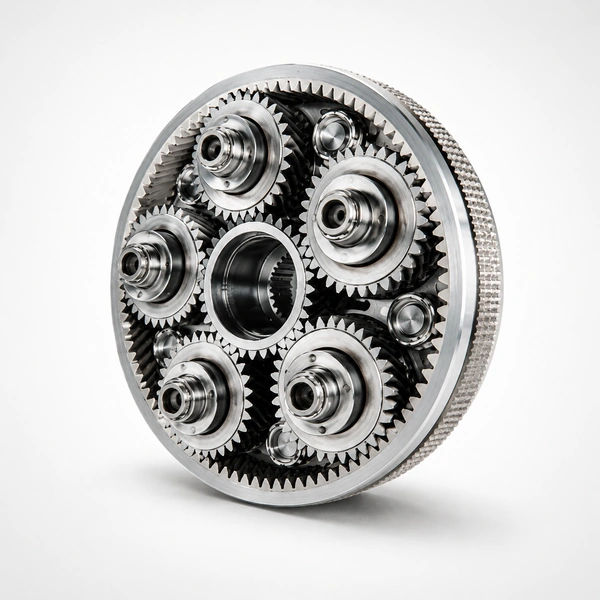
The planetary gear stage in a wind turbine gearbox is the highest-torque, most structurally critical gear component in the drivetrain — handling the full rotor torque from 5–20 RPM input through a 4:1–6:1 ratio first reduction before the parallel helical stages. The compound nature of the planetary system — with 3–4 planet gears sharing the load simultaneously around the sun and ring gear — makes it uniquely suited to this role, but also imposes demanding requirements on gear quality, planet bearing design, and ring gear material that differ from all other industrial planetary applications. This guide covers planetary gear set specification for wind turbine gearbox first-stage applications under IEC 61400-4 and AGMA 6006.
3–4 Planets · 20-year life · IEC 61400-4
1–6 MW · Low-Speed Stage · AGMA 6006
Why Planetary Gear Sets Are Used at the First Stage of Wind Turbine Gearboxes
The wind turbine gearbox first stage planetary arrangement is chosen over a parallel helical first stage because the planetary system shares the full rotor torque among 3–4 planet gears simultaneously, reducing the torque per gear mesh by a factor of 3–4 compared to a single-mesh parallel helical stage at the same ratio. This load sharing allows the first stage planetary gears to be significantly smaller and lighter than equivalent parallel helical gears at the enormous torques of modern multi-megawatt turbines — a 3 MW turbine rotor shaft torque of 1.8 MNm divided among 3 planets is 600 kNm per planet mesh, vs the full 1.8 MNm at a single helical gear mesh for an equivalent parallel shaft design. The weight saving in the first stage is multiplied by the structural cost of supporting that weight at 80–120 m hub height.
Korea Ever-Power’s planetary gear sets for wind turbines are manufactured in 18CrNiMo7-6 case carburized for sun and planet gears, and in nitrided 18CrNiMo7-6 or 34CrNiMo6 for ring gears — all ground to DIN 4–5 quality class, shot peened, and measured with individual gear reports per AGMA 915. Planet carrier and ring gear housing are forged and precision-machined to maintain planet position accuracy within the tolerance required for equal load sharing across all planets. See also: planetary gearboxes application data for wind turbine gearbox stage specification parameters.
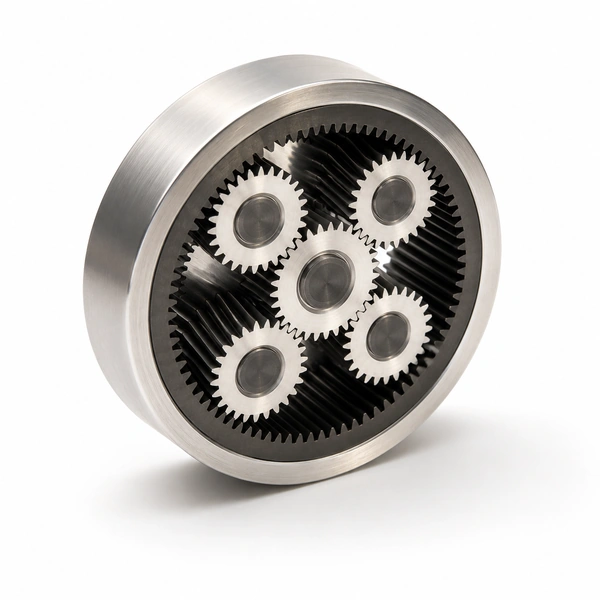
The critical manufacturing challenge in wind turbine planetary gear sets — compared to standard industrial planetary gearboxes — is achieving equal load sharing among the 3–4 planets under the variable rotor loads and the elastic deformation of the ring gear, planet carrier, and main shaft under rated torque. At 1.8 MNm first-stage torque, the ring gear OD deflects elastically, the carrier arm bends under the planet bearing radial forces, and the main shaft deflects under the combined rotor weight and torque — all of which shift the planet gear positions from their theoretical ideal positions and cause unequal tooth contact on different planets. Korea Ever-Power compensates for these elastic deflections by applying precisely calculated lead crowning to the planet gear teeth — 10–25 μm depending on the calculated deflection at rated torque — to ensure the tooth contact migrates to the tooth centre under load rather than concentrating at the edge.
WIND TURBINE PLANETARY GEAR SET — COMPONENT SPECIFICATIONS
SUN GEAR
- Material: 18CrNiMo7-6
- Heat treatment: Case carburized, HRC 60–62
- Quality class: DIN 4–5, ground
- Surface: Shot peened + ground
- Tooth form: Involute helical, helix 0°–10°
- Profile crowning: 8–15 μm
- Floating sun: most designs allow sun gear to float radially to self-centre among the planet loads
PLANET GEARS
- Material: 18CrNiMo7-6
- Heat treatment: Case carburized, HRC 60–62
- Quality class: DIN 4–5, ground
- Lead crowning: 10–25 μm (elastic deflection compensation)
- Bore: precision-bored for planet pin or needle bearing
- Count: 3 or 4 per stage; matched sets within 0.01 mm OD tolerance
RING GEAR
- Material: 34CrNiMo6 or 18CrNiMo7-6
- Heat treatment: Nitrided (case depth 0.35–0.55 mm, HV 600–750) — nitriding preferred over carburizing to minimise distortion on large OD ring
- Quality class: DIN 5–6 (internal tooth ground)
- Mounting: Tight interference fit or bolted flange to gearbox housing
Load Sharing, Planet Bearing Design and Carrier Stiffness
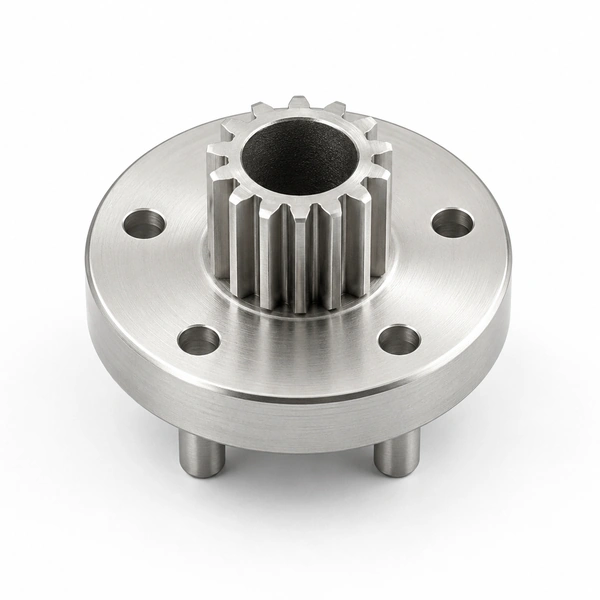
LOAD SHARING FACTOR
The load sharing factor KΓ accounts for unequal load distribution among the 3–4 planets due to manufacturing tolerances in planet position, planet pin parallelism, and carrier arm stiffness under torque. For a rigidly pinned 3-planet carrier (fixed sun), KΓ = 1.25–1.35 per ISO 6336 / AGMA 2001. For a floating sun arrangement (sun gear free to translate radially to self-centre): KΓ = 1.10–1.20. Wind turbine planetary gearboxes almost universally use a floating sun to achieve the lower KΓ and reduce the required gear tooth size — the sun gear is supported radially only through the planet mesh contacts, not by bearings, allowing it to find its load-balanced position among the three planets automatically.
Lower KΓ → smaller gear → lighter nacelle
PLANET BEARING TYPES
Three planet bearing configurations used in wind turbine first-stage planetary gearboxes: (1) Cylindrical roller bearing (CRB) on a fixed planet pin: most common for turbines below 2 MW — simple, well-understood, easily replaced. (2) Tapered roller bearing (TRB) pairs on a fixed planet pin: used for larger planets where the axial load from helix angle is significant — more complex replacement. (3) Integrated bearing (IB) — needle rollers running directly on the planet pin OD as the inner race: highest load density, no separate bearing inner ring — used in the most compact large-turbine first stages (above 3 MW) where minimum carrier OD is the constraint. Korea Ever-Power machines the planet pin OD to bearing-quality surface finish (Ra 0.1–0.2 μm, roundness 0.003 mm) for integrated bearing configurations.
Planet bearing is the #1 failure mode in wind gearboxes
Frequently Asked Questions
Explore Korea Ever-Power Gear Categories
Seven precision gear product lines for wind energy, industrial, robotics and specialist applications worldwide.
Redattore: Cxm
 Italian
  English
  Korean
  French
  Japanese