
Planetary Gearboxes for Robotics:
Joint Drive Selection and Gear Specification
Industrial robot joint drives demand the highest combination of torque density, backlash accuracy, torsional stiffness, and service life of any gear application — operating billions of cycles over 10–15-year robot lifetimes at continuous rated torque. This guide covers planetary gearbox selection for 6-axis robot arm joints, collaborative robot joints, SCARA robot drives, and delta robot arm drives — including torque, speed, and accuracy specifications for each joint type and axis position.
Backlash <1 arcmin · Ratio 5:1–100:1
6-Axis · SCARA · Collaborative · Delta
Robot Joint Drive Requirements — Why Planetary Gearboxes Are Standard
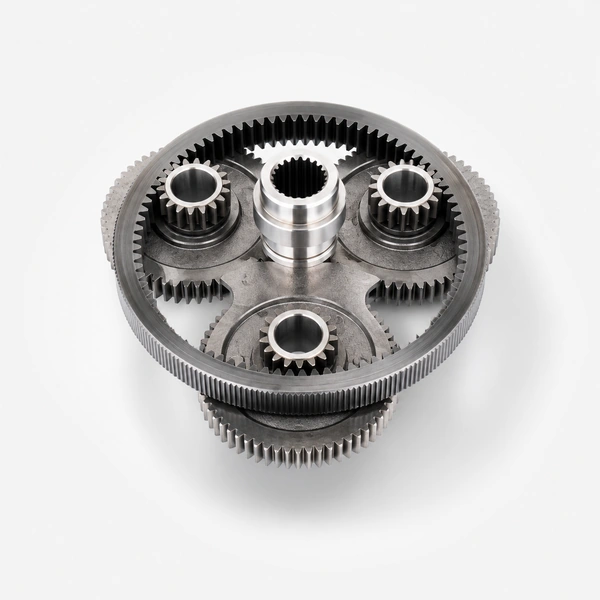
The industrial robot joint drive is the most demanding gear application in terms of the combination of required properties: the gearbox must simultaneously achieve ultra-low backlash (<1 arcmin), high torsional stiffness (>5 Nm/arcmin), maximum torque density (the heaviest possible joint torque in the smallest possible volume), and multi-billion-cycle fatigue life — all in a compact in-line (coaxial input/output) arrangement that mounts directly behind the servo motor. No gear type other than the planetary gearbox achieves this combination, which is why planetary gearboxes are used in virtually every industrial robot joint worldwide.
Korea Ever-Power’s planetary gearboxes for robotics are manufactured in 20CrMnTi case carburized for standard robot joint applications and 17-4 PH stainless for food processing and cleanroom robot joints — ground to DIN 4–5 quality class, assembled with needle roller planet bearings for maximum stiffness, and measured to backlash <1 arcmin before shipment. The carrier and ring gear are machined to H7 tolerances for precise housing fit, and the sun gear is available in a hollow shaft configuration for direct servo motor shaft insertion without a separate coupling. See also: planetary gearboxes for robotics specifications and selection data.
The backlash of a robot joint planetary gearbox defines the robot’s positioning dead band when the joint reverses direction. At a 500 mm robot arm length and a 1 arcmin joint gearbox backlash: TCP dead band = 500 × tan(1/60 × π/180) = 0.145 mm. For a 6-axis robot with six joints, each contributing up to 1 arcmin backlash, the cumulative TCP positioning uncertainty can reach 0.5–1.0 mm — unacceptable for precision assembly or laser cutting applications. This is why ultra-precision (<1 arcmin, and ideally <0.3 arcmin) planetary gearboxes are specified for robot joints despite their higher cost compared to standard precision (<3 arcmin) servo planetary gearboxes.
Torque Density — Compact Joint Design
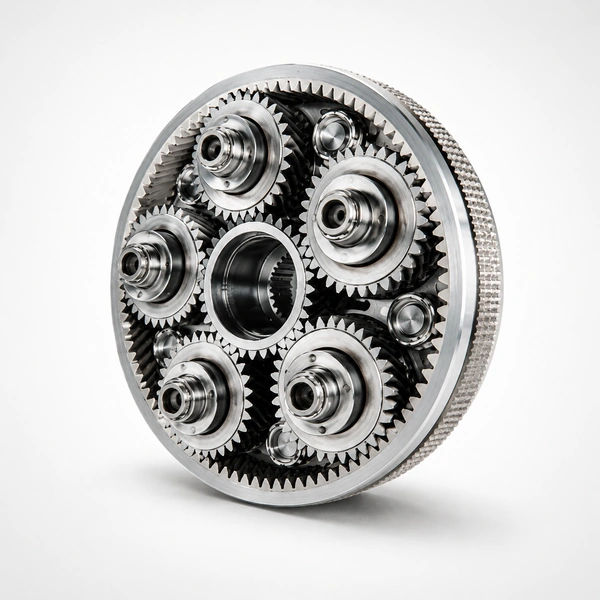
Robot joints are severely constrained in diameter by the robot arm structure — a 20 kg payload 6-axis robot typically has a J1 (waist) joint diameter of 120–160 mm and J6 (wrist flange) of 50–80 mm. The planetary gearbox, by dividing the load among 3 planet gears simultaneously, achieves 3–5× the torque density of an equivalent spur gear reducer in the same housing diameter. This allows the rated joint torque to be achieved within the robot arm diameter constraints that would be impossible with any parallel-shaft gear arrangement.
Fatigue Life — Billion-Cycle Endurance
An automotive spot-welding robot operating at 3,000 weld cycles per hour for 6,000 hours per year accumulates 108 million joint cycles per year. Over a 5-year TBO (time between overhaul), joint 6 (the wrist flip joint, which moves on every cycle) accumulates over 500 million load cycles. The gear fatigue design for robot joint planetary gears must use the tooth root bending endurance limit (σFlimN at >3 × 10⁹ cycles) rather than the finite life fatigue curve — the gears must operate at stresses permanently below the endurance limit to avoid fatigue failure within the design life.
Torsional Stiffness — Servo Response
Robot joint torsional stiffness (Nm/arcmin) determines how quickly the servo controller can accelerate the joint after a direction reversal before the output shaft begins to track the motor — lower stiffness means slower servo response and reduced contouring accuracy during high-speed continuous path motion. Korea Ever-Power robot joint planetary gears are manufactured to the tightest tooth profile tolerances achievable at DIN 4 quality to maximise mesh stiffness per planet contact, and needle roller planet bearings (vs ball bearings) provide the highest planet radial stiffness and therefore the highest gearbox torsional stiffness per unit mass.
Robot Type and Joint Specifications
KEY DIFFERENCES: INDUSTRIAL ROBOT vs COLLABORATIVE ROBOT PLANETARY GEARS
Industrial Robot (High Power)
Higher torque-to-weight ratio priority. Maximum cycle speed. 20CrMnTi case carburized standard. 3-planet for compactness. Sealed grease lifetime lubrication standard. Tool centre point repeatability ±0.02–0.05 mm. Annual operating hours 6,000–8,000.
Collaborative Robot (Cobot)
Back-drivability required for force sensing (cobot joints must allow the human to push the arm to a stop in collision). Lower efficiency acceptable. Force-torque sensor embedded in each joint. More planets (4–5) for load sharing at lower speed. TCP repeatability ±0.05–0.10 mm. Annual hours 2,000–4,000.
Washdown / Food Robot
17-4 PH stainless planetary gears or 20CrMnTi with stainless housing. NSF H1 food-grade lubricant. IP67 or IP69K rated joint housing. FDA/EU food contact compliance. Less stringent backlash (<3 arcmin acceptable) — food robots operate at lower speeds than automotive robots.
Frequently Asked Questions
Explore Korea Ever-Power Gear Categories
Seven precision gear product lines for robotics, CNC, automotive, industrial and specialist applications worldwide.
Redattore: Cxm
 Italian
  English
  Korean
  French
  Japanese