
Ring Gears for Excavators:
Swing Ring Gears, Final Drive Ring Gears and Replacement Specification
Excavator ring gears perform two of the most mechanically severe functions in any construction or mining machine — the swing ring gear enables the 360° rotation of the excavator’s upper structure around its undercarriage under the combined weight of the boom, arm, bucket, and counterweight assembly at potentially high angular deceleration, while the final drive ring gear transmits full track drive torque to the sprocket through each of the two planetary final drive gearboxes. Understanding the material, dimensional, and wear characteristics specific to each ring gear position is essential for both machine OEMs selecting specifications for new excavator designs and for maintenance engineers procuring replacement ring gears for existing fleet machines.
M8–M20 · Swing + Final Drive · 5T–70T Class
Komatsu · CAT · Hitachi · Doosan · Volvo
Excavator Ring Gear Engineering — Swing Rings vs Final Drive Rings
The excavator contains two distinct and very different ring gear applications that share only their basic ring gear geometry — an annular ring with internal or external teeth. The swing ring gear (the large-diameter ring that allows the excavator superstructure to rotate relative to the undercarriage) and the final drive ring gear (the small ring inside each track final drive gearbox) differ in module (M8–M16 vs M5–M10), material (manganese steel or nitrided alloy steel vs carburized alloy steel), tooth form (internal spur vs internal helical on many designs), load type (combined radial and moment bearing loads vs pure planetary tangential tooth load), and failure mode (surface fretting and edge contact from ring gear tilt vs contact fatigue from planet gear load cycling).
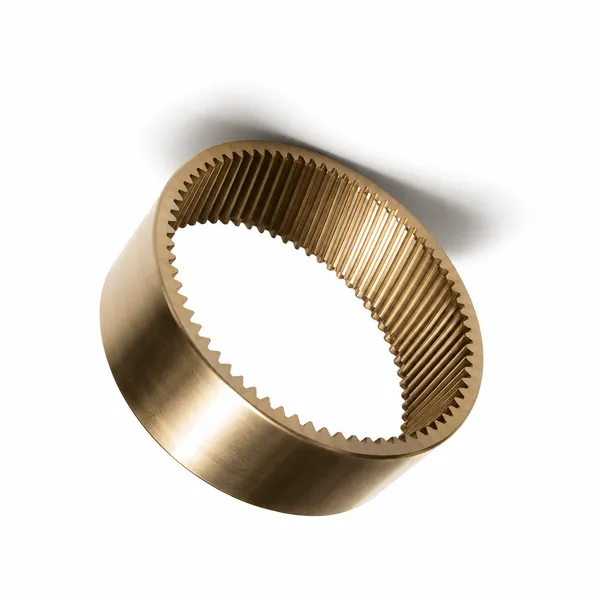
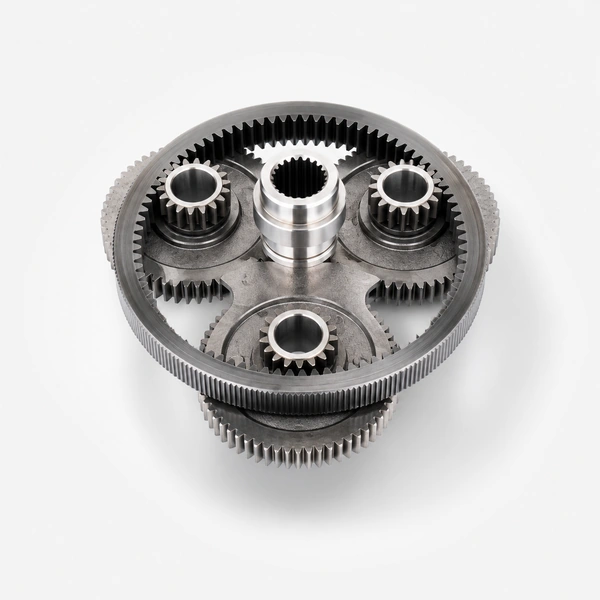
Korea Ever-Power’s ring gears for excavators are manufactured in two distinct product lines matching these two applications: 50Mn or 42CrMo4 QT + case nitrided for swing ring gears (covering the 5T through 80T excavator size range), and 18CrNiMo7-6 case carburized for final drive ring gears (covering mini through large excavator final drive gearboxes). The swing ring gears are manufactured as complete slewing ring assemblies (ring gear + bearing raceway + ball or roller bearing elements + sealing ring) for the OEM market, and as ring-gear-only replacements for the aftermarket service market where the existing slewing ring bearing is still serviceable but the gear teeth are worn. The final drive ring gears are supplied as matching internal ring gear sets for planetary final drive replacement, paired with the planet gears, sun gear, and planet carrier as complete stage kits compatible with the specific excavator model’s gearbox. For planetary final drive complete drive unit specification, see the planetary gearbox design resource for excavator final drive stage arrangement and torque calculation.
The swing ring gear wears through a fundamentally different mechanism than a standard ring gear in a gearbox. The excavator’s upper structure rotates the swing ring gear relative to the swing drive pinions through a limited angular range in the majority of work cycles — digging typically involves repeated left-right swings of 60°–120° to move material from the dig face to a truck or stockpile. Each swing cycle reverses the swing ring gear direction, introducing a cyclic load reversal at the mesh contact point. Over time, the tooth surfaces in the frequently-used angular sector (the 60°–120° sector engaged during the dig-and-swing cycle) accumulate far more contact fatigue cycles than the remaining circumference, resulting in localised pitting and spalling in the active sector while the remainder of the ring is relatively unworn. This characteristic partial-circumference wear pattern is the defining diagnostic sign of swing ring gear fatigue — and it directly informs the replacement decision, because the amount of remaining usable tooth surface is the key life-extension variable.
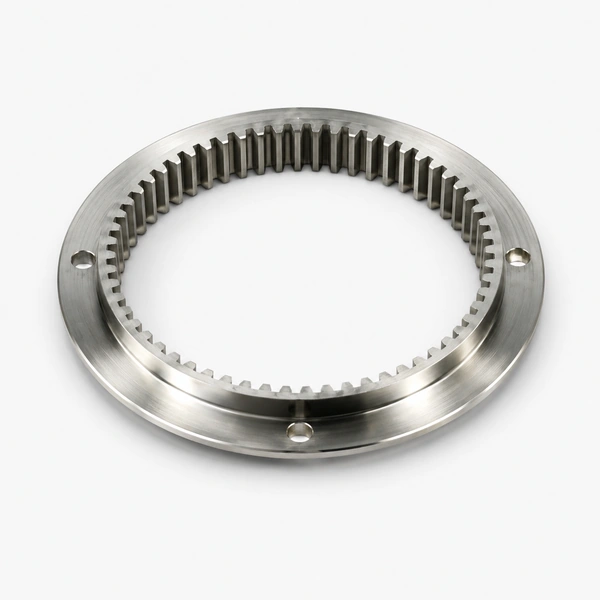
Swing Ring Gear Specification, Wear Assessment and Replacement
The swing ring gear is one of the most expensive single components in an excavator — a replacement swing ring gear for a 30T excavator costs €5,000–€15,000 depending on the machine make and model, compared to €200–€800 for a typical final drive planet gear set. This cost makes the swing ring gear replacement decision an important economic and engineering choice that should be based on measured wear criteria rather than on elapsed hours alone. The OEM-published wear limit for swing ring gears is typically 15–20% reduction in tooth height (measured from the original tooth height at the pitch circle) before replacement is mandatory — at this wear level, the tooth strength has been reduced to the point where the contact fatigue safety factor S_H falls below 1.0 under the maximum swing acceleration torque, and tooth fracture under peak dynamic load becomes a credible risk.
Swing Ring Gear Wear Assessment Procedure
Excavator swing ring gear wear should be measured at each major service interval (every 4,000–6,000 hours) using a gear tooth vernier caliper or a purpose-made tooth caliper gauge. Measure at minimum 12 positions equally spaced around the full ring circumference, including at least 4 measurements in the actively-worn sector (the 60°–120° sector engaged during the machine’s typical dig-and-swing cycle, identified by the visible surface contrast between worn grey and unworn golden-coloured tooth flanks). Compare each measurement to the original tooth height specification (typically OEM-published in the machine service manual, or calculable from the module: full tooth height = 2.25 × module for standard addendum and dedendum).
Record the measurements and the angular position of the minimum tooth height — if the minimum is below 85% of original (15% wear), replacement is recommended. If minimum is between 85% and 90% of original, begin planning procurement of the replacement ring and schedule installation at the next major service window. If minimum is above 90%, continue operation and re-measure at the next service.
Swing Ring Gear Life Extension — Rotation Method
The partial-circumference wear pattern of excavator swing rings creates an opportunity for life extension not available with uniformly-worn gears — if the ring is rotatable relative to its mounting bolts, the worn sector can be rotated away from the active position and an unworn sector positioned in the active mesh zone. This ring rotation extends the effective life of the ring by the ratio of the ring circumference to the worn sector circumference — for a ring with 90° worn sector, rotating by 90° brings a fully fresh tooth sector into service, potentially doubling the ring’s total service life before replacement.
Requirements for ring rotation to be effective: (1) The bolted mounting holes in the ring must allow rotation — most OEM swing ring designs have equally-spaced bolt holes (every 10°–15°) that allow rotation in 10°–15° increments. (2) The ring must be removed, rotated, and reinstalled — a 2–4 hour maintenance job with overhead lifting equipment. (3) The remaining unworn tooth surface must be sufficiently intact to justify the maintenance cost — this should be confirmed by tooth height measurement before committing to the rotation. Korea Ever-Power provides swing ring gear rotation guidance documents for the most common excavator models on request.
Frequently Asked Questions — Ring Gears for Excavators
Explore Korea Ever-Power Gear Categories
Seven precision gear product lines for excavator, construction, mining and heavy equipment applications worldwide.
Éditeur : Cxm
 French
  English
  Italian
  Korean
  Japanese