Large Ring Gears for Wind Turbines: Pitch Control, Yaw Drives and Planetary Gearbox Stages
Wind turbine ring gears operate in the most demanding combination of environmental exposure and mechanical loading in any rotating machinery application — supporting multi-megawatt rotor loads for 20–25 years atop towers 80–150 m high, through temperature extremes from -40°C arctic cold to +50°C tropical heat, in salt-laden offshore atmospheres that corrode standard materials within years, and with maintenance access so difficult and expensive that gear failures cannot be repaired at sea without crane vessels costing €100,000+ per day. This guide covers the three distinct ring gear roles in a wind turbine — the pitch control ring gear (which adjusts individual blade angle), the yaw ring gear (which turns the nacelle to face the wind), and the planetary gearbox ring gear (which transmits rotor torque to the generator) — with full material, quality, and documentation specification for each.
42CrMo4 · 18CrNiMo7-6 · Case Nitrided · DIN 5–7 IEC 61400 · GL · DNV · M8–M30 · 20–25 yr Life Pitch Control · Yaw Drive · Planetary Gearbox
PITCH RING DIAMETER
1.5 – 4.5 m
Wind turbine blade pitch control ring gear internal diameter range. 1.5–2.5 MW onshore turbine: 1.5–2.5 m pitch ring OD. 3–5 MW offshore turbine: 2.5–3.5 m pitch ring OD. 6–15 MW offshore next-generation turbines: 3.5–4.5 m pitch ring OD
MODULE RANGE
M8 – M30
Pitch control ring gear: M8–M16 (profile ground, DIN 5–6). Yaw ring gear: M10–M20 (hobbed or profile ground, DIN 6–7). Planetary gearbox ring gear (main gearbox low-speed stage): M16–M30 (DIN 5–6 ground, case carburized)
CERTIFICATION
GL / DNV / IEC
Wind turbine ring gears require type certification from Germanischer Lloyd (now DNV GL) or Det Norske Veritas (DNV) classification society for use in wind turbines certified to IEC 61400-1 (onshore) or IEC 61400-3 (offshore). Material, process, and dimensional requirements are specified in GL 2010 or DNV-DS-J101
MATERIAL
42CrMo4 / 18CrNiMo7-6
Pitch and yaw ring gears: 42CrMo4 QT + case nitriding (HV 650–750 nitrided layer, HB 280–320 core). Planetary gearbox ring gear: 18CrNiMo7-6 case carburized (HRC 58–62) for maximum contact fatigue resistance at the high Hertzian stresses of main gearbox planetary stage
Wind Turbine Ring Gears — Three Applications, Three Design Philosophies
A modern wind turbine contains three distinct ring gear applications, each with its own design philosophy, material specification, and quality class requirement. Understanding the differences between them is essential for correct specification and procurement — the pitch control ring gear, the yaw ring gear, and the planetary gearbox internal ring gear are not interchangeable in any design parameter, even when they happen to share similar outside diameters on a particular turbine model.
Korea Ever-Power’s large ring gears for wind turbines are manufactured in 42CrMo4 QT through-hardened (standard for pitch and yaw ring gears where case nitriding is applied after through-hardening) and 18CrNiMo7-6 case carburized (for planetary gearbox ring gears requiring maximum contact fatigue resistance). Large wind turbine ring gears are manufactured from ESR (electro-slag remelted) steel wherever possible — the ESR process removes sulphide inclusions and porosity from the steel ingot that would initiate fatigue cracks in large cross-section ring gear forgings, producing a cleaner microstructure with 15–25% higher fatigue life than standard vacuum-melted steel at the same composition. For offshore wind turbines where the consequence of ring gear failure is a crane vessel mobilisation costing €500,000+, ESR or VAR (vacuum arc remelted) steel is specified by most turbine OEMs as mandatory.
The IEC 61400-1 standard for onshore wind turbines and IEC 61400-3 for offshore turbines define the design load cases that wind turbine components — including ring gears — must withstand. The characteristic loads include: normal power production loads (statistical distribution across the turbine’s operating wind speed range), emergency stop loads (when the turbine pitches to feather position during high wind), grid loss events (when sudden loss of generator electrical torque creates a severe torque transient in the drivetrain), and extreme wind loads (50-year return period gust with rotor parked). The ring gear fatigue calculation must demonstrate that the tooth bending fatigue safety factor S_F ≥ 1.25 and the contact fatigue safety factor S_H ≥ 1.0 at the IEC characteristic load case combinations, with partial safety factors applied per ISO 6336-6. Korea Ever-Power provides ISO 6336-6 lifetime fatigue calculation reports for all wind turbine ring gear orders, prepared using the customer’s site-specific load time history from the turbine OEM’s aeroelastic simulation.
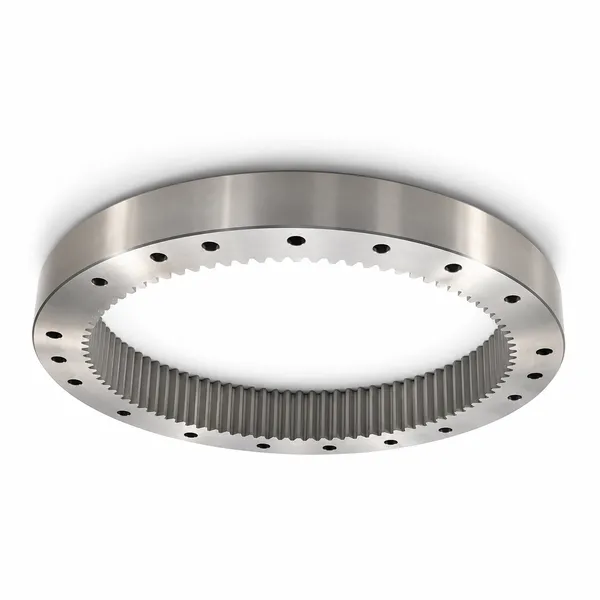
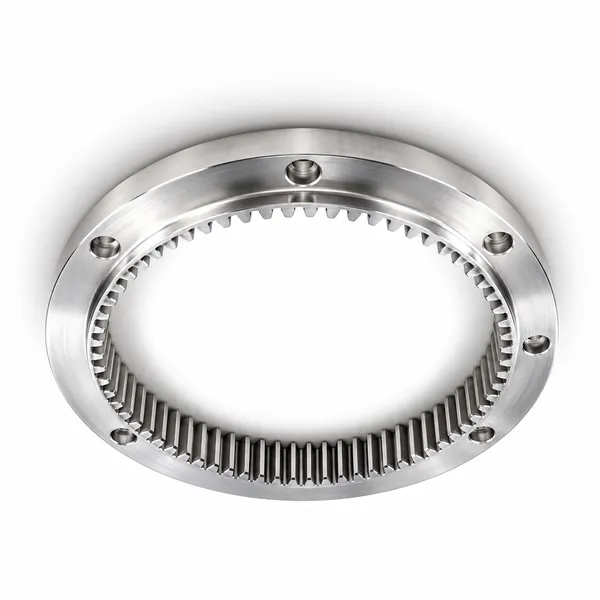
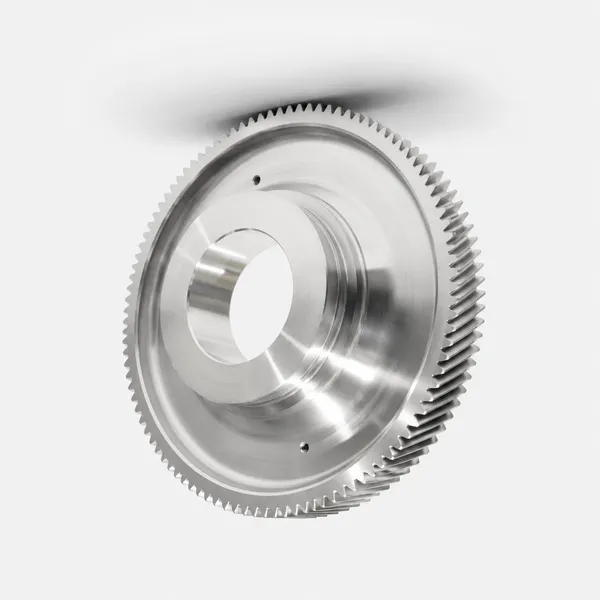
Korea Ever-Power large ring gear for wind turbine pitch control application — 42CrMo4 QT through-hardened HB 290–330, gas nitrided tooth surface HV 650–720 at depth 0.3–0.5 mm, M12, internal tooth profile, nominal pitch diameter 2,200 mm for 2.5 MW onshore turbine blade root interface. DIN 6 quality class after nitriding and profile grinding — all tooth profiles measured on large-diameter CMM with 2,500 mm swing radius. Material: 42CrMo4 forged ring from ESR steel ingot, ultra-sonic tested to SEP 1921 Class C/C after forging, magnetic particle inspected on all tooth surfaces after nitriding. DNV material certificate supplied. Mounting holes and seating surfaces machined in the same setup as the tooth profile grinding to maintain positional accuracy of the tooth profile relative to the mounting interface to ±0.05 mm.
Application-Specific Ring Gear Specifications
ROLE 01
BLADE PITCH
CONTROL RING GEAR
Ring gear specification: M8–M16, 42CrMo4 QT + gas nitrided HV 650–750, internal tooth profile (pinion gear of pitch drive motor meshes on the internal teeth), DIN 5–6 profile ground, OD 1.5–4.5 m, pitch: several segments bolted together or one-piece ring for diameters below 2 m. The pitch control ring gear is the ring gear that each blade’s individual pitch motor drives to rotate the blade around its longitudinal axis — adjusting the blade pitch angle from 0° (maximum power capture) to 90° (feathered, minimum drag during high wind or shutdown). The pitch ring gear is a large-diameter internal ring gear mounted on the blade root bearing, with the drive pinion of the electric pitch motor engaging the internal teeth. The ring gear must withstand the full aerodynamic blade root moment under all IEC 61400 design load cases — including the emergency feathering load case where the blade is driven to 90° pitch at maximum rate while the rotor is at extreme wind speed. This load case produces the highest tooth root bending stress in the pitch ring gear design. Gas nitriding produces a hard, wear-resistant tooth surface (HV 650–750) without the quench distortion that would require extensive post-hardening grinding at this large diameter — the nitrided layer is only 0.3–0.5 mm deep, so dimensional change after nitriding is small and manageable with the final profile grinding operation. Korea Ever-Power pitch ring gears are manufactured in 4- or 8-segment configurations for onshore turbine ring diameters above 2 m that cannot be transported as one piece, with precision spigot joints maintaining ring-gear concentricity after field assembly to within 0.2 mm total.
ROLE 02
YAW RING GEAR
(NACELLE ROTATION)
Ring gear specification: M10–M20, 42CrMo4 QT + gas nitrided or induction hardened, external or internal tooth profile (external tooth yaw rings are more common on large turbines), DIN 6–7, OD 3–8 m, typically two ring segments or one solid ring for onshore, one ring for offshore (crane assembly). The yaw ring gear rotates the entire nacelle (generator, gearbox, main shaft, and rotor hub assembly) around the tower axis to keep the rotor facing into the wind as the wind direction changes. The yaw ring gear is the largest ring gear in the turbine — on a 5 MW offshore turbine, the yaw ring gear is typically 4–5 m in diameter and weighs 3–6 tonnes. Unlike the pitch ring gear (which must pitch each blade quickly for power control), the yaw drive is slow — full 360° yaw rotation takes 15–30 minutes, and daily yaw activity is typically 5–15 slow rotations. The yaw ring gear sees a combination of the nacelle weight (compressive load perpendicular to tooth), wind thrust load (bending load at the yaw bearing and ring gear interface), and the yaw driving torque from the multiple yaw motors. Yaw ring gears on large offshore turbines are driven simultaneously by 8–12 yaw motors, each engaging the ring gear with its own pinion — the yaw ring tooth profile must maintain consistent pitch error across the full circumference to ensure equal load sharing between the yaw motors. Korea Ever-Power yaw ring gears are measured at 48 equally-spaced tooth positions around the full circumference on a large-ring CMM to confirm circumferential pitch uniformity.
ROLE 03
PLANETARY GEARBOX
RING GEAR
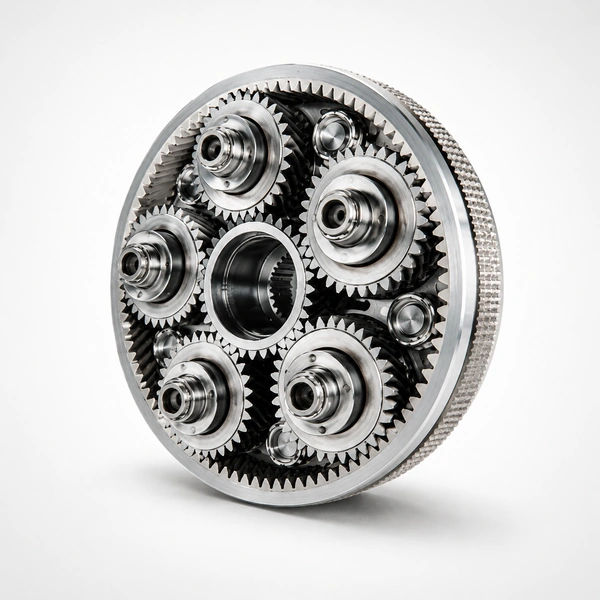
Ring gear specification: M16–M30, 18CrNiMo7-6 case carburized HRC 58–62 (mandatory — the Hertzian contact stresses in a main gearbox planetary stage exceed what case nitriding or through-hardening can sustain at long-term fatigue), DIN 5–6 profile ground, press-fit or bolted assembly in gearbox housing, ESR/VAR steel mandatory. The main gearbox planetary ring gear is the stationary member of the low-speed planetary stage in the wind turbine gearbox — the ring gear is fixed to the gearbox housing, the planet gears orbit inside it, and the planet carrier (connected to the main rotor shaft) drives the planet gears. This ring gear transmits the full rotor torque at the lowest speed stage, experiencing the highest tooth load of any gear in the turbine drivetrain. For a 5 MW turbine at 12.1 RPM rotor speed and 3,950 kNm rated torque (GE, Siemens, or Vestas 5 MW turbine class), the planetary ring gear tooth load is enormous — requiring 18CrNiMo7-6 carburized steel for the contact fatigue resistance, and profile grinding to DIN 5 for the transmission error control that prevents resonance excitation of the gearbox housing. The planetary gearbox ring gear interacts with wind turbine main gearbox design — for more detail on gearbox stage arrangement and planet gear specification, see planetary gearbox design guide for wind turbine drivetrain configuration and bearing selection.
Korea Ever-Power 18CrNiMo7-6 case carburized planetary ring gear for wind turbine main gearbox low-speed stage — M20, internal tooth profile, nominal pitch diameter 1,640 mm, 82 teeth, OD 1,720 mm, bore 1,500 mm H7 (housing press fit). ESR steel forged ring blank, UT tested to SEP 1921 Class B/B after forging. Case carburized to effective case depth 2.2–3.0 mm (deep case required at M20 module to avoid case crushing under maximum Hertzian contact stress). DIN 5 quality class after profile grinding — 100% tooth profile and lead measurement on large CMM, all measurements within DIN 5 tolerance. MT inspection of all tooth surfaces and roots after grinding — zero indications per ASTM E709. Full documentation package for DNV GL type certification: material certificate, forging procedure qualification, UT scan images, carburizing temperature-time record, gear measurement report, MT report. Used in 2.5–4 MW turbine main gearbox low-speed planetary stage.
Offshore Wind Turbine Ring Gears — Additional Requirements
Offshore wind turbine ring gears carry additional specification requirements beyond those for onshore turbines, driven by the combination of higher rated power (5–15 MW vs 2–4 MW onshore), more severe environmental conditions (salt spray, higher humidity, marine biofouling risk at sea level), and the prohibitive cost of unplanned maintenance (requiring crane vessel mobilisation at €500,000–€2,000,000 per event). These additional requirements increase the manufacturing specification and documentation requirements for offshore ring gears significantly beyond the already demanding onshore standard.
Offshore Material Specifications
Offshore wind pitch and yaw ring gears are typically specified in 42CrMo4 QT to the higher-grade specification 42CrMo4+QT with guaranteed minimum impact energy 27 J at -40°C (for arctic offshore sites in the North Sea and Baltic) rather than the standard -20°C requirement. The low-temperature impact requirement is driven by the possibility of extreme winter conditions at the ring gear’s location (the pitch ring gear inside the blade hub experiences ambient temperatures approaching the blade surface temperature, which can reach -35°C to -40°C in Scandinavian offshore winter conditions).
Planetary gearbox ring gears for offshore turbines are specified in 18CrNiMo7-6 from ESR or VAR steel, with the additional ultrasonic cleanliness requirement of SEP 1921 Class B/B — a significantly more stringent cleanliness specification than the standard Class C/C used for onshore gearbox ring gears. The cleaner steel microstructure provides higher fatigue crack initiation resistance for the 25-year design life required for offshore turbines.
Documentation and Certification
DNV GL type certification for offshore wind turbine ring gears requires a documentation package that substantially exceeds standard industrial gear documentation. The minimum package for DNV GL offshore ring gear certification includes: EN 10083-3 material certificate with DNV GL 3.2 surveyor endorsement, forging procedure qualification record, forging traceability record (heat number traceable to original melt), full ultrasonic scan images per SEP 1921 Class B/B, heat treatment records with furnace calibration certificate, dimensional inspection report with all critical dimensions measured and documented, full circumference tooth profile and pitch measurement report (100% of all teeth), surface hardness distribution map (minimum 8 positions around circumference for nitrided rings), and DNV GL surveyor witness inspection certificate.
Korea Ever-Power provides DNV GL-endorsed documentation packages for offshore wind ring gear orders on request — this requires scheduling a DNV GL surveyor witness visit at Korea Ever-Power’s facility during the critical inspection stages (forging review, heat treatment witness, final dimensional and MT inspection witness). Lead time increases by 7–14 days to accommodate the surveyor scheduling.
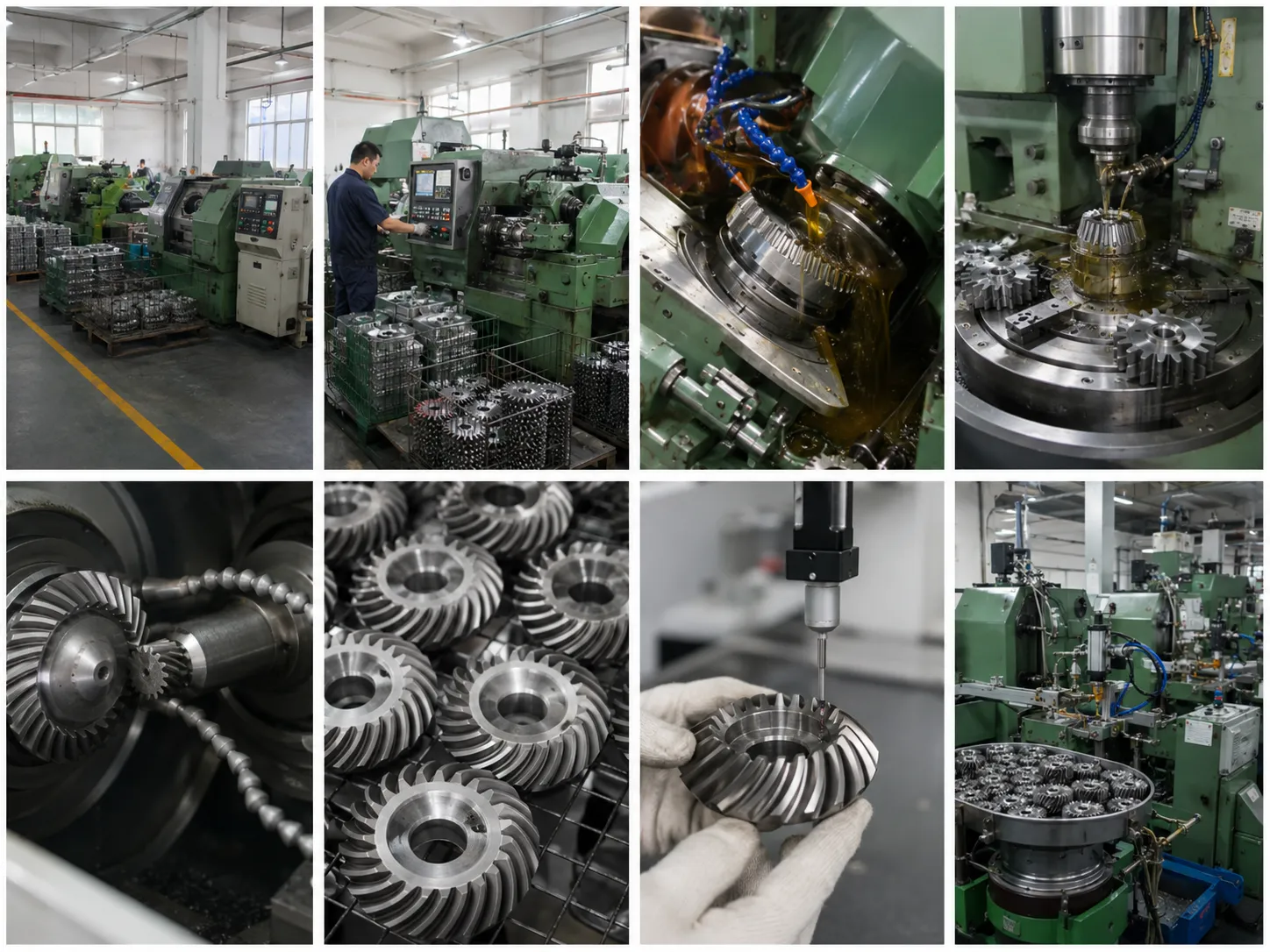
Korea Ever-Power large ring gear manufacturing facility — vertical gear hobbing and internal profile grinding machines for wind turbine ring gears up to 4,500 mm OD. The manufacturing of large wind turbine ring gears presents significant handling and measurement challenges — a 2.5 m OD 42CrMo4 pitch ring gear weighs 800–1,500 kg and requires a dedicated lifting fixture for all machining and inspection operations to prevent distortion from workpiece self-weight deflection. Korea Ever-Power uses finite element analysis (FEA) to calculate the optimal support locations for each ring gear size during machining to minimise self-weight deflection at the tooth profile grinding stage, maintaining DIN 5–6 quality class across the full ring circumference without the profile error pattern that would result from inadequate workpiece support.
Frequently Asked Questions — Large Ring Gears for Wind Turbines
Q 01
Our 2 MW onshore turbine pitch ring gear is showing progressive tooth wear on one sector (approximately 30° arc) of the ring circumference, while the rest of the ring is in good condition. What causes this and does the whole ring need replacing?
Localised pitch ring gear tooth wear on a limited arc sector is a well-documented failure mode in wind turbine pitch control systems, caused by the limited angular range of pitch actuator movement in normal operation. During normal power production, a wind turbine pitches each blade through a relatively small angle (typically ±5° to ±10° from the rated power pitch setpoint) as the wind speed fluctuates around the rated value. This means the pitch ring gear teeth that engage the drive pinion at the normal pitch setpoint position receive millions of low-amplitude load cycles, while the teeth at the extreme pitch angles (0° full-feather position, used only during startup and shutdown) receive very few. The concentrated wear in the 30° arc corresponds to the tooth sector engaged at the normal operating pitch angle, while the adjacent sectors show minimal wear because they are rarely engaged. This is called “fretting fatigue in limited-angle oscillation” — a recognised failure mode in wind turbine pitch ring gears. Can it be repaired without full ring replacement? Yes, in some cases. If the worn sector has lost less than 10% of the original tooth profile height (measurable with a gear tooth vernier caliper), the blade pitch controller can be reprogrammed to shift the mean pitch setpoint by ±5°, redistributing the load cycles to a different tooth sector and extending the ring gear service life by 12–24 months until the next planned maintenance. If wear has progressed beyond 10% depth or if tooth fracture has begun in the worn sector, full ring replacement is required. Korea Ever-Power can supply segmented pitch ring gear replacements where only the worn sector (2 or 4 segments of an 8-segment ring) is replaced rather than the full ring — reducing the replacement cost by 60–70% compared to full ring replacement.
Q 02
What is the lead time for a replacement pitch ring gear for a 3 MW offshore wind turbine, and what logistics considerations apply to offshore delivery?
Lead time for a replacement pitch ring gear for a 3 MW offshore turbine (typical ring OD 2.8–3.2 m, M12, 42CrMo4 QT + nitrided, DIN 6): If Korea Ever-Power has the turbine model in the reference database (Siemens SWT-3.0-101/108, GE 3.x, Vestas V112-3.0 MW series): 55–75 days from order confirmation to fabrication complete, plus 7–14 days if DNV GL surveyor witness is required. For turbine models not in the database — reverse engineering from OEM drawing or physical measurement: add 10–15 days for engineering review and drawing development before machining begins. Logistics for offshore delivery: (1) Transport dimensions: a 3 m OD ring gear requires a low-loader trailer with minimum 3.5 m deck width and height clearance planning for the route to the port. Segmented ring designs (2 or 4 segments) fit standard flatbed trailers and simplify logistics. (2) Port and vessel loading: offshore installation of a ring gear in the hub requires the hub to be accessible from a service vessel — most offshore pitch ring replacements are conducted during planned major overhauls when the turbine is decommissioned for crane access, because the ring gear is installed inside the hub and the hub must typically be rotated to the 6 o’clock position for access. (3) Preservation for extended outdoor or deck storage: Korea Ever-Power ships pitch ring gears with cosmoline or VCI (Volatile Corrosion Inhibitor) coating on all machined surfaces, plus sealed VCI packaging, rated for 24 months of outdoor storage — appropriate for offshore staging yards or vessel deck storage during multi-turbine replacement campaigns.
Q 03
What is the difference between gas nitriding and case carburizing for wind turbine ring gears, and which process is correct for pitch vs planetary gearbox ring gears?
Gas nitriding and case carburizing produce very different surface layer properties and are used for different wind turbine ring gear applications: Gas nitriding (42CrMo4 substrate): process temperature 500–520°C, case depth 0.3–0.5 mm, surface hardness HV 650–750 (approximately HRC 57–62). Advantages: very low distortion (performed below the steel’s transformation temperature, so no quench distortion), excellent resistance to fretting corrosion (important for pitch ring gears which oscillate at limited angles), good wear resistance for slow-speed pitch and yaw ring gear applications. Limitations: the nitrided layer is thin and cannot support the high Hertzian contact stresses at M20+ module gears in main gearbox applications — if the contact stress exceeds the load-bearing capacity of the thin nitrided layer, sub-surface fatigue cracks initiate just below the nitrided zone and progress rapidly to spalling. Case carburizing (18CrNiMo7-6 substrate): process temperature 900–950°C, effective case depth 1.5–3.0 mm depending on module, surface hardness HRC 58–62. Advantages: deep, tough case with smooth hardness gradient from surface to core — can sustain the high contact stresses of main gearbox planetary ring gears at M16–M30 module where nitriding would sub-surface fail. Limitations: quench distortion from the 900°C → oil quench process requires post-carburizing profile grinding to restore the DIN quality class, adding cost and complexity. Selection rule: pitch ring gear and yaw ring gear → gas nitriding on 42CrMo4 (low distortion, adequate contact stress capacity at M8–M16 module in pitch and yaw service). Main gearbox planetary ring gear → case carburizing on 18CrNiMo7-6 (deep case, maximum contact fatigue resistance for M16–M30 module main gearbox service). Never substitute gas nitriding for case carburizing in a main gearbox planetary ring gear application — the difference in sub-surface fatigue life under the high Hertzian contact stresses is a factor of 5–10×.
Explore Korea Ever-Power Gear Categories
Seven precision gear product lines for wind energy, heavy industry, mining and specialist applications worldwide.
Korea Ever-Power manufactures 42CrMo4 gas-nitrided pitch and yaw ring gears (OD up to 4,500 mm, DIN 5–7) and 18CrNiMo7-6 carburized planetary gearbox ring gears (M16–M30, DIN 5–6) for all wind turbine classes. ESR/VAR steel available for offshore projects. DNV GL surveyor witness and documentation package. Segmented pitch ring supply for onshore replacement campaigns. Full IEC 61400 fatigue life calculation report on request. ISO 9001:2015 certified.

 Japanese
  English
  Italian
  Korean
  French