
Spur Gears for Packaging Equipment:
Drive Design, Hygiene Standards and Speed Synchronisation
Packaging equipment spur gears serve two distinct masters simultaneously — mechanical precision and regulatory hygiene. Whether driving a high-speed carton erector, indexing a bottle-filling carousel, or synchronising the film feed of a horizontal flow wrapper, spur gears in packaging lines must deliver repeatable angular position, maintain output speed constancy across variable product loads, and in food and pharmaceutical applications, comply with FDA 21 CFR, EU 1935/2004, and NSF standards. This comprehensive guide covers spur gear material selection, quality class, backlash control, NSF H1 lubrication, stainless housing design, and speed-synchronisation requirements for the full spectrum of industrial and hygienic packaging equipment drives.
M1.5–M8 · DIN 5–8 · IP67 · FDA 21 CFR
Flow Wrapper · Filler · Carton · Pharma
Why Spur Gears Are the Standard Choice for Packaging Equipment Drive Trains
The packaging machinery industry has converged on spur gears as the dominant gear type for the vast majority of within-machine drive trains for three reasons that no alternative gear type can match simultaneously: absolute phase repeatability (a spur gear mesh maintains a fixed angular relationship between driver and driven shaft across millions of cycles, making it ideal for register-critical packaging operations), compact inline geometry (the zero helix angle eliminates axial thrust loads that would require larger, more complex bearing arrangements in the constrained space of a packaging machine frame), and straightforward replacement (spur gear tooth form inspection and cross-referencing does not require specialised spiral bevel or worm gear measurement tools, allowing maintenance engineers to specify and verify replacement gears rapidly during a production shutdown).
Korea Ever-Power’s spur gears for packaging equipment are manufactured across the full range of packaging industry material requirements — 20CrMnTi case carburized for high-speed servo-synchronised index drives and film feed gears, C45 induction hardened for medium-duty carton and case conveyor drives, and 316L stainless for hygienic packaging applications subject to daily CIP washdown. The production programme includes both standard DIN metric module spur gears (M1.5 through M8) and non-standard pitch packaging machine gears manufactured to the dimensional specification of existing OEM gears — including inch diametral pitch gears for packaging equipment originally built to North American standards.
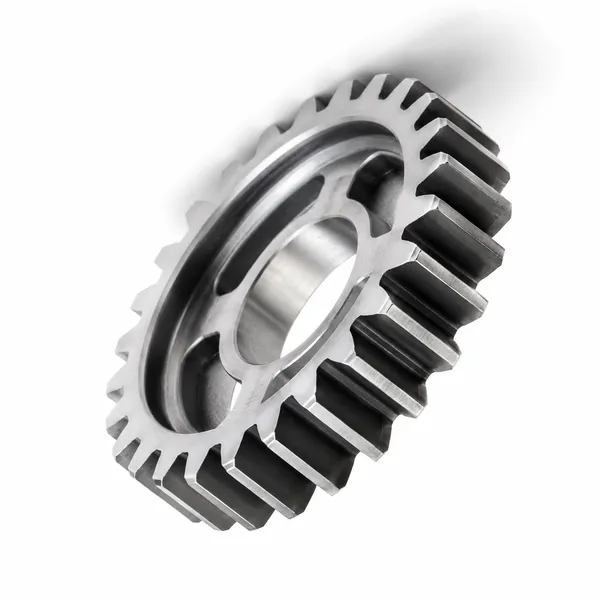
Speed synchronisation between adjacent packaging machine sections is the most critical performance parameter that packaging equipment spur gears must maintain. A horizontal flow wrapper with film feed speed mismatched to the product conveyor speed by more than 0.5% produces continuous pack defects — loose packs downstream of the seal jaw, tight packs that distort the product upstream. This synchronisation is achieved through a combination of spur gear ratio accuracy (which sets the nominal speed relationship), gear quality class (which limits the transmission error that causes cyclic speed variation), and backlash control (which determines the dead band when the drive direction reverses between push and pull phases of the film forming cycle). Korea Ever-Power packaging machine spur gears are available with measured and certified backlash for servo-synchronised drive applications.
20CrMnTi Case Carburized
The standard material for high-speed packaging equipment spur gears requiring maximum fatigue life and wear resistance. Case carburized to effective case depth 0.5–0.9 mm (module-dependent), HRC 58–62 tooth surface, ductile core HB 280–320. Used for film feed gears in FFS machines, index drive gears in carton erectors, and conveyor synchronisation gears on high-speed beverage and dairy packaging lines operating above 300 ppm. Shot peened tooth roots improve bending fatigue life by 20–25% under the cyclic acceleration and deceleration loads of servo-driven packaging indexers.
Best for: servo index drives, film feed, >300 ppm lines
C45 Induction Hardened
The cost-effective choice for medium-duty packaging equipment spur gears — carton conveyor gears, case packer product handling drives, and labelling machine label feed drives. Induction hardened to HRC 48–54 at the tooth surface, normalised core HB 180–210. Annual replacement is economically practical for many packaging line gears, making the lower first cost of C45 more attractive than the extended life of 20CrMnTi. Not suitable for food and pharmaceutical packaging lines requiring 316L material or NSF H1 hygienic design — C45 corrodes rapidly in CIP washdown environments.
Best for: carton conveyor, case packer, <200 ppm non-food
316L Stainless Steel
Mandatory for food, beverage, dairy, and pharmaceutical packaging equipment spur gears subject to product splash, CIP washdown at 80°C with NaOH and peracetic acid, or regulatory inspection under FDA 21 CFR Part 110 (food) or EU GMP (pharmaceutical). 316L stainless is austenitic and cannot be case carburized — maximum hardness HB 200 in the hobbed condition, or nitrided to approximately HV 900 in the tooth surface. Load capacity is lower than carburized steel, but adequate for the light-to-medium duty of most hygienic packaging drives. Paired with NSF H1 PAO lubricant and PTFE or EPDM shaft seals.
Best for: food, dairy, pharma, CIP washdown applications
Packaging Machine Application Drive Specifications
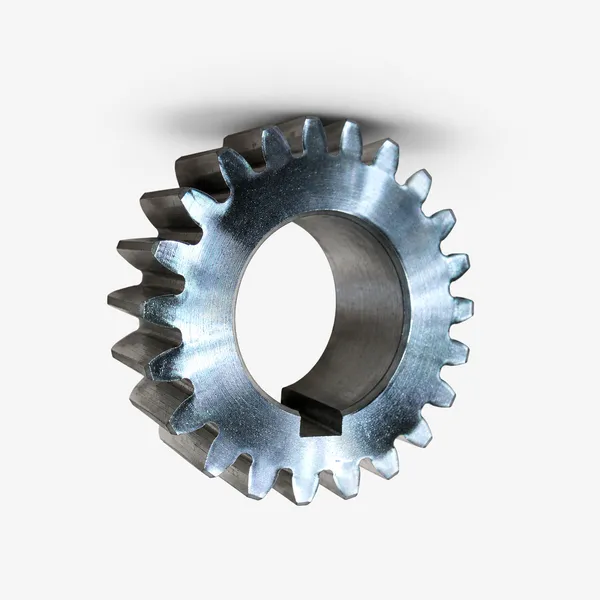
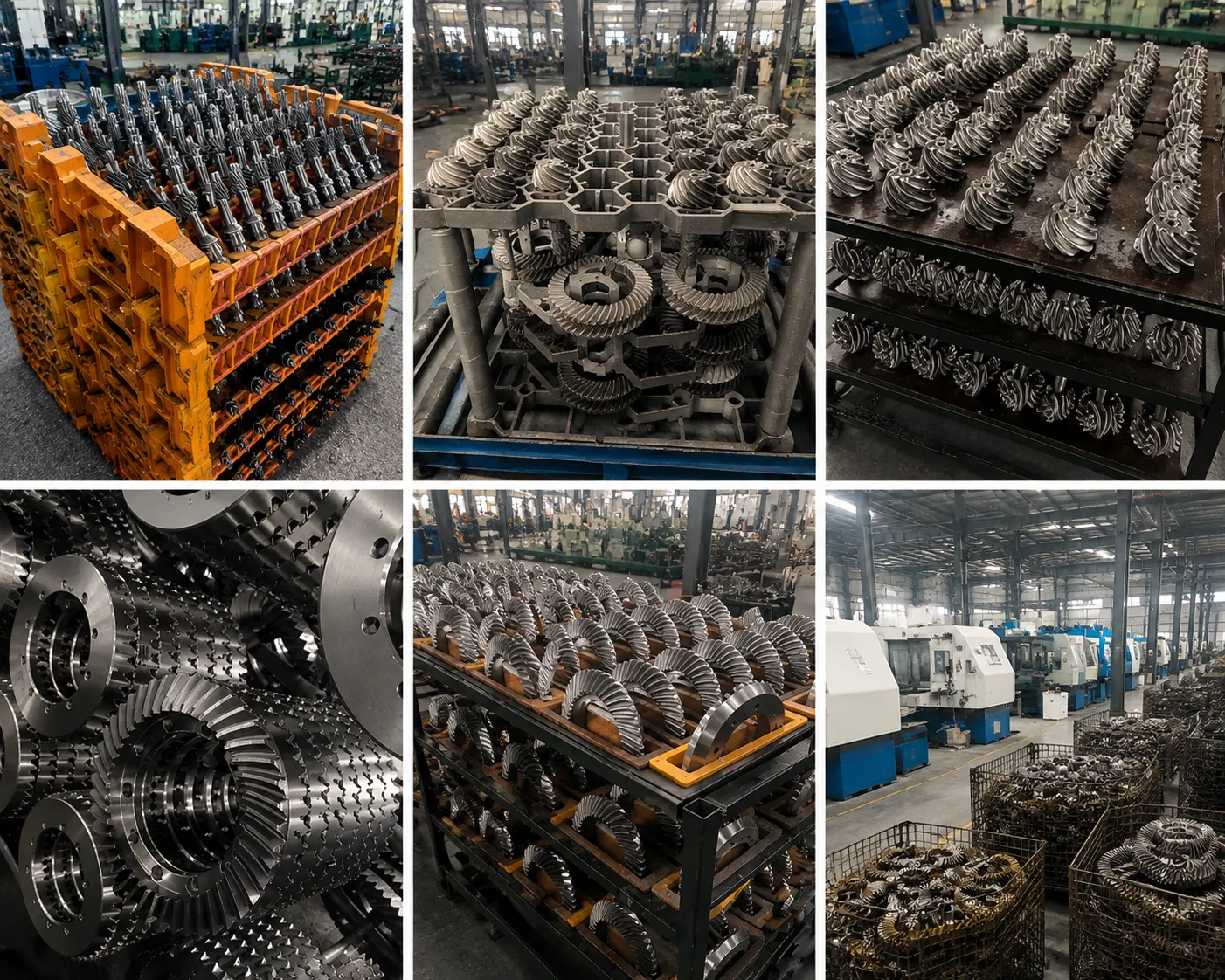
Hygienic Design for Food and Pharmaceutical Packaging Spur Gear Drives
The hygienic design of spur gear drives for food and pharmaceutical packaging equipment has evolved significantly since the original EU Machinery Directive requirements were supplemented by EHEDG (European Hygienic Engineering and Design Group) guidelines and the FSMA (Food Safety Modernization Act) requirements in North America. The current state of the art for food packaging line spur gear drives encompasses material selection, surface finish, lubricant compliance, sealing design, and drainage — all of which must be addressed simultaneously to achieve EHEDG-certified hygienic design for direct or incidental food contact zones.
A common misconception in food packaging plant specification is that 316L stainless spur gears are inherently hygienic. The gear material alone is necessary but not sufficient — a 316L stainless spur gear in a cast iron gearbox housing with standard nitrile rubber shaft seals and mineral gear oil is not EHEDG-compliant, because the housing material, lubricant, and seals all have direct or indirect food contact risk. Korea Ever-Power’s hygienic packaging spur gear drive specification addresses all four elements: 316L stainless gear set, electropolished aluminium or 316L stainless housing (Ra ≤ 0.8 μm), NSF H1 synthetic PAO lubricant, and EPDM or PTFE shaft seals rated for CIP chemical resistance at 85°C.
HYGIENIC PACKAGING SPUR GEAR DRIVE — COMPLIANCE CHECKLIST
GEAR MATERIAL
- ✓ 316L stainless (preferred for washdown zones)
- ✓ 20CrMnTi with sealed enclosed housing (acceptable for splash zones)
- ✗ C45 carbon steel (not acceptable in any food contact zone)
- ✗ Cast iron (not acceptable — corrosion risk)
LUBRICANT
- ✓ NSF H1 registered gear oil (Klüber Summit WF, Castrol Tribol GL)
- ✓ Change interval 2,000–4,000 h or annually
- ✗ Mineral gear oil (not NSF H1 compliant)
- ✗ EP gear oil with amine additives (not food-grade)
SEALING / HOUSING
- ✓ IP67 minimum; IP69K for high-pressure washdown
- ✓ EPDM or PTFE shaft seals for CIP compatibility
- ✓ Sloped housing surfaces for drainage, no horizontal ledges
- ✓ Electropolished 316L housing Ra ≤ 0.8 μm (EHEDG requirement)
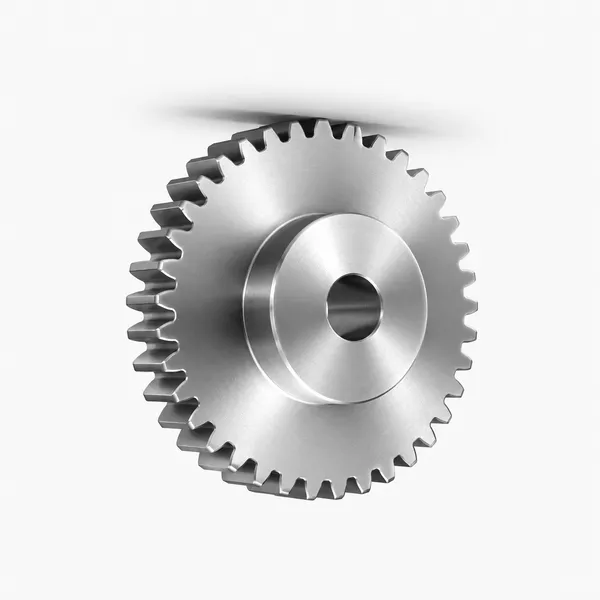
Backlash Control and Speed Synchronisation in Packaging Line Spur Gear Drives
Backlash in packaging machine spur gears is a primary contributor to pack registration error, particularly in servo-synchronised multi-axis packaging systems where the machine controller attempts to maintain precise angular relationship between independently servo-driven axes connected through spur gear drive trains. The backlash in each spur gear mesh represents a dead band — an angular range through which the output shaft can move without corresponding input shaft movement during direction reversal. In a three-mesh spur gear drive train with 0.08 mm backlash per mesh, the total drive train dead band at the final output shaft can exceed 0.24 mm tooth tangential equivalent — equivalent to a position error of several millimetres at a packaging conveyor pitch diameter of 100 mm.
Modern servo packaging machine controllers include backlash compensation algorithms that command an additional angular offset at each direction reversal, correcting for the known backlash in each axis drive train. Effective backlash compensation requires that the actual backlash is accurately measured and entered into the controller — which requires the gear supplier to measure and certify the backlash of each gear pair at the specified operating centre distance. Korea Ever-Power measures backlash on all packaging machine spur gear pairs ordered for servo drive applications, providing a measurement certificate that allows direct entry into the machine controller’s backlash compensation parameter set.
REDUCING BACKLASH — DESIGN METHODS
- →Tight centre distance: holding the gear centre distance to the lower end of the tolerance range reduces backlash to 40–60% of nominal. Requires precise housing bore positioning (±0.03 mm recommended for packaging machine spur gear housings)
- →Profile shift (addendum modification): positive profile shift on both pinion and wheel increases tooth thickness, reducing backlash at standard centre distance without changing the pitch diameter relationship. Korea Ever-Power can apply profile shift coefficients per DIN 3992 to reduce backlash by 30–50% in any packaging machine spur gear pair
- →Anti-backlash scissor gear: two identical spur gears on the same hub, spring-loaded to push apart angularly, contacting the drive and coast flanks of the mating gear simultaneously. Eliminates backlash entirely at the cost of reduced maximum torque (limited by spring pre-load)
- →DIN quality class upgrade: upgrading from DIN 8 to DIN 6 reduces the allowed tooth thickness tolerance band, tightening the achievable backlash range without changing module or centre distance
SPEED SYNCHRONISATION — SPUR GEAR ROLE
- →Ratio accuracy: spur gear ratio = tooth count ratio. Tooth count is absolute — no manufacturing variable affects it. The synchronisation ratio of a spur gear drive is therefore exact, unlike belt or chain drives which are subject to slip and elongation
- →Transmission error: TE at the mesh frequency superimposes a periodic velocity variation on the ideal ratio. DIN 5–6 quality class limits TE below 5 μrad at packaging speeds — below the threshold that causes visible pack position errors at up to 400 ppm
- →Stiffness: spur gears have high torsional stiffness per mesh — typically 2–8 Nm/μrad — providing the rigid speed coupling between synchronised axes that servo controller algorithms rely on to maintain inter-axis phase accuracy
- →Replacement traceability: when a spur gear is replaced in a servo-synchronised packaging line, the new gear must be from the same DIN quality class as the original to maintain the transmission error within the range the servo controller was tuned to. Korea Ever-Power supplies replacement packaging gears with the same quality class as the original specified gear
Frequently Asked Questions — Packaging Equipment Spur Gears
Explore Korea Ever-Power Gear Categories
Seven precision gear product lines for packaging, food processing, pharmaceutical and industrial applications worldwide.
編集者: Cxm
 Japanese
  English
  Italian
  Korean
  French