
Helical Gears for Automotive Transmissions:
Manual, DCT and EV Gearbox Design
Automotive transmission helical gears must simultaneously satisfy the most demanding combination of noise, fatigue life, efficiency, weight, and dimensional constraints of any gear application. This guide covers helical gear specification for manual transmissions, dual-clutch transmissions (DCT), and electric vehicle reduction gearboxes — including material grades, heat treatment, DIN quality class, tooth flank modification, and gear noise (whine) management.
AGMA 10–12 · DIN 4–6 · ISO 6336
Manual · DCT · EV Single-Speed · Hybrid
Automotive Transmission Helical Gear Requirements
Automotive transmission helical gears must satisfy a combination of performance requirements that collectively define the most demanding gear design environment in volume production. Noise (gear whine) is the primary driver — passenger car buyers perceive transmission noise as a direct indicator of vehicle quality, and automakers allocate a significant portion of total transmission development budget to noise, vibration, and harshness (NVH) management at the gear level. A helical gear pair that produces gear whine above 65 dB(A) at the transmission housing during a specific vehicle speed range (typically 50–130 km/h) requires expensive redesign — profile modification, quality class upgrade, or helix angle adjustment — to bring the noise into specification before Job 1 production.
Korea Ever-Power manufactures helical gears for automotive transmission applications in SCM420H (JIS), 20CrMnTi (GB), SAE 8620, and 18CrNiMo7 (DIN) case-carburizing steels — all to AGMA 10–12 or DIN 4–6 quality class as required by the automotive OEM specification. Tooth flank modifications (tip relief, lead crown, bias correction) are applied as standard on automotive transmission helical gears to optimise the contact pattern under operating load and minimise transmission error in the gear whine frequency band.
The compact packaging requirement of automotive transmissions drives module selection to the smallest value that satisfies the fatigue life requirement — automotive transmission helical gears typically use modules of M1.75–M3.5 in passenger car and M3–M5 in commercial vehicle applications, far smaller than industrial gearbox gears at equivalent transmitted torque. This compact module requires the highest accuracy (AGMA 11–12) to achieve the transmission error targets needed for the noise specification, and the most controlled heat treatment process to achieve the required case depth without distortion that would degrade the post-grind accuracy.
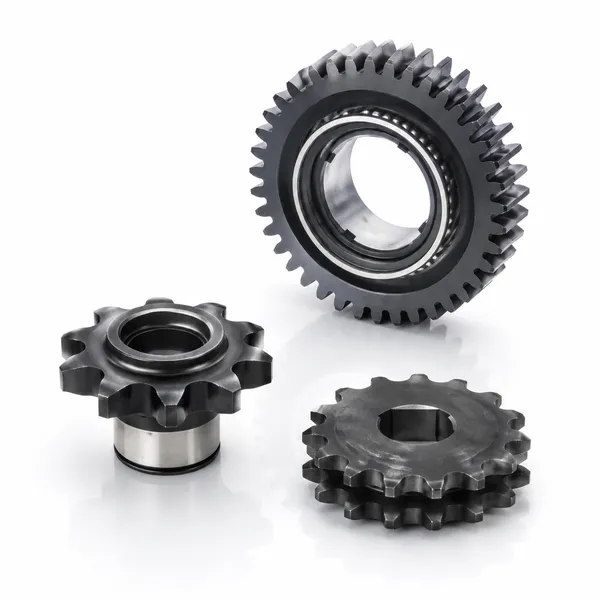
Transmission Types and Helical Gear Specifications
TOOTH FLANK MODIFICATIONS FOR AUTOMOTIVE TRANSMISSION HELICAL GEARS
Tip Relief (Involute Crowning)
Removal of 5–15 μm from the tooth tip involute form over the last 10–20% of active flank length. Eliminates the load-dependent dynamic tooth engagement impact as the incoming tooth tip contacts the flank of its mating tooth before the theoretical contact point — the primary source of gear whine at the gear mesh frequency harmonic. Optimised tip relief amplitude equals the tooth deflection under peak transmitted load.
Lead Crown (Lengthwise Crowning)
A slight barrel shape applied to the tooth face width — typically 4–8 μm convex relief from the crown to each end of the tooth. Lead crown concentrates the contact pattern in the centre one-third to one-half of the face width, preventing edge loading when shaft deflection under load shifts the contact toward the tooth end. Essential for automotive transmission helical gears where assembly tolerances and shaft deflection under peak torque would otherwise cause end contact.
Bias Correction (Twist)
A diagonal surface modification that compensates for the predictable contact pattern shift caused by gear shaft deflection under load (which moves the contact diagonally across the tooth face). Bias correction is applied as an additional helical deviation superimposed on the normal lead crown and tip relief — it is gear-pair and load-specific and requires finite element analysis of the gearbox shaft deflection under rated load to calculate the correct bias angle and amplitude.
Material and Heat Treatment: Automotive Transmission Grade
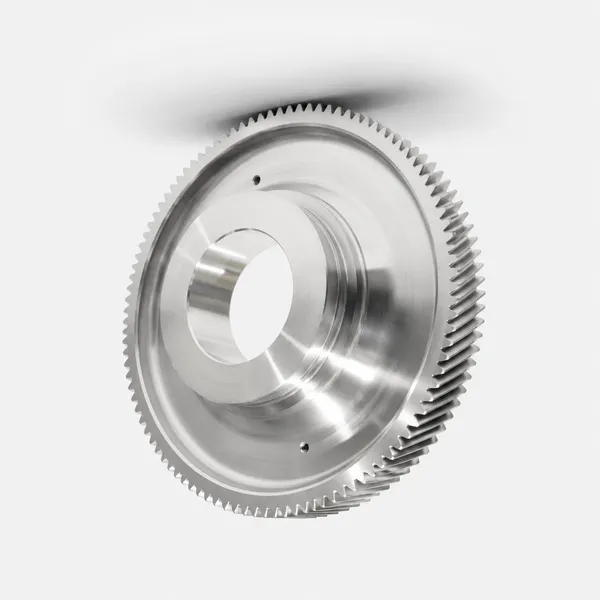
SCM420H / SAE 8620 (Cr-Mo)
The most widely used automotive transmission helical gear steel worldwide. SCM420H (JIS B 4052) and SAE 8620 are both chromium-molybdenum case-carburizing steels with excellent carburizing response, good core toughness, and consistent hardenability within the specified H-band. Case depth 0.4–0.7 mm for passenger car transmission gears, HRC 58–63 surface, core HB 330–380. The H-band specification tightly controls core hardness variation, which directly influences the compressive residual stress profile that determines tooth bending fatigue strength.
✓ Standard passenger car transmission gear material
20CrMnTi (Chinese Standard)
China’s most widely specified automotive transmission gear steel — functionally equivalent to SCM420H for most transmission applications, with established carburizing process data across Chinese heat treatment suppliers. σF = 380–430 MPa, σH = 1,400–1,550 MPa. Korea Ever-Power uses 20CrMnTi for automotive transmission helical gear orders targeting Chinese domestic vehicle OEM programmes and cost-competitive replacement parts for global markets where the property specification rather than the specific grade designation is the controlling factor.
✓ Chinese OEM transmission, cost-effective global
18CrNiMo7-6 (High Performance)
Premium transmission gear steel for maximum fatigue life and impact resistance — specified in commercial vehicle transmissions, high-performance sports car gearboxes, and EV reduction gearboxes where peak torque margins are minimal and fatigue safety factors must be confirmed to ISO 6336 with SF ≥ 1.3. The higher Ni content (1.4–1.7%) provides superior core impact toughness at low temperatures — important for commercial vehicle transmissions operating in cold climates. AKV > 80 J at −20°C for 18CrNiMo7-6 vs 50–60 J for SCM420H.
✓ Commercial vehicle, EV, high-performance transmission
Frequently Asked Questions
Explore Korea Ever-Power Gear Categories
Seven precision gear product lines for automotive, industrial, wind energy and specialist applications worldwide.
Éditeur : Cxm
 French
  English
  Italian
  Korean
  Japanese