GEAR APPLICATION GUIDE · HELICAL GEAR · H09

Helical Gears for Marine Propulsion:
Naval Reduction Gearboxes, Ferry Drives and Offshore Vessel Propulsion

Marine propulsion helical gears operate in one of the most demanding combined environments in mechanical engineering — the propulsion gearbox of a vessel at sea must transmit megawatts of power continuously for 20–30 years, in a saltwater-saturated atmosphere that corrodes standard materials within months, subject to shock loads from propeller cavitation, wave slam, and emergency full-astern manoeuvres that can triple the normal transmitted torque in milliseconds, while maintaining the dimensional stability and bearing alignment needed for quiet, vibration-free operation that meets the ship’s noise signature requirement. This guide covers helical gear specification for commercial ferry propulsion, offshore supply vessel drives, naval patrol vessel gearboxes, and large yacht main drives.

18CrNiMo7-6 · 42CrMo4 · VAR · M8–M30 · DIN 4–6
Lloyd’s · DNV GL · BV · ABS · 20–25 yr Life
Ferry · Naval · Offshore · Luxury Yacht

POWER RANGE

500 kW – 30 MW

Marine propulsion gearbox power range for helical gear drives. Fast patrol vessel (medium-speed diesel): 500 kW–2 MW. Ferry and RoPax (medium-speed diesel or gas turbine): 3–15 MW. Offshore supply vessel (diesel-electric, azimuth thruster): 2–8 MW per shaft. Naval frigate or destroyer (CODAD/CODAG): 15–30 MW per shaft

MODULE RANGE

M8 – M30

Marine propulsion helical gear module range. First reduction stage (high-speed, motor or diesel output): M8–M14. Second reduction (intermediate): M12–M20. Bull gear (propeller shaft): M18–M30 for large vessels. Double-helical (herringbone) tooth form used in all stages above M12 to eliminate axial thrust on bearings

CLASSIFICATION

Lloyd’s / DNV GL / BV

Marine propulsion gearboxes require type approval from a classification society — Lloyd’s Register, DNV GL, Bureau Veritas (BV), ABS, or ClassNK. Classification requires material, manufacturing process, NDT, and dimensional documentation submitted for the classification society’s review and surveyor witness inspection. Korea Ever-Power holds active class society approvals for gear manufacturing

TOOTH FORM

Double-Helical

Marine propulsion gearboxes above 500 kW almost universally use double-helical (herringbone) tooth form — two sets of opposing helical teeth that cancel the axial thrust produced by each helical set, allowing the use of simple journal bearings without axial thrust faces and simplifying the bearing lubrication system. The double-helical form also provides 40–50% higher contact ratio than single-helical at the same face width

Marine Propulsion Helical Gear Engineering — Classification, Materials and Design

Marine propulsion gearboxes represent the highest power density and longest design life requirement of any helical gear application. A 10 MW ferry propulsion gearbox weighs approximately 40–60 tonnes and transmits 10,000 kW through gears that must sustain this load for 20,000–30,000 operating hours over the vessel’s 25-year class period between major surveys. The power density of marine propulsion gears is achieved through the combination of high-strength alloy steel (18CrNiMo7-6 case carburized, or 42CrMo4 for lower-power stages), double-helical tooth form (which maximises the tooth contact ratio and distributes the load over a longer arc of engagement for any given centre distance), and DIN 4–5 quality class profile grinding (which maintains the EHL film thickness under the extreme Hertzian contact stresses of multi-megawatt gear mesh contact).

Korea Ever-Power’s helical gears for marine propulsion are manufactured from 18CrNiMo7-6 VAR (vacuum arc remelted) steel for the highest-loaded first and second stage gears where the combination of deep case depth, tough core, and maximum cleanliness is required, and 42CrMo4 QT for lower-loaded auxiliary marine drives. VAR steel is specified for critical marine propulsion gears because the vacuum arc remelting process removes oxide inclusions and reduces hydrogen content in the steel — both of which can initiate sub-surface fatigue cracks in large gear tooth cross-sections under the millions of high-Hertzian-stress load cycles of propulsion gearbox service. The VAR process adds approximately 15–20% to the steel cost but extends the sub-surface fatigue initiation life by 2–3× compared to standard VIM (vacuum induction melted) or air-melted steel.

The classification society approval process for marine propulsion helical gears requires Korea Ever-Power to submit a Technical File to the class society (e.g. Lloyd’s Register) containing: the gear design calculation per ISO 6336 with all service factors, the material specification and heat treatment procedure, the NDT (non-destructive testing) procedure and acceptance criteria (UT per SEP 1921 Class B/B for forgings, MPI per EN ISO 23278 Level 1 for all tooth surfaces), the dimensional inspection procedure, and the qualification test records. The class surveyor then witnesses the critical manufacturing stages — forging review, heat treatment, final MPI, and dimensional inspection — and issues the Type Approval Certificate for the gear. Korea Ever-Power provides full classification documentation support for Lloyd’s Register, DNV GL, Bureau Veritas, ABS, and ClassNK approvals, with a dedicated class society liaison team managing the documentation submission and surveyor scheduling.
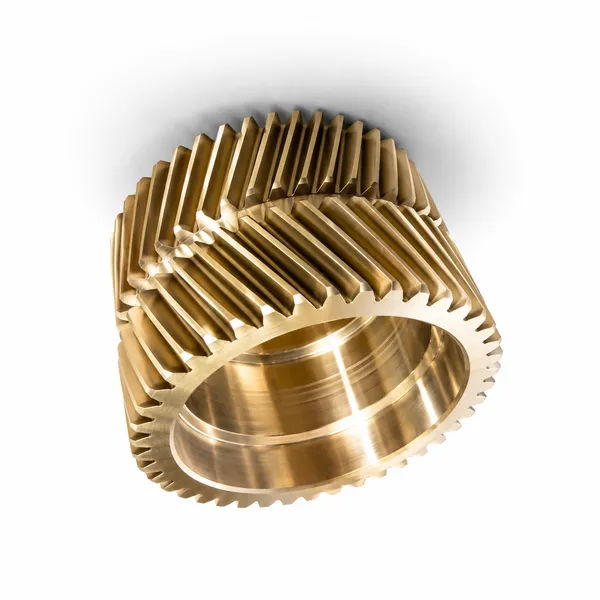
double helical gear marine propulsion gearbox Korea Ever-Power
Korea Ever-Power 18CrNiMo7-6 VAR double-helical gear for marine propulsion gearbox intermediate stage — M14, helix angle 30° (opposing double-helical — left-hand and right-hand sets cancel axial thrust), OD 840 mm, 60 teeth, face width 2 × 140 mm with 10 mm central groove for DIN 3990 full-herringbone design. Case carburized to effective case depth 2.8–3.5 mm, HRC 59–62 tooth surface, shot peened tooth roots. Profile ground to DIN 4 quality class — 100% tooth profile and lead measurement on large-ring CMM with 1,200 mm swing diameter. MPI after carburizing and after profile grinding — zero indications per Level 1. Full VAR material traceability: melt heat number → ingot → forging → gear documented. Lloyd’s Register Type Approval documentation package supplied. Used in 5–8 MW diesel reduction gearboxes for RoPax ferry and offshore supply vessel applications.

Marine Application Specifications by Vessel Type
VESSEL 01

ROPAX / FERRY
PROPULSION

Helical gear specification: M12–M22 double-helical, 18CrNiMo7-6 VAR carburized, DIN 4–5 ground, Lloyd’s or DNV GL Type Approval, service life 25 years / 120,000 operating hours, emergency full-astern capability (±2.5× rated torque impact factor). RoPax (roll-on/roll-off passenger) ferries and dedicated passenger ferries (both in frequent coastal and cross-channel service) operate their propulsion gearboxes more intensively than most commercial vessels — a cross-channel ferry making 6–8 return crossings per day at 25–28 knots accumulates 6,000+ engine-hours per year at near-maximum power. The propulsion gearbox first-stage helical gears (driven by medium-speed diesel engines at 400–750 RPM and reducing to propeller shaft speed of 120–200 RPM) are the most fatigue-loaded gears in the ship. Korea Ever-Power ferry gearbox helical gears are designed to AGMA 6032 and ISO 6336 with a bending fatigue safety factor S_F ≥ 1.4 at the class-defined rated torque and S_H ≥ 1.2 at rated torque — meeting the minimum safety factor requirements of Lloyd’s Register Rules for Ships Part 5, Chapter 3 (Main Propulsion Gearing). Emergency full-astern manoeuvring loads generate tooth load reversal on the drive flanks — both faces of the helical gear tooth must be rated for the full reversal torque, not just the normal drive direction.

VESSEL 02

OFFSHORE SUPPLY
VESSEL (OSV)

Helical gear specification: M10–M18 double-helical, 18CrNiMo7-6 carburized or 42CrMo4 QT (for azimuth thruster planetary gearboxes where the helical gear pre-stage operates at moderate speed), DNV GL Type Approval, variable speed operation (diesel-electric), azimuth thruster mounting with DP (dynamic positioning) capability. Offshore supply and platform support vessels (PSVs, AHTS vessels) use diesel-electric propulsion with azimuth thrusters for the dynamic positioning capability required during anchor-handling and platform supply operations in the North Sea and Gulf of Mexico. The azimuth thruster gearbox contains helical gears in the azimuth angle gearbox (which rotates the thruster pod through 360°) and in the main shaft reduction to the propeller shaft inside the pod. The DP (dynamic positioning) requirement means the thruster must respond to rapid control inputs — full power reversal and direction change in 2–3 seconds — which places high dynamic torque demands on the helical gears. Korea Ever-Power azimuth thruster helical gears are designed with a dynamic load factor K_v that accounts for the rapid power transients of DP operation, using the AGMA 421 marine gear standard for variable-speed diesel-electric applications.

VESSEL 03

NAVAL PATROL
VESSEL

Helical gear specification: M8–M16 double-helical, 18CrNiMo7-6 VAR carburized, DIN 4 ground (noise signature requirement), MIL-G-17859 or NATO equivalent, hard-facing on tooth contact surfaces for impact resistance, SAE J1979 type-approved lubricant. Naval patrol vessels and fast attack craft impose the most stringent combination of noise signature (radiated underwater noise that affects detectability) and shock resistance (from weapons effects and underwater blast). The noise signature requirement — typically specified in the procurement contract as a maximum sound pressure level in the frequency bands corresponding to propulsion gearbox mesh frequencies — drives the gear quality class to DIN 4 (the highest class in the DIN 3962 standard) and requires profile relief, lead crowning, and tooth surface superfinishing to Ra ≤ 0.2 μm to suppress the gear mesh harmonics that would otherwise appear in the vessel’s radiated noise spectrum. The shock load requirement (from STANAG 4141 or MIL-S-901D, both of which specify explosive shock loads that naval equipment must survive) drives a higher bending fatigue safety factor and tougher core material — Korea Ever-Power naval patrol vessel gearbox gears use a lower core hardness (HB 280–320 in 18CrNiMo7-6) than standard commercial marine to increase the tooth core toughness and impact resistance at the cost of some bending fatigue limit reduction.

Korea Ever-Power marine gear precision measurement DIN quality
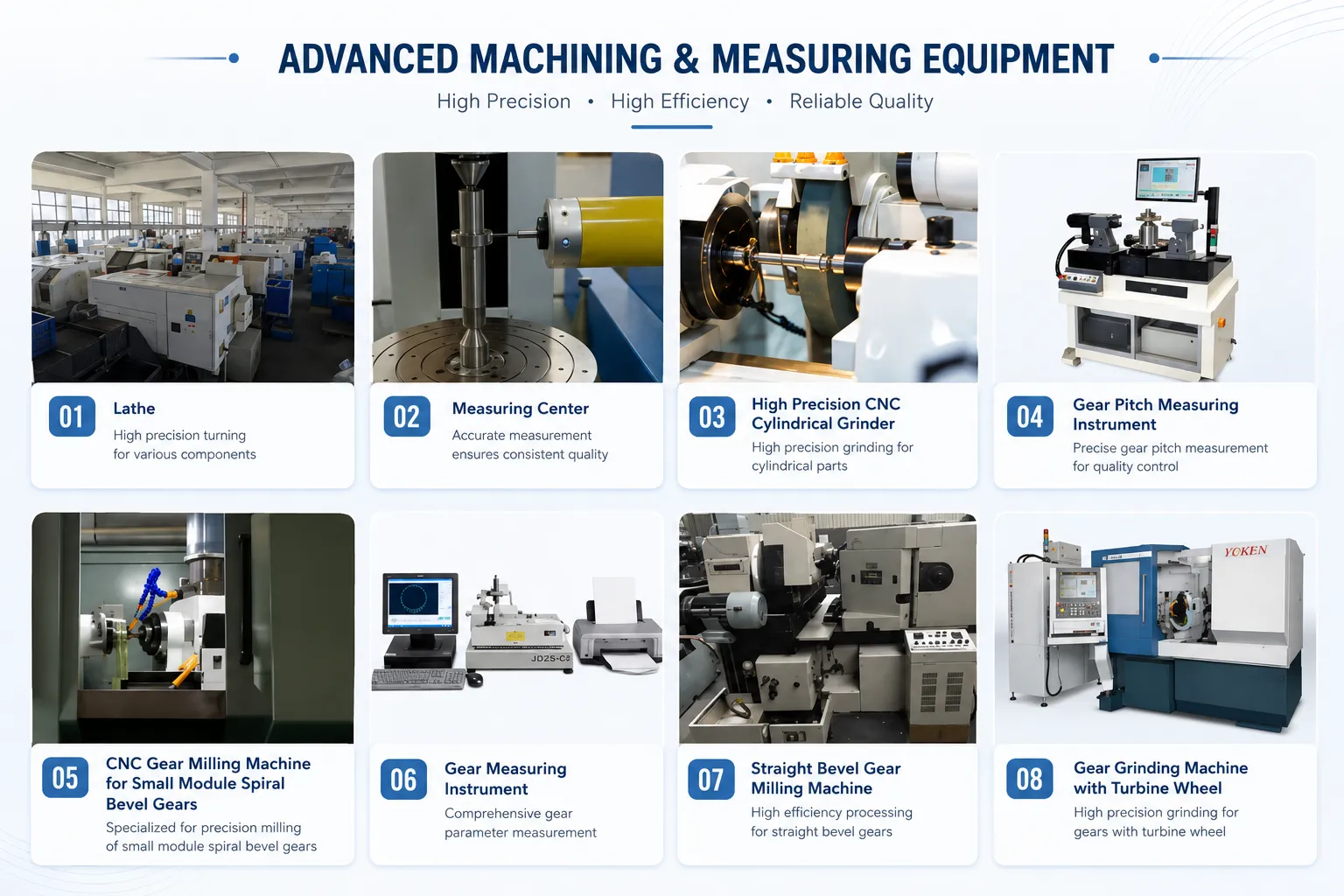
Korea Ever-Power large-gear precision measurement for marine propulsion helical gears — CNC gear measurement machine with 1,800 mm swing capacity for double-helical marine gears up to M22. Marine propulsion helical gears require the measurement of both helical flanks (left and right hand on the same gear) to confirm that the helix angle of both flanks is identical within ±0.005° — any helix angle discrepancy between the two hands creates an unbalanced axial thrust that partially defeats the purpose of the double-helical form and loads the journal bearings in a direction they are not designed to carry. Korea Ever-Power measures the helix angle of both flanks at five axial positions across the face width on 100% of all marine double-helical gear production, and issues a full measurement report confirming both flank helix angle match and individual flank profile tolerances meet the specified DIN class.

Marine Gear Lubrication, Corrosion Protection and Service Life

Marine propulsion gearbox lubrication differs from standard industrial gearbox lubrication in two key respects: the lubricant must function in an atmosphere with water vapour at 90–100% relative humidity (from seawater spray infiltrating the engine room) for decades without emulsifying or losing its anti-wear protection, and the lubricant change interval must be minimised because large marine gearboxes hold 500–5,000 litres of gear oil — every oil change is a significant cost and waste disposal event. The standard lubricant for marine propulsion helical gear drives is ISO VG 220 or VG 320 gear oil with marine-specific additive packages that provide enhanced water separation (demulsibility), rust and corrosion inhibition for the saltwater environment, and anti-wear protection compatible with silver-bearing alloys (silver is used in some high-performance marine gearbox bearings).

MARINE PROPULSION HELICAL GEAR — CORROSION AND PRESERVATION

TOOTH SURFACE PROTECTION

  • • During manufacture: VCI (Volatile Corrosion Inhibitor) film applied immediately after profile grinding to prevent flash corrosion during transport and storage — extends protection for 24 months in sealed packaging
  • • Before installation: cosmoline (petroleum wax) or thin-film corrosion inhibitor on all machined surfaces, removed with solvent wipe before gear oil fill
  • • In service: the marine gear oil’s rust inhibitor provides continuous corrosion protection on all submerged tooth surfaces — maintenance requirement is to verify oil moisture content <0.1% at annual service

OIL SYSTEM REQUIREMENTS

  • • Marine gearbox oil system: forced lubrication with cooled-and-filtered oil recirculation — oil temperature controlled to 55–75°C at the gear mesh inlet by the oil cooler seawater flow
  • • ISO VG 220 or VG 320 per Lloyd’s Rules for Ships: confirmed demulsibility ≤30 minutes per ASTM D1401 (oil-water separation speed in the presence of seawater contamination)
  • • Oil change interval: 8,000 hours or at each class survey (5 years), whichever is sooner — oil analysis recommended at 4,000 hours to detect early wear debris before the scheduled change

SPARE GEAR STRATEGY

  • • Classification societies require each vessel to carry a minimum spare gear set on board for primary propulsion gearboxes: at minimum one first-stage pinion and one second-stage wheel for each propulsion gearbox
  • • Spares packaged in VCI-sealed plywood crates designed for 10-year on-board storage without degradation of the tooth surface finish or dimensional accuracy
  • • Korea Ever-Power maintains an online spare gear registry for vessels where our gears are installed, enabling rapid identification and dispatch of a replacement set when required at port or dry dock
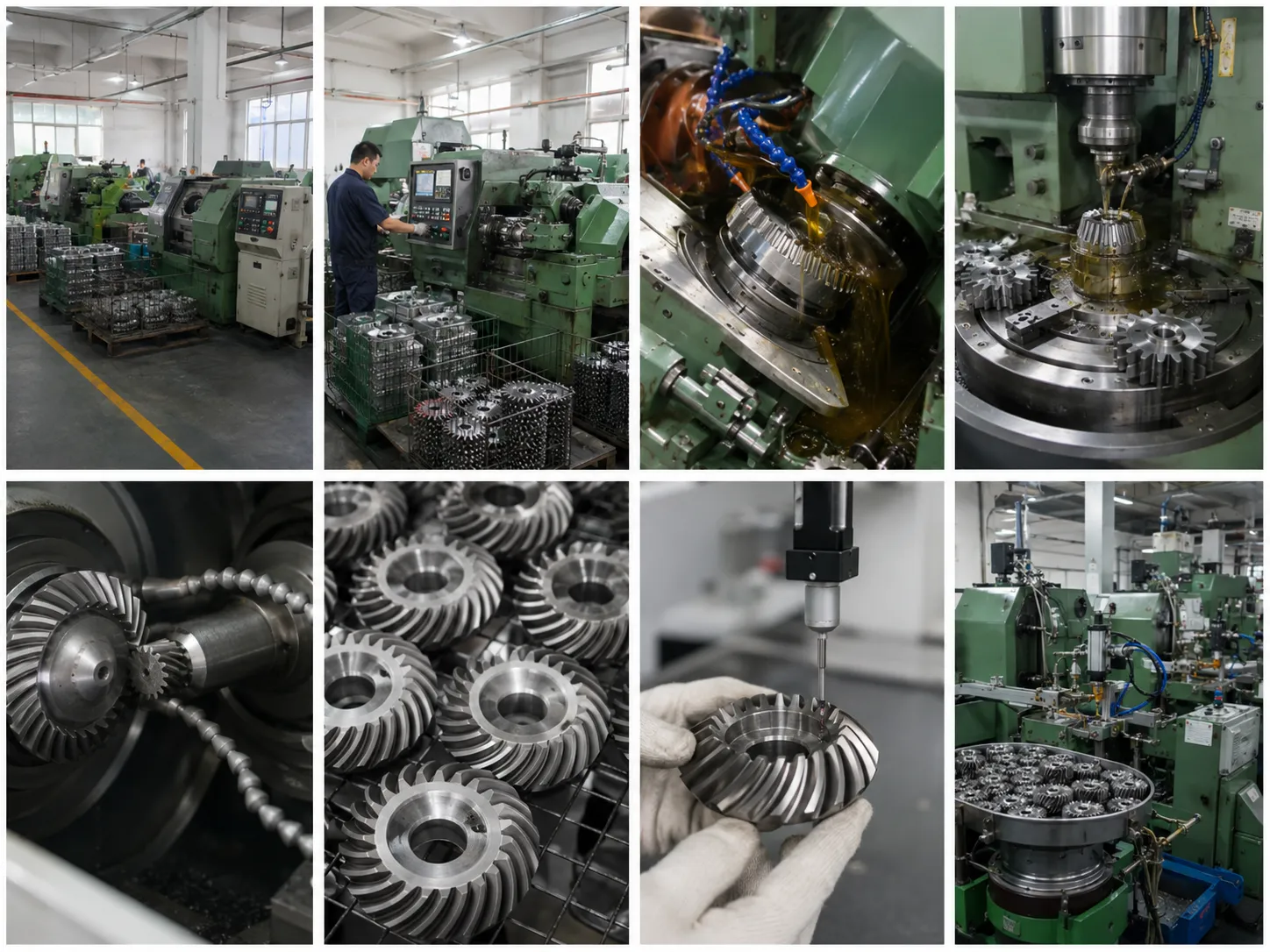
Korea Ever-Power marine gear manufacturing large helical gearbox
Korea Ever-Power marine gear manufacturing facility — large double-helical propulsion gear production, heat treatment, and class surveyor witness inspection. The manufacturing sequence for marine propulsion helical gears follows a strict process qualification order to satisfy classification requirements: (1) Forging — ring or disc forgings from VAR or ESR ingot, UT tested after forging; (2) Rough turning and hobbing to DIN 8 as preliminary step; (3) Case carburizing — furnace cycle recorded and witnessed by class surveyor; (4) Quench hardening and tempering; (5) Hard-turning of bore and reference surfaces; (6) Profile grinding to DIN 4–5; (7) MPI of all tooth surfaces — surveyor witness; (8) Dimensional inspection with full CMM report; (9) Preservation, packaging, and certification document assembly. Total cycle time from forging to class-certified finished gear: 60–90 days depending on size and class society scheduling for witness inspections.

Frequently Asked Questions — Marine Propulsion Helical Gears

Q 01

Our ferry’s propulsion gearbox is due for the 10-year class survey. The surveyor will inspect the internal gears in situ. What tooth surface conditions require gear replacement versus continued service?

Classification society guidelines for in-situ gear condition assessment during class survey (Lloyd’s Register, DNV GL, and BV all have similar criteria in their respective Rules): Continue in service (no action required): (1) Light polishing wear on tooth flanks without measurable pitch circle height reduction — the natural run-in wear during the first 500–1,000 hours of a new gear’s life creates a polished contact ellipse on the tooth flank that is normal and not a defect. (2) Minor pitting spots (individual pits less than 1 mm diameter, total affected area less than 5% of the tooth flank area, no adjacent pits coalescing) — these are initial contact fatigue indications that do not affect load-carrying capacity at this stage. Monitor closely — inform class surveyor: (1) Moderate pitting with pits 1–2 mm diameter, total area 5–10% of flank area, or pitting progressing toward the tooth root — requires monitoring at next opportunity, typically 2,500 hours or the next annual service. (2) Measurable tooth height reduction (wear) above 5% of original tooth height. Replacement required: (1) Severe pitting with pits coalescing or total affected area above 15% of flank area. (2) Any visible tooth root crack or surface fatigue that has reached the root radius. (3) Spalling — removal of material from the flank surface in flakes larger than 3 mm. (4) Scoring (adhesive wear lines across the tooth flank following the relative sliding direction) above Class 5 on the AGMA 315.02 scoring classification. Korea Ever-Power can supply replacement gear sets with full documentation for any of these failure conditions, with lead times appropriate to dry dock planning — contact with the gearbox make, year, and surveyor’s condition report for replacement quotation.

Q 02

What is the correct approach to specifying replacement helical gears for a marine gearbox where the original OEM no longer supplies the spare parts?

Marine propulsion gearbox OEMs (Renk, Reintjes, Masson Marine, Lufkin) do not always continue supporting older gearbox models — particularly gearboxes manufactured before 1990, where the original drawings may no longer be accessible at the OEM. Korea Ever-Power has reverse-engineered and supplied replacement gears for all major marine gearbox OEM platforms. The specification process for OEM-discontinued marine gears: (1) Dimensional measurement of the existing gear (worn or undamaged gear, or both): provide the OD, the tooth count, the measured tooth thickness at the pitch circle (using a gear tooth vernier caliper or a precision over-pin measurement), the face width, the bore, and the helix angle (measured with a lead measurement fixture or estimated from the tooth surface geometry). Korea Ever-Power uses these measurements to calculate the module, pressure angle, helix angle, and all tooth geometry parameters. (2) Verify the module by calculation: module = (OD − 2 × addendum) ÷ tooth count. For double-helical gears: the normal module m_n = m_t × cos(β), where m_t is the transverse module (OD based) and β is the helix angle. Korea Ever-Power confirms the module identification by a comparison of the calculated pitch with the measured tooth-to-tooth pitch on the existing gear before committing to manufacture. (3) Confirm material specification from the gearbox nameplate or class records: the original classification society type approval file (available from Lloyd’s, DNV GL, or BV archives for classed vessels) contains the original material specification — Korea Ever-Power can assist with the archive request if the vessel’s class certificate number is available. Lead time for reverse-engineered marine gears: 90–120 days including forging, carburizing, grinding, and class documentation.

Q 03

What are the specific advantages of double-helical over single-helical marine gears, and when is single-helical acceptable in a marine drive?

Double-helical (herringbone) gears have three advantages over single-helical in marine propulsion: (1) Zero net axial thrust: the left-hand and right-hand helical tooth sets produce equal and opposite axial forces that cancel at the gear web — neither the pinion nor wheel shaft carries a net axial load. This allows the propulsion shaft bearings to be simple journal bearings without axial thrust faces, simplifying the bearing design and eliminating the dedicated thrust collar that single-helical gears require. In a multi-stage propulsion gearbox where the axial loads from three or four single-helical stages would accumulate on the propeller shaft thrust bearing, the axial load elimination from double-helical gears is essential for practical thrust bearing design. (2) Higher contact ratio: the total face width of a double-helical gear (2 × each helix face width) provides a higher face contact ratio (m_F = face width × sin β / (π × m_n)) than an equivalent single-helical gear, leading to smoother torque transmission and lower dynamic mesh forces. (3) Better noise signature: the symmetric double-helical tooth contact produces a more regular excitation spectrum with lower odd harmonics than single-helical — advantageous for naval vessel noise signature and for passenger ferry comfort. When is single-helical acceptable in marine drives? Small craft (below 500 kW), where the propulsion shaft thrust bearing is not the design constraint and the cost saving from single-helical manufacture (no central groove machining) is commercially significant. Gear-driven pumps and auxiliary machinery (steering gear, fire pump drives) where the axial load on the pump shaft is a defined design input and can be accommodated in the pump bearing. Korea Ever-Power manufactures both single- and double-helical marine gears, with the double-helical form being the standard specification for main propulsion above 500 kW.

Explore Korea Ever-Power Gear Categories

Seven precision gear product lines for marine propulsion, offshore, naval and vessel auxiliary applications worldwide.
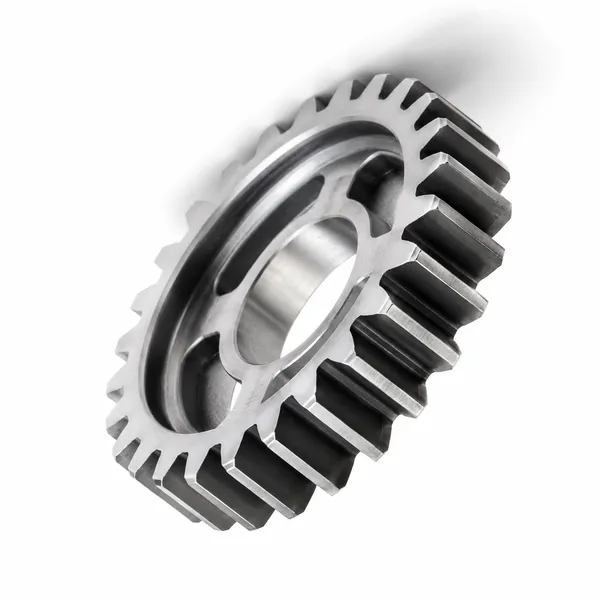
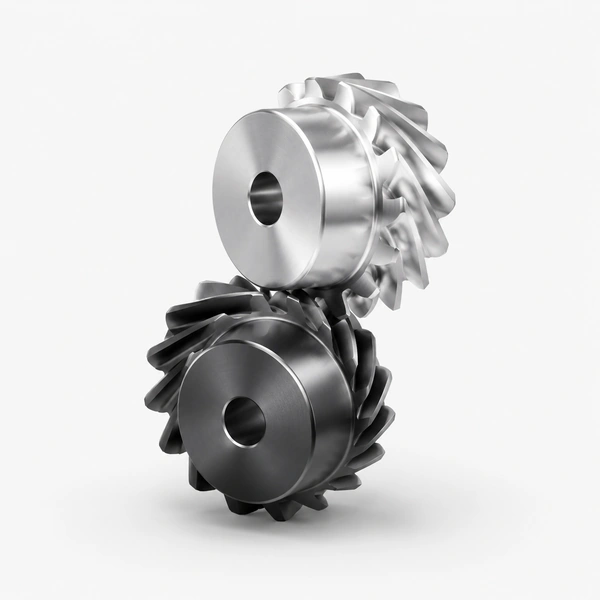
spur gear marine

Spur Gears

Marine auxiliary · pump · winch

double helical gear marine

Helical Gears

Double-helical · propulsion · DIN 4–5

bevel gear marine

ベベルギア

Stern tube · steering · angle drive

worm gear vessel

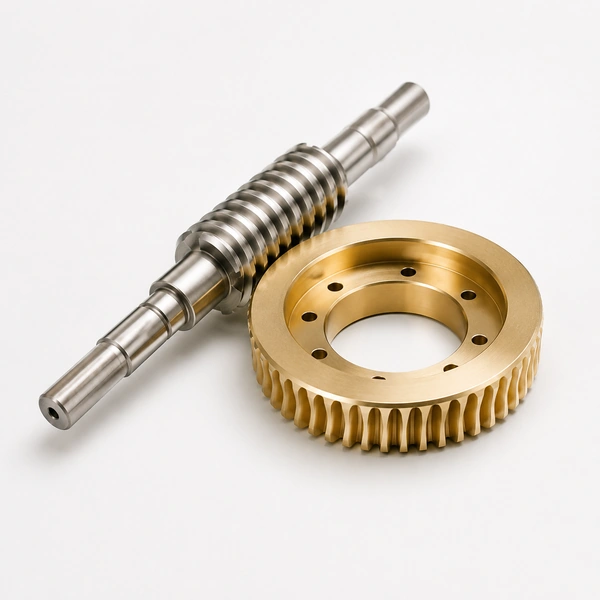
Worm Gears

Windlass · capstan · self-locking

ring gear marine

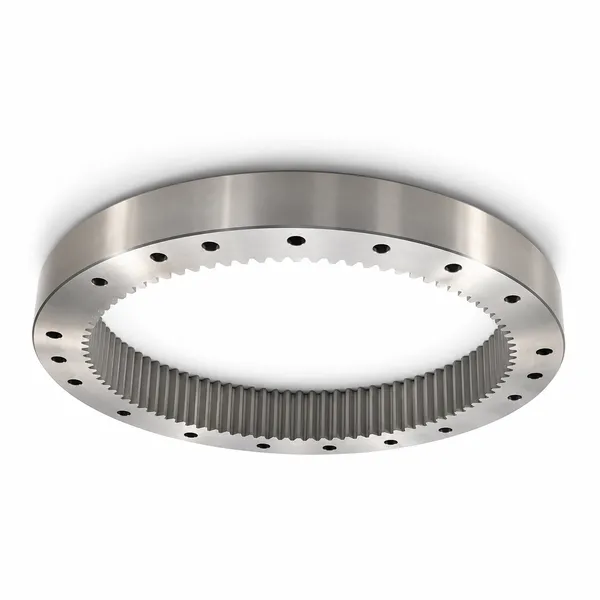
Ring Gears

Thruster · azimuth · crane slew

planetary gear marine

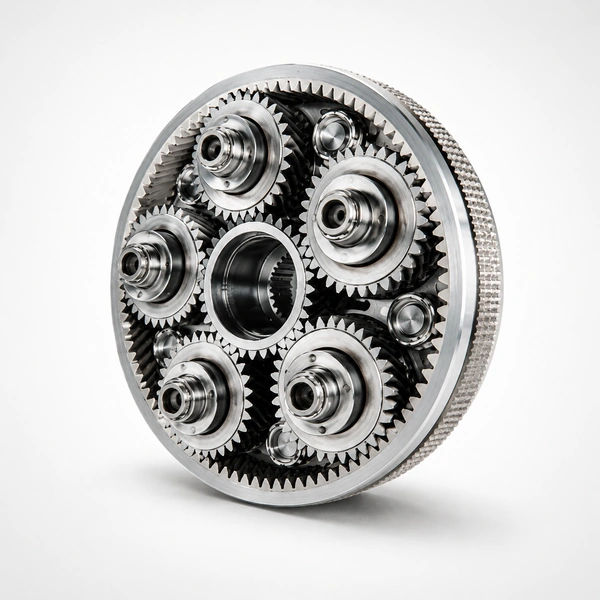
Planetary Gears

Thruster final drive · windlass motor

plastic gear

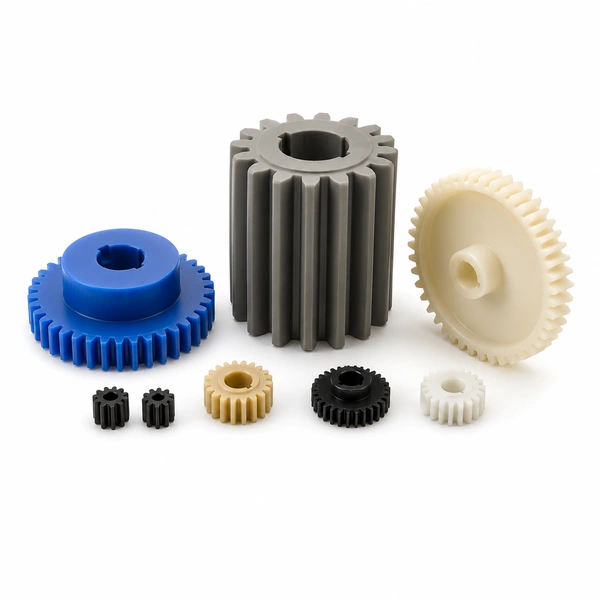
Plastic Gears

Instrument · sensor · valve actuator

GET A QUOTATION · KOREA EVER-POWER

Need Helical Gears for Marine Propulsion?

Korea Ever-Power manufactures 18CrNiMo7-6 VAR double-helical and single-helical gears for marine propulsion — RoPax and ferry drives (M12–M22), offshore azimuth thrusters (M10–M18), naval patrol vessel gearboxes (DIN 4, noise-optimised), and large yacht main drives. Lloyd’s Register, DNV GL, Bureau Veritas, ABS, and ClassNK documentation. Reverse-engineering for discontinued OEM gearboxes. On-board spare gear packages. ISO 9001:2015 certified.

Request a Quotation →

編集者: Cxm

VR Tour of Our Factory

TAGs:

ギアラック

当社は、ギアラックの大手メーカー、サプライヤー、輸出業者の一つとして、ギアラックをはじめとする様々な製品を提供しています。

詳細についてはお問い合わせください。

郵便:[email protected]

ギアラックの製造業者、サプライヤー、輸出業者

最近の投稿

jaJapanese