
Worm Gears for Food Processing Equipment:
NSF H1 Compliance, CIP Washdown Design and Hygienic Drive Engineering
Food processing equipment worm gears face a regulatory and engineering challenge that no other industrial application shares — they must meet the mechanical performance requirements of a heavy-duty gear drive and simultaneously comply with food safety regulations that restrict materials, lubricants, surface finishes, and housing geometries in ways that have no analogue in standard industrial gear design. From the meat processing plant auger drive that must withstand daily 90°C steam cleaning, through the bakery divider-rounder that runs near raw dough in a flour-dust atmosphere, to the beverage filling machine indexing drive that operates in splashing water and CIP chemical mist, worm gears in food processing equipment must be engineered to the intersection of mechanical reliability and food safety compliance.
EHEDG · CIP 90°C · Ratio 5:1–100:1 · Self-Lock
Meat · Bakery · Beverage · Dairy · Confectionery
Worm Gear Advantages in Food Processing Drives
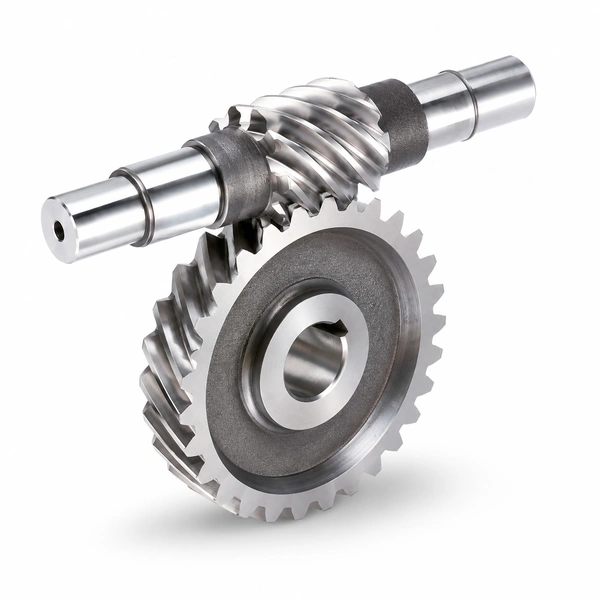
The worm gear is the preferred choice for many food processing drive applications for the same reasons it dominates agricultural and industrial auxiliary drives — high reduction ratio in a compact package, self-locking ability to hold a conveyor or mixer stationary when the motor is off, and the 90° right-angle shaft arrangement that allows the motor to be positioned parallel to the machine frame rather than extending into the food processing zone. In the food processing environment, these advantages are augmented by an additional benefit: the worm gear’s enclosed housing is easier to design for IP69K washdown compliance than an open bevel or spur gear train, because the worm gear is a self-contained right-angle gearbox that presents only shaft entries and a mounting flange to the external food-zone environment — a simpler sealing challenge than an open gear pair that requires full enclosure design.
Korea Ever-Power’s worm gears for food processing equipment are supplied in two configurations: as complete hygienic worm gearbox assemblies (housing + worm shaft + wheel + NSF H1 lubricant + EPDM shaft seals) for immediate installation on food processing machines, and as matched worm and wheel sets for customers who design and manufacture their own food processing machine gearbox housings. The complete assembly is the more common request from food processing machine builders — Korea Ever-Power’s hygienic worm gearbox range covers centre distances 40–160 mm, ratios 5:1–100:1, and power inputs from 0.1 to 22 kW in 316L stainless housing with IP69K sealing and NSF H1 lubricant fill as standard. For food processing worm gear reducer selection guidance and efficiency calculations, refer to the worm gear reducer application guide.
The EHEDG (European Hygienic Engineering and Design Group) hygienic design requirements for food processing worm gearboxes go beyond simply specifying 316L stainless material and NSF H1 lubricant. EHEDG Guideline Document No. 8 (Hygienic Equipment Design Criteria) requires that the external surface of the gearbox housing has no horizontal ledges, upward-facing flat surfaces, or crevices where food product, cleaning solution, or condensate can accumulate between cleaning cycles and provide a growth medium for bacteria or fungi. This requirement affects the housing geometry profoundly — standard worm gearboxes have flat top surfaces and square-cornered joint faces that fail the EHEDG drainage test. Korea Ever-Power’s EHEDG-compliant hygienic worm gearboxes use sloped housing top surfaces (minimum 3° slope for drainage), radiused external corners (minimum 3 mm radius), and a fully welded 316L housing (no bolted split joints) to eliminate the risk of food residue accumulation. Housing surface finish: Ra ≤ 0.8 μm on all external surfaces per EHEDG recommendation.
Food Processing Application Specifications by Sector
Frequently Asked Questions — Worm Gears for Food Processing
Explore Korea Ever-Power Gear Categories
Seven precision gear product lines for food processing, dairy, meat, beverage and pharmaceutical applications worldwide.
Editor: Cxm
 English
  Italian
  Korean
  French
  Japanese