
Helical Gears for Extruder Drives:
Single-Screw, Twin-Screw and Co-Rotating Extruder Gearbox Design
Extruder drive gearboxes present a unique set of design challenges — combining the continuous high-torque, low-speed output of a plastics or rubber processing screw with the need for precise speed control, compact installation, and thermal stability across years of uninterrupted production. The helical gears inside an extruder gearbox must handle sustained torques at the upper limit of their rated capacity for 6,000–8,000 hours per year, while the screw itself generates thrust loads, radial loads, and, in twin-screw applications, complex shaft interaction forces that must all be absorbed by the gearbox without affecting gear contact quality. This guide covers helical gear specification, material selection, and gearbox integration for single-screw, parallel twin-screw, and conical twin-screw extruder drive applications.
6,000–8,000 h/yr · Torque Split · Thrust Bearing
Single-Screw · Twin-Screw · Co-Rotating · PVC
Extruder Drive Gearbox Architecture and Helical Gear Roles
The extruder drive gearbox serves three simultaneous functions that no other single machine component performs: speed reduction from the electric motor (typically 750–1,500 RPM) to the screw shaft (10–150 RPM depending on extruder size and process), torque multiplication from the motor rating to the process-required screw torque, and thrust load absorption — carrying the full axial thrust generated by the screw as it pushes melted polymer toward the die, which in a large pipe extrusion line can exceed 500 kN. The helical gears inside the gearbox handle the first two functions; the thrust bearing (typically a large tapered roller or spherical roller thrust bearing) handles the third, but the gearbox housing and gear arrangement must be designed to keep the thrust bearing loads from interfering with the helical gear mesh geometry.
Korea Ever-Power’s helical gears for extruder drives are manufactured in 18CrNiMo7-6 case carburized (for all first-stage and second-stage helical gears in extruder gearboxes where maximum contact fatigue resistance is required at the high rotational speeds of these stages) and 42CrMo4 through-hardened (for final-stage bull gears in large slow-speed extruder gearboxes above M16 where through-hardening provides adequate load capacity at reduced manufacturing complexity). All extruder gearbox helical gears from Korea Ever-Power are ground to DIN 5–7 quality class depending on the stage position and speed — first-stage pinions at 750–1,500 RPM are ground to DIN 5–6; final-stage gears at 30–80 RPM are ground to DIN 6–7 where noise is the specification driver, or hobbed to DIN 7 where it is not.
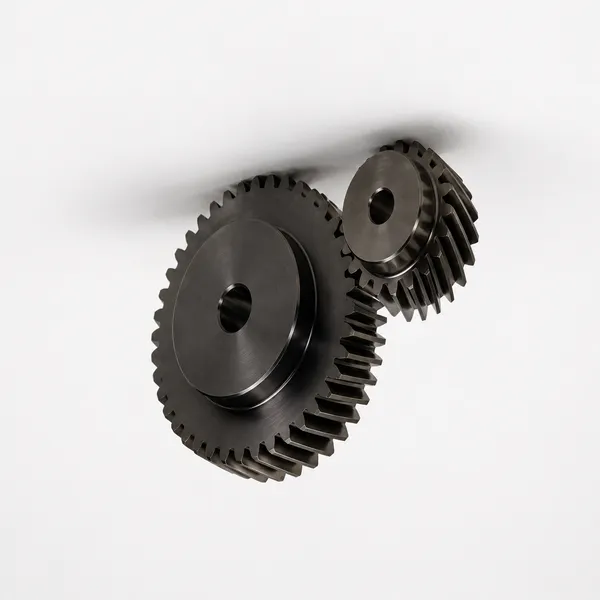
The twin-screw extruder gearbox introduces a design requirement absent in single-screw applications: the torque split — dividing the motor torque equally between the two output shafts driving the two intermeshing screws. The torque split is achieved through a set of matched helical spur gears on an intermediate shaft (the “torque distribution shaft”) that meshes simultaneously with gears on both output shafts. Equal torque split requires that both output shaft helical gears have identical tooth geometry and the torque distribution shaft gears are matched to within ±1% of theoretical torque split — verified by measuring the torque on each output shaft under load. Unequal torque split in a co-rotating twin-screw extruder causes one screw to run at higher torque than the other, potentially exceeding the screw shaft fatigue limit while the other screw runs underloaded — the imbalance is progressive as the overloaded screw gear wears faster, increasing the split imbalance. Korea Ever-Power torque distribution shaft helical gear sets are matched as complete sets to ±0.5% torque split at the specified load.
Extruder Type Application Specifications
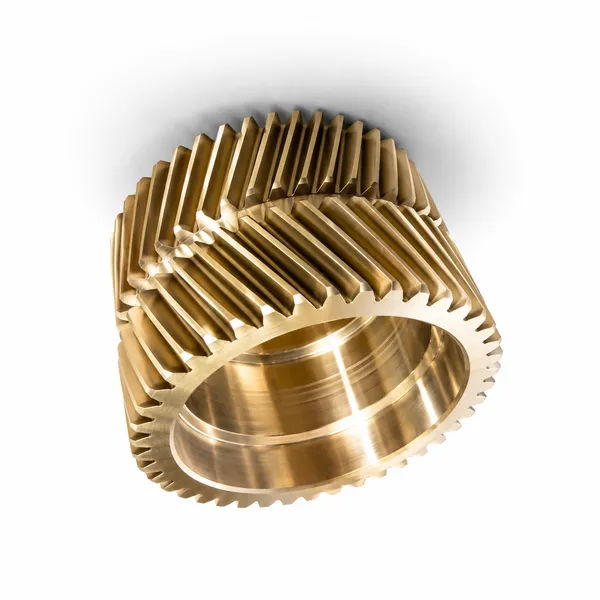
Thermal Management and Lubrication for Extruder Gearboxes
Extruder gearbox thermal management is a critical design requirement that distinguishes extruder gearbox helical gear specification from industrial gearbox specification. An extruder running at 90% of rated screw torque for 7,000 hours per year generates a sustained heat input from gear mesh losses, bearing losses, and oil churning losses that must be removed from the gearbox oil by an external cooling system — because the gearbox surface area is insufficient to reject this heat by natural convection alone at sustained full-load conditions. Overheated gear oil in an extruder gearbox degrades the base oil oxidation resistance rapidly (halving for every 10°C above 80°C), producing varnish deposits on gear tooth surfaces and bearing raceways that progressively reduce the EHL film parameter and accelerate micro-pitting.
EXTRUDER GEARBOX HELICAL GEAR — LUBRICATION AND THERMAL REFERENCE
OIL SELECTION
- • ISO VG 150 PAO synthetic: preferred for all extruder gearboxes. PAO’s flat viscosity-temperature curve maintains adequate film at 95°C operating temperature while avoiding excessive cold-start viscosity at morning startup before oil warm-up
- • ISO VG 220 mineral: acceptable for gearboxes with oil cooler maintaining oil temperature below 70°C
- • Change interval: PAO every 6,000 h; mineral every 3,000 h
TEMPERATURE LIMITS
- • Normal operating oil temperature: 60–75°C (oil cooler sized to maintain this range at max load)
- • Caution alarm: 80°C — reduce load or check cooler function
- • Emergency stop: 90°C — oil degradation rate above this is unacceptable
- • Cold start: do not run at full load until oil temperature reaches 40°C
COOLING SYSTEM
- • Oil-to-water heat exchanger: most common for large extruder gearboxes above 75 kW. Water flow rate sized for maximum heat rejection at minimum incoming coolant temperature
- • Air blast oil cooler: for extruder lines where cooling water is not available or too corrosive for plate HX service
- • Fan cooling on gearbox housing: only adequate for small extruder gearboxes below 22 kW at ambient below 25°C
Frequently Asked Questions — Helical Gears for Extruder Drives
Explore Korea Ever-Power Gear Categories
Seven precision gear product lines for plastics processing, rubber, food and industrial extrusion applications worldwide.
Editor: Cxm
 English
  Italian
  Korean
  French
  Japanese