
Bevel Gears for Mining Equipment:
Drill Rigs, Crushers, Conveyors and Haul Trucks
Mining equipment imposes the most extreme combination of load intensity, abrasive contamination, and remoteness-of-failure-consequence of any bevel gear application. A bevel gear failure in an underground drill rig or in the final drive of a 300-tonne haul truck at a remote mine site can cost tens of thousands of dollars per hour in lost production. This guide covers bevel gear specification for open-pit and underground mining equipment — drill rigs, jaw and gyratory crushers, conveyor head drives, and haul truck final drives — including material, quality class, contamination protection, and service factor selection.
SF 1.5–3.5 · IP67 Sealed · M8–M25
Drill Rig · Crusher · Haul Truck · Conveyor
Bevel Gears in Mining Equipment Drive Systems
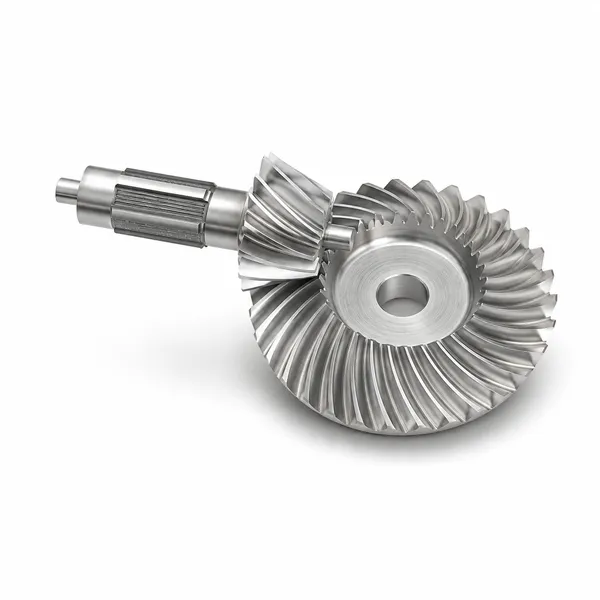
Mining equipment uses bevel gears wherever a change of drive shaft direction is required — which in the confined underground and open-pit environments of mining operations means nearly every major drive system. The drill rig rotation motor must drive the drill string through a 90° bevel gear box to align the rotation axis with the drill hole. The jaw crusher eccentric shaft requires a spiral bevel gear drive from the motor to convert horizontal motor shaft rotation to the eccentric shaft axis. The haul truck rear axle final drive uses a large spiral bevel gear set (the ring-and-pinion) to transfer power from the longitudinal propeller shaft to the transverse wheel axle — exactly as in an automotive differential, but at 10–20× the automotive scale and power level.
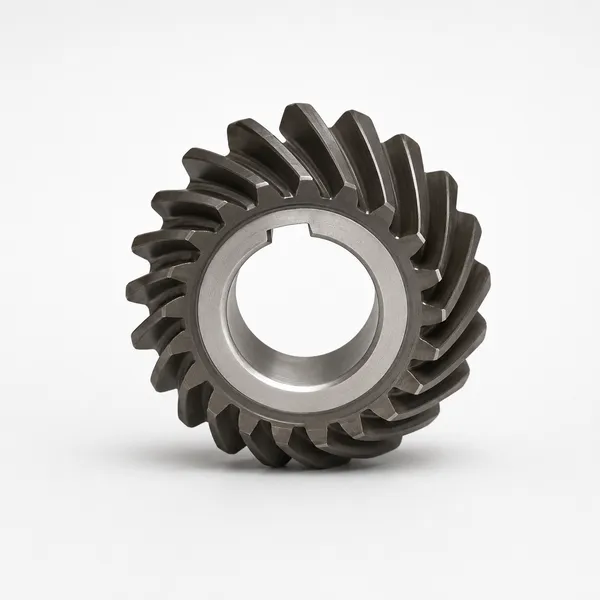
Korea Ever-Power’s bevel gears for mining equipment are manufactured in 18CrNiMo7-6 case carburized for the highest-duty applications (crusher drives, haul truck final drives) and in 42CrMo4 through-hardened (HB 300–360) for medium-duty drill rig auxiliary drives and conveyor head right-angle gearboxes. All mining bevel gears are manufactured with generous root fillet radii and shot-peened tooth roots to maximise resistance to the shock fatigue that is the dominant failure mode in crusher and drill rig bevel gear drives. Face widths are specified at the wider end of the practical range (50–60% of cone distance) to maximise load capacity without compromising tooth contact pattern quality.
The consequence of a bevel gear failure in mining determines the specification more than the calculated load alone. At a copper mine producing 50,000 tonnes of ore per day at USD 8,000/tonne, a single 24-hour production stoppage from a bevel gear failure in the primary jaw crusher costs USD 400,000 in lost production — far more than the cost of specifying a higher service factor, better material, and annual preventive gear inspection. Korea Ever-Power recommends a minimum service factor of 2.5 for all primary crusher bevel gear drives, 3.0 where unprotected tramp iron events are possible (no magnetic separator or grizzly ahead of the crusher), and 1.5–2.0 for haul truck final drive applications where the hydraulic torque converter provides inherent torque limiting.
Frequently Asked Questions
Explore Korea Ever-Power Gear Categories
Seven precision gear product lines for mining, industrial, agricultural and specialist applications worldwide.
Editor: Cxm
 English
  Italian
  Korean
  French
  Japanese