
Large Ring Gears for Wind Turbines:
Pitch Control, Yaw Drives and Planetary Gearbox Stages
Wind turbine ring gears operate in the most demanding combination of environmental exposure and mechanical loading in any rotating machinery application — supporting multi-megawatt rotor loads for 20–25 years atop towers 80–150 m high, through temperature extremes from -40°C arctic cold to +50°C tropical heat, in salt-laden offshore atmospheres that corrode standard materials within years, and with maintenance access so difficult and expensive that gear failures cannot be repaired at sea without crane vessels costing €100,000+ per day. This guide covers the three distinct ring gear roles in a wind turbine — the pitch control ring gear (which adjusts individual blade angle), the yaw ring gear (which turns the nacelle to face the wind), and the planetary gearbox ring gear (which transmits rotor torque to the generator) — with full material, quality, and documentation specification for each.
IEC 61400 · GL · DNV · M8–M30 · 20–25 yr Life
Pitch Control · Yaw Drive · Planetary Gearbox
Wind Turbine Ring Gears — Three Applications, Three Design Philosophies
A modern wind turbine contains three distinct ring gear applications, each with its own design philosophy, material specification, and quality class requirement. Understanding the differences between them is essential for correct specification and procurement — the pitch control ring gear, the yaw ring gear, and the planetary gearbox internal ring gear are not interchangeable in any design parameter, even when they happen to share similar outside diameters on a particular turbine model.
Korea Ever-Power’s large ring gears for wind turbines are manufactured in 42CrMo4 QT through-hardened (standard for pitch and yaw ring gears where case nitriding is applied after through-hardening) and 18CrNiMo7-6 case carburized (for planetary gearbox ring gears requiring maximum contact fatigue resistance). Large wind turbine ring gears are manufactured from ESR (electro-slag remelted) steel wherever possible — the ESR process removes sulphide inclusions and porosity from the steel ingot that would initiate fatigue cracks in large cross-section ring gear forgings, producing a cleaner microstructure with 15–25% higher fatigue life than standard vacuum-melted steel at the same composition. For offshore wind turbines where the consequence of ring gear failure is a crane vessel mobilisation costing €500,000+, ESR or VAR (vacuum arc remelted) steel is specified by most turbine OEMs as mandatory.
The IEC 61400-1 standard for onshore wind turbines and IEC 61400-3 for offshore turbines define the design load cases that wind turbine components — including ring gears — must withstand. The characteristic loads include: normal power production loads (statistical distribution across the turbine’s operating wind speed range), emergency stop loads (when the turbine pitches to feather position during high wind), grid loss events (when sudden loss of generator electrical torque creates a severe torque transient in the drivetrain), and extreme wind loads (50-year return period gust with rotor parked). The ring gear fatigue calculation must demonstrate that the tooth bending fatigue safety factor S_F ≥ 1.25 and the contact fatigue safety factor S_H ≥ 1.0 at the IEC characteristic load case combinations, with partial safety factors applied per ISO 6336-6. Korea Ever-Power provides ISO 6336-6 lifetime fatigue calculation reports for all wind turbine ring gear orders, prepared using the customer’s site-specific load time history from the turbine OEM’s aeroelastic simulation.
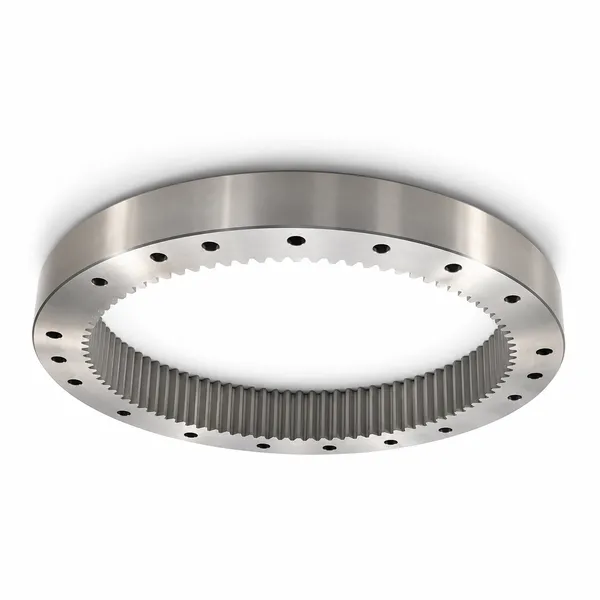
Application-Specific Ring Gear Specifications
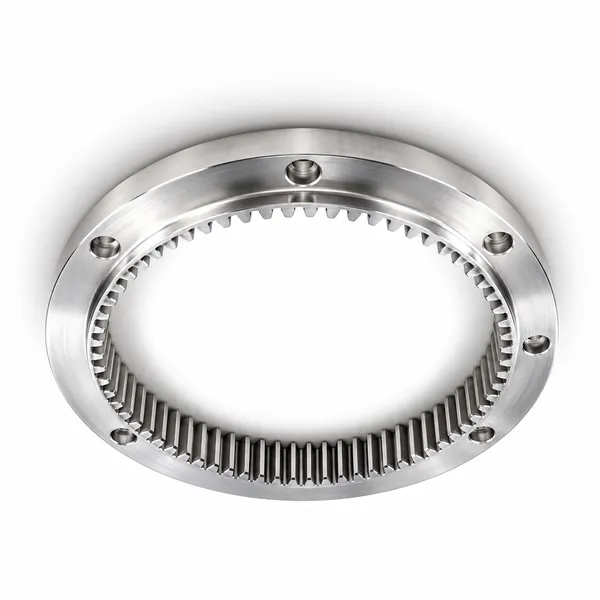
Offshore Wind Turbine Ring Gears — Additional Requirements
Offshore wind turbine ring gears carry additional specification requirements beyond those for onshore turbines, driven by the combination of higher rated power (5–15 MW vs 2–4 MW onshore), more severe environmental conditions (salt spray, higher humidity, marine biofouling risk at sea level), and the prohibitive cost of unplanned maintenance (requiring crane vessel mobilisation at €500,000–€2,000,000 per event). These additional requirements increase the manufacturing specification and documentation requirements for offshore ring gears significantly beyond the already demanding onshore standard.
Offshore Material Specifications
Offshore wind pitch and yaw ring gears are typically specified in 42CrMo4 QT to the higher-grade specification 42CrMo4+QT with guaranteed minimum impact energy 27 J at -40°C (for arctic offshore sites in the North Sea and Baltic) rather than the standard -20°C requirement. The low-temperature impact requirement is driven by the possibility of extreme winter conditions at the ring gear’s location (the pitch ring gear inside the blade hub experiences ambient temperatures approaching the blade surface temperature, which can reach -35°C to -40°C in Scandinavian offshore winter conditions).
Planetary gearbox ring gears for offshore turbines are specified in 18CrNiMo7-6 from ESR or VAR steel, with the additional ultrasonic cleanliness requirement of SEP 1921 Class B/B — a significantly more stringent cleanliness specification than the standard Class C/C used for onshore gearbox ring gears. The cleaner steel microstructure provides higher fatigue crack initiation resistance for the 25-year design life required for offshore turbines.
Documentation and Certification
DNV GL type certification for offshore wind turbine ring gears requires a documentation package that substantially exceeds standard industrial gear documentation. The minimum package for DNV GL offshore ring gear certification includes: EN 10083-3 material certificate with DNV GL 3.2 surveyor endorsement, forging procedure qualification record, forging traceability record (heat number traceable to original melt), full ultrasonic scan images per SEP 1921 Class B/B, heat treatment records with furnace calibration certificate, dimensional inspection report with all critical dimensions measured and documented, full circumference tooth profile and pitch measurement report (100% of all teeth), surface hardness distribution map (minimum 8 positions around circumference for nitrided rings), and DNV GL surveyor witness inspection certificate.
Korea Ever-Power provides DNV GL-endorsed documentation packages for offshore wind ring gear orders on request — this requires scheduling a DNV GL surveyor witness visit at Korea Ever-Power’s facility during the critical inspection stages (forging review, heat treatment witness, final dimensional and MT inspection witness). Lead time increases by 7–14 days to accommodate the surveyor scheduling.
Frequently Asked Questions — Large Ring Gears for Wind Turbines
Explore Korea Ever-Power Gear Categories
Seven precision gear product lines for wind energy, heavy industry, mining and specialist applications worldwide.
Editor: Cxm
 English
  Italian
  Korean
  French
  Japanese