GEAR APPLICATION GUIDE · WORM GEAR · W03

Worm Gears for Hoist and Lifting Drives:
Self-Locking, Safety, and Duty Classification

Hoist and lifting drives impose the most safety-critical requirements of any worm gear application — the gear must either self-lock to hold the load on motor power interruption, or be paired with a fail-safe mechanical brake. This guide covers worm gear selection for overhead crane hoists, chain block hoists, lifting platforms, stage hoists, and garage door drives — including self-locking calculation, duty classification, and the FEM/ISO standards that govern hoist gear design.

Bronze Wheel · 42CrMo4 Worm · FEM 1.001
Self-Locking · Lead Angle <5° · Ratio 20:1–80:1
Crane Hoist · Chain Block · Stage · Platform

SELF-LOCKING LIMIT

Lead angle <5.7°

Worm gears with lead angle below arctan(μ) ≈ 5.7° at μ = 0.10 are mechanically self-locking. At ratio ≥20:1 (single-start worm), self-locking is reliably achieved for all lubricated bronze-on-steel hoist gears

HOIST SAFETY STANDARD

FEM / ISO 4301

FEM 1.001 (European hoist standard) and ISO 4301 classify hoists by duty group (M1–M8) based on load spectrum and operating hours. Worm gears for hoists must be designed to the applicable duty group and verified by calculation

TYPICAL RATIO

20:1 – 80:1

Hoist worm gear drive ratio. Chain block hoists: 20:1–40:1. Overhead crane wire rope hoists: 30:1–60:1. Stage and platform lifts requiring very slow lowering speed: 60:1–80:1

BRONZE WHEEL MATERIAL

PB2 / AB2

Phosphor bronze PB2 (centrifugal cast) or aluminium bronze AB2 (for heavy-duty hoists above 10 tonne lift) worm wheel material. AB2 provides higher fatigue strength than PB2 but is harder on the worm and requires a harder worm shaft

Worm Gear Self-Locking in Hoist Applications — Safety Analysis

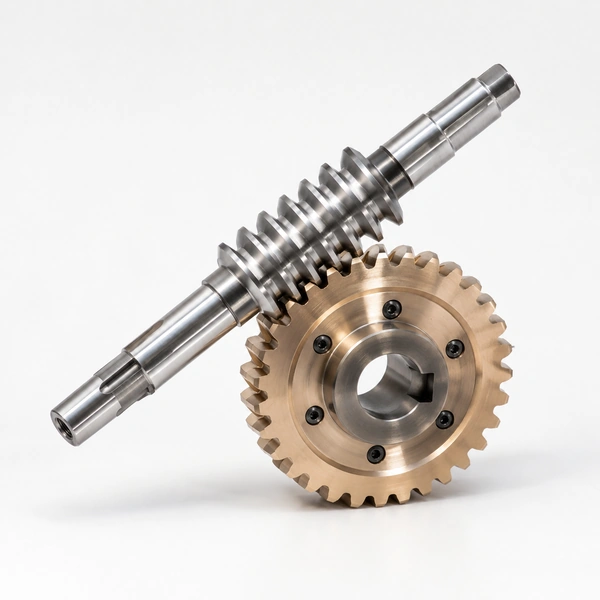
The self-locking property of worm gears — the inability of the output (wheel) shaft to back-drive the input (worm) shaft when the load is applied in reverse — is the fundamental safety mechanism that makes worm gear hoists operable without a continuous-duty mechanical brake. When the hoist motor is de-energised with a suspended load, the gravitational torque applied through the wire rope or chain to the worm wheel cannot overcome the friction in the worm-wheel mesh, and the load remains stationary. The self-locking mechanism holds the load passively, without motor current or brake engagement, for as long as the load remains below the maximum rated lift load.

Korea Ever-Power’s worm gears for hoist and lifting drives are manufactured in PB2 phosphor bronze worm wheel (standard) or AB2 aluminium bronze worm wheel (heavy-duty above 5 tonne) paired with 42CrMo4 hardened and ground worm shaft — all at ratios of 20:1 to 80:1 with confirmed lead angles below 5.7° to ensure reliable self-locking. Every hoist worm gear set from Korea Ever-Power is supplied with a self-locking confirmation calculation showing the lead angle and friction angle comparison for the specified lubrication condition.
Critical safety note: self-locking worm gears for hoists are not a substitute for a mechanical brake in applications where dynamic loads, vibration, or repeated start-stop cycles can cause incremental load creep. EN 14492-2 (European wire rope hoist standard) requires a mechanical brake on all electrically-driven hoists regardless of whether the gear drive is self-locking — the self-locking property provides a secondary holding mechanism, not the primary brake. Korea Ever-Power’s worm gear hoist sets are designed to complement rather than replace the required mechanical brake in crane hoist applications. See also: worm gear reducer selection guide for high-ratio lifting applications.

SELF-LOCKING CONFIRMATION — WORKED EXAMPLE

Given: 2-tonne Chain Block

Worm gear ratio: 30:1. Worm: single-start, lead = 1 × axial pitch = π × module = π × 5 = 15.7 mm. Worm reference diameter d1 = 50 mm. Lead angle λ = arctan(15.7 / (π × 50)) = arctan(0.100) = 5.71°.

Friction Angle

Lubricated bronze-on-hardened-steel friction coefficient μ = 0.08–0.12. At μ = 0.10 (ISO VG 220 worm oil, warm): friction angle ρ = arctan(0.10) = 5.71°. Self-locking condition: λ ≤ ρ. Here λ = ρ = 5.71° → borderline. At ratio 30:1 Korea Ever-Power uses d1 = 45 mm: λ = arctan(15.7 / (π × 45)) = 6.32° > ρ — NOT self-locking.

Correct Specification

For reliable hoist self-locking, target λ ≤ 4.5° (safety margin below ρ): at ratio 40:1, λ = arctan(lead / (π × d1)) = arctan(12.57 / (157)) = 4.57° < 5.71° ✓. Korea Ever-Power recommends ratio 40:1 minimum for safe self-locking in chain block and crane hoist worm gear drives without reliance on a marginal friction condition.

Hoist Application Types and Worm Gear Specifications
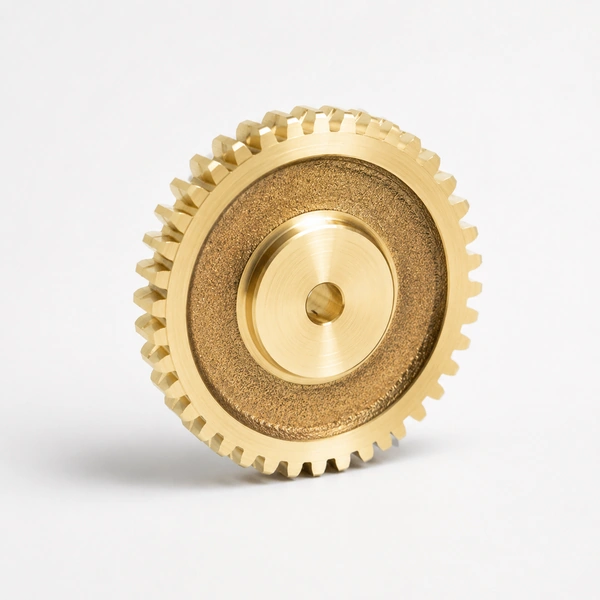
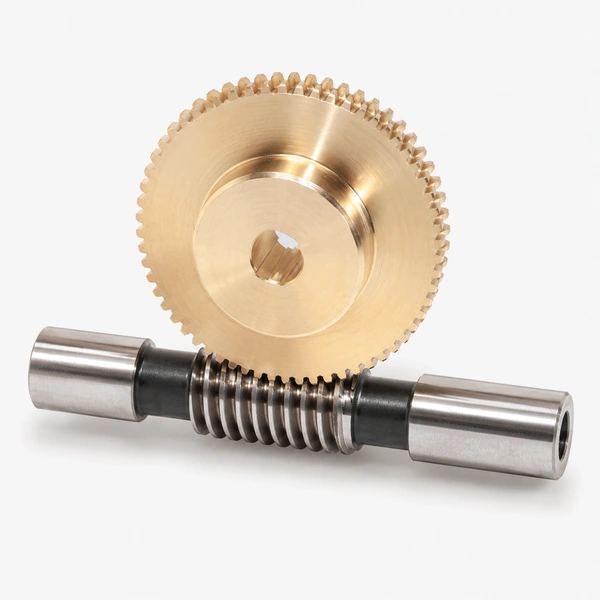
bronze brass worm wheel hoist lifting Korea Ever-Power
Korea Ever-Power centrifugal cast phosphor bronze (PB2) worm wheel for overhead crane hoist application — ratio 40:1, centre distance 100 mm, output torque 1,800 Nm, lead angle 4.1° (confirmed self-locking with μ ≥ 0.075). Worm shaft in 42CrMo4 induction hardened, HRC 55–60 thread surface, ground to thread profile tolerance. Self-locking calculation report included with hoist worm gear order. Maximum wheel load 2,500 kg at rated efficiency 55%. Supplied as matched worm gear set with housing shaft bore and keyway dimensions confirmed against crane hoist drawing before shipment.

TYPE 01

OVERHEAD CRANE
WIRE ROPE HOIST

Worm gear specification: Ratio 30:1–60:1, PB2 bronze worm wheel, 42CrMo4 worm, lead angle 3°–5° (confirmed self-locking), FEM duty group M3–M5 for general workshop crane, centre distance 80–160 mm depending on lift capacity. Overhead crane hoists (0.5–20 tonne, span 5–30 m) are the highest-volume worm gear hoist application. The crane hoist worm gear must meet FEM 1.001 rating for the applicable duty group, with the mechanical life factor applied to both the worm shaft (steel fatigue) and the worm wheel (bronze contact fatigue). Korea Ever-Power supplies hoist worm gear sets to FEM M3, M4, and M5 ratings with calculation certificate confirming compliance. EN 14492-2 crane directive requires that the hoist brake — separate from the worm gear self-locking — is capable of holding 1.5× the rated load with the motor de-energised.

TYPE 02

CHAIN BLOCK
& LEVER HOIST

Worm gear specification: Ratio 20:1–40:1, PB2 bronze, compact cast iron housing, lead angle 4°–5°. Electric chain block hoists (0.25–5 tonne, hook height 3–30 m) use compact worm gear reducers between the electric motor and the load chain sprocket. The chain block must self-lock reliably in all orientations — horizontal, vertical, and inclined — so the lead angle must be verified at the minimum expected friction coefficient (cold lubricant, worst-case contamination: μ = 0.07 for contaminated worm oil). Korea Ever-Power recommends specifying the lead angle for μ = 0.07 rather than the nominal 0.10, giving a self-locking safety margin that accounts for lubricant degradation over service life. Manual chain blocks (hand-operated) use the same worm gear geometry as electric hoists, with the operator hand-chain replacing the electric motor as the input.

TYPE 03

STAGE &
THEATRICAL HOIST

Worm gear specification: Ratio 40:1–80:1, PB2 bronze, very quiet operation required, EN 17206 (Entertainment technology lifting standard), electronic position control, emergency stop braking <0.3 s. Stage and theatrical hoists carry scenery and lighting equipment above performers and audience — the most demanding safety classification of any hoist type. EN 17206 requires hoists carrying loads above people to have two independent braking systems; the worm gear self-locking contributes one layer of this redundancy. The very high ratio (60:1–80:1) used in stage hoists provides low lifting speed for precise position control (10–50 mm/s typical) and extremely reliable self-locking at lead angles below 2°. Korea Ever-Power supplies stage hoist worm gear sets with individual efficiency measurement (to calculate braking torque contribution) and self-locking verification report on request for EN 17206 compliance documentation.

TYPE 04

GARAGE DOOR
& PLATFORM LIFT

Worm gear specification: Ratio 20:1–40:1, low cost PB2 bronze or thermoplastic worm wheel for residential garage door operators, higher-rated PB2 for commercial platform lifts and scissor lifts. Residential and commercial garage door operators use small worm gear reducers (ratio 20:1–30:1, M1.5–M2.5) between the AC motor and the door drive sprocket or lead screw. The worm gear self-locking holds the door at any intermediate position without a separate brake. Commercial platform lifts (0.5–2 tonne capacity) use larger worm gear sets (ratio 30:1–50:1, M4–M6) to the scissor lift hydraulic pump or mechanical screw drive. Korea Ever-Power supplies worm gear sets for all common garage door operator models and for commercial platform lift replacement and OEM production.

Frequently Asked Questions

Q 01

What is the difference between self-locking and self-braking in worm gear hoists, and which do I need?

Self-locking is a static property — under a sustained static load with no motor input, the worm gear cannot be back-driven because static friction at the tooth contact exceeds the reverse driving force. This is the condition calculated from lead angle vs friction angle. Self-braking (also called self-sustaining) is a dynamic property — the worm gear decelerates and stops a descending load without the motor applying braking torque, relying on friction to absorb the kinetic energy of the moving load. A worm gear that is statically self-locking may not be dynamically self-braking under shock loading or at high lowering speeds, because the dynamic friction coefficient is lower than the static friction coefficient (typically μdyn = 0.07–0.09 vs μstatic = 0.10–0.12). For hoist applications: self-locking worm gears (lead angle <5°) reliably hold static loads and are the basis of worm gear hoist drive design. Mechanical brakes (failsafe spring-applied, electromagnetically released) are required by EN 14492-2 and EN 17206 for all electrically-driven hoists as the primary braking mechanism, with the worm gear self-locking as secondary. Korea Ever-Power designs all hoist worm gear sets for reliable static self-locking and provides documentation confirming this property.

Q 02

How do I determine the FEM duty group for a worm gear hoist replacement?

FEM duty group (also referred to as ISO 4301 mechanism group) is determined by two factors: (1) The load spectrum class (L1–L4) — how often the hoist lifts its maximum rated load vs partial loads during a typical working period. L1: rarely at max load; L4: almost always at max load. (2) The utilisation class (T1–T8) — the total number of operating hours over the design life of the hoist mechanism. Combining spectrum class and utilisation class from the FEM or ISO tables gives the duty group M1–M8. For replacement purposes: if you have the original hoist manufacturer’s duty group designation from the nameplate or manual, specify the same duty group for the replacement worm gear set. If the hoist has been upgraded (heavier loads, more cycles per day than original design) you may need to specify the next higher duty group. Korea Ever-Power can calculate the required duty group from your operating data (rated load, actual load distribution, lifts per hour, and annual hours) and confirm the worm gear design to meet it — contact Korea Ever-Power with these parameters for a compliance calculation before ordering the replacement worm gear set.

Q 03

My crane hoist worm wheel shows progressive surface pitting on the tooth flanks — is this a lubrication problem or a gear specification problem?

Worm wheel bronze tooth flank pitting in hoists has three root causes with different remedies: (1) Contact stress exceeds bronze fatigue limit — the hoist is being operated at loads above its FEM duty group rating, or the original gear was under-specified. Remedy: replace with a larger-diameter worm wheel or higher-strength AB2 aluminium bronze wheel, confirm the replacement to the actual operating duty group. (2) Lubricant film breakdown — the worm oil viscosity is too low for the actual operating temperature, or the oil change interval was exceeded, allowing the EP additive package to deplete. Remedy: drain and flush, refill with ISO VG 460 worm gear oil (heavier grade), and reduce change interval to 2,000 hours or annually. (3) Misalignment between worm and wheel — the contact pattern is shifted to one side or the toe of the tooth, concentrating stress in a small contact area below the full-face capacity of the wheel. Remedy: check centre distance and shaft parallelism; the contact pattern under blue marking test should cover the central 50–65% of the tooth face. Korea Ever-Power can advise on replacement specification based on inspection photographs of the failed worm wheel — contact Korea Ever-Power with high-resolution photographs of the tooth surface showing the pitting location and pattern.

Explore Korea Ever-Power Gear Categories

Seven precision gear product lines for lifting, industrial, agricultural and specialist applications worldwide.
spur gear

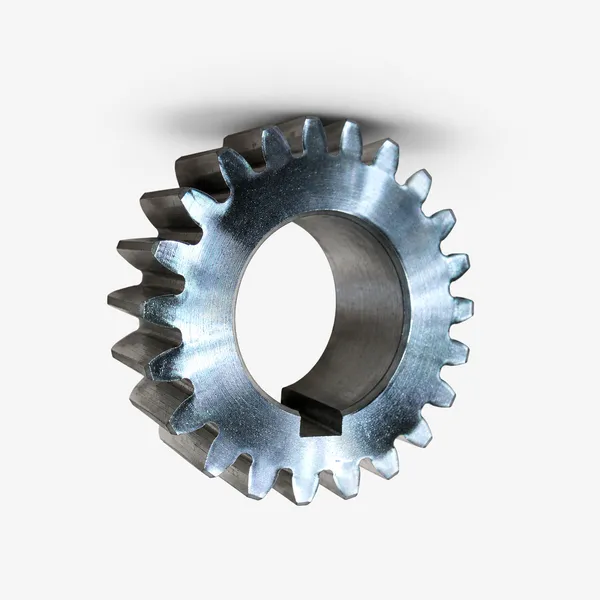
Spur Gears

M1–M20 · C45, 20CrMnTi, 316L

helical gear

Helical Gears

Low noise · high contact ratio · gearbox

bevel gear

Ingranaggi conici

Right-angle drives · straight & spiral

worm gear hoist

Worm Gears

Self-locking · hoist · valve · solar

ring gear

Ring Gears

Internal · planetary · wind, excavator

planetary gear

Planetary Gears

Compact · high torque density · servo, EV

plastic gear

Plastic Gears

POM · MC Nylon · UHMWPE · FDA

GET A QUOTATION · KOREA EVER-POWER

Need Worm Gears for Hoist or Lifting Drives?

Korea Ever-Power supplies PB2 phosphor bronze worm wheels and 42CrMo4 hardened worm shafts for all hoist and lifting drive applications — ratio 20:1–80:1, confirmed self-locking at lead angle <5°, FEM M3–M5 duty group calculation included. Overhead crane, chain block, stage hoist, platform lift and garage door drives. Self-locking calculation report with every order. ISO 9001:2015 quality documentation included.

Request a Quotation →

Redattore: Cxm

VR Tour of Our Factory

TAGs:

cremagliera degli ingranaggi

In qualità di uno dei principali produttori, fornitori ed esportatori di cremagliere, offriamo cremagliere e molti altri prodotti.

Vi preghiamo di contattarci per maggiori dettagli.

Posta:[email protected]

Produttore, fornitore ed esportatore di cremagliere

Articoli recenti

it_ITItalian