GEAR APPLICATION GUIDE · WORM GEAR · W09

Worm Gears for High-Ratio Drives:
Single-Stage 100:1, Duplex Worm Design and Self-Locking Applications

High-ratio worm gear drives — defined as single-stage worm reductions at ratios of 60:1 to 100:1 or more — represent one of the most technically challenging areas of mechanical power transmission, where the requirements for high torque multiplication, compact package, and reliable self-locking behaviour must be simultaneously satisfied within the fundamental efficiency constraints of high-ratio worm gear kinematics. At ratio 80:1, a single-start worm has a lead angle of only 0.7° to 1.5° (depending on centre distance and number of worm threads), placing the gear in the region where the self-locking condition is reliably achieved but where sliding losses at the worm thread surface consume 30–60% of the input power as friction heat. This guide covers the engineering, selection, and application of high-ratio worm gears from 60:1 to 100:1 in single stage, covering valve actuators, antenna positioners, material testing machines, lifting equipment, and adjustable machinery drives.

Single-Start · Duplex · 20CrMnTi · Phosphor Bronze
Ratio 60:1–100:1 · Self-Lock · η 25–40%
Valve · Antenna · Lift · Adjustment · Duplex

RATIO RANGE

60:1 – 100:1

High-ratio single-stage worm drive ratio range. 60:1: 1-start worm at moderate lead angle, partial self-lock. 80:1: 1-start worm, reliable self-lock. 100:1: 1-start worm at very low lead angle, strong self-lock but efficiency below 25%. Above 100:1 in single stage: possible but uncommon commercially — two stages in series more efficient above 100:1. Korea Ever-Power standard single-stage ratios: 60:1, 70:1, 80:1, 100:1

SELF-LOCK CONDITION

Lead angle < φ

Self-locking occurs when the worm lead angle γ is less than the friction angle φ = arctan(μ), where μ is the coefficient of friction between the worm thread and wheel tooth. For ground worm thread with polished bronze wheel and ISO VG 220 gear oil: μ ≈ 0.02–0.04, φ ≈ 1.1–2.3°. Self-lock is reliable at ratios above 60:1 (single-start worm) with centre distance 50–160 mm

EFFICIENCY

η 25 – 40%

Efficiency of high-ratio single-start worm drives. Ratio 60:1: η ≈ 35–40%. Ratio 80:1: η ≈ 28–35%. Ratio 100:1: η ≈ 20–28%. The low efficiency is an intrinsic consequence of the high sliding velocity and the low lead angle — a necessary trade-off for the self-locking capability. Where efficiency is critical, a 2-stage multi-start worm set or helical gear reducer is preferred

WORM THREAD

1-Start Ground

All high-ratio (60:1–100:1) single-stage worm gears use a single-thread (1-start) worm — the ratio z₂/z₁ with z₁ = 1 gives ratio = wheel tooth count (60–100 teeth on the wheel for 60:1–100:1 ratio). Thread profile: ZI involute or ZA Archimedean, ground after hardening to Ra ≤ 0.4 μm for minimum sliding friction. The duplex worm (variable lead thread) design allows backlash adjustment without housing modification

High-Ratio Worm Drive Engineering — Self-Locking, Efficiency, and Thermal Management

High-ratio worm drives occupy a unique position in power transmission design: they are simultaneously the most compact single-stage ratio multiplication element available (achieving 100:1 in the space a planetary gearbox needs for 25:1) and the least efficient conventional gear type (consuming 60–80% of the input power as friction heat at ratio 100:1). Understanding and managing this efficiency penalty is the central engineering challenge of high-ratio worm drive design — at ratio 80:1 with an input power of 2 kW, approximately 1.4 kW is lost as heat in the worm gear contact, raising the oil temperature by 40–60°C above ambient unless adequate cooling is provided. Most high-ratio worm gear failures in service are thermal failures — the oil temperature exceeds 100°C, the gear oil oxidises and loses its film strength, the phosphor bronze wheel begins to scuff against the worm thread, and catastrophic adhesive wear follows within hours.

Korea Ever-Power’s high-ratio worm gear drives at ratio 60:1–100:1 address the thermal management requirement through three design approaches: (1) housing surface area optimisation (finned aluminium housings with heat dissipation area 1.5–2.5× the smooth housing area, increasing natural convection cooling capacity without forced air); (2) synthetic ISO VG 220 gear oil with high oxidation stability (PAO-based synthetic oil rated for continuous 100°C operation retains adequate film strength at the oil temperatures reached in continuous high-ratio worm drive operation, whereas mineral oil would begin oxidising above 80°C); and (3) duty cycle guidance (for applications where the worm drive cannot be cooled adequately for continuous operation, Korea Ever-Power provides an intermittent duty cycle calculation tool that determines the safe on-time and off-time based on the housing thermal mass and the calculated heat generation rate). Complete worm gear reducer units in ratios W01 and W03 are also available through our worm gear reducer product line for customers who need a complete gearbox assembly rather than individual worm and wheel sets.

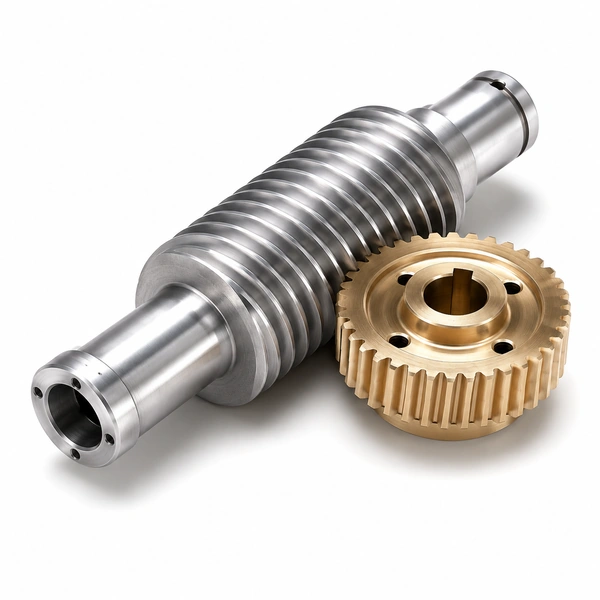
The duplex worm is an advanced worm gear design used exclusively in high-precision high-ratio applications — telescope drives, antenna positioners, precision indexing tables, and precision valve actuators — where the zero-backlash or minimum-backlash requirement cannot be met by standard worm gear assembly adjustment. A duplex worm has a variable lead (also called variable pitch) thread, where the lead of the thread changes linearly along the worm axis — from a slightly larger lead on the left-hand end to a slightly smaller lead on the right-hand end. Because the wheel tooth is cut to match the mean lead, meshing the wheel at different axial positions along the duplex worm changes the effective mesh tightness — moving the wheel housing axially relative to the worm tightens the mesh and reduces backlash, without any disassembly or shimming. The duplex worm allows continuous backlash adjustment from the nominal value (at mid-housing position) to near-zero backlash (at full inward axial shift) through a simple external adjusting screw. Korea Ever-Power manufactures duplex worm and wheel sets at ratios 60:1, 80:1, and 100:1 for precision positioning applications requiring backlash below 0.5 arc-minutes.
duplex worm gear high ratio drive Korea Ever-Power precision positioning
Korea Ever-Power duplex worm and wheel set for high-ratio precision positioning drive — ratio 80:1, single-start worm, variable lead (duplex) thread design with lead variation of ±3% from centre to ends. Worm material: 20CrMnTi case carburized HRC 60–62, ZI involute thread profile, ground to Ra ≤ 0.2 μm after hardening. Wheel material: centrifugal-cast PB2 phosphor bronze (CuSn12, BS 1400 PB2), hobbed to AGMA Q8 quality. Centre distance 100 mm, nominal backlash at centre position 0.06–0.09 mm (3–4.5 arc-min). Minimum achievable backlash with full inward axial adjustment: 0.005–0.01 mm (0.25–0.5 arc-min). Used in: antenna positioners, telescope slow-motion drives, precision valve actuators requiring sub-arc-minute positioning repeatability, laboratory test machine cross-head drives. Housing: aluminium, finned for thermal dissipation, rated for continuous operation at 30% of rated output torque without forced cooling.

High-Ratio Worm Drive Application Specifications

Gate / Butterfly Valve Actuators — Ratio 80:1

Industrial valve actuators (gate valves, butterfly valves, ball valves) for pipelines, water treatment plants, and chemical process lines use high-ratio worm drives at 60:1–100:1 to provide the high mechanical advantage needed to open and close valves against full process pressure, while the worm gear self-locking holds the valve at any position when the actuator motor or handwheel is stationary — eliminating the need for a separate valve brake or position lock. A 600 mm diameter gate valve at 10 bar process pressure requires a seat closing force of approximately 28 kN on the valve stem — a worm drive at 80:1 with an 80 mm worm wheel produces this force with an input torque of only 9 Nm from a small electric actuator motor. The self-locking requirement for valve actuators is specified by EN 15714-2 (electric actuators for valves) as a maximum reverse efficiency below 50% under any load condition — Korea Ever-Power high-ratio valve actuator worm gears are guaranteed to meet this requirement with a maximum back-driving efficiency of 35% at ratio 80:1 and above.

Ratio 80:1–100:1 · self-lock ≤35% back-drive · EN 15714

Antenna and Telescope Positioning — Ratio 60:1–100:1 Duplex

Antenna positioners (satellite dish drives, radar antenna az-el mounts, radio telescope drives) and astronomical telescope slow-motion drives use high-ratio worm gears as the primary positioning element because the worm gear’s self-locking behaviour holds the antenna at the commanded position against wind loading without continuous motor current. The positioning accuracy requirement for antenna drives is often sub-arc-minute — a 3-metre satellite dish must be aimed to within 0.05° (3 arc-minutes) of the target satellite boresight for maximum signal level. Duplex worm drives at ratio 80:1–100:1 achieve sub-arc-minute backlash after adjustment, enabling the antenna controller to command positions within the 3 arc-minute tolerance directly from encoder counts without backlash compensation algorithms. Korea Ever-Power supplies duplex worm sets for antenna positioners for 18-month delivery lead times (standard for satellite ground station procurement) and provides a zero-backlash commissioning procedure for field adjustment at the installation site.

Duplex · ratio 80:1–100:1 · sub-arc-min · antenna

Adjustable Machine Drives — Ratio 60:1–80:1

Machines that require slow, precision adjustment of a mechanism position during operation — press die height adjustment, printing machine impression roller gap setting, laminating machine nip gap control, tile press ram adjustment — use high-ratio worm drives to provide the combination of slow movement, high force, and self-locking that holds the position under the working load of the machine process. The worm gear in a press die height adjustment must hold the die platen position to within ±0.1 mm under the full press force (which may be 500 kN for a medium-size stamping press) while the press cycles at 60–100 strokes per minute. At ratio 80:1, a worm drive with a 100 mm worm wheel holds the die position against the full press force without any external locking mechanism — the self-locking worm gear is the lock. Korea Ever-Power adjustable machine worm gears at ratio 60:1–80:1 are specified with an additional safety factor of 1.5 on the self-locking condition to ensure reliable locking even at the maximum permissible variation in friction coefficient from oil viscosity changes across the machine operating temperature range.

Ratio 60:1–80:1 · self-lock safety 1.5× · press · laminator
worm gear shaft high ratio drive Korea Ever-Power precision
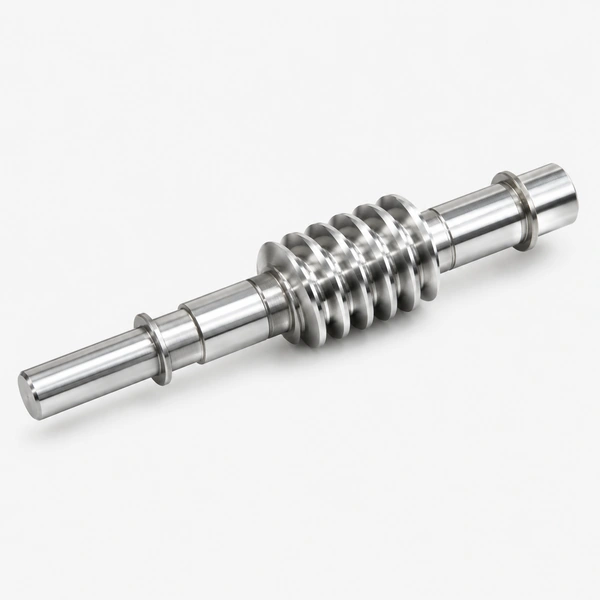
Korea Ever-Power 20CrMnTi case carburized high-ratio worm shaft for 80:1 valve actuator drive application — single-start worm thread, ZI involute profile, axial pitch 14 mm, thread angle 20°, shaft diameter 45 mm, total shaft length 280 mm. Ground thread flanks Ra ≤ 0.3 μm — the low surface roughness minimises sliding friction at the worm-wheel contact (where the relative sliding velocity at 1,400 RPM input is 1.1 m/s for this geometry), enabling the efficiency and self-lock behaviour to remain within the designed values over the full service life. Runout of worm thread pitch cylinder relative to journal bearing diameters: ≤ 0.01 mm TIR — this concentricity specification ensures uniform load distribution across the worm thread circumference, preventing localised wear of the bronze wheel teeth on one side. 100% magnetic particle inspection (MPI) on worm thread surfaces after grinding. Hardness: case HRC 60–62, core HB 300–340 at worm shaft diameter. Used in Class VI butterfly valve actuators per EN 15714-2 in water treatment and chemical process service.
types of gears worm gear high ratio comparison Korea Ever-Power
Korea Ever-Power gear type comparison for high-reduction-ratio application selection — worm gear, planetary gearbox, and helical multi-stage reducer. For ratio 60:1–100:1 in a single stage, the worm gear is the only practical option: a single-stage helical or spur gear cannot achieve ratios above approximately 10:1 without exceeding practical tooth size limits, and a single-stage planetary achieves maximum ratios of 12:1–14:1. A two-stage planetary can reach 60:1–100:1, but occupies significantly more axial length and costs 2–3× more than the equivalent worm gear for the same output torque. The worm gear’s unique advantage at these high ratios is not just the compact package but the inherent self-locking — neither a planetary nor a helical reducer can self-lock, requiring an additional brake or holding device to keep the output stationary when the motor is de-energised. For valve actuators, lifting equipment, and positioning drives where holding without power is a safety requirement, the self-locking worm drive at ratio 80:1–100:1 remains the most technically and economically optimal solution.

Frequently Asked Questions — High-Ratio Worm Drives

Q 01

Our 80:1 valve actuator worm drive is overheating — oil temperature reaches 115°C after 20 minutes of continuous operation. What is causing this and how do we solve it?

Oil temperature of 115°C after 20 minutes of continuous operation in an 80:1 worm drive is a thermal management failure — the heat generated by the high sliding friction at the low lead angle is exceeding the housing’s ability to dissipate it to the ambient air. Root causes and solutions in order of likelihood: (1) Continuous operation duty: at ratio 80:1, the efficiency is approximately 28–35% — meaning 65–72% of the input power is converted to heat. For a 1 kW input motor, 650–720 W is generated as heat continuously. Calculate whether the housing thermal rating (typically expressed as the maximum continuous kW input for a given housing size) is exceeded. If the input power exceeds the housing thermal rating, either reduce the input power (reduce the motor rating) or add forced cooling. (2) Housing surface area too small: confirm the housing has adequate fin area. A standard NMRV 050 worm gearbox at ratio 80:1 has a maximum continuous input of approximately 0.25 kW without forced cooling in a 25°C ambient. If your 80:1 actuator is receiving 0.5 kW input, the housing must be doubled in surface area or forced air cooled. (3) Oil degraded or incorrect grade: check the current oil viscosity — if the oil has degraded to below ISO VG 150 (from shear thinning of a polymer-thickened oil) or has oxidised and lost film strength, sliding friction increases significantly. Replace with ISO VG 220 PAO synthetic oil and monitor temperature improvement. (4) Intermittent duty cycle design: if the valve actuator must operate continuously, reconsider the drive arrangement — replace the single 80:1 worm with a two-stage worm (e.g. 20:1 × 4:1) which achieves the same 80:1 total ratio at 60–65% efficiency, generating only 35–40% heat instead of 65–72% for the same input power. Korea Ever-Power can provide a thermal management calculation for your specific actuator housing size and input power on request.

Q 02

How do I verify that a worm drive is genuinely self-locking, not just “nominally” self-locking based on a catalogue specification?

The self-locking condition of a worm drive is not binary — it is a function of the friction coefficient at the specific operating condition (oil temperature, surface finish, and speed), and catalogue specifications are typically stated at a nominal friction coefficient that may not reflect the actual condition in your application. The reliable methods for verifying self-locking in your specific application: (1) Calculate the back-driving efficiency at worst case: back-driving efficiency η_back = (tan(γ) − tan(φ)) / (tan(γ) + tan(φ)), where γ is the lead angle and φ is the friction angle (arctan(μ_min)). For self-lock, η_back must be negative — which requires φ > γ. At ratio 80:1 with a 100 mm centre distance: typical lead angle γ ≈ 1.5°. For μ_min = 0.02 (well-lubricated, warm, polished surfaces): φ_min = 1.1°. Since φ_min (1.1°) is below γ (1.5°), self-lock is NOT guaranteed at this friction coefficient — the worm could back-drive if the oil is warm and the surfaces are very well polished. For guaranteed self-lock, γ must be below φ_min — increase the ratio to 100:1 (γ ≈ 1.1°) or use a worm with a smaller centre distance at the same ratio (reducing γ further). (2) Back-drive test at warm oil temperature: assemble the worm gearbox with the rated oil fill, run it at rated input for 30 minutes (to reach normal operating temperature), then apply the rated output torque to the output shaft with the input shaft free to rotate. Observe whether the input shaft rotates under the output torque. This is the definitive self-locking test at actual operating conditions. Korea Ever-Power performs this back-drive test on all worm gears supplied for safety-critical self-locking applications (valve actuators, lifting mechanisms) and provides a test certificate confirming the result.

Q 03

What is a duplex worm and when is it worth the cost premium over a standard single-start worm for precision positioning?

A duplex worm (also called a variable-lead worm) has a thread where the axial pitch varies linearly from one end of the worm to the other — the thread is slightly coarser at the left end than at the right end (or vice versa). The wheel is cut at the centre lead of the worm. When the housing is adjusted to move the wheel axially relative to the worm (by an external adjusting screw), the effective mesh tightness changes — moving toward the finer-pitch end reduces the backlash until the backlash reaches near-zero. When is a duplex worm worth the cost premium (typically 60–100% more than a standard single-start worm)? (1) Applications requiring backlash below 1 arc-minute that cannot accept the loss of range of motion from a spring-loaded anti-backlash wheel design. (2) Applications where the backlash must be field-adjustable after installation to compensate for wear — an antenna positioner operating for 10 years accumulates enough worm wheel wear that the backlash increases above the pointing accuracy requirement, and a field-adjustable duplex worm allows re-commissioning without gear replacement. (3) Applications where the initial assembly backlash must be tuned precisely — a standard worm requires shimming of the wheel housing to adjust backlash (a process that requires iteration and gear removal), while a duplex worm requires only turning the external adjusting screw. Korea Ever-Power’s duplex worms are priced at a 70–80% premium over the equivalent single-start worm — this cost is usually recovered within the first service event (eliminated gear removal and shim replacement labour).

Explore Korea Ever-Power Gear Categories

Seven precision gear product lines for valve actuation, antenna positioning, lifting and precision adjustment applications worldwide.
spur gear

Spur Gears

Pre-stage · motor drive · M2–M10

helical gear

Helical Gears

High efficiency · 2-stage reducer

bevel gear

Ingranaggi conici

Right-angle · actuator angle drive

duplex worm high ratio gear

Worm Gears

Duplex · 60:1–100:1 · self-locking

ring gear

Ring Gears

Slewing · indexing · large diameter

planetary gear

Planetary Gears

Compact · multi-stage · servo drive

plastic gear

Plastic Gears

Instrument · light positioning drive

GET A QUOTATION · KOREA EVER-POWER

Need High-Ratio Worm Gear Drives?

Korea Ever-Power manufactures high-ratio single-start and duplex worm gears at ratios 60:1–100:1 for valve actuators, antenna positioners, telescope drives, adjustable machine drives, and lifting equipment. 20CrMnTi carburized worm shaft Ra ≤ 0.2 μm, PB2 phosphor bronze wheel, self-locking verification test certificate, duplex worm backlash adjustment to sub-arc-minute. Complete worm gearbox assemblies in finned aluminium housing also available. ISO 9001:2015 certified.

Request a Quotation →

Redattore: Cxm

VR Tour of Our Factory

TAGs:

cremagliera degli ingranaggi

In qualità di uno dei principali produttori, fornitori ed esportatori di cremagliere, offriamo cremagliere e molti altri prodotti.

Vi preghiamo di contattarci per maggiori dettagli.

Posta:[email protected]

Produttore, fornitore ed esportatore di cremagliere

Articoli recenti

it_ITItalian