
Planetary Gears for Conveyor Drives:
Belt Conveyor Drives, Mining Conveyors and Bulk Material Handling
Conveyor drives are the highest-power, longest-running, and most maintenance-sensitive application category for planetary gearboxes in bulk material handling — a single belt conveyor at an iron ore mine may run 24 hours per day, 365 days per year, transmitting 2–5 MW through each drive head, with a total annual energy consumption equivalent to a small power plant. The planetary gearbox in a conveyor drive must simultaneously deliver the high torque density needed to reduce the drive head physical size (which is limited by the conveyor structure), the efficiency needed to minimise energy cost, and the operational reliability needed to prevent unplanned stops that cascade through the entire mining or materials handling operation. This guide covers planetary gear specification for all classes of conveyor application — light-duty package handling conveyors through heavy-duty mining overland belt conveyor main drives.
Power 5 kW–5 MW · DIN 5–7 · ISO 6336 · η 97%
Package · General Industry · Mining · Overland
Planetary Gearbox Advantages for Conveyor Drives
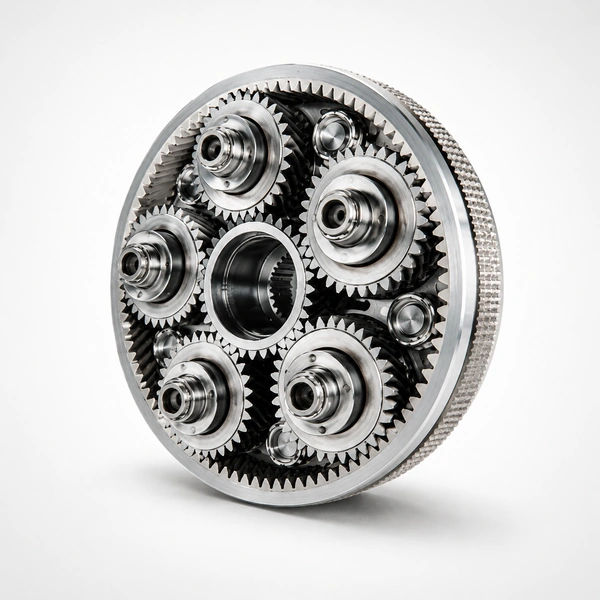
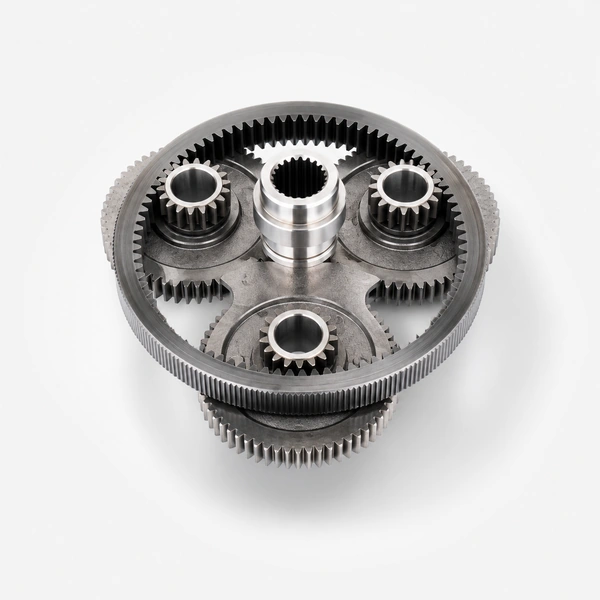
The planetary gearbox has become the dominant drive solution for belt conveyor applications above 100 kW because it offers a combination of advantages that parallel-shaft helical gearboxes cannot match: the coaxial input-output shaft arrangement (motor and conveyor drum on the same axis) allows the gearbox to be integrated directly into the conveyor drum as a drum motor or mounted on the drive shaft without a flexible coupling and separate motor base; the high torque density (3–5× helical) reduces the gearbox mass and mounting structure cost for conveyor drives where the drive head is elevated 5–20 metres above the ground on the conveyor structure; and the high per-stage efficiency (97–99%) minimises the energy cost for large conveyors that run continuously. Korea Ever-Power’s planetary gear sets for conveyor drives are manufactured to ISO 6336 load capacity standards and ISO 1328 quality class specifications, covering the full power range from 5 kW package handling conveyors through 5 MW overland mining belt conveyor main drives. For complete planetary gearbox units including housing, bearings, and seals, our planetary gearbox product range covers the standard conveyor drive configurations from foot-mounted to shaft-mounted to drum motor integrated forms.

The load sharing among the planet gears is the key mechanism that gives the planetary gearbox its torque density advantage — but it is also the most critical design and manufacturing parameter that determines whether the promised torque density is actually achieved in service. In a theoretically perfect planetary gearbox with 3 planets, each planet gear carries exactly 1/3 of the total ring gear tangential force. In practice, manufacturing and assembly tolerances in the planet pin hole positions, planet gear pitch errors, and ring gear eccentricity cause unequal load distribution — one planet may carry 40% of the total load while another carries only 27%. This load sharing imbalance reduces the effective load capacity of the planetary set below the theoretical 3-planet capacity and is the root cause of planet gear fatigue failures that occur at torques well below the nominal rated capacity. Korea Ever-Power addresses load sharing inequality through controlled planet gear pitch accuracy (all planets in a matched set within ±3 μm pitch deviation from the mean) and floating sun gear design (where the sun gear is not fixed to the input shaft by a rigid coupling but is allowed a small radial float to self-centre under the net force from the planet gears), which is the most effective load sharing improvement mechanism for 3-planet designs.
Conveyor Type Planetary Drive Specifications
Frequently Asked Questions — Planetary Gears for Conveyor Drives
Explore Korea Ever-Power Gear Categories
Seven precision gear product lines for conveyor drives, mining, bulk materials, and industrial power transmission worldwide.
편집자: Cxm
 Korean
  English
  Italian
  French
  Japanese