
Custom OEM Bevel Gear Manufacturing:
Non-Standard Ratios, Special Materials and Complete Design-to-Delivery Service
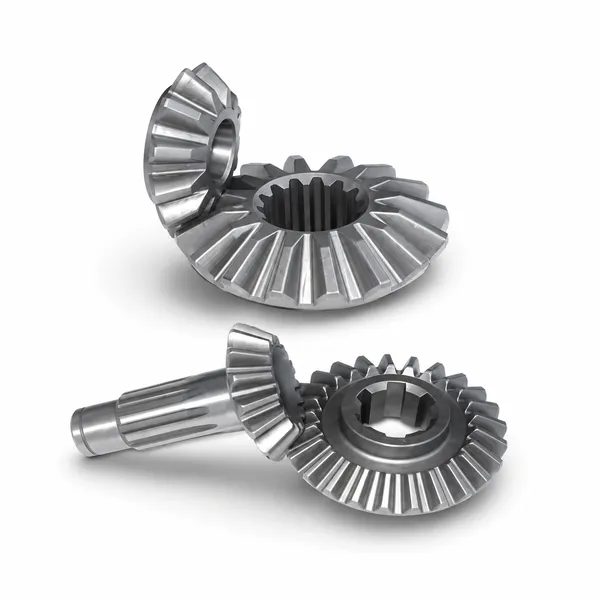
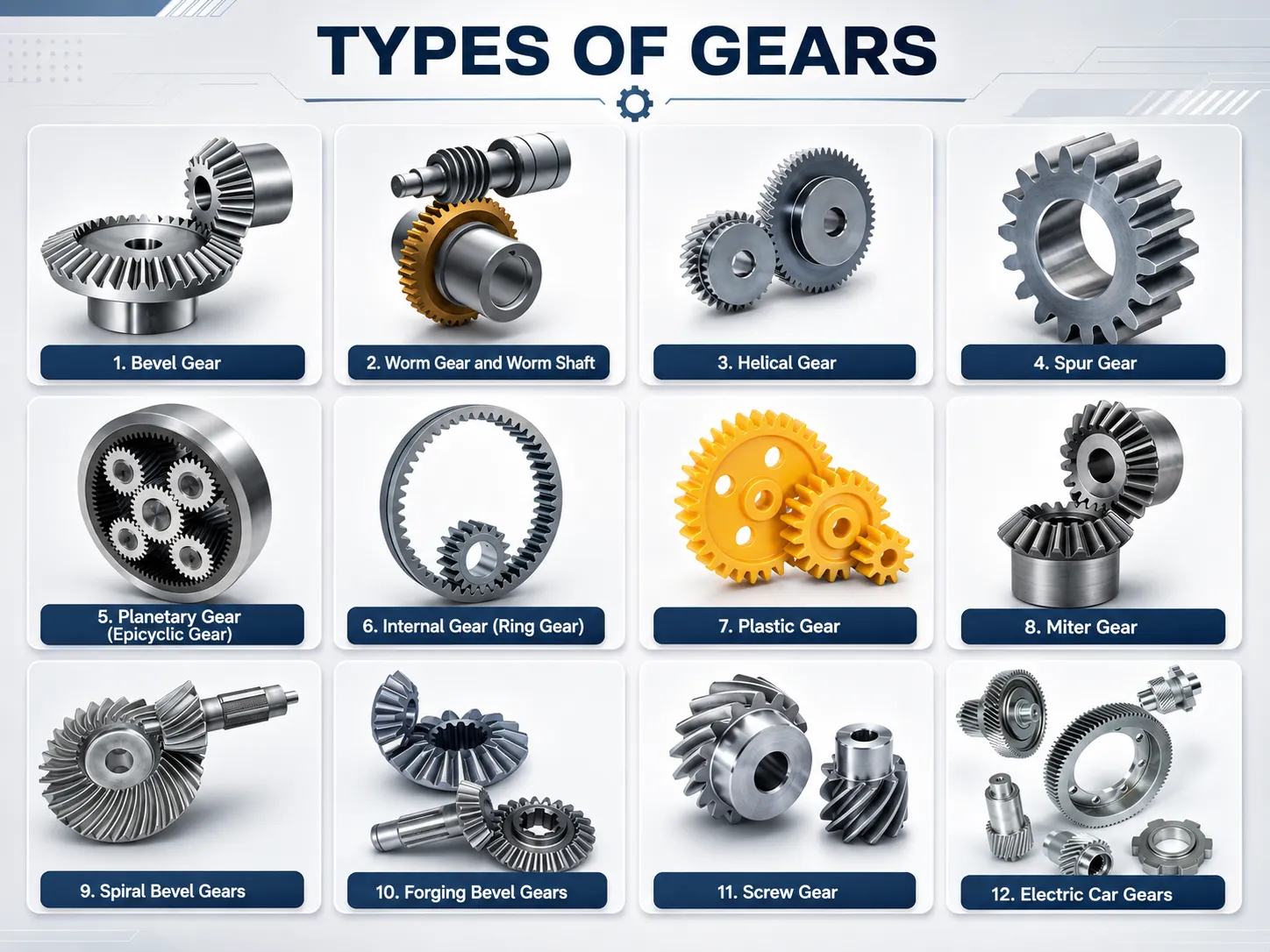
The majority of bevel gear applications — from power tool angle drives to agricultural implement drives and automotive differentials — can be served by catalogue bevel gears at standard ratios and modules. But a significant proportion of industrial, agricultural, and specialty machine designs require bevel gears that deviate from catalogue standards in ways that cannot be accommodated by modification of standard parts: non-standard shaft angles (not 90°), proprietary ratios dictated by the machine’s kinematic design, special materials for corrosion or temperature resistance, non-standard bore configurations, or dimensional envelopes that cannot accommodate any catalogue size. This guide covers Korea Ever-Power’s complete custom bevel gear manufacturing service — from specification through design calculation, material selection, manufacturing, and quality documentation.
Non-Std Shaft Angle · Gleason · Klingelnberg
OEM · Replacement · Reverse Engineer · Low Volume
Custom Bevel Gear Design Service — From Specification to Delivery
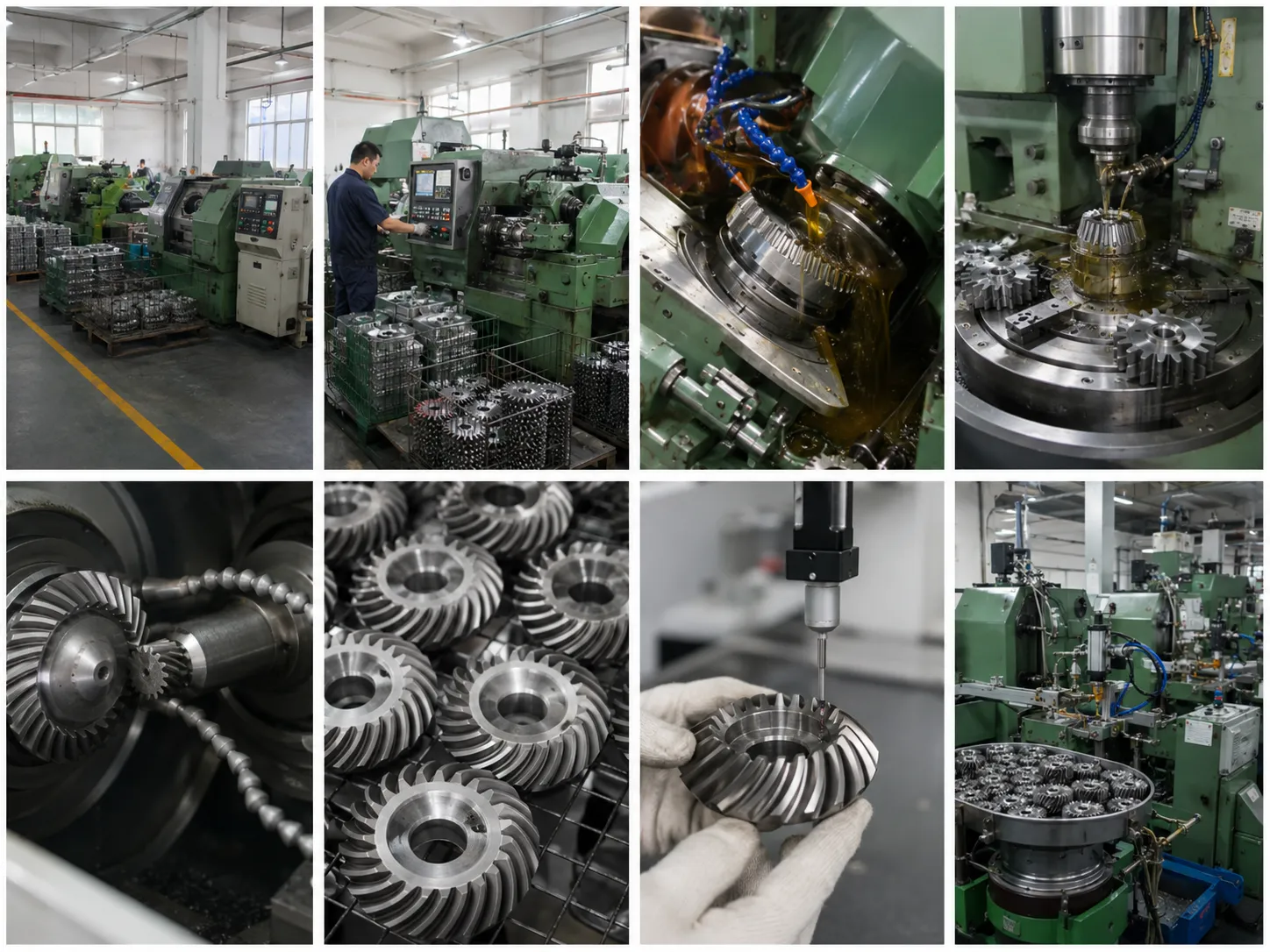
The majority of custom bevel gear enquiries that Korea Ever-Power receives fall into one of three categories: new OEM designs where the machine designer has a known shaft angle, ratio, and torque requirement but no existing bevel gear drawing; replacement programmes where the original OEM bevel gear is discontinued or the drawing is unavailable and a reverse-engineered replacement must be manufactured to a worn gear’s dimensions; and upgrade programmes where an existing bevel gear design is to be improved in material, quality class, or surface hardness to extend service life or increase load capacity. Each category requires a different engagement approach and documentation input, but all share the same manufacturing capability at Korea Ever-Power — CNC spiral bevel cutting by both the Gleason face-milling process (dominant for automotive, PTO, and general industrial ratios above 1.5:1) and the Klingelnberg cyclo-palloid continuous indexing process (preferred for miter gears and precision small-module robotics bevel gears).
Korea Ever-Power’s custom bevel gear OEM service begins with the application engineering (AE) review — a free technical evaluation of the customer’s application data (shaft angle, ratio, input torque, output speed, duty cycle, environment, and material constraints) that produces a recommended bevel gear specification within 5–7 working days. The AE review output includes the proposed module, tooth count (driver and driven), face module, mean pitch diameter, face width, helix angle (for spiral bevel), material and heat treatment, quality class, and the calculated safety factors S_F (bending) and S_H (contact) at the rated and peak torque conditions. The customer reviews the AE specification, raises any questions or modifications, and approves it before Korea Ever-Power proceeds to the drawing preparation and manufacturing quotation. This AE-first approach prevents the most common custom bevel gear project failures — the customer discovering after manufacture that the gear does not fit the housing (because the pitch cone geometry was not checked against the housing drawing), or that the gear cannot carry the required load at the specified size (because the material or module selection was optimistic).
Reverse engineering of bevel gears — manufacturing a replacement bevel gear to the dimensions of a worn or failed gear where the original drawing is unavailable — requires a systematic measurement procedure that correctly identifies all the geometric parameters of the original gear. The most common measurement errors in bevel gear reverse engineering occur in two areas: identifying whether the original gear is Gleason system (with profile-shifted, non-generated straight bevel or Gleason-system spiral bevel geometry) or DIN/Klingelnberg system (with equivalent-spur involute tooth form and cyclo-palloid cutting), and calculating the correct pitch apex (the theoretical point where the gear pair axes intersect) from the measured gear dimensions. An incorrectly identified system results in replacement gears that have the correct tooth count, module, and outer diameter but whose tooth surface geometry does not match the original — producing a poor contact pattern and rapid tooth surface wear when the replacement gear is meshed with the original mating gear that was not replaced. Korea Ever-Power’s reverse engineering procedure for bevel gears includes a tooth form identification step using over-pin measurement comparison between the measured values and the theoretical values for both Gleason and Klingelnberg tooth systems at the measured module and tooth count — the system that produces the smaller deviation between measured and theoretical over-pin dimension is selected as the original standard.
Custom Bevel Gear Material and Quality Class Selection
Standard Industrial OEM (M4–M12)
Material: 20CrMnTi case carburized (pinion) + 20CrMnTi or 42CrMo4 QT (wheel). Quality class: DIN 7 for ratio 2:1–6:1 at PLV below 5 m/s; DIN 6 for PLV 5–12 m/s or where noise below 75 dB(A) is specified. Applications: conveyor right-angle drives, agricultural PTO drives, pump right-angle drives, industrial gearbox input stages. Heat treatment: carburize pinion to HRC 60–62, wheel to 42CrMo4 QT HB 300–340 — the differential hardness pair promotes progressive run-in and extends paired life beyond same-material pairs. Most common Korea Ever-Power custom bevel specification by volume.
Lead time 15–25 days · MOQ 1 pair
Precision Robotics / CNC (M1–M4)
Material: 20CrMnTi carburized (standard) or 17-4 PH stainless (food, medical, cleanroom). Quality class: DIN 5 for all robotics applications; DIN 6 for CNC ATC and machine tool auxiliary. Klingelnberg cyclo-palloid process for M1–M2.5 (superior tooth form accuracy at small module compared to Gleason face-milling). 100% transmission error (TE) measurement for DIN 5 gears. Matched pair certification including tooth thickness measurement, contact pattern at 3 load levels, and axial thrust direction document for robot joint integration. Highest technical specification bevel gear product in Korea Ever-Power range.
Lead time 18–28 days · MOQ 2 pairs
Special Materials — Stainless, Bronze, Titanium
316L stainless: food, marine, chemical. 17-4 PH stainless: food and medical with moderate load. Phosphor bronze CuSn8: ATEX Zone 1, marine instrument, low-duty non-sparking. Duplex stainless 2205: offshore, seawater immersion. Titanium Grade 5 (Ti-6Al-4V): aerospace and racing, minimum mass — machined not forged for bevel gear application. Hastelloy C276: chemical plant severe acid service at low load. POM Delrin: instrument and control bevel gears at very light duty. Quote each material on request — material availability, machining difficulty, and lead time vary significantly. Not all materials are appropriate for all tooth forms: titanium bevel gears are straight bevel only at Korea Ever-Power (spiral bevel cutting tool compatibility limitation).
Lead time by material · enquiry required
Frequently Asked Questions — Custom OEM Bevel Gears
Explore Korea Ever-Power Gear Categories
Seven precision gear product lines for custom OEM, replacement, and specialist engineering applications worldwide.
편집자: Cxm
 Korean
  English
  Italian
  French
  Japanese