
Ring Gears for Robotics and Automation:
Robot Joint Drives, Harmonic Drive Alternatives and Collaborative Robot Ring Gears
Ring gears in robotics applications are at the frontier of precision gear manufacturing — the ring gear in a collaborative robot (cobot) joint drive must achieve backlash below 1 arc-minute, torsional stiffness above 500 Nm per arc-minute, and absolute position accuracy below 0.05° over the full joint rotation range, while fitting inside the robot arm cross-section of 80–120 mm OD and having a mass below 200–400 grams per joint. These specifications — the combination of precision, stiffness, compactness, and low mass — push ring gear manufacturing to its technical limit and have driven the development of alternative drive principles (harmonic drives, cycloidal drives) that achieve higher precision than standard planetary at the cost of higher manufacturing complexity. This guide covers both the technical specifications of ring gears for standard high-precision planetary robot joint drives and the design principles of harmonic drive flex-splines (a special form of internal ring gear) used in precision robotic applications.
≤1 arc-min · ≥500 Nm/arc-min · 0.05° accuracy
Cobot · SCARA · 6-Axis · AGV · Delta · EOAT
Robot Joint Ring Gear Engineering — Backlash, Stiffness, and the Planetary vs Harmonic Trade-Off
The robot joint drive debate between standard planetary ring gears and harmonic drive (strain wave gear) flex-splines is fundamentally a trade-off between backlash, stiffness, mass, and manufacturing cost. Standard planetary ring gears achieve the ≤ 1 arc-min backlash required for cobots at DIN 4–5 quality class with matched planet pitches — this is demonstrated in production by Korea Ever-Power’s printing press and packaging machine planetary gear sets, which reach 0.5–0.8 arc-min backlash at DIN 5. However, the standard planetary’s inherent kinematic mechanism (discretely meshing sun-planet-ring contacts at fixed pitch positions) produces a periodic torque ripple (at the planet tooth mesh frequency) that can excite structural resonances in the robot arm — particularly in the lower-stiffness carbon fibre composite arms used in cobots. The harmonic drive (a cup-shaped thin-ring flex-spline that deforms elliptically inside an internal circular spline) achieves backlash below 0.1 arc-min and near-zero torque ripple — but at 3–5× the manufacturing cost of an equivalent planetary ring gear, and with a torsional stiffness that is typically 30–50% lower than the equivalent planetary at the same gear ratio and joint OD.
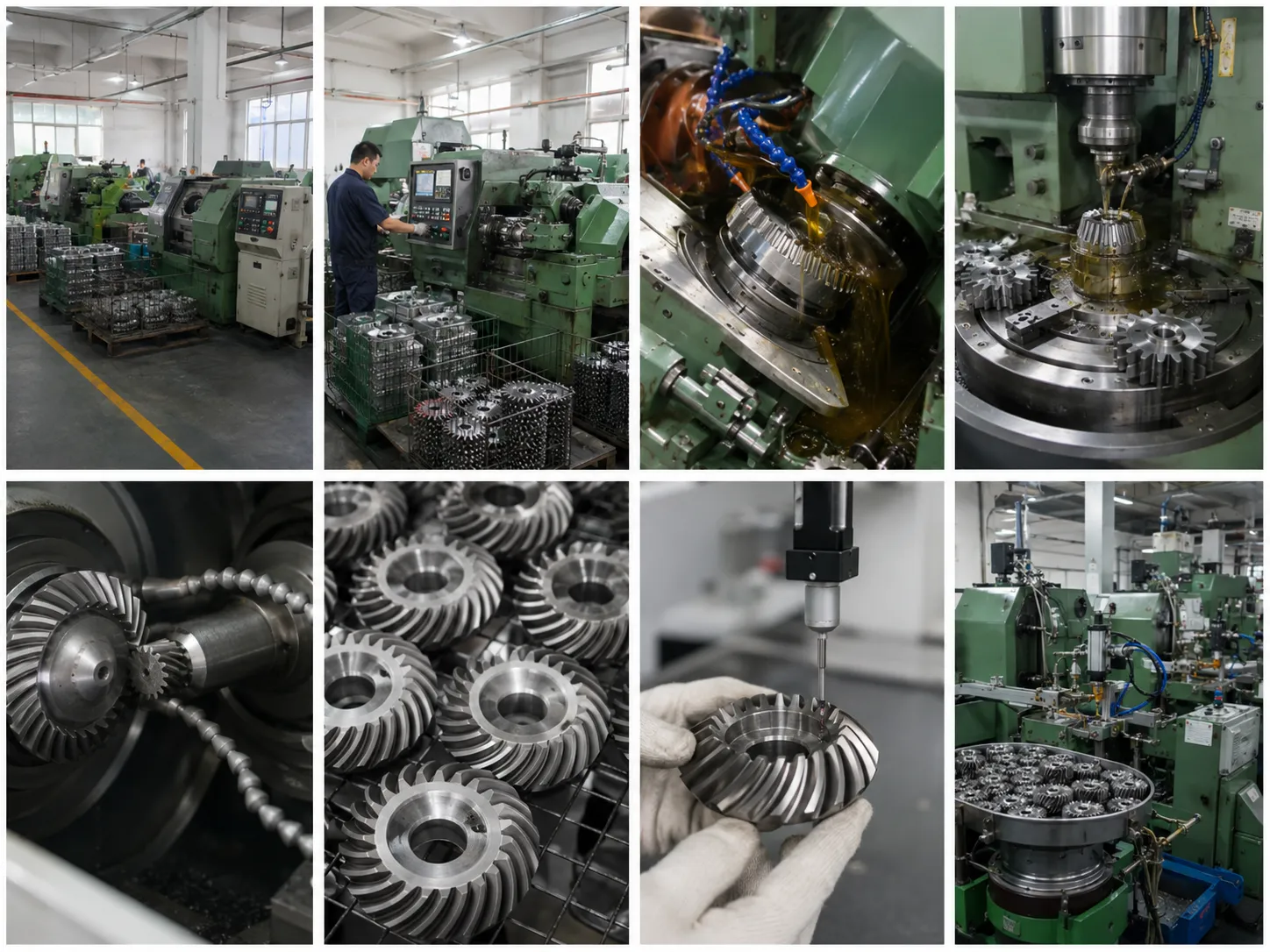
Korea Ever-Power’s ring gears for robotics and automation are manufactured in 20CrMnTi case carburized (HRC 60–62 tooth surface, 42CrMo4 QT carrier for the standard industrial robot and cobot market) and 17-4 PH H900 stainless (for food handling cobots and medical robots where the joint drive must withstand washdown or autoclave sterilisation). The precision level for robot ring gears (DIN 4–5 internal tooth, CBN-ground) requires the planet gear matched set tolerance of ±2 μm and the ring gear internal tooth total pitch deviation below 3 μm — parameters that push the manufacturing process to its limits at modules M1–M3, where a 3 μm pitch deviation represents 0.1% of the tooth pitch of a M3 ring gear. Korea Ever-Power achieves these tolerances by processing robot ring gears on dedicated CNC internal grinding machines in a climate-controlled cell (20°C ± 0.2°C) and measuring each ring gear individually on a Klingelnberg P26 gear measurement machine with 0.1 μm stylus resolution.
The cobot-specific design requirements differ from standard industrial robot requirements in several key respects that affect the ring gear specification. Cobots (collaborative robots designed to work alongside humans without physical safety barriers) require a lower backlash specification than conventional industrial robots because the cobot operates under position control in the human-shared workspace — any backlash-induced position overshoot at a direction reversal could cause unintended contact with a human operator. Cobots also typically use a torque-limited control mode (the motor controller limits the torque to a level safe for human contact, typically 30–80 N effective force at the TCP) — this torque limitation reduces the peak torque at the ring gear to a value significantly below the structural limit of the gear, meaning the ring gear design for cobots is dominated by precision and stiffness requirements, not load capacity. The lower torque requirement at cobots allows Korea Ever-Power to use smaller modules (M1–M2 for cobot wrist joints vs M3–M5 for equivalent-ratio industrial robot joints) — producing a smaller, lighter ring gear that fits within the cobot’s more compact arm cross-section, while still maintaining the DIN 4 quality required for the ≤ 1 arc-min backlash specification.
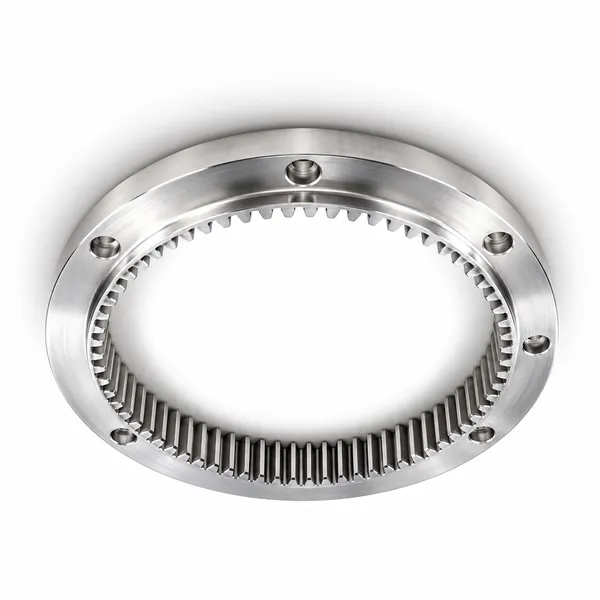
Robot and Automation Platform Ring Gear Specifications
6-Axis Industrial Robot Joints (J1–J6)
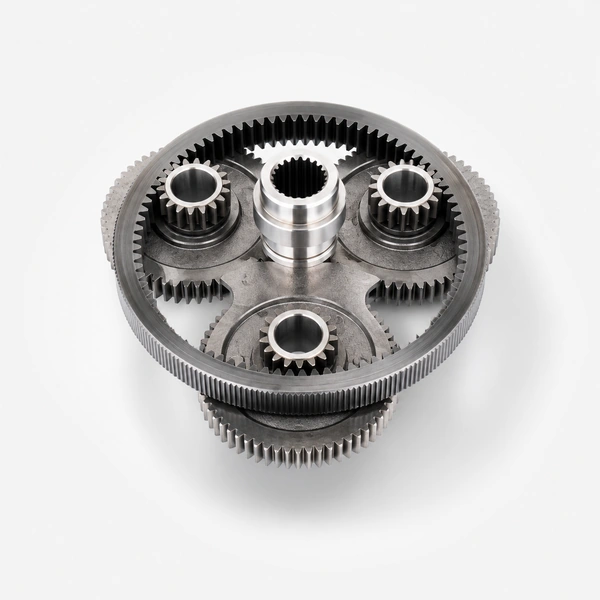
M2–M5 depending on joint, DIN 4–5, 20CrMnTi carburized, 2-stage planetary per joint, matched planet pitch ±2 μm, angular contact bearings (preloaded), backlash ≤ 1.5 arc-min, torsional stiffness ≥ 400 Nm/arc-min, design life 30,000 hours. The 6-axis industrial robot (Fanuc, KUKA, ABB, Yaskawa, Denso, Epson) uses a planetary gearbox at each of the 6 joints — joint 1 (base rotation, highest torque) has the largest planetary ring gear (M4–M5, shoulder-size), while joints 5 and 6 (wrist roll and yaw, lowest torque but also smallest OD) use the smallest ring gears (M1.5–M2, wrist-size). Korea Ever-Power manufactures matched ring gear sets for all 6 joints of the major robot brands, with cross-reference to robot model and production year for aftermarket service supply.
M2–M5 · DIN 4–5 · 30,000h · 6-joint set
Collaborative Robot (Cobot) Joint Drives
M1–M3, DIN 4, 20CrMnTi carburized or 17-4 PH (washdown variant), torque-sensing joint design (ring gear integrated with a strain gauge or piezoelectric torque sensor element for the cobot’s collision detection system), backlash ≤ 1.0 arc-min, mass ≤ 300 g per stage, design life 10,000 hours. Collaborative robots (Universal Robots, FANUC CRX, ABB GoFa, KUKA LBR, Doosan, Aubo, Techman) have become the fastest-growing segment of the industrial robotics market — their compact, lightweight design and direct human-collaboration capability drive unique ring gear requirements that standard industrial robot ring gears do not address. The torque-sensing ring gear is a Korea Ever-Power custom product where the ring gear OD integrates a precision torsional compliance element (a section of reduced wall thickness that deflects measurably under torque) with strain gauge mounting holes — allowing the ring gear to function as both the gear element and the torque sensor housing in the cobot’s integrated joint module.
M1–M3 · DIN 4 · cobot · torque sensor option
AGV Wheel and Pivot Drive Ring Gears
M3–M5, DIN 5–6, 20CrMnTi carburized, compact hub-integrated design (ring gear OD doubles as the wheel hub bore — the ring is pressed into the drive wheel hub), IP67 sealing (AGVs operate in wet warehouse and manufacturing environments), design life 15,000 hours, shock resistance from floor transitions. Automated guided vehicles (AGVs) and autonomous mobile robots (AMRs) use planetary ring gears in the wheel drive assembly (the motor + planetary gearbox combination that drives each wheel) and in the pivot drive (the mechanism that steers the drive wheel module around its vertical axis for omnidirectional AGV navigation). The hub-integrated ring gear design for AGV wheel drives requires the ring gear OD to be precision-machined to the wheel hub bore tolerance — usually H7 fit — and for the ring gear to maintain this OD dimension over the 15,000+ hour life, including the thermal cycling from cold warehouse starts in −10°C to +40°C summer operating temperature in a Southern European or North American distribution centre.
M3–M5 · hub-integrated · IP67 · AGV AMR
Frequently Asked Questions — Ring Gears for Robotics and Automation
Explore Korea Ever-Power Gear Categories
Seven precision gear product lines for industrial robots, collaborative robots, AGVs, SCARA, Delta, and automation system drives worldwide.
편집자: Cxm
 Korean
  English
  Italian
  French
  Japanese