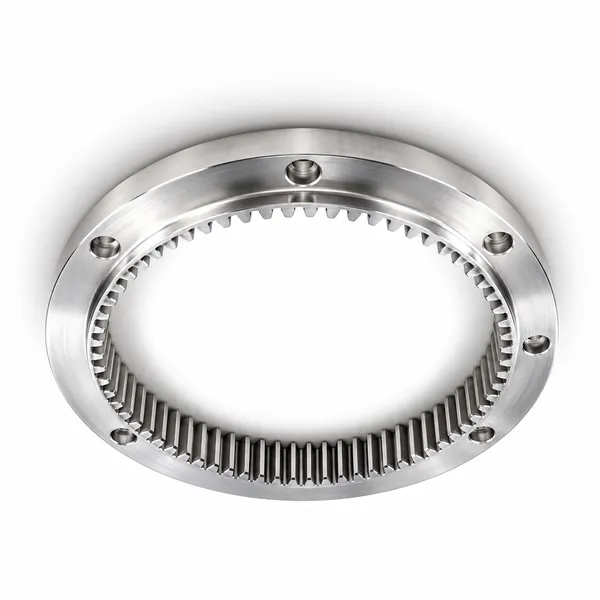
GEAR APPLICATION GUIDE · PLASTIC GEAR · PL04

Plastic Gears for Packaging Machines:
POM, PA66 and PEEK Gears in Labellers, Wrappers and Cartoners

Packaging machinery contains a higher density of plastic gears than any other industrial machine category — a modern labelling machine for round containers uses plastic gears in the container rotation drive (spinning each container so the label can be applied uniformly), in the label take-up spindle drive, in the print head position mechanism, and in the registration sensor feedback linkage, with each gear operating at a different speed, load, and environment condition within the same machine. The designer selecting plastic gears for packaging machinery must navigate a matrix of material properties, operating conditions, and functional requirements that is more varied than in almost any other plastic gear application, because packaging machines span an enormous range of product types — from sterile pharmaceutical blister packaging (clean room, chemical resistance) to hot-melt adhesive carton sealing (high temperature at the glue head), to wet food label application (moisture resistance) — often in the same production facility.

POM · PA66 GF30 · PEEK · M1–M5 · FDA / NSF
Labeller · Wrapper · Cartoner · Blister · Shrink
Low Noise · Self-Lubricating · Chemical Resistant

MATERIALS

POM / PA66 / PEEK

The three primary plastic gear materials for packaging machinery. POM: standard for dry and wet environments at <90°C — label applicator drives, wrapper film drives. PA66 GF30: higher strength and stiffness than POM, preferred for higher-load cartoner and case packer auxiliary drives where the stiffness of the unfilled PA is insufficient. PEEK: highest performance, for hot-melt glue systems and pharmaceutical clean room packaging where PA and POM are inadequate

MODULE RANGE

M1 – M5

Packaging machine plastic gear module range. Label roll take-up: M1–M1.5. Labeller container rotation: M1.5–M2. Wrapper film unwind: M2–M3. Cartoner blank erector: M3–M4. Case packer secondary drive: M4–M5. All machined for quantities below 200 pieces per order; injection moulded (in multi-cavity tools) for volumes above 500 pieces per order at M1–M3

NOISE ADVANTAGE

8–12 dB(A) Quieter

Plastic gear mesh noise advantage over steel gear mesh at the same module, tooth count, and speed. Packaging machine operators work in close proximity to the machine — 8–12 dB(A) noise reduction from plastic gears in the labeller drive is significant in the production environment (every 6 dB represents halving of the noise energy). The noise reduction is primarily from plastic’s lower elastic modulus (damping of the tooth impact vibration) and the manufacturing tolerance flexibility that allows a higher backlash (which avoids tight mesh binding) than precision steel gears in the same drive

SELF-LUBRICATION

Dry Running

Plastic gears with self-lubricating additives (PTFE in POM or PA, MoS₂ in PA) can run dry against a steel mating gear in packaging machine drives where grease or oil lubrication would contaminate the packaging film, label adhesive, or product. PTFE-filled POM (2% PTFE) reduces the POM gear-to-steel friction coefficient from 0.28 to 0.12 — enabling dry-run life of 5,000+ hours in light-load packaging auxiliary drives at < 500 RPM

Plastic Gear Material Selection for Packaging Machine Subsystems

The packaging machine is unique among industrial machines in the diversity of environments that different gear drives within the same machine experience — and this internal diversity means a single plastic gear material specification is almost never appropriate for the full machine. A labelling machine illustrates the point: the container rotation drive (rotating each product container so the label wraps 360°) operates at ambient temperature with the container surface facing the gear, where label adhesive spray or adhesive mist can reach the gear — POM with PTFE additive (adhesive does not stick to PTFE-coated surfaces) is optimal. The label roll take-up motor drive (winding the waste carrier matrix from the label roll onto a take-up spool) operates in the enclosure beside the print head, at elevated temperature (40–60°C from the print head thermal radiation) — POM approaches its upper continuous temperature limit at 60°C; PA66 is preferred for this drive. The print head registration gear (the micro-adjustment mechanism that fine-positions the print head to the label registration mark) operates at high cycle rate with near-zero load — self-lubricating PTFE-filled POM is ideal. And the main conveyor drive gear (transmitting the motor torque to the main conveyor belt that moves containers through the machine) operates at the highest torque — PA66 GF30 provides the stiffness needed for repeatable conveyor positioning under varying load.

Korea Ever-Power’s plastic gears for packaging machines are manufactured across the full range of materials used in packaging machine drives — POM-H and POM-C (standard and PTFE-filled) for labeller and wrapper drives, PA66 GF30 (30% glass fibre reinforced) for higher-load cartoner and case packer drives, and PEEK (polyether ether ketone, natural grade and 30% carbon fibre reinforced) for hot-melt glue system gears and pharmaceutical packaging clean room applications. Korea Ever-Power’s packaging machine plastic gear design service includes material selection consultation for each drive position in the machine — the design engineer provides the drive function, operating speed, peak torque, temperature, and any chemical exposure (label adhesive, CIP agents, solvent inks), and Korea Ever-Power recommends the optimal material and minimum module for the design life required.

The noise reduction benefit of plastic gears in packaging machinery is one of the most practical advantages of the material — a label applicator running at 400 containers per minute generates a gear mesh frequency in the range of 800–1,500 Hz (depending on the tooth count), directly in the human ear’s most sensitive frequency range. A steel gear mesh at DIN 7 quality generating 6 μrad transmission error at this frequency produces a A-weighted sound pressure level of approximately 72–75 dB(A) at 1 metre — above the EU Machinery Directive maximum permissible noise level of 70 dB(A) for operators without hearing protection. A POM gear mesh at the same drive geometry generates approximately 62–64 dB(A) at 1 metre — 8–12 dB(A) below the steel equivalent — because the POM’s lower elastic modulus (2.8 GPa vs 210 GPa for steel) provides structural damping of the tooth impact vibration, and the slightly higher backlash in the plastic gear mesh (typical backlash 0.05–0.10 mm vs 0.02–0.04 mm for precision steel) reduces the re-engagement impact at each tooth cycle. This noise reduction from plastic gears allows packaging machine builders to meet the EU Machinery Directive noise requirements without adding acoustic enclosures to the drive mechanism, reducing machine cost and improving operator access for job changes and maintenance.
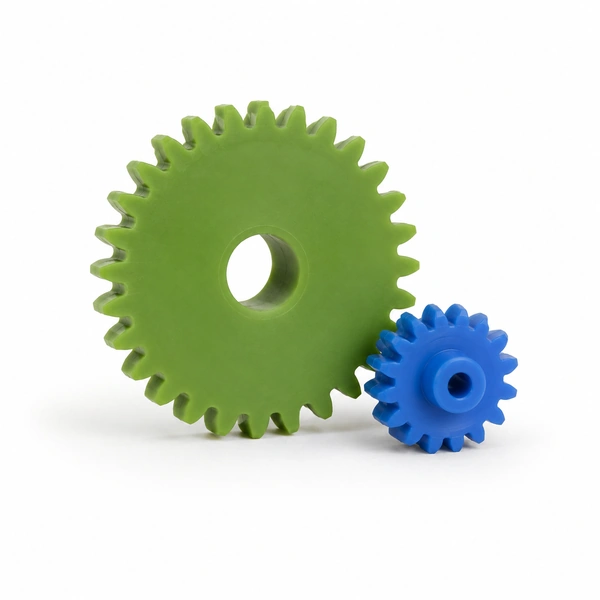
nylon plastic gear packaging machine labeller wrapper Korea Ever-Power
Korea Ever-Power PA66 GF30 (30% glass fibre reinforced nylon 66) gear set for packaging machine cartoner blank erector drive — M3, 36T, OD 114 mm, bore 22 mm H7, face width 28 mm. PA66 GF30 flexural strength 210 MPa (vs 80 MPa unfilled PA66 and 90 MPa POM-H) — the GF30 reinforcement is needed for the cartoner blank erector drive because the peak torque at blank erection (the moment the erected carton blank is squared up and held against the mandrel by the erector mechanism) can reach 8–12 Nm, above the continuous design limit of unfilled PA66 at M3. The glass fibre reinforcement also increases the gear’s flexural modulus from 2.8 GPa (unfilled PA66) to 9.5 GPa — closer to the modulus of steel than any other unreinforced polymer, which is important for positional accuracy of the carton blank erector that must position the blank to ±0.5 mm for the glue application and folding operations. Korea Ever-Power PA66 GF30 packaging machine gears are hobbed from extruded GF30 rod (not injection moulded) because the glass fibre orientation in injection moulded GF30 gears is circumferential (fibres align with the mould flow around the gear disc) which produces anisotropic tooth root properties — the hobbed gear has randomly oriented fibres at the tooth root surface, giving more isotropic (direction-independent) strength.

Packaging Machine Plastic Gear Selection Matrix
PACKAGING MACHINE DRIVE Recommended Material Module Key Reason
Label applicator container rotation POM + 2% PTFE M1.5–M2 Adhesive non-stick, dry run
Wrapper film unwind drive POM-H M2–M3 Moisture stable, low noise
Cartoner blank erector drive PA66 GF30 M3–M4 High stiffness, peak torque
Hot-melt glue head gear PEEK M1.5–M3 150–180°C hot-melt temp
Blister pack pharma conveyor POM-C M2–M3 FDA, clean room, alcohol CIP
Shrink tunnel conveyor drive PA66 GF30 M3–M5 90–120°C tunnel ambient
Print head registration mechanism POM + 2% PTFE M1–M1.5 Low friction, high cycle
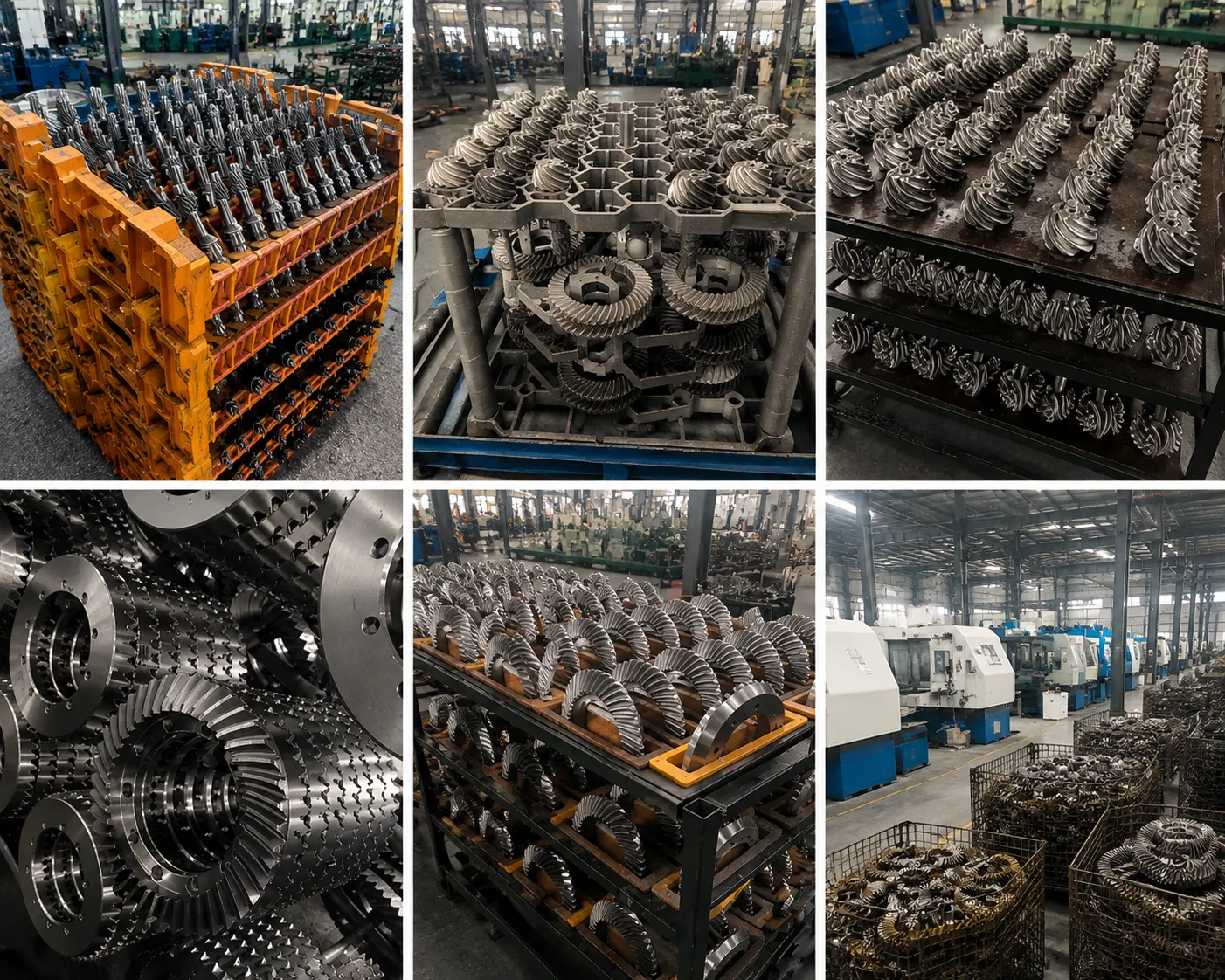
Korea Ever-Power packaging machine plastic gear manufacturing hobbing
Korea Ever-Power plastic gear manufacturing for packaging machine applications — gear hobbing of PA66 GF30 cartoner drive gears from extruded GF30 rod stock. The hobbing parameters for PA66 GF30 differ significantly from those for steel gears and even from unfilled PA66: the glass fibre reinforcement is highly abrasive to the hob cutting edges (the glass fibres — harder than the cobalt binder of the HSS hob — cause rapid flank wear on uncoated hob teeth). Korea Ever-Power uses TiAlN-coated HSS hobs for all PA66 GF30 hobbing operations — the TiAlN coating (hardness HV 3,200, oxidation temperature 900°C) resists the abrasive wear from glass fibres approximately 4× longer than uncoated HSS, reducing the per-tooth hob cost and the frequency of hob sharpening cycles that would otherwise interrupt the production batch. Coolant for PA66 GF30 hobbing: Korea Ever-Power uses a directed air blast (not cutting fluid) to clear the glass-fibre-reinforced chip from the cutting zone — cutting fluid (water or oil-based) is not used on PA66 GF30 because it causes immediate moisture absorption at the freshly cut tooth surface, potentially causing dimensional change before the gear is measured, and because the glass fibre chips become a dense slurry with cutting fluid that is difficult to collect and filter from the machine coolant system.
Korea Ever-Power packaging plastic gear dimensional inspection quality
Korea Ever-Power packaging machine plastic gear dimensional inspection — over-pin measurement of PEEK gears for hot-melt packaging systems. PEEK gears present a particular dimensional inspection challenge: the material’s high thermal stability (HDT 160°C unfilled, 315°C for PEEK CF30) means that the gear dimensions are essentially unchanged by temperature variation in the measurement room — unlike nylon gears that require a 4-hour temperature conditioning period before measurement. However, PEEK’s stiffness (tensile modulus 3.6 GPa unfilled, 14 GPa for CF30) means that any measurement force above approximately 0.5 N on the over-pin measurement fixture will not cause measurement artefacts from gear flex, as would be the concern for very thin-wall POM or nylon gears at small modules. Korea Ever-Power uses a spring-loaded bench micrometer at 0.2 N measuring force for all M1–M3 plastic gear over-pin measurements, regardless of material — this low measurement force prevents any deformation-induced measurement error in thin-wall gears (where the tooth tips can deflect under measurement force, giving a falsely low OPM reading that would incorrectly indicate an undersize tooth). All Korea Ever-Power packaging machine plastic gears — POM, PA66 GF30, PEEK — are measured at the same fixture force and the results recorded to ±0.01 mm in the batch inspection report.

Frequently Asked Questions — Plastic Gears for Packaging Machines

Q 01

Our hot-melt glue application unit in a carton sealer uses POM gears that are deforming and sticking after the machine runs at temperature for 2 hours. The gear housing reaches 130°C during operation. What should we use instead?

POM gear deformation at 130°C is predictable — POM-H begins to soften progressively above 90°C and loses 50% of its room-temperature flexural strength at 120°C. At 130°C continuous service, POM gears will creep (permanently deform) under any sustained tooth contact load. The gear is deforming first and then sticking as the softened POM surface bonds to the mating gear or housing bore when the machine cools. The correct replacement for a 130°C hot-melt glue application gear: PEEK (Polyether ether ketone) is the standard material for hot-melt system gears at up to 200°C continuous temperature. PEEK retains more than 60% of its room-temperature flexural strength at 150°C (flexural strength at 150°C approximately 100 MPa vs 170 MPa at 23°C) and does not creep measurably at 130°C under light packaging machine gear loads. PEEK also has excellent chemical resistance to the polyurethane (PU) and ethylene vinyl acetate (EVA) hot-melt adhesives used in carton sealing — it does not swell, soften, or bond to the hot-melt adhesive at the gear surface. Korea Ever-Power PEEK gears for hot-melt packaging systems: M1.5–M3, machined from Victrex PEEK 450G rod stock (natural grade, no filler — unfilled PEEK is preferred over PEEK GF30 for hot-melt applications because the glass fibres can become exposed at the tooth surface under wear and can act as nucleation sites for hot-melt adhesive adhesion). Available in the natural tan colour or black (carbon-black pigmented PEEK — the black pigment reduces UV degradation for packaging lines with UV-curing adhesive stations). Lead time for standard PEEK gear sizes: 12–18 working days. Note: PEEK costs approximately 15–20× POM per kg, but in packaging machine gear applications the gear volume is small and the service life is dramatically longer — the total cost per machine service life is typically lower with PEEK than POM for any application above 100°C ambient gear temperature.

Q 02

We need to replace the steel drive gears in our labelling machine with plastic gears to reduce noise and vibration. The steel gears are M2, 40T, face width 20 mm, running at 800 RPM, driving a label roll take-up spool. What plastic material and any module change is needed?

Replacing M2 steel label take-up drive gears with plastic — noise analysis and design recommendation: Current steel gear transmit load estimate: a label roll take-up spool at 800 RPM driving a 300 g label roll at 150 mm spool radius produces a tangential load of approximately F_t = T/r = (0.3 kg × 9.81 m/s² × 0.15 m) / 0.02 m = 22 N at the M2 gear pitch circle. This is a very light load — well within the capability of any engineering plastic at M2. Material recommendation: POM-H with 2% PTFE additive (or standard POM-H if the label adhesive exposure is minimal). The PTFE additive provides dry-run capability in case the label machine’s periodic cleaning removes the light lubrication that the steel gears previously had. No module change needed — M2 in POM-H has a tooth bending fatigue strength sufficient for 22 N tangential load with a safety factor above 5.0 at the 10⁷ cycle design life. The tooth contact fatigue (pitting) life is also comfortable at this light load. NVH improvement expected: the label take-up drive at M2, 40T, 800 RPM produces a gear mesh frequency of 800/60 × 40 = 533 Hz. At this frequency, POM gears produce approximately 55–60 dB(A) at 1 metre versus 66–70 dB(A) for steel DIN 7 gears — a 8–12 dB(A) improvement, consistent with the general plastic gear noise advantage. Design note on bore tolerance: for the replacement POM gears to fit the existing shaft, the bore H7 tolerance must be maintained. POM machines to a stable bore diameter without the spring-back effect that makes some nylon gears difficult to bore to precise tolerance — Korea Ever-Power holds ±0.015 mm on bore diameter for POM labeller gears up to 30 mm bore diameter, which is adequate for H7 fit on the existing label take-up shaft without additional reaming after fitting.

Q 03

What are the minimum order quantity and lead times for packaging machine plastic gears, and does Korea Ever-Power offer annual supply agreements for packaging machine OEM builders?

Korea Ever-Power’s packaging machine plastic gear supply structure: Machined (any quantity above minimum): minimum 10 pieces per order for machined POM, PA66 GF30, or PEEK gears at M1.5–M5. Lead time 10–18 working days for standard materials; 15–22 working days for PEEK. The minimum order cost for machined plastic gears is essentially the setup and material cost — for small packaging machine gear sizes (M2, 30 mm OD), 10 pieces can be cut from a single rod of POM in 2–3 hours of CNC time. Injection moulded (high volume): for M1–M3 gears ordered above 500 pieces per order, injection moulding from Korea Ever-Power’s multi-cavity tooling (where the tool exists) is more economical than machining — the injection moulded piece price is typically 40–60% below the machined price at 1,000 pieces. Korea Ever-Power holds tooling for approximately 200 common packaging machine plastic gear sizes (the most frequently ordered M1–M3 gear sizes for major labelling machine and wrapper brands). If the required gear is not in the tooling library, new tooling is designed and manufactured in approximately 25–35 working days at a one-time tooling charge, after which injection moulded supply has a lead time of 12–18 working days per order. Annual OEM supply agreements: Korea Ever-Power offers packaging machine OEM builders annual supply agreements that cover: (a) a committed annual volume (e.g. 10,000 pieces per year of a specific gear) at a fixed unit price; (b) a maximum call-off response time (typically 5–8 working days for call-offs within the annual volume); (c) consignment stock at Korea Ever-Power’s warehouse (typically 3 months of forecast demand) for immediate dispatch on call-off without manufacturing lead time; and (d) a first-article acceptance test at the start of each production year, confirming dimensional compliance with the drawing before the annual production run. Annual OEM supply agreements are the preferred supply model for packaging machine builders who produce 50+ machines per year with the same plastic gear specifications, as they eliminate the lead time uncertainty of individual purchase orders and provide price certainty for the machine builder’s component cost forecast.

Explore Korea Ever-Power Gear Categories

Seven precision gear product lines for packaging machinery, labellers, wrappers, cartoners, shrink tunnels, and packaging line drives worldwide.
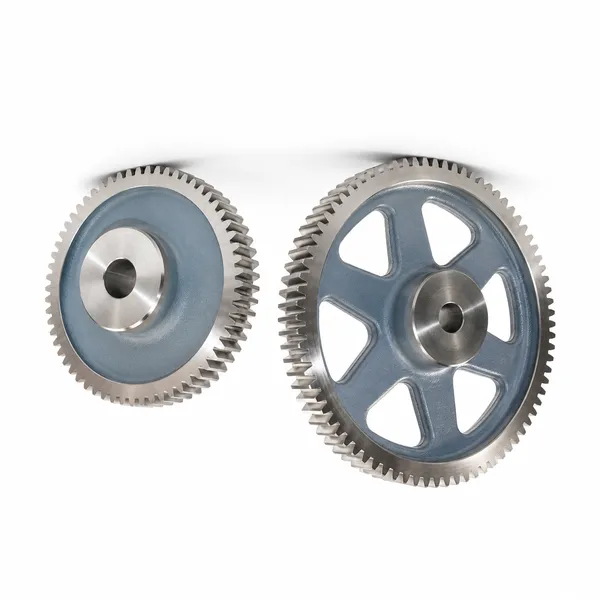
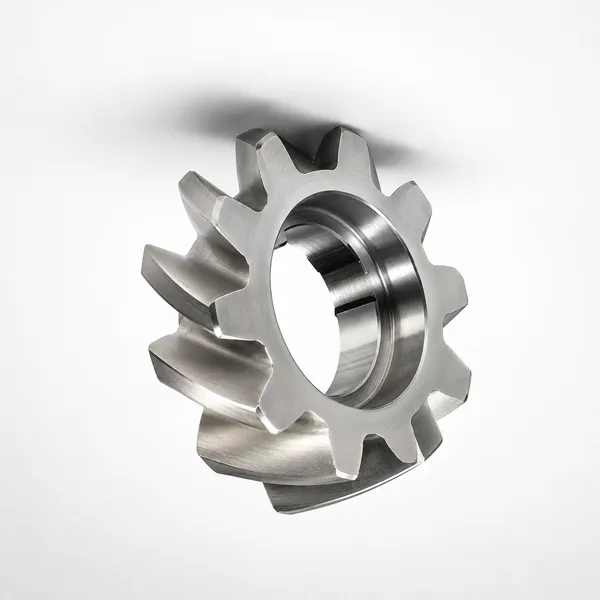
spur gear packaging

Spur Gears

Packaging steel · stainless · M1–M6

packaging helical gear

Helical Gears

Packaging main drive · low noise

bevel gear packaging

Bevel Gears

Packaging angle drive · compact

worm gear packaging

Worm Gears

Label metering · self-lock packaging

planetary gear packaging

Planetary Gears

Servo kit · packaging · DIN 5–6

ring gear packaging

Ring Gears

Packaging servo ring · DIN 5–6

plastic gear packaging

Plastic Gears

POM · PA66 GF30 · PEEK · packaging

GET A QUOTATION · KOREA EVER-POWER

Need Plastic Gears for Packaging Machines?

Korea Ever-Power manufactures POM-H, POM-C, PA66 GF30, and PEEK gears for all packaging machine applications — M1–M5, machined or injection moulded, FDA food contact certified, PTFE or MoS₂ dry-run additive options. Material selection consultation for each drive position. Annual OEM supply agreements with consignment stock. Minimum 10 pieces machined, 500 pieces injection moulded. PEEK for hot-melt and clean room from 5 pieces. ISO 9001:2015 certified.

Request a Quotation →

Editor: Cxm

VR Tour of Our Factory

TAGs:

gear rack

As one of leading gear rack manufacturers, suppliers and exporters of products, We offer gear rack and many other products.

Please contact us for details.

Mail:[email protected]

Manufacturer supplier exporter of gear rack

Recent Posts

en_USEnglish