
POM Gears for Food Processing Equipment:
Delrin Acetal Gear Applications in Food Machinery, Conveyors and Beverage Systems
Polyoxymethylene (POM) — sold under the DuPont trade name Delrin and also marketed as acetal or polyacetal — is the most widely used engineering plastic for food processing gear applications where a combination of high dimensional stability, low moisture absorption, excellent machinability, good wear resistance, and FDA-compliant composition is needed. POM gears are found in virtually every segment of the food industry: in the mixing shaft drives of commercial food processors, in the conveyor belt indexing mechanisms of meat slicing lines, in the dosing and portioning drives of filling machines for dairy and beverages, and in the dispenser mechanisms of coffee machines and vending equipment. Understanding when POM outperforms nylon (PA6, PA66) in food gear applications — and when it does not — is essential for specifying the correct material for each specific food processing drive.
−40°C to +90°C · Moisture Stable · CIP Compatible
Food Conveyor · Mixer · Filler · Vending · Beverage
POM vs Nylon in Food Processing Gears — The Critical Material Differences
The choice between POM and PA6/PA66 for food processing gear applications is more nuanced than simply selecting the material with the higher strength or the lower cost — each material has specific advantages in the food environment that make it the correct choice for certain applications and the wrong choice for others. The decisive comparison is across five properties: moisture absorption and dimensional stability, chemical resistance to CIP agents, strength and stiffness, temperature resistance, and food contact regulatory compliance. POM leads in moisture stability (0.2% vs 2.8% absorption) and dimensional stability in wet cleaning environments, and is comparable in food contact compliance. Nylon (PA6/PA66) leads in impact toughness — the Charpy notched impact energy of PA6 is 6.5 kJ/m², compared to 6.0 kJ/m² for POM-H, making nylon the preferred material for food processing gears in applications with impact loading (meat bone-in product, frozen block processing). Nylon also has significantly higher elongation to break than POM (200% vs 25%), meaning a nylon gear will deflect visibly under overload and warn the operator before fracture, while a POM gear will fracture more abruptly under the same overload.
Korea Ever-Power’s POM gears for food processing equipment are manufactured from food-grade POM-H (DuPont Delrin 500 or equivalent, with FDA 21 CFR 177.2470 material certificate from the polymer supplier) for standard food processing applications, and POM-C (copolymer, BASF Ultraform N2320 or equivalent) for applications requiring better long-term thermal stability above 80°C or improved resistance to acid CIP agents (POM-C has marginally better acid stability than POM-H because the copolymer terminator groups are more resistant to chain-end depolymerisation in acid). The machining of POM food gears follows a standard process: rough turning of the gear blank from rod stock, rough hobbing of the tooth profile, then finish hobbing or finish profile grinding to the required tolerance. POM machines very cleanly (better surface finish than nylon at the same tooling and parameters), producing tooth flanks with Ra ≤ 0.8 μm from a well-maintained hobbing machine — significantly better than the Ra 1.6–3.2 μm typical of machined nylon gears. This better surface finish directly reduces the gear mesh friction coefficient and wear rate in dry-running food processing gear applications.
The chemical resistance of POM food gears to CIP cleaning agents is a critical application engineering consideration that is often underspecified. Standard CIP chemicals used in food processing include alkaline detergents (NaOH-based, pH 11–13), acid rinses (phosphoric or citric acid, pH 2–4), and sanitising agents (chlorine-based at 200–500 ppm, or peracetic acid at 100–200 ppm). POM-H has good resistance to the alkaline NaOH solutions at the concentrations and temperatures used in standard food CIP (1–2% NaOH at 70–80°C), but moderate resistance to strong acid at elevated temperature — concentrated phosphoric acid (above 5%) at 60°C can cause slow surface degradation of POM-H over repeated exposure cycles. POM-C has better acid resistance than POM-H at temperatures up to 60°C. Peracetic acid (PAA) is the CIP agent that most severely limits POM gear life — PAA at 0.1–0.2% concentration (common in dairy and beverage CIP) causes measurable surface oxidation of POM after repeated exposure at 40–50°C, reducing the tooth surface hardness and increasing the wear rate in subsequent operation. Korea Ever-Power recommends POM-C over POM-H for any food processing gear that is directly wetted by PAA sanitising cycles, and provides a CIP compatibility assessment as part of the application engineering review for food processing POM gear enquiries.
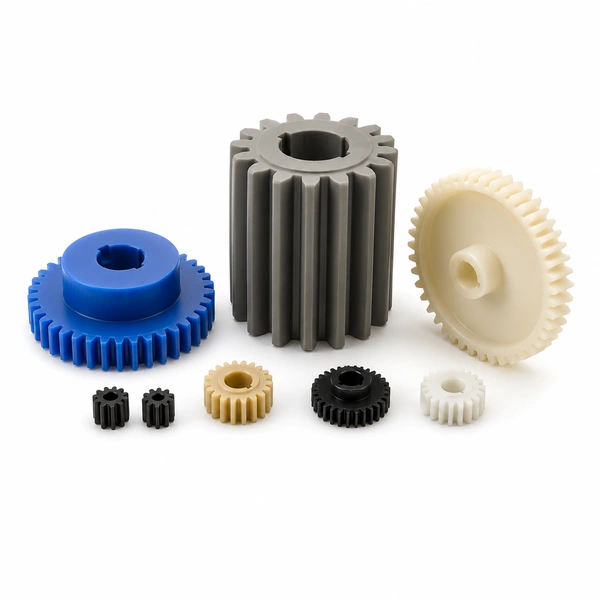
POM Gear Applications in Food Processing
Beverage and Dairy Filling Machines
M2–M4, POM-C, machined from rod stock, natural white FDA colour, bore keyway for drive shaft, CIP compatible (1% NaOH, PAA 0.1%), operating speed 100–300 RPM, output torque ≤ 20 Nm per gear, continuous duty. Beverage and dairy filling machine drive gears (the metering star wheel drives, the filling carousel indexing drives, and the capping head drives) are the highest-volume single food processing application for POM gears. The CIP wash-down cycle is typically 2–4 times daily on a beverage filling line, making moisture stability the primary material selection criterion — POM-C outperforms PA6 in this application because the POM gear dimensions remain constant across the production day (from dry startup in the morning to fully wetted steady-state after the first CIP cycle), while a PA6 gear would swell measurably over the first 30–60 minutes of each production day as it absorbs moisture, potentially causing jamming in tight-clearance metering star wheel housings. Korea Ever-Power beverage filling machine POM gear range covers the most common star wheel module and tooth count combinations for major filling machine brands (KHS, Krones, Sidel, SIDCO, GEA, Tetra Pak filling line equipment).
POM-C · M2–M4 · CIP stable · beverage OEM
Food Conveyor and Indexing Drives
M3–M5, POM-H or POM-C, machined or injection moulded depending on volume, white or blue (visually detectable), operating temperature −15°C (refrigerated conveyor) to +40°C (ambient), shock resistant (food products fall onto conveyor from above, transmitting impact through the conveyor drive to the indexing gear). Food processing conveyor indexing gears (the intermittent-motion gear drives that advance a conveyor by one product pitch at each indexing cycle, then stop to allow a process operation on the product in the index position) use POM gears because the intermittent motion and frequent starts create a dynamic loading environment where the dimensional stability of POM (vs nylon’s moisture-induced dimensional changes) is critical for the precise index positioning accuracy that maintains product alignment in the process station. Korea Ever-Power conveyor indexing POM gear range covers M3–M5 in standard tooth counts for the index drives of meat portioning lines, bread baking lines, cheese cutting lines, and fresh produce packing conveyors used by major food processing equipment builders in Australia, the Netherlands, the UK, and Germany.
POM-H · M3–M5 · blue detectable option · −15°C
Coffee Machine and Vending Equipment
M1–M2, POM-H injection moulded (volumes above 5,000 pieces per year make injection moulding more economical than machining at M1–M2), tight dimensional tolerance (±0.05 mm on tooth thickness for consistent coffee dose metering accuracy), operating cycles ≥ 2 million per year (commercial espresso machines brew 50,000–200,000 cups per year, the bean grinder drive gear accumulates 1–2 million cycles per year), temperature stability up to 80°C (the boiler proximity raises the ambient around the grinder drive mechanism to 60–80°C). Coffee machine and vending equipment POM gears operate at the intersection of miniaturised precision (M1–M1.5, tooth height 2.25–3.37 mm), high cumulative cycle count (millions per year), and food-safety compliance that makes POM the dominant material choice. Korea Ever-Power injection moulds POM-H coffee machine gears in multi-cavity tools (8–16 cavities for M1–M1.5 gears) from DuPont Delrin 500NC10 (natural colour, unreinforced, FDA compliant) — the NC10 grade has a melt flow rate optimised for the thin-wall filling needed to inject coffee machine gears at M1 without short shots or sink marks on the tooth flanks that would affect the metering accuracy.
POM-H · M1–M2 · injection moulded · 2M+ cycles/year
Frequently Asked Questions — POM Gears for Food Processing
Explore Korea Ever-Power Gear Categories
Seven precision gear product lines for food processing, dairy, beverage, meat packing, and hygienic industrial equipment worldwide.
Editor: Cxm
 English
  Italian
  Korean
  French
  Japanese