GEAR APPLICATION GUIDE · RING GEAR · R08

Starter Ring Gears and Flywheel Ring Gears:
Automotive, Tractor, Heavy Truck and Industrial Engine Starting Systems

The flywheel ring gear is among the highest-volume ring gear products in the automotive and agricultural sectors, yet it is routinely treated as a commodity item until a premature failure forces a costly engine teardown for replacement. The starter ring gear must engage the electric starter motor pinion at rest — from zero speed, against the inertia of the stationary engine — and must then release the mesh as the engine fires and accelerates above the starter speed, typically within 0.5–2.0 seconds. This rapid engagement-rotation-disengagement cycle, repeated thousands of times over the engine’s service life, creates a very specific pattern of wear and impact damage on the gear tooth chamfer and leading edge that ultimately determines the starter ring gear’s service life, and that is directly influenced by the ring gear material, heat treatment, tooth geometry, and chamfer design in ways that are often not reflected in the original equipment specification.

C45 · 65Mn · 42CrMo4 · Induction · M4–M10
Press-fit / Bolted · DIN 8–10 · Lead-In Chamfer
Automotive · Tractor · Truck · Marine · Generator

MODULE RANGE

M4 – M10

Starter ring gear module range. Passenger car (1.0–2.5L): M4–M5. Light commercial / van (2.0–3.0L diesel): M5–M6. Tractor and agricultural machinery (3–8L): M6–M8. Heavy truck (6–16L): M7–M9. Marine and generator (large bore industrial diesel): M8–M10. Tooth count: 96–175T depending on OD and module

MATERIAL

C45 / 65Mn / 42CrMo4

Starter ring gear materials. C45 (medium carbon steel): standard for automotive passenger car press-fit ring gears — induction hardened tooth tips and leading face to HRC 40–50. 65Mn (high manganese spring steel): tough, used where a tougher but slightly lower hardness profile is preferred. 42CrMo4 QT: heavy-duty truck and agricultural ring gears where higher tooth root strength is required for the larger module and heavier starter engagement impact

ATTACHMENT

Press-fit / Bolted

Starter ring gear flywheel attachment. Press-fit (interference fit): standard for automotive and light commercial — the ring gear is heated to 200–250°C and pressed onto the flywheel OD, the thermal contraction on cooling produces the interference fit that locks the ring to the flywheel. Bolted: heavy truck, marine, and large industrial engines where the ring gear OD is too large for reliable interference fit and where field replacement without full flywheel removal is required

CHAMFER

Lead-in Critical

The tooth lead-in chamfer on the starter ring gear is the most safety-critical feature — a chamfer that is too flat (small angle, long axial length) causes the starter pinion to ride up on the ring gear tooth tip and jam rather than mesh; too steep causes impactful tooth edge engagement that chips the ring gear tooth corner. Standard: 35°–45° chamfer angle, 1.5–2.5 mm axial length for M5–M8. Korea Ever-Power chamfer profile is validated by engagement testing with the OEM starter pinion

Starter Ring Gear Engineering — Impact Loading, Tooth Geometry, and Wear Mechanisms

The starter ring gear tooth is subjected to a loading pattern that is unique among all gear applications — the initial engagement between the rotating starter pinion and the stationary ring gear at start initiation is an impact event, not a smooth mesh engagement. The starter motor energises and its pinion accelerates from rest to full starter speed (typically 2,000–4,000 RPM at the pinion) in 50–100 milliseconds before the pinion makes contact with the ring gear tooth. When the pinion tooth meets the ring gear tooth during this high-speed rotation, the impact force is determined by the difference in peripheral velocity between the pinion tip and the ring gear tooth — if the ring gear is stationary and the pinion is rotating at 3,000 RPM with a pinion radius of 20 mm, the pinion tip velocity at first contact is π × 0.04 × 3,000 / 60 = 6.28 m/s. This 6 m/s tip-to-tooth impact, multiplied by the pinion mass and repeated thousands of times over the engine’s start/stop life, produces a characteristic impact fatigue damage pattern on the ring gear tooth leading edge chamfer — progressive chipping of the chamfer edge that eventually prevents clean mesh engagement and requires ring gear replacement.

Korea Ever-Power’s starter ring gears and flywheel ring gears are manufactured in C45 (for standard automotive and light commercial press-fit applications), 65Mn spring steel (for tractor and off-highway applications where a higher toughness profile over the full tooth cross-section is preferred), and 42CrMo4 QT (for heavy truck and large industrial engine ring gears where the higher alloy content provides both the hardenability for induction hardening of thick-section ring gears and the core toughness to resist the impact loads from large-displacement diesel engine starter engagement). The chamfer geometry is CNC-machined to ±0.1° angular accuracy and ±0.15 mm axial length tolerance — stricter than most OEM specifications — because Korea Ever-Power’s quality experience across many engine applications has confirmed that chamfer geometry variance is the single largest source of premature starter ring gear failure in the field, more significant than tooth hardness variation or material selection.

The press-fit installation of automotive starter ring gears is a critical assembly operation that is often performed incorrectly in field replacement, leading to ring gear loosening or, in the worst case, ring gear spinning on the flywheel. The correct procedure is to heat the ring gear uniformly (not locally with a torch — local heating creates a non-uniform temperature distribution that causes the ring to go on crooked) to 200–250°C in an oven or induction heater, then press or drop the heated ring over the flywheel OD in a single continuous motion, and allow to cool to ambient temperature without quenching. The interference fit is generated by the thermal contraction of the ring gear as it cools — a C45 ring gear heated to 230°C from 20°C ambient undergoes a diameter increase of α × ΔT × D = 11.7 × 10⁻⁶ × 210 × D (mm) = 0.00246 × D mm — for a 320 mm OD ring, the thermal expansion is 0.79 mm. The design interference (the difference between the flywheel OD and the ring gear bore at ambient temperature) is typically 0.20–0.35 mm, safely below the 0.79 mm thermal gap, ensuring the ring can be installed without force during the hot installation window. Korea Ever-Power flywheel ring gears are supplied with a printed installation instruction card that specifies the recommended heating temperature, maximum heating time, and assembly procedure for each ring gear OD and bore combination.
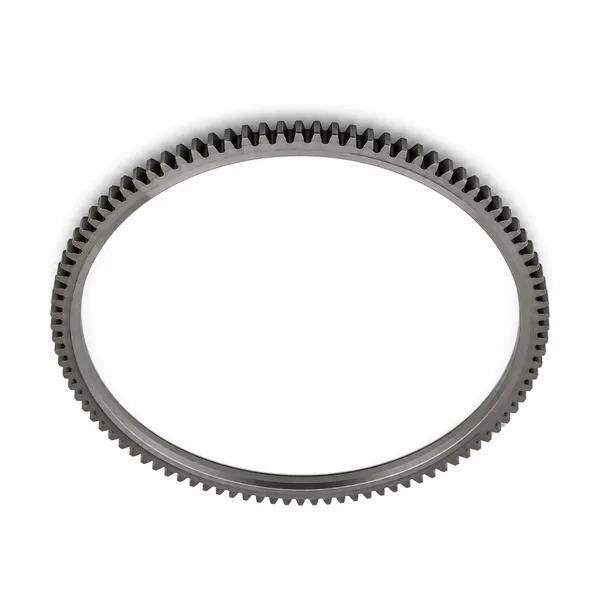
flywheel ring gear tractor agricultural starter Korea Ever-Power
Korea Ever-Power 65Mn flywheel ring gear for agricultural tractor engine — M7, 132T, OD 940 mm, bore 920 mm, face width 38 mm, overall height 52 mm, press-fit bore tolerance H7. Heat treatment: austenitise at 850°C, oil quench to HRC 40–48 core hardness, tooth tips and leading face induction hardened to HRC 52–58 (additional surface hardening on the high-impact zones). The 65Mn spring steel provides the combination of moderate surface hardness after quenching and high core toughness (Charpy KV ≥ 35 J at −20°C for cold-start tractor applications in northern Europe and North America) that outperforms C45 steel in agricultural tractor starter ring gears — the higher manganese content (0.9–1.2% Mn vs 0.5–0.8% for C45) delays the austenite-to-martensite transformation during quenching, producing a more uniform hardness profile around the ring circumference even in the large section sizes of tractor ring gears. Korea Ever-Power tractor starter ring gears are cross-referenced to John Deere, New Holland, Case IH, Massey Ferguson, Deutz-Fahr, and CLAAS tractor models for aftermarket replacement supply.

Starter Ring Gear Application Matrix

Automotive (Passenger Car & Van)

M4–M6, C45 induction hardened (tooth tip HRC 40–50, core HRC 28–35), press-fit bore H7, chamfer 40° × 2.0 mm, OD 250–420 mm, tooth count 108–144T. The highest-volume starter ring gear segment — passenger car and light van engines require ring gears that are economical to manufacture at high volume (millions per year across the automotive aftermarket) while meeting the OEM’s start-life specification (typically 30,000–60,000 starts for a vehicle warranty period). Korea Ever-Power automotive ring gears are manufactured on dedicated high-volume production lines with automated induction hardening and 100% Brinell hardness checking of every ring gear before dispatch. Cross-reference database covers over 8,000 vehicle application codes across European, Japanese, Korean, American, and Chinese makes and models.

M4–M6 · C45 · 108–144T · 250–420mm OD

Heavy Truck & Bus

M7–M9, 42CrMo4 QT (HB 280–320) + tooth induction hardening (HRC 48–55), press-fit or bolted attachment, chamfer 38° × 2.5 mm, OD 500–750 mm, tooth count 120–160T. Heavy truck and bus engines (Cummins, MAN, Mercedes-Benz OM, Volvo, Scania, DAF, Iveco) use larger bore and module ring gears than passenger cars because the engine displacement and compression ratio are both substantially higher — cranking a 12-litre Euro VI diesel against cold cylinder compression at −20°C requires a significantly higher starter torque than a 1.5-litre passenger car engine, which translates to higher tooth load at the ring gear mesh. Korea Ever-Power heavy truck ring gears are supplied as matched sets (ring gear + installation instruction + torque values for bolted versions) and cross-referenced to the major truck engine families. Heat treatment: complete ring QT first, then tooth face induction hardening, ensuring the core toughness for the high engagement impact is maintained.

M7–M9 · 42CrMo4 · bolted option · 500–750mm OD

Marine & Generator Diesel

M8–M10, 42CrMo4 QT + flame hardened (HRC 45–52), bolted attachment (flanged ring with bolt holes), OD 600–1,200 mm for marine medium-speed diesel (Caterpillar 3500 series, MTU 2000 series, MAN L/V series, Wärtsilä 20), corrosion protection: zinc phosphate + anti-corrosion coating for marine use (salt air exposure). Marine and generator application starter ring gears face an additional constraint beyond the automotive ring gear — the engine may sit unused for weeks or months between starts (standby generator), during which the exposed gear surface can develop surface rust that affects the chamfer geometry and the induction-hardened surface layer at the tooth tip. Korea Ever-Power marine and generator ring gears are supplied with a corrosion-resistant phosphate + epoxy primer coating on all non-tooth contact surfaces, and with a protective grease on the tooth flanks (light petroleum grease, easily wiped off before installation) to prevent transit and storage rust. Also supplied: 316L stainless bolts for the bolted ring gear attachment for marine applications where carbon steel fasteners would corrode in the marine atmosphere.

M8–M10 · 42CrMo4 · bolted · marine-coated · 600–1,200mm
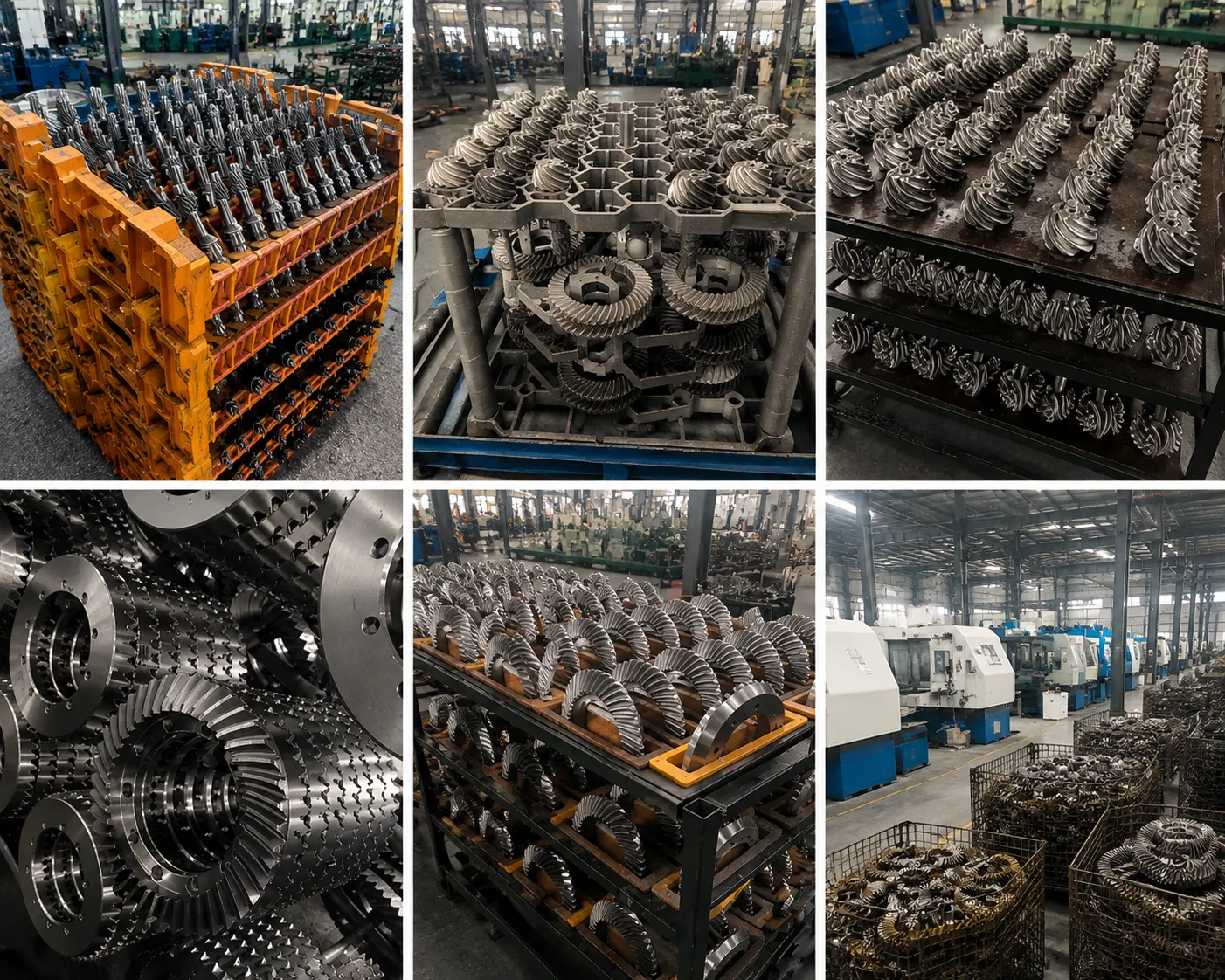
Korea Ever-Power starter ring gear manufacturing induction hardening quality
Korea Ever-Power starter ring gear manufacturing and quality inspection — induction hardening of flywheel ring gears in the dedicated ring gear hardening line. The induction hardening setup for starter ring gears requires a shaped coil that follows the ring circumference and produces the required hardness profile (tooth tip and leading face) without overheating the ring body or the press-fit bore area — overheating the bore causes thermal expansion that creates residual stress at the interference fit zone and can cause the bore to spring back out of the design tolerance after hardening. Korea Ever-Power uses a separate bore protection shield during induction hardening (a copper heat-sink ring placed inside the bore during the hardening cycle) to prevent bore-area temperature rise above 150°C, confirmed by thermocouple temperature monitoring on a sample ring from each hardening batch. After hardening, every ring gear undergoes a Brinell hardness check at 4 positions around the ring circumference (at 0°, 90°, 180°, and 270°) on both the tooth tip and the ring body — any ring with tooth tip hardness below the minimum or body hardness above the maximum (indicating case depth runaway) is rejected before chamfer machining.
Korea Ever-Power starter ring gear dimensional inspection quality control
Korea Ever-Power starter ring gear dimensional inspection — OD and bore measurement on a precision measuring bench with 0.001 mm resolution. The critical dimensions for starter ring gear acceptance are: OD (which determines the gear pitch diameter and tooth count relationship with the starter pinion), bore diameter and roundness (which determines the interference fit with the flywheel — bore roundness out by more than 0.05 mm from mean circle causes non-uniform clamp force around the circumference, creating a weak zone that will allow the ring to spin under high engagement shock), face width (determines the engagement depth of the starter pinion at full mesh), tooth tip diameter (OD minus 2× addendum — confirms the module from a simpler measurement than over-pin), and chamfer angle and axial length (the two most important parameters for reliable engagement and premature chipping resistance). Korea Ever-Power starter ring gears are 100% inspected for OD, bore, and face width at the production stage, with chamfer geometry sample-inspected on every 50th ring using a profile projector to confirm the chamfer angle is within ±1° of the specification value.

Frequently Asked Questions — Starter Ring Gears

Q 01

Our tractor fleet is experiencing premature starter ring gear failure — chipped tooth corners on the drive-side leading edge after only 2,000–3,000 starts. The starter motor and solenoid have been checked and are within spec. What is causing the chipping?

Leading-edge tooth corner chipping at 2,000–3,000 starts on a tractor ring gear indicates that the starter pinion is engaging the ring gear teeth at an angle or speed that produces a corner impact load exceeding the chamfer’s fracture toughness. Root causes in order of probability: (1) Ring gear chamfer geometry out of specification: measure the chamfer angle and axial length on the failed ring gear — if the chamfer angle is above 50° (too steep), the starter pinion tooth is impacting the ring gear tooth corner nearly perpendicularly rather than sliding up the chamfer face, producing a high localised impact stress at the corner instead of the distributed sliding contact that a correct chamfer angle produces. Korea Ever-Power replacement ring gears for the relevant tractor model use a validated chamfer geometry (38°–42°, 2.2–2.5 mm axial length for M7 tractor ring gears) that has been confirmed by engagement testing with the original-specification starter pinion. (2) Starter pinion not fully withdrawn before re-engagement: if the starter is being re-engaged before the engine has fully decelerated from a failed start attempt, the residual rotation of the ring gear means the pinion engages a ring gear tooth that is already moving — the differential velocity at first contact is higher than for engagement into a stationary ring, increasing the impact energy per start and accelerating chamfer chipping. Check the starter’s anti-restart interlock and the operator procedure for repeated starts on cold mornings. (3) Ring gear has incorrect bore (too loose on flywheel): if the ring gear bore is at the maximum H7 tolerance and the flywheel OD is at the minimum tolerance, the interference fit may be at the minimum design value — under repeated engagement shock, the ring gear can micro-slip on the flywheel at each engagement, gradually working the ring around the flywheel until the pinion encounters a mis-timed tooth position. Check for circumferential slip marks on the flywheel OD under the ring gear bore. Korea Ever-Power tractor ring gears are manufactured with bore tolerance in the upper H6 range (H6 is tighter than H7) to ensure the interference fit is maintained even with flywheel OD at its minimum tolerance — this bore upgrade is the single most reliable measure against ring gear spinning in high-shock agricultural tractor starting applications.

Q 02

We need to supply replacement starter ring gears for 25 different truck and tractor models as aftermarket spare parts. What information does Korea Ever-Power need to provide a cross-reference supply for our catalogue?

Korea Ever-Power provides a complete aftermarket cross-reference service for starter ring gear supply programmes. For a 25-model programme, the most efficient approach is: (1) Provide the OEM part numbers for each of the 25 ring gears — Korea Ever-Power maintains a database of OEM part numbers cross-referenced to ring gear specifications (module, tooth count, OD, bore, face width, material, hardness) for the major engine makers. For many common truck and tractor models, Korea Ever-Power can confirm the specification from the OEM part number alone, without requiring a physical sample. (2) For any models not in the database (older or less-common engines), provide one of: (a) a sample worn ring gear (Korea Ever-Power will measure it and identify the specification); (b) the drawing with dimensions; or (c) the following key dimensions measured from an installed ring gear — OD, bore, face width, tooth count (counted with a piece of chalk marking each 10th tooth as you rotate the engine). (3) Programme structure: Korea Ever-Power sets up your 25-model programme as a standing catalogue — each model is assigned a Korea Ever-Power part number with the cross-reference to your catalogue number and the OEM part number. Repeat orders use the Korea Ever-Power part number for clarity. (4) MOQ and lead time: standard aftermarket programmes have a minimum of 10 pieces per model per order for models with existing tooling. Lead time: 12–18 working days for standard models; 20–28 working days for models requiring new tooling (unusual OD or module combinations outside the standard range). Korea Ever-Power currently cross-references starter ring gears for John Deere, Case IH, New Holland, Fendt, Claas, Deutz, MAN, Mercedes-Benz, Volvo Trucks, Scania, Iveco, Caterpillar, Cummins, and Perkins engine families — covering the majority of European, American, and Asian commercial vehicle and agricultural engine markets.

Q 03

What is the correct way to check whether a starter ring gear needs replacement before complete tooth failure, and when is ring gear reversal (flipping to use the unworn side) a valid option?

Starter ring gear condition inspection and reversal: Inspection method: with the engine stopped and the starter pinion retracted, rotate the flywheel and inspect all ring gear teeth around the full circumference. Look for three indicators: (a) Chamfer chipping: visible material loss from the leading-edge chamfer face — any chip larger than 3 mm axial length on a M6–M8 ring gear indicates the chamfer can no longer guide the pinion into clean mesh and the ring gear must be replaced. (b) Tooth tip wear: the tooth tips on the drive side of the ring gear (the side the starter pinion first contacts) show progressive rounding as the pinion tip wears the ring gear tooth tip corner over many thousands of engagements. Compare the tooth tip profile against a new tooth — when the tip radius exceeds 1.5 mm (for M6) or 2.0 mm (for M8), starter engagement becomes unreliable and replacement is recommended. (c) Uniform or localised wear: wear concentrated in a 30°–60° arc of the ring (approximately 15–25 teeth in a continuous zone) indicates the engine always starts with the crankshaft at the same position (common in diesel engines with programmed stop positions), concentrating all engagement impacts on the same 15–25 teeth. In this case, only a portion of the ring gear is worn — ring reversal can be effective. Ring reversal: symmetrical starter ring gears (where the tooth profile and chamfer are identical on both axial faces) can be reversed on the flywheel to present the unworn face to the starter pinion. This effectively doubles the service life of the ring gear. Korea Ever-Power supplies symmetrical ring gears as the standard design for all applications where the flywheel geometry permits it — both faces are chamfered to the same specification. To reverse: heat the ring, press off the flywheel, reverse it 180°, reheat, and press back on. Check: the ring bore contact surface and flywheel OD for any scoring before reinstallation. Ring reversal not valid when: the ring gear has been damaged by pinion jamming (which scores the bore as well as the teeth), when the bore interference has been compromised by previous removal, or when the ring gear is asymmetric (some heavy truck ring gears have different chamfers on each face — verify by inspection before reversal).

Explore Korea Ever-Power Gear Categories

Seven precision gear product lines for automotive, truck, tractor, marine, and industrial engine starter and drivetrain applications worldwide.
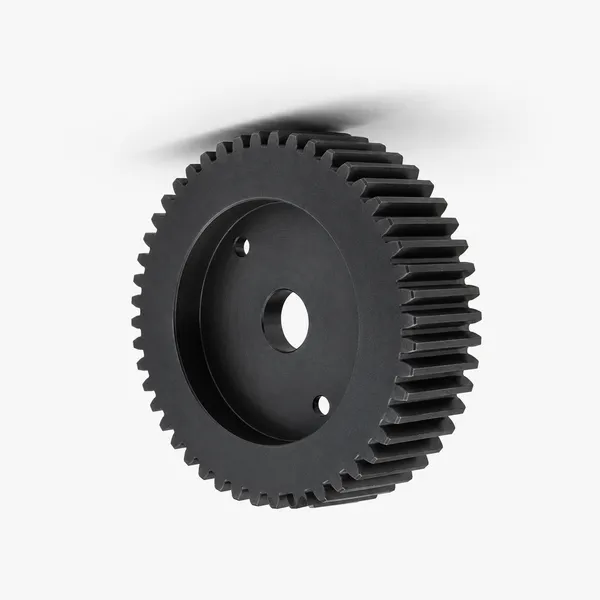
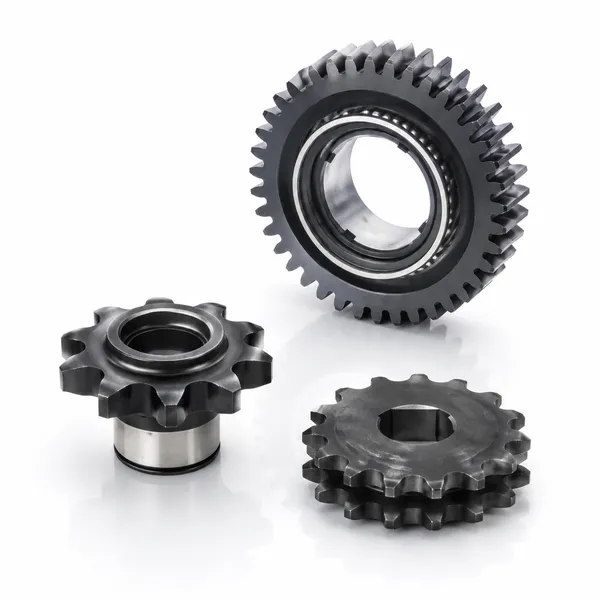
automotive spur gear

Spur Gears

Starter pinion · automotive · M4–M8

automotive helical gear

Helical Gears

Transmission · differential · axle

hypoid bevel gear automotive

Ingranaggi conici

Automotive differential · rear axle

worm gear automotive

Worm Gears

Auto steering · window · seat drive

starter flywheel ring gear

Ring Gears

Flywheel · starter · M4–M10 · OEM

planetary gear automotive

Planetary Gears

Auto transmission · starter gear set

plastic gear automotive

Plastic Gears

Sensor · instrument · HVAC auto

GET A QUOTATION · KOREA EVER-POWER

Need Starter Ring Gears and Flywheel Ring Gears?

Korea Ever-Power manufactures flywheel ring gears for all engine applications — automotive (M4–M6, C45, press-fit H6 bore), tractor and agricultural (M6–M8, 65Mn, OD to 950 mm), heavy truck (M7–M9, 42CrMo4, bolted), marine and generator (M8–M10, 42CrMo4, zinc phosphate corrosion protection). OEM part number cross-reference database covering 8,000+ vehicle/engine applications. Aftermarket programme minimum 10 pieces. ISO 9001:2015 certified.

Request a Quotation →

Redattore: Cxm

VR Tour of Our Factory

TAGs:

cremagliera degli ingranaggi

In qualità di uno dei principali produttori, fornitori ed esportatori di cremagliere, offriamo cremagliere e molti altri prodotti.

Vi preghiamo di contattarci per maggiori dettagli.

Posta:[email protected]

Produttore, fornitore ed esportatore di cremagliere

Articoli recenti

it_ITItalian