
Custom OEM Planetary Gear Manufacturing:
Non-Standard Ratios, Special Materials and Multi-Stage Planetary Stage Kits
Every catalogue planetary gearbox starts as a custom design before it becomes a production standard — the gear stage kit at its core (sun gear, matched planet set, internal ring gear) was engineered to a specific ratio, torque, speed, and size that was then frozen and repeated in volume. The custom OEM planetary gear stage kit occupies the space between what catalogues cover and what the machine designer actually needs: the exact ratio that gives a certain output speed from a given motor, the exact OD envelope that fits the housing available in the machine frame, the exact material that meets the temperature or chemical environment of the specific process, and the exact quality class that balances the noise, backlash, and cost requirements of the specific customer. Korea Ever-Power’s custom planetary gear stage kit manufacturing service delivers these non-standard configurations from single prototypes to series production runs, with the full engineering support — tooth count calculation, load capacity confirmation, material specification, and quality measurement certificate — that OEM machine builders need to integrate custom planetary stages into their machine designs.
1–4 Stage · Matched Planets · OEM Documentation
Gearbox · Servo · Medical · Marine · Aerospace
Custom Planetary Gear Stage Kit Design — Tooth Count Arithmetic, Load Sharing, and OD Constraints
The design of a custom planetary gear stage kit begins with the tooth count arithmetic — the constraint that the tooth counts of the sun (z₁), planet (z₂), and ring (z₃) gears must simultaneously satisfy the ratio requirement, the assembly condition, and the tooth interference condition. The ratio of a standard planetary (fixed ring) is i = (z₃/z₁) + 1. For a non-standard ratio such as 7.3:1, the tooth count combination must give z₃/z₁ = 6.3, which with z₁ = 10 gives z₃ = 63 and z₂ = (z₃ − z₁)/2 = 26.5 — not an integer, so z₁ = 10 does not work. Trying z₁ = 20: z₃ = 126, z₂ = 53 — integers. Assembly condition: (z₁ + z₃)/n_planets must be an integer, where n_planets is the number of planets. With 3 planets: (20 + 126)/3 = 48.67 — not integer. Try z₁ = 30: z₃ = 189, z₂ = 79.5 — not integer. Try z₁ = 15: z₃ = 94.5 — not integer. This iterative search continues until a tooth count combination is found that satisfies ratio (within acceptable tolerance), assembly condition, and tooth interference. Korea Ever-Power’s application engineering team performs this tooth count calculation using a gear design tool that systematically searches all tooth count combinations within the OD constraint for a given module and number of planets.
Korea Ever-Power’s custom OEM planetary gear stage kits are engineered from first principles for each non-standard requirement — the tooth count calculation, load capacity analysis (ISO 6336 for gear bending and contact fatigue), planet pin bearing life calculation (ISO 281), and efficiency estimation are all performed and documented in the application engineering report that accompanies each custom stage kit. This report is designed to support the OEM machine builder’s own technical documentation — it provides the data needed to validate the gear stage in a machine CE technical file, or to answer a customer’s technical query about the gearbox specification. For complete custom planetary gearbox assemblies (including housing, output shaft, motor flange, and seals, in addition to the gear stage kit components), Korea Ever-Power’s planetary gearbox product line covers many standard and non-standard configurations that can serve as the starting point for a custom gearbox design.
The OD constraint is the second key design driver for custom planetary stage kits — the stage kit must fit within the housing bore available in the machine, which may be a non-standard dimension driven by the machine frame design or by the flanged motor OD that the stage kit must couple with. The relationship between the OD constraint and the achievable gear module (and therefore load capacity) is non-linear — reducing the OD by 20% while maintaining the same ratio and planet count reduces the module by 20% (since the ring gear OD scales with module), but reduces the tooth load capacity by 36% (since the bending and contact fatigue resistance scale with module²). This means the OD constraint is often the limiting factor in a custom planetary design, and the application engineer must evaluate whether the required load capacity can be achieved within the given OD or whether the OD must be increased. Korea Ever-Power communicates this constraint analysis clearly in the application engineering review — if the specified OD is too small for the required torque at the requested module, Korea Ever-Power proposes either a larger module at a larger OD, a higher planet count to improve load sharing and reduce the load per tooth, or a higher-strength material (18CrNiMo7-6 deep carburized instead of 20CrMnTi standard carburized) to achieve the required load capacity at the constrained OD.
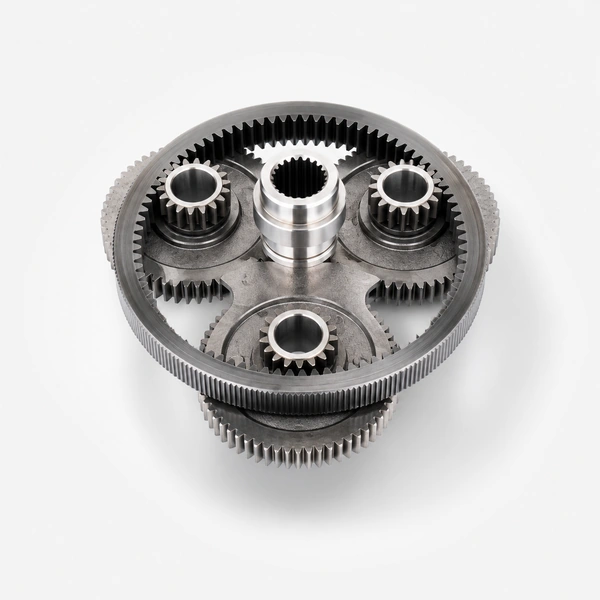
Custom Planetary Stage Kit Categories and Special Requirements
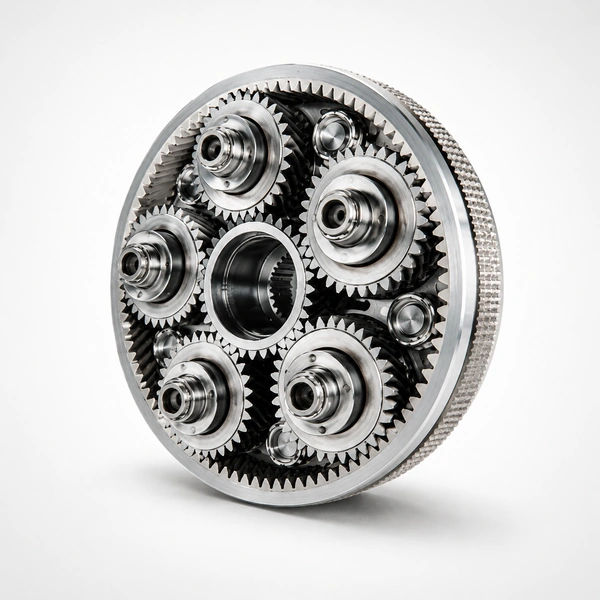
Korea Ever-Power Custom Planetary Gear Kit — OEM Supply Process
STEP 1 — ENQUIRY
Submit the gear kit requirement: ratio (exact or nominal), output torque, maximum input speed, OD constraint (maximum ring gear OD), number of stages, material requirement (or application description for Korea Ever-Power to recommend), quality class (or NVH and backlash target), and quantity (prototype and production). If a drawing or gear card exists, include it. If a worn gear set is being replaced, describe the gearbox make and model or send the worn components for measurement.
STEP 2 — DESIGN
Korea Ever-Power performs the tooth count calculation (ratio optimisation within the OD constraint), ISO 6336 gear capacity analysis (bending and contact safety factors at rated torque), planet pin bearing life calculation, and efficiency estimate. A design summary is submitted to the customer with the exact achieved ratio, the tooth count combination, and the safety factors — the customer confirms or requests modifications before tooling and manufacturing commence.
STEP 3 — MANUFACTURE
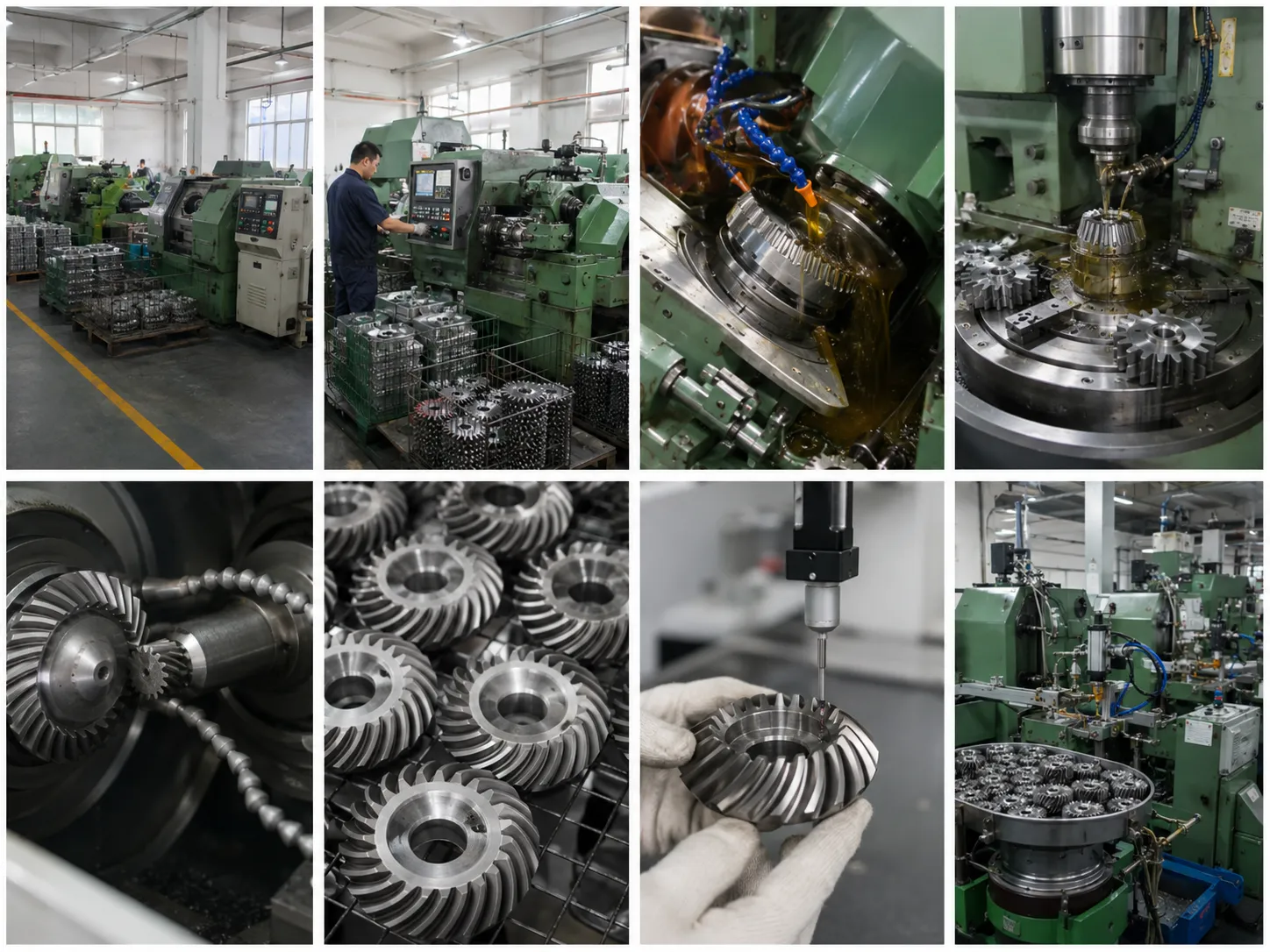
Gear blanks are turned, hobbed (or shaped for the ring), heat treated (carburized + quenched, or through-hardened), and profile ground to the specified DIN class. Planet gears are individually measured and then matched into sets — the matching process selects planets from the production batch that are closest in pitch position to achieve the specified pitch matching tolerance (±2–5 μm depending on DIN class). The complete stage kit (sun + matched planets + ring) is bagged and labelled as a matched set.
STEP 4 — DOCUMENTATION
Each custom planetary stage kit is dispatched with: material certificate (EN 10204 Type 3.1), dimensional inspection report for each gear in the kit (CMM measurement of key functional dimensions: OD, bore, pitch diameter, tooth thickness, profile form error, pitch deviation), matched planet certificate (individual pitch measurements and the within-set pitch deviation confirming the matching tolerance), and the application engineering report (tooth count combination, exact ratio, ISO 6336 safety factors). The documentation supports the customer’s quality system traceability requirement for OEM-supplied components.
Frequently Asked Questions — Custom OEM Planetary Gear Stage Kits
Explore Korea Ever-Power Gear Categories
Seven precision gear product lines for custom OEM planetary drives, non-standard ratios, special materials, and legacy gearbox replacement worldwide.
編集者: Cxm
 Japanese
  English
  Italian
  Korean
  French